
Running for Beginners: The Complete Guide to Starting, Staying Injury-Free and Loving It
Running for beginners should feel like an invitation, not a punishment. Mine started badly. I bought a pair of trainers, ran out of the door as fast as I could, and was walking with my hands on my hips four minutes later, wondering why anyone does this for fun. I tried again a week later and did exactly the same thing. Then I gave up for six months.
The second time, I did it differently. I walked more than I ran, I ran slowly enough to talk, and I followed a simple plan instead of trying to prove something every time. Ten weeks later I ran for 30 minutes without stopping. A year later I finished a half marathon. Nothing about my body had changed between the two attempts. My approach had.
This is the guide I wish I had read before that first painful run. It brings together everything we have written about starting to run: what you need, your first runs, a 10-week plan, how fast to go, how to avoid injury, and the beginner running tips that make the biggest difference. Each section links to a deeper guide when you want more detail.
At a glance
- You need comfortable running shoes and clothes, and nothing else to start
- Begin with run-walk intervals, three times a week, with rest days between
- Run slowly enough to talk in full sentences. Most beginners run far too fast
- Build up gradually. Novice runners get injured more often than experienced runners
- Strength training twice a week makes you a more resilient runner
- Even small amounts of running are linked with a longer, healthier life
- Expect to run 30 minutes without stopping after about 8 to 12 weeks
Why start running?
| Benefit | What it means |
|---|---|
| Health and longevity | Running is linked with a lower risk of death from all causes and heart disease |
| Fitness | Your heart, lungs and legs get stronger quickly |
| Mental health | Many runners find it one of the best ways to clear their head |
| Weight management | Running burns a lot of energy for the time it takes |
| Low cost | Shoes and a door are all you need |
| Flexibility | Run anywhere, any time, alone or with others |
What the research says
- Any running helps. A meta-analysis of 14 studies with more than 230,000 participants found running was linked with a 27 percent lower risk of death from any cause, 30 percent lower from heart disease and 23 percent lower from cancer. Even running once a week was better than none, and more running was not necessarily linked with greater benefit
- Five to ten minutes a day counts. A large study of about 55,000 adults found runners had a 30 percent lower risk of death from any cause and 45 percent lower from heart disease than non-runners, with benefits seen even in people running just 5 to 10 minutes a day at slow speeds
- Beginners need to build up carefully. A meta-analysis found novice runners had about 17.8 injuries per 1,000 hours of running, more than twice the 7.7 seen in recreational runners. That is why gradual progress matters so much
- Big jumps are risky. A study of more than 800 novice runners suggested those who increased their weekly distance by more than 30 percent over two weeks were more likely to develop overuse injuries than those who increased by less than 10 percent, although the authors called this exploratory
What you need to start
Running shoes
The only real investment. Go to a running shop if you can and try several pairs. Choose the pair that feels most comfortable when you jog in them, not the one with the most features. Comfort is a better guide than any label. Replace them every 400 to 500 miles, or when the cushioning feels flat.
Clothes
| Item | What to look for |
|---|---|
| Top | Light, breathable fabric that wicks sweat. Avoid heavy cotton |
| Bottoms | Shorts, leggings or running tights you can move freely in |
| Socks | Running socks without thick seams help prevent blisters |
| Sports bra | Essential for women, chosen for high-impact activity |
| Extras | A light jacket for rain and wind, gloves and a hat in winter, a cap and sunscreen in summer |
Nice to have
- A watch or phone app to time your intervals
- A water bottle for runs over 45 minutes in warm weather
- A reflective vest or light for running in the dark
That is genuinely it. Running for beginners does not require a gym, a fancy watch or expensive kit, which is one of the best things about it.
Before your first run
- Check with your doctor first if you have heart disease, high blood pressure, diabetes, a joint problem, are pregnant, or have been inactive for a long time and are over 45
- Walk first if you are very new to exercise. Two weeks of daily 20 to 30-minute brisk walks makes your first runs much easier. Our guide on how long it takes to walk a mile helps you pace your walks
- Plan your route. Choose a flat, safe loop, ideally with soft surfaces like a park path
- Schedule your runs. Three non-consecutive days a week, such as Monday, Wednesday and Saturday
Your first run
- Warm up: 5 minutes of brisk walking plus a few gentle drills. Our guide to the running warm up has a simple routine
- Run-walk: jog slowly for 1 minute, walk for 2 minutes. Repeat 6 to 8 times
- Cool down: 5 minutes of easy walking
- Stretch if you like: calves, quads and hips, 30 seconds each
That is a perfect first run. It might feel too easy. Good. The goal of your first few weeks is to build the habit and let your body adapt, not to exhaust yourself. Our guide to the run walk method explains why walk breaks are such a powerful tool.
A 10-week plan: from zero to 30 minutes
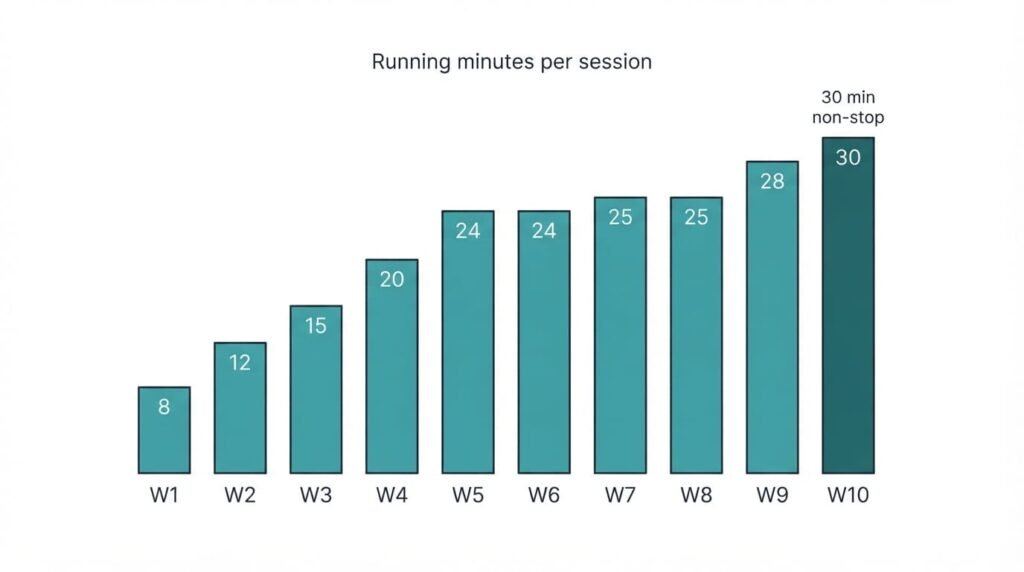
This is the heart of running for beginners. Do three sessions a week. Start each with a 5-minute brisk walk and finish with a 5-minute walk. If a week feels too hard, repeat it. Many people take 12 or 14 weeks, and that is completely fine.
| Week | Each session | Total running |
|---|---|---|
| Week 1 | Run 1 minute, walk 2 minutes, repeat 8 times | 8 minutes |
| Week 2 | Run 2 minutes, walk 2 minutes, repeat 6 times | 12 minutes |
| Week 3 | Run 3 minutes, walk 2 minutes, repeat 5 times | 15 minutes |
| Week 4 | Run 5 minutes, walk 2 minutes, repeat 4 times | 20 minutes |
| Week 5 | Run 6 minutes, walk 1 minute, repeat 4 times | 24 minutes |
| Week 6 | Run 8 minutes, walk 1 minute, repeat 3 times | 24 minutes |
| Week 7 | Run 10 minutes, walk 1 minute, repeat 2 times, then run 5 minutes | 25 minutes |
| Week 8 | Run 15 minutes, walk 1 minute, run 10 minutes | 25 minutes |
| Week 9 | Run 20 minutes, walk 1 minute, run 8 minutes | 28 minutes |
| Week 10 | Run 30 minutes continuously at an easy pace | 30 minutes |
When you can run for 30 minutes, you can comfortably run a 5K at an easy pace. Our guide on how to increase running endurance takes you further, and the 12 week half marathon training plan is a natural next goal.
How fast should a beginner run?
Slower than you think. This is the single most important of all beginner running tips, and the one that makes running for beginners feel possible. Easy runs should feel like a 3 to 5 out of 10 effort, where you can speak in full sentences.
| Talk test | Effort | Use it for |
|---|---|---|
| Can talk in full sentences | Easy | Almost all your runs as a beginner |
| Can say a few words | Moderate to hard | Later, once a week at most |
| Cannot talk | Hard | Short intervals only, after a few months |
If you have a heart rate monitor, our target heart rate calculator shows your easy zone. Our pace calculator helps you track how your pace improves over time.
Breathing
Feeling out of breath almost always means you are running too fast. Slow down, breathe through your nose and mouth together, and breathe from your belly. Our guide to breathing while running covers rhythms and how to beat side stitches.
Simple running form tips
You do not need perfect form, but a few simple cues help:
- Run tall, with a slight lean forward from the ankles
- Keep your shoulders low and relaxed
- Swing your arms forward and back, not across your body
- Take short, quick steps that land close to under your hips
- Look ahead, not at your feet
Our running form guide covers drills and how to check your form on video.
Where to run
Where you run shapes how running for beginners feels. A pleasant, safe route makes it much easier to get out of the door.
| Surface | Pros | Cons |
|---|---|---|
| Park paths and trails | Softer, scenic, varied | Uneven ground needs attention |
| Pavement | Convenient, consistent | Harder on the legs |
| Running track | Measured distances, flat | Can be repetitive |
| Treadmill | Any weather, controlled pace, private | Can feel boring, no fresh air |
Mixing surfaces is ideal. Our treadmill workouts for beginners guide is useful for dark or wet days.
How to avoid beginner running injuries
Novice runners get injured more than twice as often per hour of running as recreational runners, so prevention is worth taking seriously. These novice runner tips are the ones that matter most.
| Rule | Why |
|---|---|
| Build up gradually | Bones, tendons and muscles adapt more slowly than your heart and lungs |
| Take rest days | Your body adapts between runs |
| Strength train twice a week | Stronger muscles absorb impact better |
| Keep most runs easy | Hard running every day is the fastest way to get hurt |
| Listen to niggles | A sore spot that gets worse each run needs rest, not more running |
| Replace worn shoes | Flat cushioning offers less protection |
The most common beginner problems and where to find help:
- Sore shins: see our shin splints stretches
- Tight calves: see our guide to calf stretches
- Sore knees: see our exercises for knee pain
- Weak hips and core: see our core exercises for runners and monster walks
Strength training for new runners
Two short strength sessions a week make a big difference, both for performance and for staying injury-free. Focus on:
| Exercise | Why | Dose |
|---|---|---|
| Squats or split squats | Leg strength for every stride | 3 x 10 |
| Calf raises | Spring and Achilles strength | 3 x 15 |
| Glute bridges | Hip power and stability | 3 x 12 |
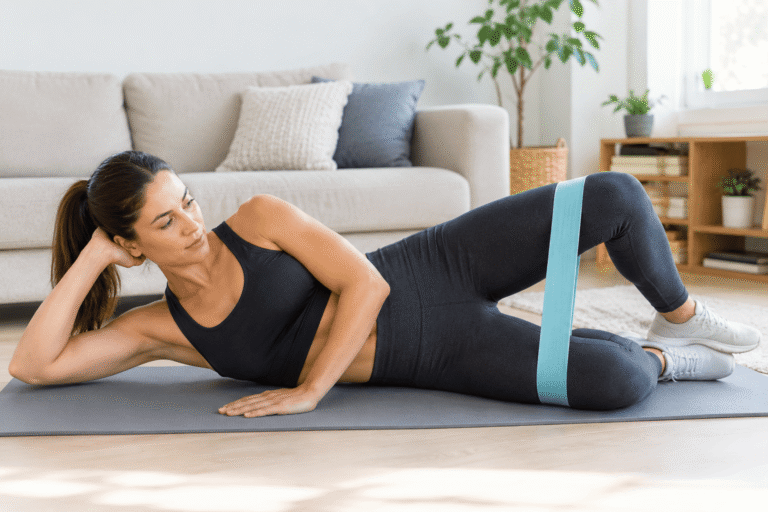
| Side-lying leg raises or monster walks | Keep the knees and pelvis steady | 3 x 12 |
| Plank and side plank | A steady trunk | 3 x 30 seconds |
Food, water and sleep
- Before running: a light snack 1 to 2 hours before, or nothing for short morning runs. Our guide on what to eat before a workout has simple ideas
- During: water is enough for runs under an hour
- After: a normal meal with protein and carbohydrate
- Sleep: seven to nine hours makes every run feel better
Staying motivated
Motivation is the quiet half of running for beginners. The plan gets you fitter, but habits keep you going when the novelty wears off.
- Schedule your runs like appointments
- Track every run in a notebook or app. Seeing progress is a powerful motivator
- Sign up for a 5K six to ten weeks away
- Find a running buddy or a beginner-friendly running group or parkrun
- Celebrate small wins: your first non-stop mile, your first 20 minutes, your first rainy run
- Expect bad days. Everyone has them. One bad run means nothing
Running for beginners who want to lose weight
Running burns a lot of energy, and it can be a great part of a weight loss plan. Start with walking and run-walk intervals, especially if you are carrying extra weight, because they are kinder on the joints. Pair your running with sensible eating and strength training. Our guide to walking for weight loss is a gentle place to start if running feels too much right now.
Running for beginners in different situations
The basics stay the same for everyone, but a few adjustments help depending on where you are starting from.
| Situation | What to adjust | Why |
|---|---|---|
| Over 40 or 50 | Start with brisk walking for two weeks, leave two days between runs at first, and keep strength training in the plan | Tendons and joints adapt more slowly with age |
| Carrying extra weight | Begin with walking and incline walking, then short run-walk intervals on soft surfaces | Less impact while your heart, lungs and legs adapt |
| Very busy | Three 20-minute sessions a week are enough. Run from your front door to save time | Consistency matters more than long sessions |
| Returning after a break | Start at about half of what you used to do | Your fitness returns faster than your tendons adapt |
| Recovering from injury | Get the all-clear first, then use a very gentle run-walk plan | Avoid a setback in the first weeks |
What a typical beginner week looks like
| Day | What to do |
|---|---|
| Monday | Run-walk session from the plan |
| Tuesday | Strength training, 20 minutes |
| Wednesday | Run-walk session |
| Thursday | Rest or an easy walk |
| Friday | Strength training or rest |
| Saturday | Run-walk session |
| Sunday | Rest, a long walk or gentle stretching |
This pattern gives your body a day to recover between runs while keeping you active. It is the simplest structure for running for beginners, and it works whether your goal is fitness, weight loss or your first 5K.
Your first 5K
A 5K is 3.1 miles, and it is the perfect first goal. Once you can run for about 30 minutes, you can usually complete a 5K at an easy pace, with or without short walk breaks. Many towns have free, weekly, timed 5K events in local parks, and they are famously welcoming to beginners and walkers.
- Sign up for an event about 10 to 12 weeks after you start the plan
- Run the distance at an easy pace in training before the day
- Start at the back and run your own race
- Walk if you need to. Finishing is the goal
How to become a runner often comes down to moments like this. Crossing your first finish line changes how you see yourself. You stop being someone who is trying running, and start being a runner.
Common beginner mistakes
- Running too fast, the biggest mistake by far
- Doing too much too soon, especially after a good week
- Running every day in the first few months
- Skipping walk breaks out of pride
- Ignoring pain
- Comparing yourself to others
- Giving up after one bad run
How to become a runner, not just someone who runs
Learning how to become a runner is less about fitness and more about identity and habit. You become a runner the moment you run regularly, no matter how slow or short your runs are. A few habits make it stick:
- Run at the same times each week so it becomes automatic
- Lay out your kit the night before
- Keep a log so you can see how far you have come
- Plan your next goal before you reach the current one
Safety tips
- Run against traffic where there is no pavement, and wear bright or reflective clothing in low light
- Tell someone your route if you run alone
- Keep one ear free if you use headphones
- Carry your phone
- Stop and seek help for chest pain, severe breathlessness, dizziness or fainting
This article is general information, not medical advice. Check with your doctor before starting a running programme if you have a health condition. See our medical disclaimer.
The bottom line
Running for beginners comes down to a few simple ideas: start with run-walk intervals, run slowly enough to talk, run three times a week with rest days between, build up gradually and add two short strength sessions a week. Follow the 10-week plan, repeat weeks when you need to, and use the guides linked throughout this page when you want more help.
My first attempt at running failed because I tried to run fast. My second worked because I ran slowly, walked often and stayed patient. If you take one thing from this guide, let it be that. Slow is not a weakness. It is the secret.
Frequently asked questions
How should a beginner start running?
The best approach to running for beginners is to start with run-walk intervals, such as 1 minute of running and 2 minutes of walking, repeated 6 to 8 times, three times a week. Run slowly enough to talk and gradually lengthen the running parts over 8 to 12 weeks.
How often should a beginner run?
Three times a week on non-consecutive days is ideal for most beginners. Rest days let your bones, joints and muscles adapt, which helps prevent injuries.
How long should a beginner run for?
Start with 20 to 30 minutes in total, including walk breaks and a warm-up. Aim to build up to 30 minutes of continuous running over about 10 weeks.
How fast should a beginner run?
Slowly enough to hold a conversation in full sentences. In running for beginners, slow is the secret. This feels too slow at first, but it builds fitness safely and makes running far more enjoyable.
What are the best beginner running tips?
Run slowly, use walk breaks, build up gradually, take rest days, strength train twice a week, wear comfortable running shoes and track your runs. The most important of these beginner running tips is to run slowly.
How do I become a runner?
Run regularly, three times a week, and keep going for a few months. You become a runner through consistency, not speed or distance. A simple plan and a running log make it much easier.
Is it normal to struggle when starting running?
Yes. Almost every beginner finds the first few weeks hard. Slowing down and using walk breaks makes a big difference, and it gets noticeably easier within three to six weeks.
What are the most useful novice runner tips for avoiding injury?
Increase your running gradually, keep most runs easy, take rest days, replace worn shoes and add strength training twice a week. Stop and rest if a sore spot gets worse with each run.
What’s next?
Reading is the easy part. Pick one of these and do it today.