
Running Form for Beginners: 9 Simple Fixes, Drills and What the Research Actually Says
Running form was something I never thought about until a friend filmed me finishing a local 5K. I watched the video and winced. My shoulders were up around my ears, my arms swung across my chest like I was rowing a boat, and each foot landed far out in front of me with a loud slap. No wonder my knees ached after every long run.
I did not overhaul everything at once. A running coach told me to change just two things: take slightly shorter, quicker steps, and relax my shoulders. Within a month my knees felt better, my runs felt smoother, and I had shaved a minute off my 5K without trying to run faster.
This guide explains good running form in plain English: what matters, what does not, nine simple fixes, six running form drills, how to film and check yourself, and how to improve running form without getting injured along the way.
At a glance
- There is no single perfect running form. Small, gradual tweaks work better than a complete overhaul
- Run tall with a slight forward lean from the ankles, not the waist
- Keep your shoulders relaxed and your arms swinging forward and back at about 90 degrees
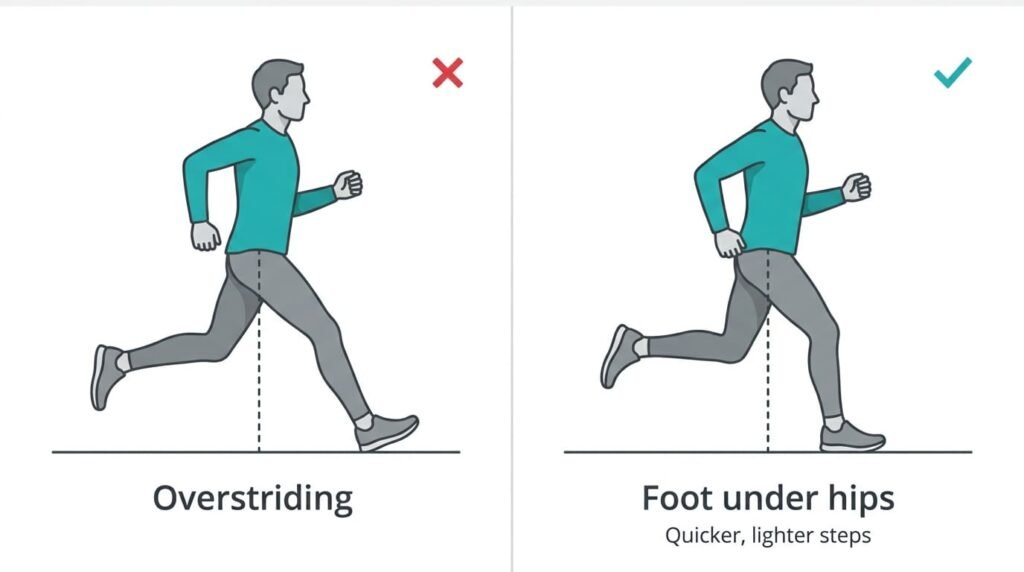
- Land with your foot under your body rather than far in front, and avoid overstriding
- A slightly quicker step rate, about 5 to 10 percent above your normal, can reduce load on the hips and knees
- Most runners do not need to force a forefoot strike
- Change one thing at a time and give it four to six weeks
Does running form really matter?
Yes and no. Your body naturally finds a fairly efficient way to run, and studies of good runners show a wide range of styles. You do not need to copy elite athletes. But a few common habits, especially overstriding, tense shoulders and a very slow step rate, waste energy and increase the load on your joints. Fixing those can make running feel easier and more comfortable.
What the research says
- A quicker step rate reduces joint loading. A laboratory study of recreational runners found that increasing step rate by 5 to 10 percent above their preferred rate, while keeping speed the same, substantially reduced the energy absorbed at the knee and hip. The authors concluded that subtle increases in step rate may help prevent and treat common running injuries
- The pattern holds across studies. A systematic review of ten studies found consistent evidence that a higher stride rate with a shorter stride reduced vertical bounce, ground reaction force and the energy absorbed at the hip, knee and ankle
- Efficiency is personal. A review of the biomechanics of running economy found that factors linked with efficient running included using your preferred stride length (or slightly shorter), less up-and-down bounce, maintaining a natural arm swing and staying relaxed. The author concluded there is no single economical technique to recommend to every runner
Good running form at a glance
| Body part | Good running form | Common fault |
|---|---|---|
| Head | Eyes looking 10 to 20 metres ahead, chin level | Looking down at your feet or phone |
| Shoulders | Low and relaxed | Hunched up toward the ears |
| Arms | Elbows bent about 90 degrees, swinging forward and back | Crossing in front of the chest |
| Hands | Loose, as if holding crisps without crushing them | Clenched fists |
| Torso | Tall, with a slight lean forward from the ankles | Bent forward at the waist or leaning back |
| Hips | Level and stable | Dropping to one side with each step |
| Knees | Slightly bent when the foot lands | Straight knee landing far in front |
| Feet | Landing close to under your hips | Reaching far forward and striking heel first |
| Cadence | Quick, light steps | Long, slow, bouncing strides |
9 simple fixes for better running form
These are the changes that make the biggest difference for most beginners. Pick one or two to work on at a time.
1. Run tall
Imagine a string gently pulling the top of your head toward the sky. Your spine lengthens, your chest lifts, and your hips sit under you instead of trailing behind. This is the foundation of proper running technique, and it costs nothing.
2. Lean slightly from the ankles
Let your whole body tip forward a few degrees from the ankles, as if you were about to fall into a run. Do not bend at the waist. A slight lean lets gravity help, and it naturally brings your foot strike under your body.
3. Relax your shoulders
Tension creeps up the body when you get tired. Every few minutes, check in: drop your shoulders, shake out your hands, unclench your jaw. Relaxed runners use less energy. This was one of the two fixes that changed my running form most.
4. Swing your arms forward and back
Bend your elbows to about 90 degrees and let your arms swing like pendulums from the shoulders, forward and back. Your hands should brush past your hips and come up to around chest height, not cross the middle of your body. Arm swing helps balance the rotation of your legs.
5. Stop overstriding
Overstriding means reaching your foot far out in front of your body, usually landing on a straight leg and a heel. It acts like a brake with every step and sends more force up through the knee. The fix is not to change how your foot lands. It is to let your foot land closer to underneath your hips, with a slightly bent knee.
6. Take slightly quicker steps
Cadence, or step rate, is the number of steps you take per minute. Many beginners run with a slow, bouncing cadence of 150 to 160 steps per minute. You do not need to hit a magic number like 180. Instead, count your steps for 30 seconds, double it, and aim to increase it by about 5 percent. A metronome app or a playlist at the right tempo makes this easy. This simple change is one of the most researched ways to improve running form.
| Your current cadence | 5 percent higher | 10 percent higher |
|---|---|---|
| 150 steps per minute | About 158 | About 165 |
| 160 steps per minute | 168 | 176 |
| 170 steps per minute | About 179 | 187 |
7. Do not force your foot strike
Some runners land on the heel, some on the middle of the foot and some on the forefoot. Forcing a change, especially jumping to a forefoot strike, often shifts the load to your calves and Achilles tendons and can cause problems. If you fix overstriding and quicken your cadence, your foot strike usually becomes lighter and more midfoot on its own.
8. Run quietly
Listen to your feet. A loud slap usually means a heavy landing or overstriding. Try to run as quietly as you can, as if you did not want to wake someone up. It is a surprisingly effective cue for lighter, softer steps.
9. Breathe rhythmically
Breathe through both your nose and mouth, deep into your belly. Many runners settle into a rhythm, such as breathing in for three steps and out for two on easy runs. Do not overthink it. If you are gasping, slow down.
6 running form drills
Running form drills exaggerate parts of the running action so your body learns them. Do two or three of these after your warm-up, two or three times a week. Each takes about 20 to 30 metres or 20 to 30 seconds.
1. A-march and A-skip
March forward, lifting one knee to hip height with the foot pulled up under you, while the opposite arm swings forward. Land on the ball of the foot under your hip. Once smooth, turn it into a light skip. This drill teaches knee drive and landing under the body.
2. Butt kicks
Jog forward with short steps, flicking your heels up toward your bottom. Keep your knees pointing down. This drill encourages a quick leg recovery and light feet.
3. High knees
Run on the spot or move forward slowly, driving your knees up quickly with fast, light steps. Our high knees exercise guide covers the technique in detail.
4. Strides
Run 60 to 80 metres, gradually building to about 80 percent of your top speed, then ease off. Focus on relaxed shoulders and quick feet. Walk back and repeat four to six times. Strides are one of the best running form drills because they let you practise good form at speed.
5. Wall lean drill
Stand facing a wall, lean into it with your hands on the wall and your body in a straight line from head to heels at a slight angle. Drive one knee up, then switch quickly. This teaches the forward lean from the ankles.
6. Single-leg balance and hops
Stand on one leg for 30 seconds, then do 10 small hops in place. Repeat on the other side. Better single-leg control means a steadier pelvis and knee when you run.
| Drill | What it teaches | Dose |
|---|---|---|
| A-march and A-skip | Knee drive, landing under the hips | 2 x 20 metres |
| Butt kicks | Quick leg recovery | 2 x 20 metres |
| High knees | Quick, light steps | 2 x 20 seconds |
| Strides | Relaxed form at speed | 4 to 6 x 60 to 80 metres |
| Wall lean drill | Forward lean from the ankles | 2 x 10 each leg |
| Single-leg balance and hops | Hip and knee stability | 2 x 30 seconds and 10 hops each leg |
How to check your running form on video
Filming yourself is the quickest way to see what you are actually doing, rather than what you think you are doing.
- Ask a friend to film you, or prop your phone up on a treadmill or by a path
- Record a side view and a view from behind, each for about 10 seconds at your easy running pace
- Use slow motion to watch where your foot lands compared with your hips, how bent your knee is, and what your arms and shoulders are doing
- Check from behind for hips dropping or knees collapsing inward
- Film again after four to six weeks of working on one or two fixes
A treadmill makes this easy, because you can film from the same spot every time. Our guide to treadmill workouts for beginners includes easy sessions you can use for practice.
How to improve running form safely
The biggest risk with changing your running form is doing too much too fast. Your muscles, tendons and joints are used to your old way of running. These rules help:
- Change one thing at a time. Start with relaxed shoulders or a slightly quicker cadence
- Practise in short bursts. Focus on the new habit for a minute or two at a time during easy runs, then relax
- Keep runs easy while you learn. Form breaks down when you are exhausted
- Give it time. New movement patterns take four to six weeks or more to feel natural
- Strengthen the engine. Weak hips and calves make good form hard to hold. Hip exercises such as monster walks and a calf workout help a lot
Strength work that supports good running form
| Exercise | Why it helps | Dose |
|---|---|---|
| Glute bridges | Stronger hips for push-off | 3 x 12 |
| Monster walks or side-lying leg raises | Level pelvis, stable knees | 3 x 12 steps each way |
| Calf raises | Spring and Achilles strength | 3 x 15 |
| Split squats or step-ups | Single-leg strength | 3 x 8 each leg |
| Plank and side plank | Steady trunk | 3 x 30 seconds |
Two short strength sessions a week make proper running technique much easier to hold, especially late in a run when you are tired.
Running form on hills
Hills change the rules a little. A few small adjustments keep your running form efficient and protect your legs.
| Situation | What to do | Why |
|---|---|---|
| Running uphill | Shorten your stride, lean slightly into the hill from the ankles, drive your arms a little harder and keep your eyes up | Shorter, quicker steps keep the effort steady |
| Running downhill | Keep your feet under you, take quick light steps and let gravity do the work. Do not lean back or brake hard | Leaning back and reaching forward hammers the quads and knees |
| Steep hills | Walk if you need to. Power walking with your hands on your thighs is often as fast as running | Saves energy and keeps the session easy |
Running form when you are tired
Form falls apart late in a run. The shoulders creep up, the arms cross over and the feet start to drag and slap. Use a simple body scan every 5 to 10 minutes: head up, shoulders down, hands loose, quick feet. Saying the cues in your head becomes a habit surprisingly fast. If your form keeps collapsing, that is a sign to slow down or finish the run, not to push through.
A 4-week plan to improve running form
If you want a clear structure for how to improve running form, follow this plan alongside your normal easy running, three times a week.
| Week | Focus | What to do |
|---|---|---|
| Week 1 | Posture and shoulders | Practise running tall and relaxing your shoulders for 1 minute in every 5. Film a side and back view |
| Week 2 | Arms and cadence | Add arm swing practice and raise your cadence about 5 percent for 2 minutes in every 5. Add 2 running form drills after your warm-up |
| Week 3 | Landing under the hips | Keep the quicker cadence and listen for quieter steps. Add strides twice a week |
| Week 4 | Put it together | Hold your new form for longer stretches on easy runs. Film again and compare with week 1 |
By week four, most beginners see a visible change in the video: less overstriding, quieter feet and a more relaxed upper body. That is proper running technique becoming automatic. Keep doing the drills twice a week to lock it in.
Running form on a treadmill
Running form on a treadmill is very similar to running outside, which makes it a great place to practise. Set the incline to 1 percent, keep your eyes forward and stay in the middle of the belt. Do not hold the handrails. Treadmills are also ideal for cadence work, because the speed is fixed and you can focus completely on your steps.
Common running form mistakes
- Overstriding and landing on a straight leg far in front
- Hunching the shoulders and clenching the fists
- Crossing the arms in front of the body
- Bending at the waist instead of leaning from the ankles
- Bouncing too much, with a lot of up-and-down movement
- Looking at your feet or your watch every few seconds
- Forcing a forefoot strike overnight
- Copying elite runners instead of finding your own efficient style
Running form and injuries
Running form is only one piece of the injury puzzle. Doing too much too soon, poor sleep, worn-out shoes and weak muscles matter at least as much. If you have shin pain, our shin splints stretches guide can help, and our exercises for knee pain are useful for sore knees. If pain persists, a physiotherapist or running coach can assess your running form in person.
This article is general information, not medical advice. See a professional for pain that is sharp, getting worse or affecting how you walk. See our medical disclaimer.
The bottom line
Good running form is relaxed, tall and light. Keep your shoulders down, swing your arms forward and back, lean slightly from the ankles, land with your foot close to under your hips, and take slightly quicker steps. Add a few running form drills and two strength sessions a week, film yourself every month, and change only one thing at a time.
When I made just two changes, a quicker cadence and relaxed shoulders, running felt easier within weeks and my knees stopped aching. You do not need perfect running form. You just need a little better than yesterday.
Good posture also makes breathing easier. My guide to breathing while running covers belly breathing, rhythm patterns and side stitches.
Frequently asked questions
What is proper running form?
Proper running technique means running tall with a slight forward lean from the ankles, relaxed shoulders, arms swinging forward and back at about 90 degrees, and your foot landing close to under your hips with a slightly bent knee. There is no single perfect style.
How can I improve my running form?
Change one thing at a time, such as relaxing your shoulders or increasing your step rate by about 5 percent. Add running form drills like A-skips and strides, strengthen your hips and calves, and film yourself every few weeks to check progress.
Should I land on my heel or forefoot when running?
Most runners do not need to change their foot strike. Focus on landing with your foot closer to under your body and avoiding overstriding. Forcing a forefoot strike suddenly can overload your calves and Achilles tendons.
What is a good running cadence for beginners?
There is no magic number. Count your steps for 30 seconds and double it, then aim to increase it by about 5 percent. Research shows small increases in step rate reduce load on the hips and knees.
What are the best running form drills?
A-marches and A-skips, butt kicks, high knees, strides, the wall lean drill and single-leg balance and hops. Do two or three after your warm-up, two or three times a week.
Does running form prevent injuries?
It can help, especially avoiding overstriding and running with a slightly quicker cadence. But training load, recovery, footwear and strength matter just as much for preventing injuries.
How should I hold my arms when running?
Bend your elbows to about 90 degrees, keep your hands relaxed and let your arms swing forward and back from the shoulders. Avoid crossing them in front of your chest or holding them tense and high.
How long does it take to change running form?
Small changes start to feel natural after four to six weeks of regular practice. Bigger changes can take several months. Practise in short bursts during easy runs and progress gradually.
Do running shoes affect running form?
They can a little. Very cushioned shoes and minimal shoes change how your foot meets the ground. Choose a pair that feels comfortable and stable, and change shoe types gradually, because a sudden switch changes the load on your feet, calves and knees.
What’s next?
Reading is the easy part. Pick one of these and do it today.