
Breathing While Running: How to Breathe Properly, Stop Gasping and Beat Side Stitches
Breathing while running was the thing I struggled with most as a new runner. My legs were fine. My lungs were not. Two minutes into every run I was gasping, my chest felt tight, and by the third lamp post I had a stabbing side stitch under my ribs. I genuinely thought some people were just born better at breathing.
They are not. What I eventually learned is that breathing problems in beginners are almost always pace problems, and the rest is a handful of simple techniques: breathe deep into your belly, settle into a rhythm, relax your upper body, and stop eating a big lunch an hour before running. Within a month, running felt completely different. I could hold a conversation on easy runs, and the side stitches mostly disappeared.
This guide explains how to breathe properly while running, whether to use your nose or mouth, breathing rhythms that help, how to control breathing while running up hills and at faster paces, and how to prevent cramps while running, including side stitches.
At a glance
- Feeling out of breath is usually a sign you are running too fast for your current fitness
- Breathe through your nose and mouth together for easy and hard runs
- Belly breathing, using your diaphragm, fills your lungs more efficiently than shallow chest breathing
- A steady rhythm, such as breathing in for three steps and out for two or three, helps many runners stay calm
- Relax your shoulders, jaw and hands. Tension makes breathing harder
- Side stitches affect about 70 percent of runners in a year. Avoid big meals and sugary drinks before running
- See a doctor for wheezing, chest pain or breathlessness that seems out of proportion to the effort
Why you get out of breath when running
When you run, your muscles need far more oxygen than at rest, and they produce more carbon dioxide to get rid of. Your breathing rate and depth rise to keep up. As you get fitter, your heart pumps more blood with each beat and your muscles use oxygen more efficiently, so the same pace demands less from your lungs.
| Cause | What it feels like | Fix |
|---|---|---|
| Running too fast | Gasping within a few minutes | Slow down until you can talk in full sentences |
| Shallow chest breathing | Tight chest, quick short breaths | Practise belly breathing |
| Tension | Hunched shoulders, clenched jaw | Relax your upper body |
| Starting too fast | Breathless early, settles later | Start slower and build up |
| Low fitness | Breathless at any pace | Run-walk intervals and patience |
| Heat, hills or altitude | Breathing harder than usual | Adjust your pace to effort |
| Asthma or another condition | Wheezing, chest tightness, coughing | See a doctor |
For most beginners, the first row explains almost everything. Breathing while running gets easier the moment you slow down. Our guide on how to increase running endurance explains why easy running builds fitness so effectively.
What the research says
- Runners often link breathing to their steps. A classic study recorded breathing and stride patterns in several running animals and in humans. Four-legged animals usually breathe once per stride, but human runners used several patterns, such as 4:1, 3:1, 2:1, 1:1, 5:2 and 3:2 strides per breath, with 2:1 the most common
- The pattern is flexible. A later study of 14 runners found people use ratios of 2, 2.5, 3 or 4 strides per breath, and sometimes no fixed pattern at all, and that the timing of each step can affect airflow. There is no single correct rhythm for everyone
- Side stitches are very common. A review found that about 70 percent of runners had experienced a side stitch in the past year, and about one in five participants in a single running event could expect one. Stitches were made worse by eating beforehand, and sugary or concentrated drinks were particularly likely to trigger them
- Breathing muscles can be trained. A meta-analysis of 46 studies found respiratory muscle training improved endurance exercise performance in healthy people, with bigger improvements in less fit individuals
Source: Bramble and Carrier, Running and breathing in mammals, Science (1983)
Source: Morton and Callister, Exercise-related transient abdominal pain (ETAP), Sports Medicine (2015)
How to breathe properly while running
1. Run at a pace you can breathe at
This is the foundation of how to breathe properly while running. On easy runs you should be able to speak in full sentences. If you cannot, slow down or walk for a minute. It feels too slow at first. It is not. Our target heart rate calculator shows the heart rate zone for easy running if you use a watch.
2. Breathe through your nose and mouth
When you run, your body needs a lot of air. Breathing through the nose alone limits how much you can take in once the pace picks up, so most runners breathe through the nose and mouth together. Some people like nose breathing on very easy runs because it naturally keeps them slow. That is fine, but switch to nose-and-mouth breathing as soon as you feel you are not getting enough air.
3. Breathe from your belly
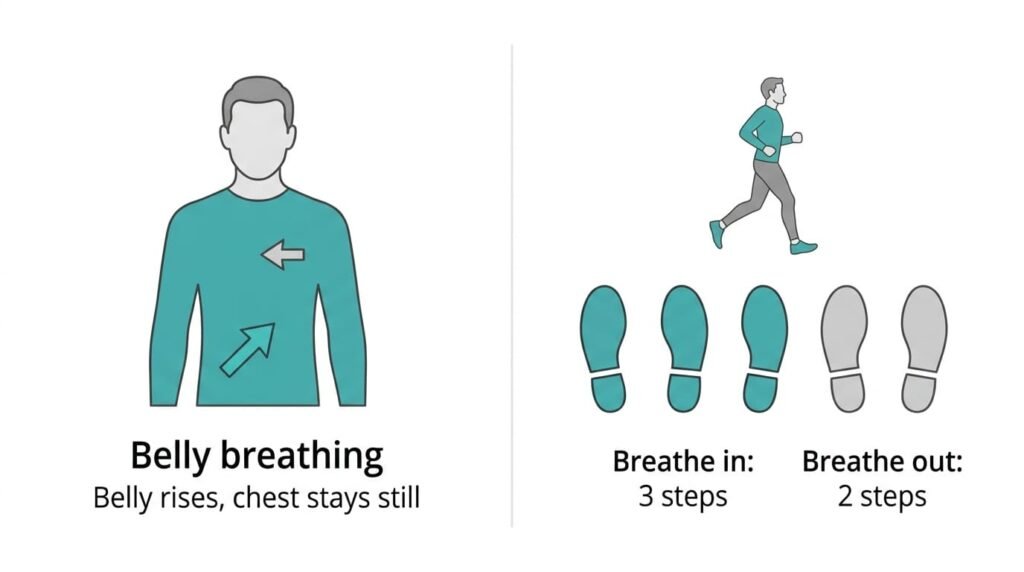
Shallow chest breathing uses only the top of your lungs and tires the small muscles of the neck and shoulders. Belly breathing, also called diaphragmatic breathing, uses your main breathing muscle and fills your lungs more completely.
Practise it lying down first:
- Lie on your back with your knees bent, one hand on your chest and one on your belly
- Breathe in slowly through your nose so that your belly hand rises and your chest hand barely moves
- Breathe out slowly through your mouth, letting your belly fall
- Do this for 2 to 3 minutes a day for a week, then try it while walking, then while jogging
4. Find a rhythm
Many runners find that linking breathing to their steps calms them down and keeps the effort steady. Two popular patterns:
| Pattern | How it works | When to use it |
|---|---|---|
| 3:3 | Breathe in for 3 steps, out for 3 steps | Very easy runs and warm-ups |
| 3:2 | In for 3 steps, out for 2 steps | Easy to steady runs |
| 2:2 | In for 2 steps, out for 2 steps | Moderate to hard efforts |
| 2:1 | In for 2 steps, out for 1 step | Hard efforts and hills |
| 1:1 | In for 1 step, out for 1 step | Sprints and final pushes |
Patterns with an odd number of steps, such as 3:2, mean you start each breath out on alternating feet. Some coaches believe this spreads the impact more evenly, but this has not been proven, so treat it as a preference. There is no single correct rhythm. Try a few and use whatever feels natural. If counting steps makes you anxious, forget it and simply aim for slow, deep, regular breaths.
5. Focus on the out-breath
When you feel breathless, concentrate on breathing out fully. A long, complete exhale empties the lungs and makes the next in-breath deeper without effort. A slow “whoosh” out through pursed lips can help you settle in seconds.
6. Relax your upper body
Tense shoulders and a clenched jaw restrict your breathing. Every few minutes, drop your shoulders, shake out your hands and unclench your jaw. Our running form guide covers posture and arm swing, which both affect how easily you can breathe.
7. Run tall
Slumping forward squashes your chest and belly, leaving less room for your lungs and diaphragm. Run tall with your chest open and your eyes looking ahead, not down at your feet.
How to control breathing while running in different situations
At the start of a run
Most people start too fast. Your breathing has not caught up yet, so you get breathless in the first few minutes. Walk briskly for 5 minutes, then start jogging slower than feels necessary. After 10 minutes you can ease into your normal pace. This simple change is often the biggest help in learning how to control breathing while running.
On hills
Shorten your stride, keep your effort steady rather than your pace, and let your breathing rhythm speed up, for example from 3:2 to 2:2. Walking steep hills is completely fine. Focus on deep out-breaths at the top to recover.
During faster running and intervals
Hard efforts make breathing while running much harder, and that is expected. Use a faster rhythm such as 2:1 and focus on full exhales. Between intervals, slow your breathing deliberately with long out-breaths while you walk or jog.
In cold weather
Cold, dry air can irritate the airways. Wear a light buff or scarf over your mouth and nose to warm the air, start more gently, and talk to your doctor if cold air regularly makes you cough or wheeze.
In races
Excitement raises your breathing before you even start. Take five slow belly breaths on the start line, and start slower than your goal pace for the first mile. If you are training for a race, our 12 week half marathon training plan includes pacing tips.
How to stop cramps while running
There are two very different kinds of cramps while running: the side stitch, a sharp pain under the ribs, and muscle cramps, usually in the calves or hamstrings.
Side stitches
A side stitch is a sharp or cramping pain, usually just under the ribs on one side, sometimes with a pain at the tip of the shoulder. Nobody knows exactly what causes it, but several things clearly make it more likely.
| To prevent stitches | Why |
|---|---|
| Avoid big meals in the 2 to 3 hours before running | Stitches are more common after eating |
| Avoid sugary or concentrated drinks before running | These were particularly likely to provoke a stitch |
| Sip water rather than gulping large amounts | A full stomach makes stitches more likely |
| Warm up gradually | Sudden hard efforts often bring them on |
| Strengthen your core | Some runners find a stronger trunk helps |
If you get a stitch:
- Slow down to a walk or very easy jog
- Breathe deeply into your belly and out fully through pursed lips
- Press your fingers firmly into the painful spot and lean slightly forward
- Some runners find that breathing out as the opposite foot lands helps
- Start running again gently once it eases
Muscle cramps
Muscle cramps are sudden, painful tightening of a muscle, often in the calf or hamstring, usually late in a long or hard run. The exact cause is still debated. Fatigue of the muscle is likely to play a big part, and very hot weather, heavy sweating and doing more than you are used to also seem to contribute.
To ease a muscle cramp, stop and gently stretch the muscle. For the calf, straighten your leg and pull your toes toward you. Our calf stretches guide shows the best positions. To prevent them, build up distance gradually, fuel and hydrate sensibly on longer runs, and include strength training in your week.
Breathing while running as a complete beginner
If you are brand new to running, everything in this guide still applies, but the first priority is simpler: give your heart and lungs time to adapt. Breathing while running feels hard for every beginner. It is not a sign that you are doing anything wrong.
| Week | What to do | Breathing goal |
|---|---|---|
| Weeks 1 to 2 | Run 1 minute, walk 2 minutes, repeated 6 to 8 times | Recover your breath fully during each walk |
| Weeks 3 to 4 | Run 2 to 3 minutes, walk 1 to 2 minutes | Keep breathing steady enough to say a short sentence |
| Weeks 5 to 6 | Run 5 minutes, walk 1 minute | Try a relaxed 3:3 or 3:2 rhythm |
| Weeks 7 to 8 | Run 10 minutes or more without stopping | Breathe calmly through most of the run |
The walk breaks are your friend. They let your breathing settle, which means you can keep moving for longer in total. That extra time on your feet is what builds fitness. By week eight, most beginners notice they can breathe and talk at a pace that used to leave them gasping.
If you are carrying extra weight
Breathing while running is harder when you carry more body weight, simply because every step takes more energy. Brisk walking and incline walking build the same heart and lung fitness with less strain, and they are a great way to start. Add short jogs gradually once a 30-minute brisk walk feels easy.
If you are older
Breathing capacity changes a little with age, but older runners improve with training just as younger ones do. Start with walking, build up slowly, and pay extra attention to warm-ups, which give your breathing time to adjust before the effort rises.
What to eat and drink before running
Food and drink have a big effect on side stitches and on how comfortable breathing while running feels.
| Timing | What works for most people |
|---|---|
| 3 to 4 hours before | A normal meal is fine |
| 1 to 2 hours before | A light snack, such as toast, a banana or yoghurt |
| 30 to 60 minutes before | A small snack only, or nothing |
| Just before | Sips of water. Avoid large volumes and sugary drinks |
Our guide on what to eat before a workout has more ideas. If you often get stomach pain during or after runs, our article on stomach pain after a workout explains common causes.
Exercises to improve your breathing
- Daily belly breathing: 2 to 3 minutes lying down, as described above
- Box breathing: breathe in for 4 counts, hold for 4, out for 4, hold for 4. Repeat for 2 minutes. This calms the nervous system before a run or race. Our mental health exercises guide covers more breathing techniques
- Easy running: regular, conversational runs are the best breathing training there is
- Respiratory muscle training: handheld devices that add resistance to breathing in. Research suggests they can improve endurance performance, especially in less fit people. They are optional, not essential
- Strength and core work: a strong trunk supports good posture as you tire
| Week | Breathing focus on easy runs |
|---|---|
| Week 1 | Practise belly breathing lying down daily. Run at conversational pace |
| Week 2 | Try belly breathing while walking. Start runs with 5 minutes of brisk walking |
| Week 3 | Try a 3:3 or 3:2 rhythm for the first 10 minutes of each run |
| Week 4 | Use rhythm and long out-breaths on hills and the final part of runs |
Breathing on the treadmill
Breathing while running on a treadmill feels harder for some people because indoor air is warmer and there is no breeze. Use a fan, keep water nearby and set the incline to 1 percent so the effort matches running outside. A treadmill is a great place to practise breathing rhythms, because the pace stays steady. Our treadmill workouts for beginners include easy sessions to try.
Common breathing mistakes
- Running too fast, the most common cause of breathlessness by far
- Breathing only through your nose when the pace demands more air
- Shallow, chest-only breathing
- Holding your breath on hills or when you concentrate
- Eating a big meal or drinking something very sugary just before running
- Tense shoulders and jaw
- Obsessing over a breathing pattern that does not feel natural
When to see a doctor
Some breathlessness while running is normal, and heavy breathing while running hard is expected. See a doctor if:
- You wheeze, cough or feel your chest tighten during or after running
- You feel breathless at a pace you used to manage easily, without an obvious reason
- You have chest pain, pressure or discomfort during exercise
- You feel dizzy, faint or have a racing or irregular heartbeat
- A side stitch is severe, lasts long after you stop, or comes with nausea or vomiting
Exercise-induced asthma is common and very treatable, and many top athletes have it. Getting it diagnosed can transform how running feels.
This article is general information, not medical advice. Stop and seek urgent help for chest pain, severe breathlessness, fainting or a racing heartbeat during exercise. See our medical disclaimer.
The bottom line
Breathing while running gets easier when you slow down to a conversational pace, breathe through your nose and mouth together, use your belly rather than your chest, relax your upper body and find a rhythm that feels natural. Focus on long out-breaths when you feel breathless, start every run gently, and avoid big meals and sugary drinks before you head out to prevent side stitches.
When I stopped fighting my breathing and simply slowed down, everything changed. My breathing settled, the stitches faded and running finally felt enjoyable. Give these techniques a few weeks, and yours will too.
Frequently asked questions
How do you breathe properly while running?
Run at a pace where you can talk, breathe through your nose and mouth together, and breathe deep into your belly rather than your chest. Relax your shoulders and settle into a steady rhythm, such as in for three steps and out for two or three.
Should I breathe through my nose or mouth when running?
Most runners breathe through both. Nose breathing alone limits how much air you can take in once you speed up. Nose-only breathing can work on very easy runs, but switch to both as soon as you need more air.
How can I control my breathing while running?
Slow down, start every run gently, focus on full out-breaths and link your breathing to your steps with a rhythm like 3:2 or 2:2. Practise belly breathing at rest so it becomes natural.
Why do I get out of breath so fast when running?
Usually because you are running faster than your current fitness allows. Slow down to a conversational pace and use run-walk intervals. Your breathing improves quickly as your aerobic fitness builds.
How do I stop a side stitch while running?
Slow down, breathe deeply into your belly, breathe out fully, and press firmly on the painful spot while leaning slightly forward. To prevent stitches, avoid big meals and sugary drinks in the two to three hours before running.
What causes cramps while running?
Side stitches are linked to eating or drinking before running and to sudden hard efforts. Muscle cramps in the legs are linked mainly to muscle fatigue and doing more than you are used to, with heat and heavy sweating also playing a part.
Is there a best breathing pattern for running?
No single pattern suits everyone. Research shows runners use several patterns, such as two or three strides per breath. Try 3:3, 3:2 or 2:2 steps and use whatever feels most natural for the pace.
Can breathing exercises make running easier?
Yes. Belly breathing and box breathing help you stay calm and breathe more efficiently, and respiratory muscle training devices can improve endurance in some people. Regular easy running is still the most effective breathing training.
What’s next?
Reading is the easy part. Pick one of these and do it today.