Best Exercises for Strength at Home: 12 Moves, Progressions and a 3-Day Plan
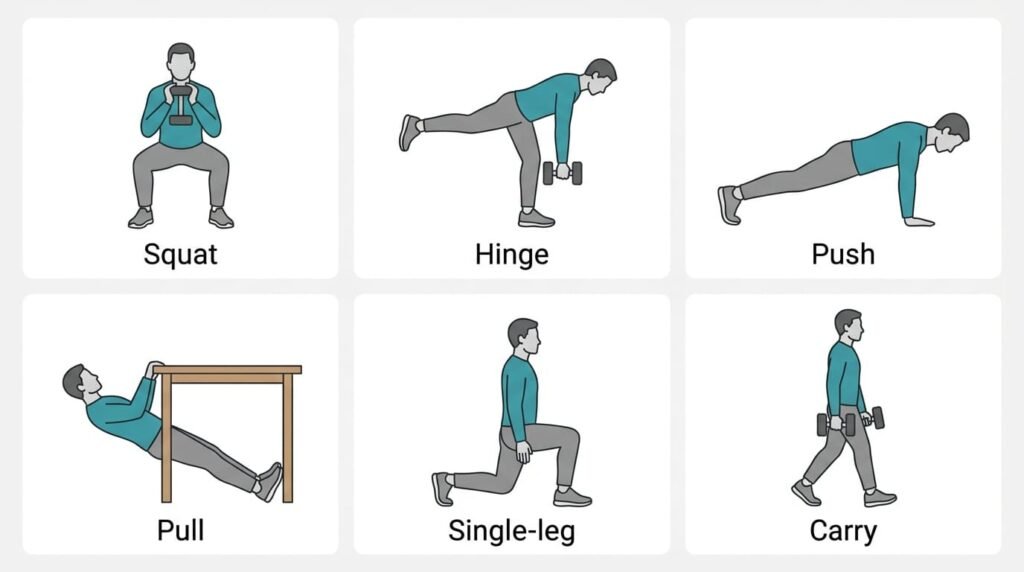
The best exercises for strength at home are not fancy. They are the same basic movement patterns that strong people have trained for a century: squatting, hinging, pushing, pulling, lunging and carrying, plus a few core moves to hold it all together. What makes them work at home is knowing how to make them harder as you get stronger, because a living room has no rack of heavier weights waiting for you.
I learned that the slow way. When I started training at home, I did endless sets of 30 easy squats and 20 knee push-ups and wondered why I was getting fitter but not much stronger. A friend who coached gymnastics watched one session and said, “You are doing cardio with extra steps.” He swapped my high-rep circuits for harder variations I could only do 6 to 12 times: split squats instead of squats, decline push-ups instead of knee push-ups, rows under my kitchen table. Within three months I could do my first proper pistol squat to a box and 25 strict push-ups, and carrying the shopping upstairs stopped being a workout.
This guide covers the 12 best exercises for strength at home, how to make each one easier or harder, the equipment that is genuinely worth buying, how to keep progressing without a gym, and a simple three-day plan you can start this week.
At a glance
- Strength comes from hard sets of roughly 5 to 15 reps where the last few reps are a real effort
- Cover six movement patterns: squat, hinge, push, pull, single-leg and carry, plus core
- Bodyweight exercises can build real strength if you keep making them harder
- Research shows push-ups can build similar strength to the bench press when the effort is matched
- Train each pattern two or three times a week
- A pair of adjustable dumbbells or a set of resistance bands opens up many more options
- Track your sets, reps and variations so you know you are progressing
What makes an exercise good for building strength?
Strength is your ability to produce force. To build it, your muscles need to work against a load that is genuinely challenging, and that load needs to increase over time. At home, the “load” can come from your body weight, dumbbells, bands, a backpack full of books or simply a harder version of the exercise.
| Principle | What it means at home |
|---|---|
| Challenging effort | Most sets should end with 1 to 3 reps left in the tank |
| Right rep range | Roughly 5 to 15 reps per set for strength. If you can do 25 or more, the exercise is too easy |
| Progressive overload | Make the exercise harder over time: more reps, a harder variation, slower tempo or added weight |
| Compound movements | Exercises that use several joints and muscles at once give the most strength for your time |
| Consistency | Two or three sessions a week, every week |
What the research says
- Bodyweight can match weights. A study of experienced lifters found that push-ups made harder with elastic bands, matched to the same muscle activity as a 6-rep-max bench press, produced similar strength gains to the bench press over five weeks
- Push-ups build strength too. Another trial found that push-ups and a light bench press at a similar load produced comparable gains in bench press strength and chest and triceps muscle thickness over eight weeks
- Bands are a real option. A meta-analysis of eight studies found no difference in strength gains between elastic resistance, such as bands and tubes, and conventional equipment like machines and dumbbells
- Heavier work builds maximal strength best. A meta-analysis of 21 studies found that heavier loads produced greater gains in one-rep max strength than light loads, while muscle growth was similar. At home, that means choosing harder variations rather than just doing more reps
- It is good for your health. A meta-analysis of 16 studies linked muscle-strengthening activities with a 10 to 17 percent lower risk of death from any cause and of heart disease, cancer and diabetes, with the biggest benefit at around 30 to 60 minutes a week
The six movement patterns to cover
| Pattern | What it trains | Best home exercises |
|---|---|---|
| Squat | Quads, glutes, core | Goblet squat, split squat, single-leg squat to a box |
| Hinge | Glutes, hamstrings, lower back | Single-leg Romanian deadlift, hip thrust, good morning |
| Push | Chest, shoulders, triceps | Push-up variations, pike push-up, dips |
| Pull | Back, biceps, grip | Inverted row, one-arm dumbbell row, pull-up if you have a bar |
| Single-leg | Leg strength and balance | Reverse lunge, step-up, Bulgarian split squat |
| Carry and core | Trunk, grip, posture | Farmer’s carry, plank, side plank, dead bug |
If you train at least one exercise from each row, two or three times a week, you have a complete strength programme. That is why the best exercises for strength at home below are grouped by pattern rather than by muscle.
The 12 best exercises for strength at home
Each of the best exercises for strength at home below includes an easier version, the standard version and a harder version. Start where you can do 6 to 12 good reps with one to three left in the tank, and move up when you can do three sets of 12 to 15.
1. Push-up
The push-up is the king of upper body pushing at home. It works the chest, shoulders, triceps and core together.
- Hands slightly wider than shoulders, body in one straight line from head to heels
- Lower your chest to just above the floor, elbows at about 45 degrees from your body
- Push the floor away until your arms are straight
| Easier | Standard | Harder |
|---|---|---|
| Incline push-up with hands on a counter or bench | Full push-up on the floor | Decline push-up with feet raised, then archer push-up |
Our incline and decline push-ups guide explains each step. Decline push-ups load about 70 to 74 percent of your body weight, compared with about 64 percent for a standard push-up.
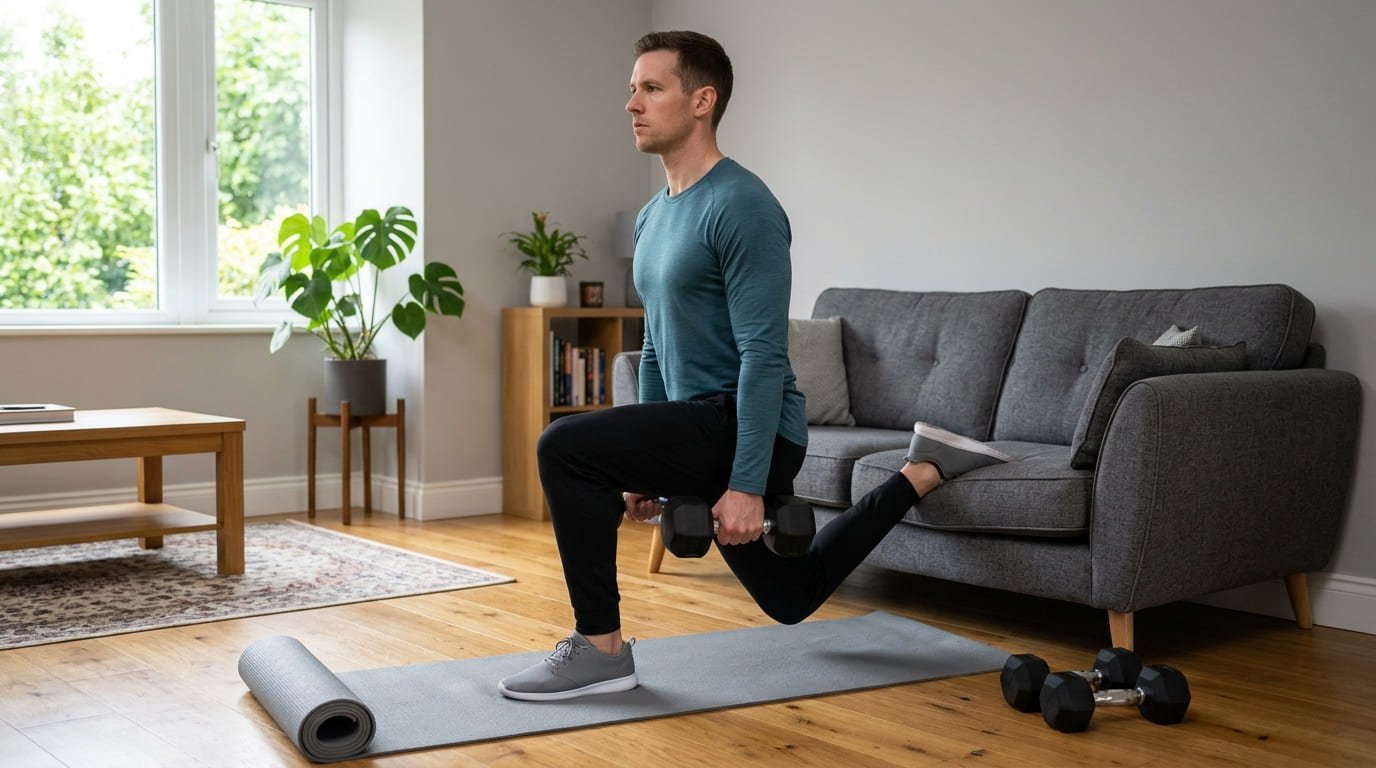
2. Split squat
The split squat is the best leg exercise for most people training at home, because it is hard enough to build strength without any weights.
- Stand in a long split stance, back heel lifted
- Lower your back knee toward the floor, keeping your front knee over your mid-foot
- Drive through your front foot to stand
| Easier | Standard | Harder |
|---|---|---|
| Split squat holding a chair for balance | Split squat | Rear-foot-elevated split squat, back foot on a chair or sofa |
3. Goblet squat
Holding a dumbbell, kettlebell or even a heavy water bottle against your chest makes the squat a true strength exercise and naturally improves your posture.
- Hold the weight at your chest, feet about shoulder-width apart
- Sit down between your heels, keeping your chest up
- Stand by pushing the floor away
| Easier | Standard | Harder |
|---|---|---|
| Bodyweight squat to a chair | Goblet squat | Goblet squat with a 3-second pause at the bottom |
If you have no weights, use a backpack loaded with books. Our guide to what muscles squats work covers the different squat styles.
4. Inverted row
Pulling is the pattern most home workouts miss, and it is essential for balanced shoulders and good posture. An inverted row under a sturdy table works the whole upper back.
- Lie under a strong table and grip the edge, hands shoulder-width apart
- Keep your body straight from heels to head
- Pull your chest to the table, squeezing your shoulder blades together
| Easier | Standard | Harder |
|---|---|---|
| Knees bent, feet flat on the floor | Legs straight, heels on the floor | Feet raised on a chair, or a one-second pause at the top |
Check the table can take your weight before you start. Our pull-up alternatives guide has more pulling options for home.
5. One-arm dumbbell row
If you have a dumbbell, this is one of the best back exercises there is.
- Place one hand and knee on a bench or sturdy chair
- Pull the dumbbell toward your hip, keeping your back flat
- Lower slowly
| Easier | Standard | Harder |
|---|---|---|
| Lighter dumbbell, higher reps | Moderate dumbbell, 8 to 12 reps | Heavier dumbbell with a 2-second pause at the top |
A resistance band anchored in a door gives a similar pull if you have no dumbbells.
6. Single-leg Romanian deadlift
The hinge trains the back of your body: glutes, hamstrings and lower back. Doing it on one leg makes it hard enough for strength even with light weights.
- Stand on one leg with a soft knee
- Hinge at the hip, reaching your free leg back as your torso tips forward, keeping your back flat
- Return to standing by squeezing your glute
| Easier | Standard | Harder |
|---|---|---|
| Two-leg Romanian deadlift with a light weight | Single-leg RDL with bodyweight, touching a wall for balance | Single-leg RDL holding a dumbbell |
7. Hip thrust
The hip thrust is the most direct strength exercise for the glutes, and it is easy to load at home with a dumbbell or a backpack.
- Sit with your upper back against the edge of a sofa or bench
- Drive through your heels to lift your hips until your body is flat from shoulders to knees
- Squeeze your glutes at the top, then lower
| Easier | Standard | Harder |
|---|---|---|
| Glute bridge on the floor | Bodyweight hip thrust from a sofa | Single-leg hip thrust, or loaded with a dumbbell |
Our hip thrusts at home guide covers set-up and loading in detail.
8. Pike push-up
The pike push-up builds overhead pressing strength for the shoulders without any equipment.
- Start in a push-up position, then walk your feet in and lift your hips high, making an upside-down V
- Bend your elbows to lower the top of your head toward the floor between your hands
- Push back up
| Easier | Standard | Harder |
|---|---|---|
| Pike push-up with hands on a bench | Pike push-up on the floor | Feet-elevated pike push-up, then wall handstand holds |
9. Chair or bench dip
Dips build strong triceps and the bottom of the chest. At home, two sturdy chairs or the edge of a bench work well.
- Sit on the edge of a bench, hands beside your hips, then slide your hips off
- Bend your elbows to about 90 degrees, keeping your shoulders down
- Press back up
| Easier | Standard | Harder |
|---|---|---|
| Bench dip with knees bent | Bench dip with legs straight | Parallel dips between two sturdy chairs or on a dip station |
Stop if you feel pain at the front of the shoulder. Our dip exercise guide explains safe depth.
10. Reverse lunge and step-up
Single-leg strength carries straight over to stairs, hills and sport. The reverse lunge is kinder to the knees than the forward lunge, and the step-up is one of the most functional exercises you can do.
| Exercise | Easier | Harder |
|---|---|---|
| Reverse lunge | Hold a chair for balance | Hold dumbbells, or add a knee drive at the top |
| Step-up | Low step, no weight | High step or a dumbbell in each hand |
Our single-leg squat guide shows how to build all the way up to a pistol squat.
11. Farmer’s carry
Picking up something heavy and walking with it builds grip, shoulders, core and posture all at once.
- Hold a heavy dumbbell, kettlebell or loaded shopping bag in each hand
- Stand tall with your shoulders down
- Walk for 20 to 40 metres, or 30 seconds, without leaning
Our guide to the farmer’s carry covers variations, including the one-arm suitcase carry, which is excellent for the side of your core.
12. Plank, side plank and dead bug
Core strength is less about crunches and more about resisting movement. These three exercises cover the front, sides and coordination of your trunk.
| Exercise | Dose | Harder version |
|---|---|---|
| Plank | 3 x 20 to 45 seconds | Plank with shoulder taps or a long-lever plank |
| Side plank | 3 x 15 to 30 seconds each side | Side plank with top leg raised |
| Dead bug | 3 x 8 each side | Hold a light weight in your hands |
Our guide to the McGill Big 3 explains a simple core routine that is kind to the back.
| Exercise | Pattern | Equipment |
|---|---|---|
| Push-up | Push | None |
| Split squat | Squat and single-leg | None |
| Goblet squat | Squat | Dumbbell, kettlebell or backpack |
| Inverted row | Pull | Sturdy table |
| One-arm dumbbell row | Pull | Dumbbell and chair |
| Single-leg Romanian deadlift | Hinge | None or dumbbell |
| Hip thrust | Hinge | Sofa or bench |
| Pike push-up | Push (overhead) | None |
| Chair or bench dip | Push | Sturdy chair or bench |
| Reverse lunge and step-up | Single-leg | Step or stairs |
| Farmer’s carry | Carry | Dumbbells or heavy bags |
| Plank, side plank and dead bug | Core | None |
How I chose these exercises
There are hundreds of exercises you could do at home. To make this list of the best exercises for strength at home, each one had to pass four simple tests:
| Test | Why it matters |
|---|---|
| Can it be made harder over time? | Without progression, strength stops improving within weeks |
| Does it use several joints and muscles? | Compound moves build the most strength per minute |
| Can you do it in a small space with little or no equipment? | It has to fit a real living room or bedroom |
| Is it safe to learn without a coach? | You should be able to check your own form |
Exercises that failed the tests, such as crunches, which are hard to progress and train only a small range of strength, or jumping exercises, which build power more than maximal strength, did not make the main list. They still have their place, just not at the centre of a strength plan.
The best exercises for strength at home by goal
| Your goal | Prioritise | Add |
|---|---|---|
| Stronger legs | Split squat, goblet squat, step-up | Single-leg squat to a box |
| Stronger upper body | Push-up variations, inverted row, pike push-up | Dips and one-arm rows |
| A stronger back and better posture | Inverted row, one-arm row, farmer’s carry | Band pull-aparts and prone Y raises |
| Stronger glutes | Hip thrust, single-leg Romanian deadlift, reverse lunge | Frog pumps and monster walks |
| Everyday strength and independence | Sit-to-stand, step-up, farmer’s carry | Wall push-up and band row |
| Sport and running | Split squat, single-leg Romanian deadlift, plank | Calf raises and jump squats once strong |
Whatever your goal, keep at least one exercise from every movement pattern in your week. Choosing the best exercises for strength at home for your goal simply means giving your priority areas a little more volume, not dropping everything else.
How to keep getting stronger at home
The biggest challenge with strength training at home is progression. In a gym you add plates. At home, you have to be a little more creative. These are the levers, in roughly the order I would use them:
- Add reps. Work up to 12 to 15 good reps per set
- Add a set. Go from two sets to three, then four
- Slow down. A three-second lowering phase makes the same exercise much harder
- Add a pause. Hold for one or two seconds at the hardest point, such as the bottom of a squat
- Move to a harder variation. From push-up to decline push-up, from split squat to rear-foot-elevated split squat
- Go single-limb. One-leg and one-arm versions roughly double the load on the working side
- Add weight. Dumbbells, a weighted backpack or resistance bands
| If you can do | What to do next |
|---|---|
| Fewer than 5 good reps | Choose an easier variation |
| 5 to 12 reps with 1 to 3 left | Perfect. Stay here and add reps each week |
| 3 sets of 12 to 15 easily | Move to a harder variation or add weight |
| 25 or more reps | The exercise is now endurance work. Make it harder |
Our next-step resistance calculator shows the variations between where you are now and where you want to be, and our bodyweight exercise progress calculator compares two sessions even when your body weight changes.
A simple 3-day plan using the best exercises for strength at home
Do these three sessions on non-consecutive days, such as Monday, Wednesday and Friday. Rest 60 to 120 seconds between sets. Each session takes about 35 to 45 minutes, including a short warm-up of marching, arm circles, bodyweight squats and a few push-ups against a wall.
| Day A | Day B | Day C |
|---|---|---|
| Split squat, 3 x 8 to 12 each leg | Goblet squat, 3 x 8 to 12 | Rear-foot-elevated split squat, 3 x 6 to 10 each leg |
| Push-up variation, 3 x 6 to 12 | Pike push-up, 3 x 6 to 10 | Push-up variation, 3 x 6 to 12 |
| Inverted row, 3 x 6 to 12 | One-arm dumbbell row or band row, 3 x 8 to 12 each arm | Inverted row, 3 x 6 to 12 |
| Hip thrust, 3 x 10 to 15 | Single-leg Romanian deadlift, 3 x 8 each leg | Hip thrust, 3 x 10 to 15 |
| Plank, 3 x 30 seconds | Chair or bench dip, 3 x 8 to 12 | Farmer’s carry, 4 x 30 seconds |
| Dead bug, 2 x 8 each side | Side plank, 2 x 20 seconds each side | Reverse lunge, 2 x 10 each leg |
How to progress the plan
| Weeks | Focus |
|---|---|
| Weeks 1 to 2 | Learn the movements. Two sets of each, stopping 3 reps short of failure |
| Weeks 3 to 4 | Three sets. Aim to add one or two reps per set each week |
| Weeks 5 to 6 | Use a slower lowering phase on squats and push-ups |
| Weeks 7 to 8 | Move to harder variations where you can do 3 sets of 12 to 15 |
| Week 9 | An easier week with two sets of each, then start a new cycle with harder versions |
Write down every session. It sounds dull, but a simple notebook is what turns random workouts into real strength training at home. Our guide to sets and reps explains how to adjust the numbers for your goals.
Equipment worth buying for home strength training
You can build real strength with nothing, but a little equipment opens up a lot of options.
| Equipment | Why it helps | Rough priority |
|---|---|---|
| Adjustable dumbbells | Goblet squats, rows, RDLs, carries and endless progression | First choice if budget allows |
| Resistance bands | Rows, presses and assistance for pull-ups. Cheap and portable | Great first buy |
| Pull-up bar | The best pulling exercise of all, if your doorway allows | High |
| Sturdy bench or step | Hip thrusts, step-ups, rows and incline push-ups | Medium |
| Kettlebell | Swings, goblet squats and carries | Medium |
| Exercise mat | Comfort for floor work | Low but useful |
Our guides to the best adjustable dumbbells for home and the best resistance bands for beginners explain what to look for.
Strength exercises for beginners: where to start
If you are completely new, start with the easiest version of each pattern and focus on form for the first two weeks. Even the best exercises for strength at home only work if you can do them with good control. These are my favourite strength exercises for beginners, because they are safe, simple and easy to progress:
- Squat: sit-to-stand from a chair
- Push: incline push-up with hands on a kitchen counter
- Pull: band row, or inverted row with knees bent
- Hinge: glute bridge on the floor
- Single-leg: step-up onto the bottom stair, holding the rail
- Core: dead bug and a short plank from the knees
Two sets of 8 to 12 reps, two or three times a week, is plenty to start. Our guide to compound exercises for beginners and the calisthenics workout plan for beginners give you more structure.
Strength training at home for older adults
Strength becomes more important with age, not less, and the best exercises for strength at home suit older adults just as well as younger ones. Muscle and bone strength protect your independence, balance and ability to get up from the floor. The same exercises work, with a few adjustments:
- Use a chair or counter for balance on squats, lunges and single-leg work
- Start with sit-to-stands, wall push-ups and seated rows with a band
- Move slowly and control every rep
- Build up gradually, adding a few reps or one more set each week
Our leg exercises for seniors guide is a gentle place to start.
Common mistakes
- Doing high-rep circuits only. Fun and good for fitness, but not the best way to build maximal strength
- Never making exercises harder. If the same 20 push-ups feel easy for months, progress has stopped
- Skipping pulling exercises, which leads to rounded shoulders and imbalance
- Rushing reps. Slow, controlled reps build more strength than fast, sloppy ones
- Training to total failure every set, which makes recovery harder. Leave one to three reps in reserve most of the time
- Not tracking anything, so you cannot tell whether you are getting stronger
- Ignoring recovery. Muscles get stronger between sessions. Sleep, protein and rest days matter
Food, sleep and rest
Getting stronger needs fuel and recovery as much as hard sets.
- Protein: include a good source of protein at each meal. Our protein intake calculator gives you a daily target
- Sleep: seven to nine hours makes a noticeable difference to your strength and recovery
- Rest days: at least one day between hard sessions for the same muscles
- After training: a meal or snack with protein and carbohydrate within a couple of hours. Our guide on what to eat after a workout has simple ideas
How long until you get stronger?
| Timescale | What usually happens |
|---|---|
| Weeks 1 to 4 | Fast early gains as your nervous system learns the movements |
| Weeks 4 to 12 | Steady increases in reps and harder variations |
| 3 to 6 months | Clear changes in strength and often in muscle size |
| 6 months and beyond | Slower progress that needs more careful progression and added weight |
Beginners often get stronger surprisingly quickly in the first few months. Our article on newbie gains explains why. To see where you stand, the strength calculator includes bodyweight standards for push-ups and squats.
Safety
Strength training at home is safe for most people when you start easy and progress gradually. Check that chairs, tables and benches are sturdy before using them, clear the space around you, and stop any exercise that causes sharp pain. Speak to your doctor first if you have heart disease, high blood pressure, a joint problem, are pregnant or are returning from an injury or surgery.
This article is general information, not medical advice. See our medical disclaimer.
The bottom line
The best exercises for strength at home cover six movement patterns: a squat, a hinge, a push, a pull, a single-leg exercise and a carry, plus core work. Push-ups, split squats, goblet squats, inverted rows, dumbbell rows, single-leg Romanian deadlifts, hip thrusts, pike push-ups, dips, lunges and step-ups, farmer’s carries and planks will take you a very long way.
The secret is not the exercise list. It is making those exercises harder as you get stronger, training each pattern two or three times a week, and writing down what you did. That is what turned my endless easy circuits into real strength, and it will do the same for you, no gym required.
Frequently asked questions
What are the best exercises for strength at home?
Push-ups, split squats, goblet squats, inverted rows, one-arm dumbbell rows, single-leg Romanian deadlifts, hip thrusts, pike push-ups, dips, reverse lunges and step-ups, farmer’s carries and planks. Together they cover every major movement pattern.
Can you build real strength at home without weights?
Yes, if you keep making the exercises harder. Research shows push-ups can produce similar strength gains to the bench press when the effort is matched. Progress to harder variations such as decline push-ups and rear-foot-elevated split squats.
How many reps should I do to build strength?
Roughly 5 to 15 reps per set, stopping with one to three reps left in the tank. If you can do 25 or more reps easily, choose a harder variation.
How often should I do strength training at home?
Two or three sessions a week is ideal for most people, training each movement pattern at least twice a week with a rest day between hard sessions.
What equipment is best for home strength training?
Adjustable dumbbells are the most versatile, followed by resistance bands and a pull-up bar. A sturdy bench or step is also useful. You can start with no equipment at all.
What are good strength exercises for beginners?
Sit-to-stands, incline push-ups, band rows, glute bridges, step-ups and dead bugs are good strength exercises for beginners. Start with two sets of 8 to 12 reps, two or three times a week.
Are bodyweight strength exercises as good as lifting weights?
For many people, especially beginners, they can be. Bodyweight strength exercises build strength well when you progress them. For maximal strength in the long run, adding heavier loads helps, which is where dumbbells and bands come in.
How long does it take to get stronger at home?
Most beginners notice clear progress within four to eight weeks, and significant changes in strength within three to six months of consistent training.
What’s next?
Reading is the easy part. Pick one of these and do it today.