Stretches for Shin Splints: 8 Gentle Stretches, 6 Strength Exercises and a Return-to-Running Plan
Stretches for shin splints were the first thing I searched for when the inside of my shins started aching three weeks into my first running plan. I had gone from barely exercising to running four times a week, mostly on pavement, in old trainers. By week three, the first few minutes of every run felt like someone was tapping on my shin bones with a spoon.
What helped was not one magic stretch. It was a mix of things: easing back on the running, gently stretching my calves and shins every day, strengthening my lower legs, and building back up much more slowly. Six weeks later I was running pain-free, and I have not had shin splints since.
This guide shares the eight stretches for shin splints that helped me, six strengthening exercises, a simple daily routine, a plan for getting back to running and the warning signs that mean you should see a doctor.
At a glance
- Shin splints is the common name for pain along the inner edge of the shin bone, usually from doing too much too soon
- The main treatment is reducing the activity that caused it, then building back gradually
- Stretches for shin splints target the calves, the soleus and the muscles at the front of the shin
- Strengthening the calves, shins, feet and hips helps your legs handle running and jumping
- Stretching and strengthening help many people feel better, but the research on them is limited, so load management comes first
- Most people improve within a few weeks to a few months
- See a doctor if pain is sharp, in one small spot, present at rest or at night, or getting worse
What are shin splints?
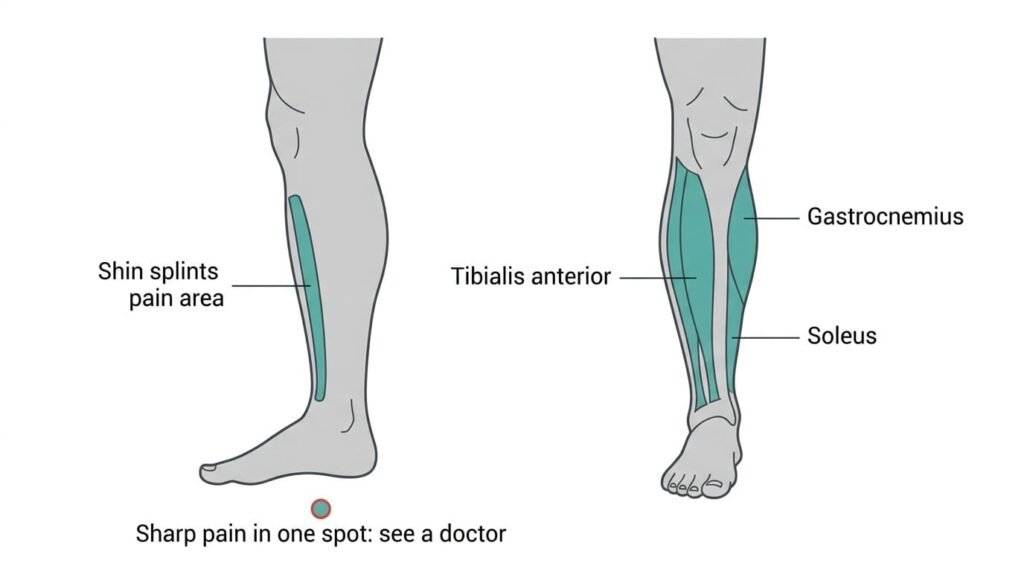
Shin splints is the everyday name for medial tibial stress syndrome. It causes a dull or aching pain along the inner border of the shin bone, usually over a stretch of several centimetres rather than one spot. It is very common in new runners, people returning to sport after a break, military recruits and anyone who suddenly increases running, jumping or marching.
For a long time people thought shin splints were caused by inflamed muscles pulling on the bone. A detailed review of the research found that the main problem is actually the bone being overloaded. The shin bone is constantly remodelling itself. When you increase impact faster than it can adapt, breakdown outpaces repair and it becomes sore.
Common causes and risk factors
| Risk factor | Why it matters |
|---|---|
| Increasing running too quickly | The bone has not had time to adapt to the extra impact |
| New or changed training surface | Hard pavements or a sudden switch to hills or a track |
| Worn-out or unsupportive shoes | Less cushioning and support |
| Feet that roll in a lot (overpronation) | Linked with shin splints in several studies |
| Previous shin splints | The best predictor of getting them again |
| Weak calves and hips | Less ability to absorb force with each step |
| Low bone health or under-eating | Less raw material for bone repair |
What the research says
- Cause. A critical review of shin splints concluded the condition is caused by bony overload, where bone breakdown outpaces bone formation along the shin, rather than inflammation of the outer lining of the bone. Excessive foot pronation and female sex were risk factors in several studies
- Treatment. A systematic review of treatment trials found that all the studies had a high risk of bias, and that stretching and strengthening exercises, braces and compression stockings had not been proven effective on their own. None of the studies were strong enough to recommend any single treatment
- What that means for you. Stretches and exercises for shin splints are still widely used by physiotherapists, because they help many people feel and move better. But they work best as part of a bigger plan that reduces load first and builds it back gradually
Source: Moen and colleagues, Medial tibial stress syndrome: a critical review, Sports Medicine (2009)
First steps when your shins hurt
Before any stretches for shin splints, deal with the cause:
- Cut back. Reduce or pause the running or jumping that hurts. Switch to cycling, swimming or the elliptical to keep your fitness
- Ice for comfort. 10 to 15 minutes with a cold pack wrapped in a towel can ease the ache after activity
- Check your shoes. If they have done more than 400 to 500 miles, or the cushioning is flat, replace them
- Walk without pain. If walking hurts, rest more and see a professional
- Then add stretches and strength work, keeping everything pain-free
8 stretches for shin splints
Do these stretches for shin splints once or twice a day, ideally after a short walk when your muscles are warm. Hold each one for 30 seconds, breathe slowly, and never push into sharp pain. A gentle pulling feeling is what you are looking for.
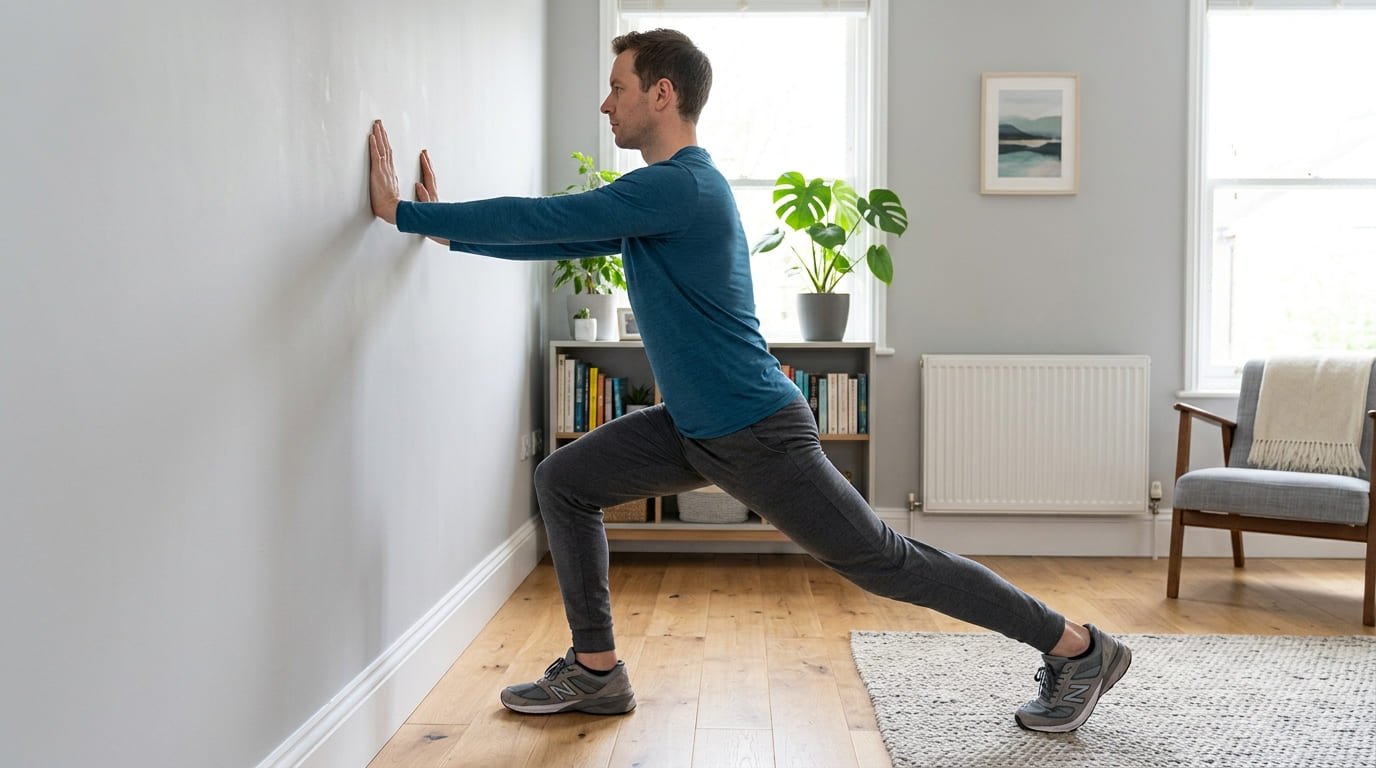
1. Wall calf stretch (gastrocnemius)
- Stand facing a wall with your hands on it at shoulder height
- Step one foot back, keeping that leg straight and the heel on the floor
- Bend the front knee and lean toward the wall until you feel a stretch in the upper calf of the back leg
Hold: 30 seconds, 2 to 3 times each side. Tight calves are one of the most common partners of shin pain, so this is the first of the stretches for shin splints I do every day.
2. Bent-knee calf stretch (soleus)
- Stand in the same position as the wall calf stretch
- Bring the back foot a little closer and bend the back knee, keeping the heel down
- Feel the stretch lower down, just above the Achilles tendon
Hold: 30 seconds, 2 to 3 times each side. The soleus attaches along the inner shin, close to where shin splints usually hurt.
3. Kneeling shin stretch
- Kneel on a soft surface with the tops of your feet flat on the floor and your toes pointing straight back
- Slowly sit back toward your heels until you feel a stretch along the front of your shins
- Lean back on your hands to make it gentler
Hold: 20 to 30 seconds, 2 to 3 times. This is one of the classic shin stretches for the muscles on the front of the lower leg. Skip it if kneeling hurts your knees.
4. Standing toe-drag shin stretch
- Stand near a wall for balance
- Place the top of one foot behind you on the floor, toes pointing back, as if you were dragging your toes
- Gently bend the standing knee until you feel a stretch along the front of the back shin
Hold: 30 seconds each side. A good alternative when kneeling is uncomfortable.
5. Seated towel stretch
- Sit on the floor with your legs straight out
- Loop a towel or band around the ball of one foot
- Gently pull your toes back toward you, keeping the knee straight
Hold: 30 seconds, 2 to 3 times each side.
6. Step calf stretch
- Stand on a step with your heels hanging off the edge, holding a rail
- Slowly lower your heels below the step until you feel a calf stretch
- Keep your knees soft
Hold: 20 to 30 seconds, twice. Go gently, because this one can be strong.
7. Ankle circles and alphabet
Sit with one leg crossed over the other and draw slow circles with your foot, ten each way. Then trace the letters of the alphabet with your big toe. It is a mobility drill rather than a stretch, but it eases stiffness and warms up the ankle.
8. Calf foam roll
Sit with a foam roller under your calves. Roll slowly from just above the ankle to below the knee for 60 seconds. Avoid rolling directly on the painful inner border of the shin bone itself.
| Stretch | Target | Hold | Daily sets |
|---|---|---|---|
| Wall calf stretch | Upper calf (gastrocnemius) | 30 seconds | 2 to 3 each side |
| Bent-knee calf stretch | Lower calf (soleus) | 30 seconds | 2 to 3 each side |
| Kneeling shin stretch | Front of shin | 20 to 30 seconds | 2 to 3 |
| Standing toe-drag shin stretch | Front of shin | 30 seconds | 2 each side |
| Seated towel stretch | Calf and Achilles | 30 seconds | 2 to 3 each side |
| Step calf stretch | Calf | 20 to 30 seconds | 2 |
| Ankle circles and alphabet | Ankle mobility | 1 to 2 minutes | 1 |
| Calf foam roll | Calf muscles | 60 seconds per leg | 1 |
6 exercises for shin splints
Stretches for shin splints ease tightness. Strength work helps your lower legs handle impact again. Start these exercises for shin splints once you can walk without pain, and keep them pain-free.
For more ways to strengthen the front of the shin, see our full guide to tibialis anterior exercises.
1. Calf raises
- Stand holding a wall or chair, feet hip-width apart
- Rise onto the balls of your feet
- Lower slowly over three seconds
Dose: 3 sets of 15. Progress to single-leg calf raises, then to bent-knee calf raises for the soleus. Our calf workout at home has more progressions.
2. Toe raises (tibialis raises)
- Stand with your back against a wall and your heels about 30 cm away from it
- Keeping your legs straight, lift your toes and the front of your feet toward your shins
- Lower slowly
Dose: 3 sets of 15 to 20. This strengthens the muscle at the front of the shin.
3. Heel walks
Walk forward on your heels with your toes lifted for 20 to 30 metres. Then turn around and walk back on your toes. Repeat 2 to 3 times.
4. Towel scrunches
Sit with a towel flat on the floor under your bare foot. Scrunch the towel toward you with your toes, then push it away. Do this for 1 minute per foot. It strengthens the small muscles of the foot that support the arch. Our flat feet exercises include more arch-strengthening moves.
5. Single-leg balance
Stand on one leg for 30 seconds, then switch. Make it harder by closing your eyes or standing on a cushion. Balance training improves ankle control.
6. Side-lying leg raise or clamshell
Weak hips can let the knee and shin twist inward on landing. Do 2 sets of 15 side-lying leg raises or clamshells on each side. Monster walks are a great progression once these are easy.
| Exercise | Target | Dose |
|---|---|---|
| Calf raises | Calves | 3 x 15 |
| Toe raises | Front of shin (tibialis anterior) | 3 x 15 to 20 |
| Heel walks and toe walks | Shin and calf | 2 to 3 lengths |
| Towel scrunches | Foot arch muscles | 1 minute per foot |
| Single-leg balance | Ankle control | 30 seconds each leg, 3 times |
| Side-lying leg raise or clamshell | Hip abductors | 2 x 15 each side |
A 15-minute workout for shin splints
Put the stretches and strength moves together into one simple routine. I find workouts for shin splints much easier to stick with when everything is in one short session. These workouts for shin splints take about 15 minutes. Do them once a day while your shins are recovering, then three times a week to help prevent the pain returning.
| Part | Exercises | Time |
|---|---|---|
| Warm-up | Ankle circles and alphabet, 2 minutes of easy walking | 3 minutes |
| Strength | Calf raises, toe raises, heel and toe walks, single-leg balance, clamshells | 7 minutes |
| Stretch | Wall calf stretch, bent-knee calf stretch, kneeling or standing shin stretch | 5 minutes |
If any exercise causes sharp pain, skip it for now. If the whole routine aggravates your shins, take a few days off and try again with fewer reps.
How to get back to running after shin splints
The most important part of recovery is how you return. Going straight back to your old running routine is the quickest way to bring the pain back.
Signs you are ready
- You can walk briskly for 30 minutes without pain
- You can hop 10 times on each leg without pain
- Pressing along the inner shin is no longer tender
- The strength exercises above feel easy
A gradual return plan
| Week | Running sessions | What to do |
|---|---|---|
| Week 1 | 3 sessions on soft or flat ground | Run 1 minute, walk 2 minutes. Repeat 5 times |
| Week 2 | 3 sessions | Run 2 minutes, walk 2 minutes. Repeat 5 times |
| Week 3 | 3 sessions | Run 4 minutes, walk 1 minute. Repeat 4 times |
| Week 4 | 3 sessions | Run 10 minutes, walk 1 minute, run 10 minutes |
| Week 5 onwards | 3 to 4 sessions | Build your continuous running by about 5 minutes per week |
Keep doing your stretches for shin splints and the strength exercises throughout. If pain comes back, drop back a week. Our guide on how to increase running endurance shows how to keep building safely after that.
How to prevent shin splints
- Build up gradually. Avoid big jumps in running time or distance, especially in the first few months
- Run three or four times a week rather than every day as a beginner
- Mix surfaces. Grass, trails and tracks are kinder than pavement for some of your runs
- Replace worn shoes and choose shoes that feel comfortable and stable on your feet
- Strengthen your legs and hips twice a week
- Cross-train. Cycling, swimming and the elliptical build fitness without the impact
- Eat enough, especially calcium, vitamin D and overall calories, which bones need to adapt
- Take short, quick steps that land under your body rather than far in front
Jumping adds load to the shins too. If you love jump rope workouts or high knees, build them up slowly and keep them on a forgiving surface.
When and how often to do shin stretches
Timing makes a difference. These are the rules I follow:
| When | What to do | Why |
|---|---|---|
| Before a run or walk | Ankle circles, heel and toe walks, a few gentle calf raises | Dynamic movement warms the muscles without long static holds |
| After a run or walk | Wall calf stretch, soleus stretch and shin stretches, 30 seconds each | Muscles are warm and stretch more comfortably |
| On rest days | The full 15-minute routine | Keeps the lower legs moving while they recover |
| In the evening | Seated towel stretch and ankle circles | Eases stiffness after a long day on your feet |
Little and often beats one long session a week. Two or three minutes of shin stretches after every walk adds up quickly, and it becomes a habit you hardly notice.
Who gets shin splints, and how to adapt
- New runners. The most common group by far. Follow a gradual plan and use run-walk intervals for the first couple of months
- People returning after a break. Your fitness comes back faster than your bones adapt. Start at about half your old distance
- Team sport players and dancers. Lots of jumping and quick changes of direction, often on hard floors. Build up training slowly at the start of a season
- Heavier beginners. More body weight means more impact. Start with walking, cycling and the elliptical, and add short runs on soft surfaces gradually
- Hikers and walkers. Long downhill sections can bring on shin pain. Use poles, shorten your stride and build up distance gradually
Whoever you are, the same mix of stretches for shin splints, strength work and patient progression applies.
Common mistakes
- Running through the pain, which can turn shin splints into a stress fracture
- Relying on stretches alone without reducing the load
- Stretching aggressively into pain
- Returning too quickly once the pain eases for a few days
- Ignoring shoes that are years old
- Skipping strength work once the pain goes
When to see a doctor
Shin splints are common and usually settle with rest and a gradual return. See a doctor or physiotherapist if:
- The pain is sharp and in one small spot you can point to with a finger, which can suggest a stress fracture
- Your shin hurts at rest or wakes you at night
- There is swelling, a lump, redness or warmth
- The pain started after a fall or direct blow
- Your lower leg feels tight, numb, tingly or weak during exercise and settles with rest, which can be a sign of a pressure problem in the muscles called exertional compartment syndrome
- Nothing has improved after two to three weeks of rest from the activity that caused it
This article is general information, not medical advice. Seek urgent help for severe pain, numbness or a lower leg that looks pale or feels cold. See our medical disclaimer.
The bottom line
Stretches for shin splints ease tight calves and shins, but they work best as part of a bigger plan: reduce the activity that hurts, stretch gently each day, strengthen your calves, shins, feet and hips, and return to running gradually. Most people recover within a few weeks to a few months.
The routine in this guide got me back to pain-free running after my own bout of shin splints. I still do calf raises and the wall calf stretch three times a week, and I have kept my promise to myself never to add too much running too fast again.
Overstriding adds load to the shins. My running form guide shows how slightly quicker, lighter steps can take some of that load off.
Want more options for the back of the lower leg? My full guide to calf stretches covers ten stretches and when to strengthen instead.
Frequently asked questions
What are the best stretches for shin splints?
The best stretches for shin splints are the wall calf stretch, the bent-knee soleus stretch, the kneeling shin stretch, the standing toe-drag shin stretch and the seated towel stretch are among the most useful. Hold each for about 30 seconds and keep them gentle.
Should I stretch if I have shin splints?
Gentle stretches for shin splints are usually fine and can ease tightness, as long as it does not cause sharp pain. Research has not proven stretching alone treats shin splints, so combine it with rest from the painful activity and strengthening exercises.
What exercises are good for shin splints?
Calf raises, toe raises, heel and toe walks, towel scrunches, single-leg balance and hip exercises such as clamshells are good exercises for shin splints once you can walk without pain.
How long do shin splints take to heal?
Mild cases often settle in two to four weeks of reduced activity. More stubborn cases can take two to three months. A gradual return to running is essential.
Can I keep running with shin splints?
It is best to stop or greatly reduce running until you can walk and hop without pain. Running through shin splints can lead to a stress fracture. Cycling and swimming keep your fitness up in the meantime.
How do I stretch my shins?
Kneel and gently sit back on your heels with the tops of your feet flat, or stand and place the top of one foot on the floor behind you and bend the other knee. Both shin stretches target the front of the lower leg.
Do shoes cause shin splints?
Worn-out or unsupportive shoes can contribute, especially combined with a sudden increase in running. Replace running shoes every 400 to 500 miles and choose a pair that feels comfortable and stable.
How do I know if it is shin splints or a stress fracture?
Shin splints usually cause a dull ache along a longer stretch of the inner shin that eases with warm-up early on. A stress fracture tends to cause sharp pain in one small spot, pain at rest or at night, and pain that gets worse with activity. See a doctor if you suspect a fracture.
Are there workouts for shin splints I can do at home?
Yes. A 15-minute routine of ankle circles, calf raises, toe raises, heel and toe walks, single-leg balance, clamshells and calf and shin stretches needs no equipment. Do it daily while recovering and three times a week for prevention.
What’s next?
Reading is the easy part. Pick one of these and do it today.