The Warm-Up Routine to Do Before Every Workout (Beginners)
The best warm-up exercises before a workout are gentle, moving ones that rehearse what you are about to do: marching, shoulder rolls, arm circles, torso twists, side lunges and leg swings. Five minutes is enough, and no stretching-and-holding is needed beforehand. This beginner-friendly routine uses gentle, dynamic movements to loosen your joints, raise your heart rate, and prepare your body to move with more control. Do it before every workout, and your muscles will thank you.
The quick routine: spend about 5 minutes on 6 gentle moves, marching, shoulder rolls, arm circles, torso twists, side-to-side lunges, and leg swings, doing each for 30 to 45 seconds. You’re ready when you feel warm and loose, with a slightly raised heart rate.
Build your warm-up
A warm-up works best when it rehearses the session you are about to do. Tell it what you are training and how long you have, and it will pick the moves for you.
Why warming up matters
Warming up gradually increases blood flow to your muscles, loosens stiff joints, and switches on the muscles you’re about to use. That means better, more comfortable movement and a lower chance of tweaking something. For beginners especially, a few warm-up minutes turn a workout that feels awkward and stiff into one that feels smooth and doable.
Dynamic vs static stretching
Before a workout, use dynamic movements: gentle, controlled motions that take your joints through their range, like leg swings and arm circles. Save static stretches (holding a stretch still) for your cool-down afterward, when your muscles are warm. In short: move to warm up, hold to cool down.
Your 5-minute beginner warm-up
Do each move for about 30 to 45 seconds, one after another. Keep everything gentle and controlled.
- March in place: pump your arms gently and lift your knees to get your heart rate up.
- Shoulder rolls: roll your shoulders slowly backward, then forward, to loosen your upper body.
- Arm circles: make small circles with both arms, gradually making them bigger.
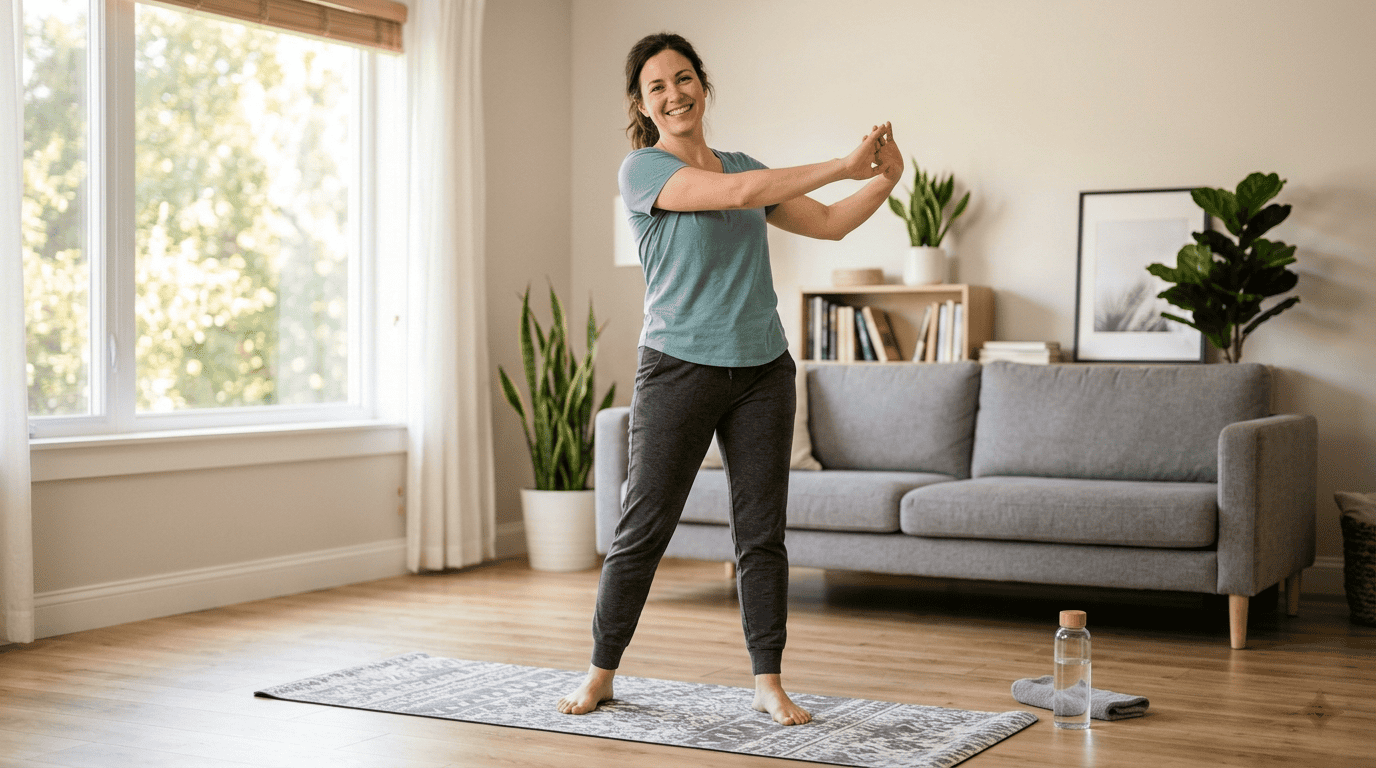
- Torso twists: stand tall and rotate your upper body gently side to side.
- Side-to-side lunges: step wide and shift your weight from side to side in a shallow lunge.
- Leg swings: holding a wall for balance, swing each leg gently forward and back.
That’s it. You should feel warmer and looser, not tired. Now you’re ready for your workout, whether that’s the 15-minute full-body routine or a beginner leg workout.
Warm-up by workout type
The general routine above works for anything. If you want to be a little smarter about it, the principle is simple: rehearse the movement you are about to do, gently and unloaded. A warm-up before squats should involve some shallow squatting.
| Before a… | Add these | Why |
|---|---|---|
| Leg session | Side lunges, leg swings, shallow squats | Opens the hips and rehearses the squat pattern |
| Upper-body session | Arm circles, wall push-ups, shoulder blade squeezes | Wakes up the shoulders before you load them |
| Core session | Cat-cow, glute bridges, dead bug reaches | Gets the spine moving and the glutes switched on |
| Walk or cardio | Start slowly for the first 3 minutes | The first few minutes are the warm-up |
| Morning workout | Everything, and take an extra minute | You are stiffer first thing than later in the day |
That last row matters more than people expect. If you train first thing, as in the 10-minute morning workout, give the warm-up an extra minute and expect the first exercise to feel worse than the third.
A warm-up with no jumping
Most warm-up lists you will find start with jumping jacks and high knees. That is fine in a gym, and a problem if you live in a flat with neighbours below, have knees that object to impact, or are warming up at 6am in a quiet house.
You do not need impact to warm up. The aim is raised blood flow and joints that have moved through their range, and marching, step-touches, low step-ups and controlled squats do that perfectly well. Tick the no-jumping box in the builder above and it will keep both feet available at all times.
If impact is a wider concern for your whole session, the low-impact workout for beginners follows the same principle throughout.
Common warm-up mistakes
- Holding long stretches beforehand. Static stretching before training can leave muscles feeling temporarily weaker. Save it for afterwards.
- Turning it into a workout. If you are out of breath and tired at the end of your warm-up, it was too much. You should feel ready, not spent.
- Rushing through it. Thirty seconds of frantic arm circles does very little. Gentle and unhurried is the point.
- Warming up nothing you are about to use. Arm circles before a leg session are pleasant but not particularly useful.
- Skipping it on short sessions. A 15-minute workout still deserves three minutes of preparation, and cutting the warm-up is where beginners tweak things.
Don’t forget to cool down
After your workout, spend two or three minutes on gentle static stretches while your muscles are warm: reach for your toes, open your chest, and stretch your thighs and calves. It helps you feel good afterward and supports recovery.
Keep it gentle. This is general information, not medical advice. A warm-up should never hurt. Move within a comfortable range, and check with a professional if you have an injury or condition that affects how you move.
Warming up properly also helps prevent digestive discomfort. See stomach pain after a workout.
These double up nicely as a warm-up. See 7 exercises to do every day.
Save the long holds for afterwards. Quad stretches explains the timing and gives you five to choose from.
Bodyweight good mornings make an excellent leg-day warm-up. See the good morning exercise.
Frequently asked questions
How long should a warm-up be?
About 5 minutes is plenty for most beginner workouts, and up to 10 minutes before something longer or more intense. You’re warmed up when you feel loose and your heart rate is slightly raised.
Should I stretch before or after a workout?
Do gentle, moving (dynamic) stretches before your workout as part of your warm-up, and save held (static) stretches for afterward when your muscles are warm. That order is safer and more effective.
Do I really need to warm up for a short home workout?
Yes. Even a quick 2 to 3 minute warm-up before a short session helps your muscles move better and lowers your injury risk. It’s a small investment for a big payoff.
What happens if I skip warming up?
You can still work out, but cold muscles are stiffer and more prone to strains, and the workout often feels harder. Warming up simply makes exercise safer and more comfortable.
Can a warm-up be my whole workout on a low-energy day?
Absolutely. On a tired day, doing just the gentle warm-up counts as movement and keeps your habit alive. Something is always better than nothing.
What are the best warm-up exercises before a workout?
Gentle moving exercises that rehearse what you are about to do: marching in place, shoulder rolls, arm circles, torso twists, side-to-side lunges and leg swings. Add shallow squats before a leg session and wall push-ups before upper-body work.
How many warm-up exercises should I do?
Four to six is plenty for a five-minute warm-up. Doing 30 to 45 seconds of each is more useful than rushing through ten different moves.
Should you warm up before a bodyweight workout?
Yes. Bodyweight training still loads your joints and muscles, and cold muscles move less comfortably. Three to five minutes is enough, and it makes the first few exercises feel noticeably better.
What is a good warm-up without jumping?
Marching in place, step-touches, low step-ups on the bottom stair, shallow squats, arm circles and leg swings. None involve both feet leaving the floor, which keeps them quiet for flats and kinder to sore knees.
Is walking a good warm-up?
Yes, for cardio especially. Starting your walk slowly for the first three minutes is the warm-up. Before strength training, add a few joint-moving exercises such as arm circles and leg swings as well.
Related articles
- Home Workouts for Beginners: The Complete Guide
- 15-Minute Full-Body Home Workout
- Beginner Leg Workout at Home
- Beginner Workout Mistakes to Avoid
- Full-Body Stretching Routine for Beginners
Explore more beginner guides in Stretching & Mobility.
Free tools to plan your progress
Put real numbers to your goals with our free, no-sign-up beginner calculators:
- Calories Burned Calculator, calories burned by any activity.
- Steps to Calories Calculator, turn your daily steps into calories.