Beginner Leg Workout at Home (No Equipment Needed)
Strong legs make everyday life easier, from stairs to standing up without a groan. This beginner leg workout uses just your body weight, needs no equipment, and can be done at home in about 15 minutes. Every move comes with an easier option and simple form cues so you can start safely, wherever you are today.
The workout: after a short warm-up, do 1 to 2 rounds of 6 bodyweight leg moves (squats, reverse lunges, glute bridges, calf raises, wall sit, side steps). Rest between moves, keep it controlled, and stop if your knees hurt.
Why training your legs matters more than you think
Legs are the part most beginners skip, usually because leg day has a reputation for being miserable. It does not have to be. Your legs and glutes are the biggest muscles you own, which means training them does more for your everyday life than almost anything else you can do at home.
- Everyday movement gets easier. Stairs, getting out of a low chair, carrying shopping, standing up off the floor. All of it runs on leg strength.
- Your knees get more support. Strong quads, glutes and hips take load off the joint rather than adding to it, which is why leg training is often part of knee rehab.
- Balance improves. Single-sided moves like lunges and side steps train the small stabilising muscles that keep you steady.
- You burn more energy. Big muscles doing work means a bigger effort from your whole body, even in a short session.
What you need
Nothing, really. Enough floor space to take a step backwards, a sturdy chair or a wall for balance, and something soft under you for the glute bridges. A mat is pleasant but a folded towel does the job. Bare feet or flat shoes are better than cushioned trainers here, because you want to feel where your weight is.
Warm up your legs first
Spend two or three minutes marching in place, doing gentle leg swings, and a few slow, shallow squats to wake up your muscles and joints. A proper warm-up is especially worth it before leg day.
The 6-move beginner leg workout
Do each exercise with control, resting 30 to 60 seconds between them.
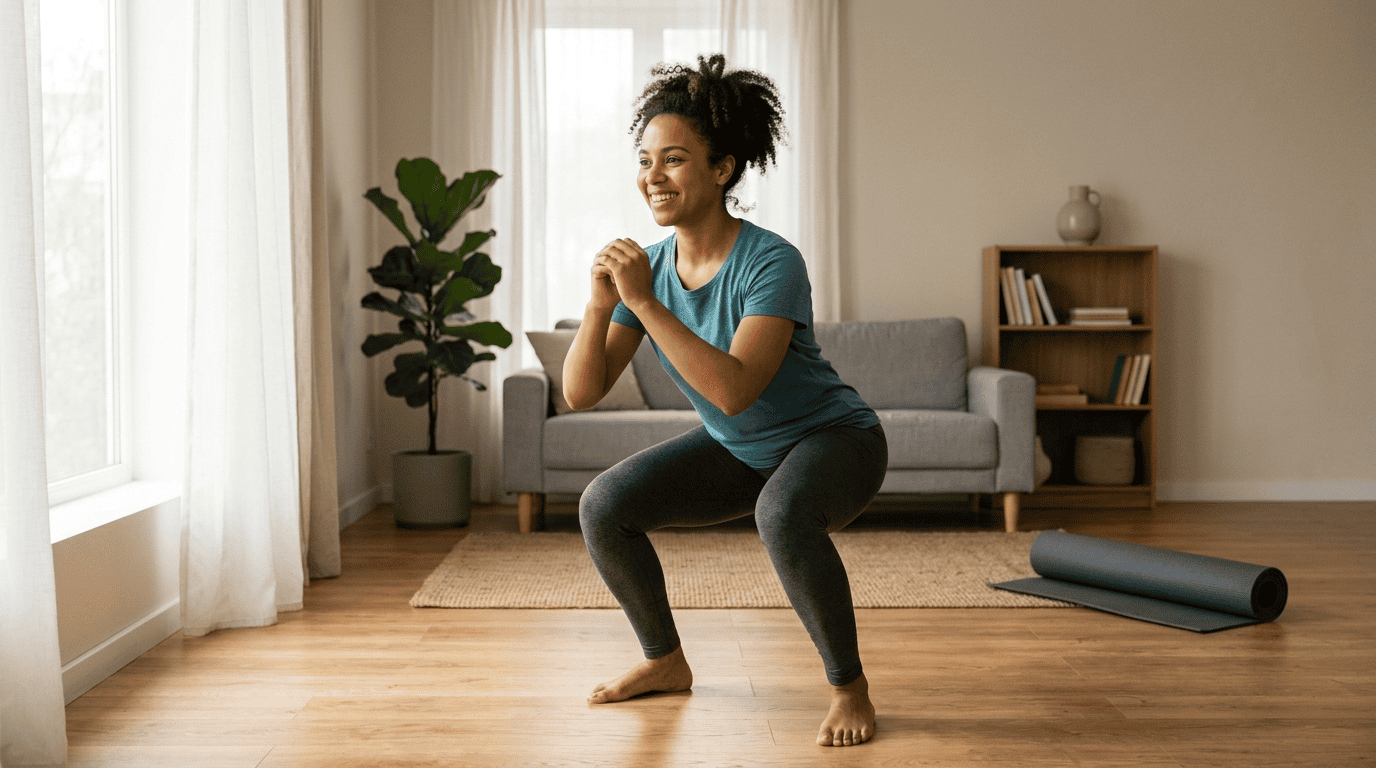
1. Bodyweight squats (8 to 12)
Feet shoulder-width apart, sit your hips back and down, chest up, weight in your heels, then stand. Go only as low as feels comfortable. Easier: squat down to tap a chair and stand back up.
2. Reverse lunges (5 to 8 per leg)
Step one foot back and lower your back knee gently toward the floor, then push back up. Stepping backward is kinder on the knees than stepping forward. Easier: hold a wall or chair for balance and take a smaller step.
3. Glute bridges (10 to 12)
Lie on your back, knees bent, feet flat. Squeeze your glutes and lift your hips, then lower slowly. Great for your backside and easy on the joints.
4. Calf raises (12 to 15)
Stand tall, rise onto the balls of your feet, then lower slowly. Hold a wall for balance. This strengthens your lower legs and ankles.
5. Wall sit (15 to 30 seconds)
Lean your back against a wall and slide down until your knees are bent (no lower than a comfortable angle), and hold. Easier: don’t slide as low, and hold for less time.
6. Side steps (10 per side)
Step to the side into a shallow half-squat, then step back. This works your outer hips and glutes, which help with balance and knee comfort.
Protect your knees. This is general information, not medical advice. Keep movements slow and controlled, only go as deep as feels comfortable, and stop if you feel sharp knee pain. If you have a knee condition or injury, check with your doctor or a physical therapist first.
Sets, reps and how often to train legs
Start with one full round of the six moves. When that stops leaving you sore for days, add a second round. Two rounds is a solid place to stay for quite a while.
The rep numbers above are a guide, not a target to force. A useful rule: stop each set two or three reps before your form would start falling apart. If your knees are drifting inward, your heels are lifting, or you are holding your breath, that set is over regardless of the number.
Two to three sessions a week, with at least one rest day in between, is plenty. Your legs get stronger while they recover, not while you train them, so back-to-back leg days are the fastest route to being too sore to continue. Our guide on how often a beginner should work out goes into this properly.
If your knees are a problem
Sore or cranky knees do not mean you cannot train legs. They usually mean you need a smaller range and a slower tempo, at least to start.
- Reduce the depth first. A quarter squat you can do without pain is worth far more than a deep one that hurts.
- Step backwards, not forwards. Reverse lunges keep the load off the front knee compared with forward lunges.
- Lean on the hinge moves. Glute bridges strengthen the hips and backside with almost no knee involvement, and stronger glutes usually mean happier knees.
- Slow everything down. Three seconds lowering, no bouncing at the bottom.
Sharp, pinching or swelling pain is a different thing from muscle effort. That is a stop-and-check-with-a-professional signal, not something to push through. If jumping and impact are the issue, the low-impact beginner workout is a gentler place to start.
How to progress
When one round feels easy, add a second, add a few reps, or slow each move down. You can also hold the wall sit a little longer each week. Pair this with the beginner calisthenics plan or the full-body no-equipment routine for balanced training, and check how often to work out so your legs get enough recovery.
Making it harder without any equipment
Once two rounds feel comfortable, you do not need weights to keep progressing. Legs respond very well to leverage and tempo, both of which are free.
- Slow the lowering. Take three full seconds to lower into every squat and lunge. This alone can turn an easy set into a hard one.
- Add a pause. Hold the bottom of the squat, or the top of the glute bridge, for two seconds before moving.
- Go to one leg. Single-leg glute bridges, then split squats holding a chair, then step-ups onto a low stair. One leg doing the work of two is a big jump in difficulty.
- Shorten the rest. Drop from 60 seconds between moves to 30 and the same workout becomes noticeably harder.
You can also swap moves in and out to keep it interesting. The free workout builder puts together a session from the same beginner-safe moves, and the exercise library has a how-to for each one.
Common mistakes on beginner leg day
- Going too deep too soon. Depth is something you earn as your hips and ankles loosen up. Chasing it on day one is how knees and lower backs get grumpy.
- Rushing the reps. Bouncing out of the bottom of a squat uses momentum instead of muscle. Slow is harder, and it is the point.
- Letting the knees cave inward. Think about gently pushing your knees out over your middle toes as you stand up.
- Doing a huge first session. Fifty squats on day one buys you three days of hobbling and no extra progress. One controlled round is the right start.
- Skipping the glutes. Squats alone do not cover it. The bridges and side steps are not filler, they are what balances the routine.
Soreness, and how soon you will notice a difference
Expect your legs to be sore a day or two after your first couple of sessions, particularly after lunges. That delayed soreness is normal, it settles as your body adapts, and it is not a scorecard for how good the workout was. Walking, gentle stretching and a normal amount of sleep help more than lying completely still. There is more in how to reduce muscle soreness.
As for results, the first thing you notice is not in the mirror. Within two or three weeks the movements feel smoother and you can do more reps, because your nervous system gets efficient before your muscles visibly change. Around the four to six week mark the everyday stuff, stairs and standing up, starts feeling easier. Visible change takes a couple of months of consistency, as covered in how long it takes to see results.
Once bodyweight squats stop feeling challenging, adding weight is the natural next step. See the dumbbell leg workout at home.
Curious which muscles you are actually training here? See what muscles squats work.
To bias the side of the hip specifically, see upper glute exercises.
A cheap band adds resistance the floor cannot. See the resistance band leg workout.
To add a one-legged option once these feel manageable, work through the single leg squat progression.
To train the back of the leg properly, see hamstring exercises at home.
To cover the inside of the thigh too, see inner thigh exercises.
If lunges bother your knees, lunge alternatives covers eight swaps that train the same muscles.
To progress your glute work sensibly, see glute bridge vs hip thrust.
When these leg exercises start to feel easy, my guide to jump squats walks you through a safe progression, from landing drills to a full jump squat workout.
Calves need a slightly different approach to the rest of your legs. Our calf workout at home guide covers the range-of-motion fixes that make calf raises actually work.
Frequently asked questions
Can you build leg strength without weights?
Yes. Bodyweight moves like squats, lunges, and glute bridges challenge your legs enough to build real strength as a beginner. You progress by adding reps, rounds, slower tempos, or single-leg versions over time.
How do I do squats safely with bad knees?
Keep the movement slow, sit your hips back, only go as low as feels comfortable, and use a chair to squat onto if needed. If you have a knee condition, check with a professional before starting.
How many reps should a beginner do for legs?
Around 8 to 12 reps per move for one or two rounds is a solid beginner range. Stop a couple of reps before your form breaks down, since good form matters more than hitting a number.
How often should I train legs?
Two to three times a week, with a rest day in between, is plenty for beginners. Your legs get stronger while they recover, so don’t train them hard on back-to-back days.
Why are my legs shaky during the workout?
Mild shaking usually just means your muscles are working and tiring, which is normal for beginners. Slow down, rest, and stop if it feels like more than fatigue or if you feel dizzy.
Do I need weights to build leg strength at home?
Not as a beginner. Your body weight is enough resistance to start, and you can keep progressing by slowing each rep down, pausing, shortening your rest, or moving to single-leg versions like split squats and one-leg glute bridges.
How long should a beginner leg workout take?
About 15 minutes for one round including a short warm-up, or around 25 minutes for two rounds. Short and consistent beats long and occasional, so do not stretch it out just to hit a number.
Related articles
- Home Workouts for Beginners: The Complete Guide
- No-Equipment Beginner Workout Routine
- 15-Minute Full-Body Home Workout
- The Warm-Up Routine to Do Before Every Workout
- Calisthenics Workout Plan for Beginners
- Beginner Exercise Library
- The Free 4-Week Beginner Program
Explore more beginner guides in Home Workouts.
Free tools to plan your progress
Put real numbers to your goals with our free, no-sign-up beginner calculators:
- Calories Burned Calculator, calories burned by any activity.
- TDEE Calculator, the total calories you burn each day.


