Calf Workout at Home: 12 Exercises and an 8-Week Plan
Calves have a reputation for being stubborn, and some of that is deserved. They are built from a high proportion of endurance-oriented muscle fibres, they already take thousands of steps of work every day, and their size is more strongly influenced by genetics than most muscle groups, particularly the length of the muscle belly relative to the tendon.
But a large part of the stubbornness is self-inflicted. Most people train calves with bodyweight raises on flat ground, with a short range of motion, bouncing at the bottom, for two sets at the end of a leg session. That is not a training stimulus, it is a rounding error next to the work your calves do walking around.
This guide fixes the three things that actually make calf training work: range of motion, bottom-position stretch, and progressive overload. Twelve exercises, two routines and an eight-week plan, none of which needs equipment beyond a step and something heavy to hold.
At a glance
- Two main calf muscles need two different exercises: standing for one, seated for the other
- Elevating your toes on a step is the single biggest improvement you can make
- Pause at the bottom in the stretched position rather than bouncing
- Calves tolerate high frequency well, 3 to 4 sessions a week
- Higher reps work, but so do heavy sets. Use both
- Calf size is partly genetic, but strength and endurance improve for everyone
Two muscles, two exercises
This is the piece most people miss, and it explains why one exercise is never enough.
| Muscle | Where it attaches | Crosses the knee? | Trained by | Fibre type |
|---|---|---|---|---|
| Gastrocnemius | Above the knee on the femur, down to the heel | Yes | Standing calf raises, knee straight | More fast-twitch, responds to heavier work |
| Soleus | Below the knee on the tibia and fibula, down to the heel | No | Seated calf raises, knee bent | Mostly slow-twitch, responds to higher reps |
Because the gastrocnemius crosses the knee, bending your knee slackens it and takes it largely out of the movement. That is not a flaw, it is the mechanism that lets you isolate the soleus underneath.
The practical rule:
- Knee straight equals gastrocnemius, the visible muscle that gives the calf its diamond shape
- Knee bent to roughly 90 degrees equals soleus, the larger, deeper muscle underneath
The soleus is the bigger of the two by volume and it is almost universally undertrained, because nearly everyone does standing raises only. If your calves have not responded to years of standing raises, seated work is the most likely missing piece.
There is also the tibialis anterior on the front of the shin, which lifts the foot. It is worth training for ankle balance and shin splint prevention, and there is an exercise for it below.
The three fixes that make calf training work
Before the exercise list, these three changes matter more than which exercises you pick.
1. Elevate your toes
Doing calf raises flat on the floor means you can only go up, never down below neutral. That removes roughly the bottom third of the range, which is exactly where the muscle is loaded in a stretched position, and stretched-position loading is a strong driver of muscle growth.
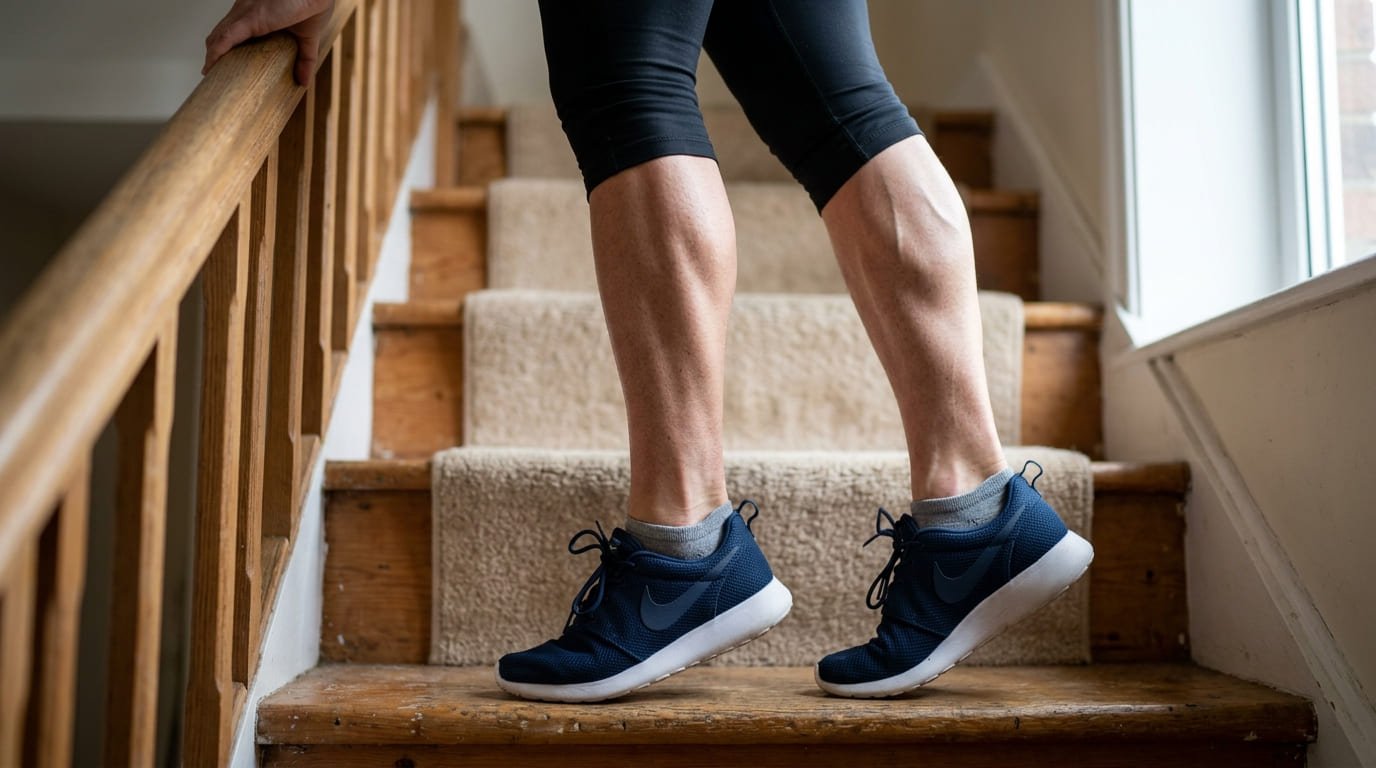
Stand with the balls of your feet on a step, a thick book or a doorway threshold, so your heels can drop below the level of your toes. This single change transforms the exercise.
2. Pause at the bottom, do not bounce
The Achilles tendon is highly elastic. Bouncing out of the bottom lets the tendon do the work and gives the muscle an easy ride. Pause for one to two seconds in the stretched position with the muscle under tension, then drive up.
3. Pause at the top too
Rise all the way up onto your toes and hold for a second at the top. Most people cut the top third off as well, meaning they train the middle of the range and nothing else.
Put together: heels drop below the step, two-second pause at the bottom, drive all the way up, one-second squeeze at the top. That is a proper rep, and you will need far fewer of them than you are used to.
12 calf exercises for home
Standing, for the gastrocnemius
1. Elevated standing calf raise
Balls of the feet on a step, heels hanging off. Drop the heels as far as comfortable, pause, then rise up as high as you can and squeeze.
- Sets and reps: 4 sets of 12 to 20
- Progression: hold a backpack full of books, or move to one leg
2. Single-leg elevated calf raise
The same movement on one leg. This is the most important progression available at home, because it roughly doubles the load without any equipment.
- Sets and reps: 3 sets of 8 to 15 each leg
- Tip: hold a wall lightly for balance so your calf sets the limit, not your balance
3. Weighted calf raise with a backpack
Load a backpack with books or water bottles and wear it while doing elevated raises. A well-packed bag easily reaches 15 to 20 kg, which is real loading.
- Sets and reps: 4 sets of 10 to 15
4. Donkey calf raise
Hinge forward at the hips with your hands on a chair or counter and your torso roughly horizontal, feet on a step. The hip position changes the stretch on the gastrocnemius and many people feel this version far more.
- Sets and reps: 3 sets of 12 to 20
5. Toes-in and toes-out raises
The same elevated raise with feet turned slightly inwards, then slightly outwards, which shifts emphasis between the outer and inner heads of the gastrocnemius.
- Sets and reps: 2 sets of 15 each position
- Note: the shift is modest, so treat this as variety rather than a primary exercise
Seated, for the soleus
6. Seated calf raise with weight on the knees
Sit with the balls of your feet on a book or step, knees bent at 90 degrees, and place something heavy across your thighs close to the knees: a loaded backpack, dumbbells, or a heavy box.
- Sets and reps: 4 sets of 15 to 25
- Why it matters: this is the exercise almost nobody does and the one most likely to be missing from your training
7. Single-leg seated calf raise
The same, one leg at a time, with the weight over the working knee.
- Sets and reps: 3 sets of 12 to 20 each leg
8. Wall sit heel raise
Hold a wall sit with your back against the wall and knees at 90 degrees, then raise and lower your heels. Your own body weight provides the load through the bent knee position.
- Sets and reps: 3 sets of 15 to 20
Explosive, endurance and the shins
9. Pogo hops
Small, fast, springy hops on the balls of your feet with the knees nearly straight, staying tall and bouncing quickly off the ground.
- Sets and reps: 3 sets of 20 to 30
- Purpose: trains the fast, elastic quality of the calf and Achilles that slow raises do not
10. Tiptoe walk
Walk on your toes with heels off the ground, ideally carrying something heavy in each hand.
- Distance: 3 walks of 30 to 45 seconds
11. Jump rope, or the same motion without a rope
Skipping is one of the best calf conditioning tools there is. If you have no rope or no ceiling height, do the same bouncing motion on the spot.
- Time: 3 rounds of 60 seconds
12. Tibialis raise
Stand with your back against a wall and your feet about 30 cm forward. Keeping your heels planted, lift your toes toward your shins as high as possible, then lower slowly.
- Sets and reps: 3 sets of 20 to 25
- Why include it: it balances the calf, improves ankle control and is one of the more useful exercises for preventing shin splints
Two calf routines
Routine A: the 10-minute add-on
Twice or three times a week, at the end of a leg session or on its own.
| Exercise | Sets | Reps | Rest |
|---|---|---|---|
| Elevated standing calf raise | 4 | 12 to 20 | 45 sec |
| Seated calf raise, weighted | 3 | 15 to 25 | 45 sec |
| Pogo hops | 2 | 25 | 30 sec |
Routine B: the full calf session
Once a week, alongside Routine A on other days, roughly 20 minutes.
| Exercise | Sets | Reps | Rest |
|---|---|---|---|
| Single-leg elevated calf raise | 4 | 8 to 15 each | 60 sec |
| Seated calf raise, heavy | 4 | 15 to 20 | 60 sec |
| Donkey calf raise | 3 | 15 to 20 | 45 sec |
| Tiptoe walk with weight | 3 | 40 sec | 45 sec |
| Pogo hops | 3 | 25 | 30 sec |
| Tibialis raise | 3 | 20 to 25 | 30 sec |
An 8-week progression plan
Calves need progressive overload just like every other muscle, and this is the piece missing from almost every home calf article.
| Weeks | Standing work | Seated work | Added |
|---|---|---|---|
| Weeks 1 to 2 | 3 sets of 15, both feet, 1-sec pauses | 3 sets of 20, light weight | Pogo hops, 2 sets of 20 |
| Weeks 3 to 4 | 3 sets of 20, 2-sec bottom pause | 3 sets of 25 | Pogo hops, 3 sets of 25 |
| Weeks 5 to 6 | Single leg, 3 sets of 8 to 12 | Add weight, 3 sets of 15 to 20 | Tiptoe walks, 3 rounds |
| Weeks 7 to 8 | Single leg with a backpack, 4 sets of 10 | 4 sets of 15 to 20, heavier | Tibialis raises added throughout |
The lever to use first is always range and pause quality, then single-leg work, then added weight. Moving to a loaded backpack before you can do a proper single-leg raise with a full pause skips the most valuable step.
Track one number: how many strict single-leg raises you can do with a full pause at the bottom. Most beginners start around 8 and reach 20 within a couple of months.
How often should you train calves?
Calves tolerate more frequency than almost any other muscle group, because they are built for repeated daily use and recover quickly.
| Your goal | Sessions per week | Structure |
|---|---|---|
| General strength | 2 | Routine A, twice |
| Building size | 3 to 4 | Routine A twice plus Routine B once or twice |
| Running or sport performance | 3 | Routine A plus pogo hops and skipping |
| Injury prevention or shin splints | 3 | Routine A plus tibialis raises daily |
Twenty four to forty eight hours between sessions is enough. If your calves are still genuinely sore, reduce the volume rather than skipping entirely, since light work often helps them feel better.
Calf soreness after the first few sessions of proper range-of-motion work can be surprisingly intense, particularly from the stretched bottom position. Start with fewer sets than you think you need in week one.
The honest bit about genetics
Calf size is more strongly influenced by genetics than most muscle groups, and the reason is structural.
The gastrocnemius attaches to the Achilles tendon, and where that transition happens varies considerably between people. Someone with a long muscle belly and a short tendon has more muscle to develop and calves that look full down toward the ankle. Someone with a short muscle belly and a long tendon has a higher, smaller-looking calf, and no amount of training changes where the tendon starts.
What this means practically:
- Your calf shape is largely fixed. Where the muscle sits on your lower leg is not trainable
- Your calf size is trainable, just with a different ceiling depending on your structure
- Strength and endurance improve for everyone, regardless of shape
- Comparisons are unhelpful. Someone with naturally large calves is not necessarily training better than you
This is not a reason to skip calf training. It is a reason to judge progress by your own numbers, particularly single-leg raise reps and added weight, rather than by how your calves compare to someone else’s.
Why calf training is worth the effort
Appearance is the usual motivation, but it is the least interesting reason to train calves.
- Every step you take is a calf contraction. The calf and Achilles store and return elastic energy with each stride, which is a large part of what makes walking and running efficient
- Ankle stability starts here. Strong calves and a strong tibialis anterior improve balance and reduce the likelihood of rolling an ankle
- They protect the Achilles. A stronger calf muscle means less strain passed to the tendon during running, jumping and quick changes of direction
- Balance matters more with age. Single-leg calf strength is closely tied to the ability to catch yourself when you stumble
- They support the knee and hip. The calf helps control how the lower leg moves over the foot, which influences everything above it
- They are heavily involved in sprinting and jumping, so sport performance improves alongside strength
The single-leg calf raise is also a useful self-test. Being unable to perform 20 strict single-leg raises is a common finding in people dealing with Achilles or lower leg complaints.
Eight common mistakes
- Training flat on the floor, which removes the most productive third of the range
- Bouncing out of the bottom, letting the Achilles tendon do the work instead of the muscle
- Only doing standing raises, which leaves the soleus, the larger muscle, largely untrained
- Never adding load. Bodyweight raises stop being a stimulus once you can do 30
- Only doing high reps. The gastrocnemius responds well to heavier sets of 10 to 15 too
- Rushing the reps. Twelve slow, paused reps beat thirty fast ones comfortably
- Training calves twice a month and expecting change from a muscle that walks 8,000 steps a day
- Ignoring the tibialis anterior, which is where a lot of ankle and shin problems begin
Achilles and shin pain
Calf training is where two common complaints appear.
Achilles discomfort usually follows a jump in volume or an abrupt move into deep-stretch work. Reduce the range slightly, slow the lowering phase to three or four seconds, cut the jumping and skipping temporarily, and rebuild over several weeks. Tendons adapt more slowly than muscle, often taking 8 to 12 weeks.
Shin pain, particularly along the front or inner edge of the shin, is often associated with a sudden increase in running or jumping. Tibialis raises, better footwear and a slower build-up in impact volume are the usual first steps.
Sharp pain, a sudden painful snap in the calf or Achilles, swelling, or an inability to push off the foot needs proper medical assessment rather than self-management.
Fitting calves into your week
Calf work sits easily at the end of a leg day, or on its own on days you are not training legs.
| Day | Main session | Calf work |
|---|---|---|
| Monday | Upper body | Routine A |
| Tuesday | Dumbbell leg workout | Routine B at the end |
| Wednesday | Rest or walking | Tibialis raises only |
| Thursday | Upper body | Routine A |
| Friday | Full body | None |
| Saturday | Optional cardio or a walk | Skipping, 3 rounds |
| Sunday | Rest | None |
If you train legs with bodyweight, our beginner leg workout at home pairs well with Routine A at the end.
The bottom line
Calves are not actually stubborn. They are usually just trained badly: flat ground, half the range, bouncing reps, two sets at the end of a session, no added weight, and only ever standing.
Fix those. Get your heels below your toes on a step. Pause for two seconds at the bottom and one at the top. Do seated raises as well as standing ones, because the soleus is the bigger muscle and almost nobody trains it. Train them three times a week rather than occasionally. Then add single-leg work, and after that a loaded backpack.
Accept that shape is genetic while size and strength are not, and judge your progress on your own single-leg rep count rather than anyone else’s calves.
Frequently asked questions
Can you build calves at home without equipment?
Yes. Single-leg elevated calf raises provide substantial load with no equipment at all, and a backpack full of books adds 15 to 20 kg when you need more. The key changes are elevating your toes on a step so the heels drop below the level of the toes, and pausing at the bottom rather than bouncing.
How often should I train calves?
Three to four times a week for size, or twice a week for general strength. Calves recover quickly because they are built for repeated daily use, so they tolerate higher frequency than most muscle groups. Leave 24 to 48 hours between sessions.
Why are my calves not growing?
Usually one of four reasons: training flat on the floor instead of elevated, bouncing out of the bottom so the Achilles tendon does the work, doing only standing raises and never seated ones, or never adding load. Calf size also has a stronger genetic component than most muscle groups, particularly muscle belly length.
What is the difference between seated and standing calf raises?
Standing raises train the gastrocnemius, the visible muscle that crosses the knee. Seated raises, with the knee bent at 90 degrees, slacken the gastrocnemius and shift the work onto the soleus underneath. The soleus is the larger of the two by volume, which is why doing only standing raises leaves most of the calf untrained.
How many reps should I do for calves?
Twelve to twenty for standing work and fifteen to twenty five for seated work, with full range and a pause at the bottom. The soleus is predominantly slow-twitch and responds well to higher reps, while the gastrocnemius also benefits from heavier sets of 10 to 15 when you can add weight.
Do calf raises make your calves bigger or smaller?
Bigger, if performed with enough load and progressive overload. Calf raises are a resistance exercise and build muscle like any other. Calves can appear smaller after significant fat loss, but that is fat reduction rather than any effect of the exercise itself.
How long does it take to see results from calf training?
Strength and endurance improve within three to six weeks, measured by how many strict single-leg raises you can perform. Visible size changes typically take three to six months of consistent, progressive training, and the extent varies considerably between individuals because of muscle belly length.
Are calf raises bad for your Achilles?
No, properly performed calf raises strengthen the Achilles tendon. Problems arise from jumping into deep-stretch work too quickly or increasing volume abruptly. If the Achilles becomes sore, reduce the range, slow the lowering phase to three or four seconds and rebuild gradually, since tendons adapt more slowly than muscle.


