
Indoor Workouts for Rainy Days (No Equipment Needed)
The best indoor exercises for a rainy day are simple bodyweight moves that need no equipment and very little space: squats, wall push-ups, glute bridges, dead bugs and marching on the spot. Twenty minutes of those covers strength, core and cardio, and you can do the whole thing between the sofa and the coffee table.
At a glance: 12 indoor exercises, no equipment, one square metre of floor. There is a full 20-minute rainy-day routine further down, 5-minute and 10-minute versions for busy days, plus a quieter apartment-friendly version if you have neighbours below you.
Rainy day exercise ideas: pick by the time you have
Not every wet day is the same. Some mornings you have half an hour. Some evenings you have five minutes and no enthusiasm. Start from the row that matches today.
| You have | Do this | Where to find it |
|---|---|---|
| 5 minutes | The mini workout: march, squats, wall push-ups, plank | Quick workouts section below |
| 10 minutes | Warm-up plus rounds 1 and 2 of the routine | Quick workouts section below |
| 20 minutes | The full rainy-day routine | The 20-minute routine |
| 30 minutes | The routine plus ten minutes of stairs, dancing or yoga | More ideas section |
| Low energy | Stretching or gentle yoga only | More ideas section |
| Children at home | Indoor games that count as exercise | Kids section |
Why a rainy day doesn’t have to cost you a workout
Most people who search for indoor exercises on a wet day are not looking for a new hobby. They had a plan, usually a walk or a run, and the weather took it away. The risk is not the missed session. It is that one missed session turns into three, and by the following week the habit has quietly gone.
I say that as someone who lost a walking habit exactly that way, twice, before working out that the fix was boringly simple: have a default indoor session you already know, so the decision on a rainy morning is which workout rather than whether to bother.
There is also good news in the physiology. Health bodies including the World Health Organization and the NHS recommend roughly 150 minutes of moderate activity a week plus two muscle-strengthening sessions. None of that specifies outdoors. A brisk indoor circuit counts. Marching on the spot in your living room counts. The guidelines care about the effort, not the postcode.
What you need (spoiler: almost nothing)
This is the part that stops people, and it shouldn’t. An indoor workout at home needs less than most beginners assume.
| What | Do you need it? | If you don’t have it |
|---|---|---|
| Floor space | Yes, about the size of a bath towel | Push the coffee table back a metre |
| A mat | Helpful, not required | A folded towel or a rug works |
| A sturdy chair | Useful for balance and incline push-ups | A worktop, windowsill or the arm of a sofa |
| A wall | Yes, for wall sits and wall push-ups | A door frame will do at a push |
| Shoes | Optional | Bare feet or grippy socks are fine on carpet |
| Dumbbells | No | Everything below is bodyweight only |
If you want a broader answer on kit, we cover it honestly in Do You Need Equipment to Work Out at Home?. The short version: not for this.
The 12 best indoor exercises for a rainy day
These twelve cover everything a beginner indoor workout needs: a warm-up, lower body, upper body, core and a way to raise your heart rate without jumping. Each one has a plain description, a form cue that actually matters, and an easier and harder version so the same list works whether it is week one or week ten.
Warm-up moves (1 to 3)
Do these for two to three minutes total. They are not optional filler. Cold muscles and a cold living room are a poor combination, and warming up is the cheapest injury insurance there is. There is more detail in our warm-up routine guide.
1. Marching on the spot. Stand tall and lift one knee to hip height, then the other, swinging your arms naturally. Sixty seconds. Cue: stay quiet, land through the whole foot rather than stamping. Easier: lower knees. Harder: pick up the pace until you feel slightly warm.
2. Arm circles. Arms out to the sides, small circles forward for 20 seconds, then backward for 20. Cue: keep your shoulders down away from your ears. Easier: smaller circles. Harder: widen the circle gradually.
3. Cat-cow. On all fours, round your back up as you breathe out, then let it gently arch as you breathe in. Eight slow repetitions. Cue: move with your breath, not faster than it. Easier: do it seated in a chair. Harder: hold each end position for two seconds.
Lower body (4 to 7)
4. Bodyweight squat. Feet about shoulder-width, toes turned slightly out. Push your hips back as if sitting into a chair behind you, then stand back up through your heels. Cue: chest stays up and knees track over your toes rather than caving in. Easier: squat down to touch a chair, then stand. Harder: pause two seconds at the bottom.
5. Reverse lunge. Step one foot backward and lower your back knee toward the floor, then push through the front foot to stand. Alternate sides. Cue: step back, not down; the front knee stays stacked over the ankle. Easier: hold a wall or chair for balance. Harder: lower more slowly, taking three seconds down.
6. Glute bridge. Lie on your back, knees bent, feet flat and hip-width apart. Press through your heels and lift your hips until your body forms a straight line from knees to shoulders. Cue: squeeze your glutes at the top rather than arching your lower back. Easier: lift only halfway. Harder: hold the top for three seconds each repetition.
7. Wall sit. Back flat against a wall, slide down until your knees are comfortably bent, and hold. Cue: keep your whole back in contact with the wall and breathe normally rather than holding your breath. Easier: a shallower bend. Harder: hold longer, or lift one heel at a time.
Upper body (8 to 10)
8. Wall push-up. Stand an arm’s length from a wall, hands at chest height slightly wider than your shoulders. Bend your elbows to bring your chest toward the wall, then press away. Cue: body stays in one straight line from head to heels; do not let your hips sag or lead with your chin. Easier: stand closer to the wall. Harder: step your feet further back.
9. Incline push-up. The same movement with your hands on a sturdy chair seat, a worktop or the bottom of the stairs. Lower the surface over time and you are gradually building toward a floor push-up. Cue: elbows travel back at roughly 45 degrees, not flared straight out. Easier: use a higher surface. Harder: use a lower one, or add a pause at the bottom.
10. Superman. Lie face down, arms extended in front of you. Lift your chest, arms and legs a few centimetres off the floor, hold briefly and lower. Cue: think long rather than high; a small lift done well beats a big one that pinches your lower back. Easier: lift only the arms, or only the legs. Harder: hold for three seconds at the top.
This one earns its place on a rainy indoor day for an unglamorous reason: if the weather keeps you in, you are probably sitting more than usual, and your upper back will thank you.
Core (11 to 12)
11. Dead bug. Lie on your back with arms pointing at the ceiling and knees bent over your hips. Slowly lower one arm behind your head and the opposite leg toward the floor, then return. Alternate. Cue: press your lower back gently into the floor throughout; the moment it lifts, you have gone too far. Easier: move only the legs. Harder: extend the leg fully and move more slowly.
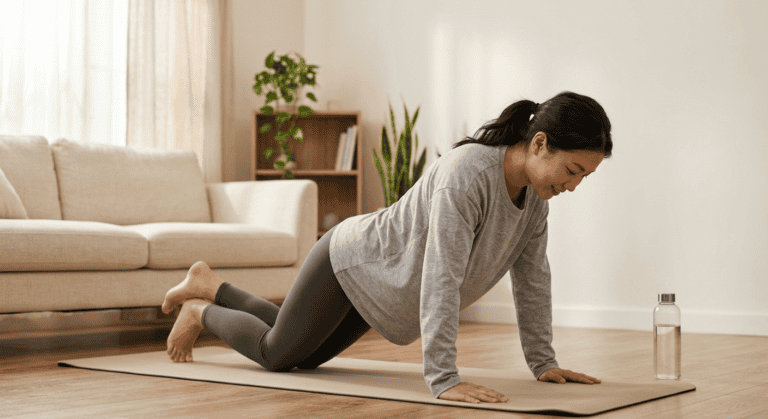
12. Forearm plank. Elbows under shoulders, body in a straight line, hold. Cue: squeeze your glutes; it instantly stops the hips sagging. Easier: plank from your knees, or with forearms on a chair seat. Harder: hold longer, in ten-second increments rather than doubling.
| # | Exercise | Main target | Beginner start | Noise |
|---|---|---|---|---|
| 1 | Marching on the spot | Warm-up, heart rate | 60 seconds | Low |
| 2 | Arm circles | Shoulders | 20 sec each way | Silent |
| 3 | Cat-cow | Spine mobility | 8 slow reps | Silent |
| 4 | Bodyweight squat | Quads, glutes | 10 reps | Silent |
| 5 | Reverse lunge | Legs, balance | 8 each side | Low |
| 6 | Glute bridge | Glutes, hamstrings | 12 reps | Silent |
| 7 | Wall sit | Quad endurance | 20 sec hold | Silent |
| 8 | Wall push-up | Chest, arms | 10 reps | Silent |
| 9 | Incline push-up | Chest, triceps | 8 reps | Silent |
| 10 | Superman | Upper back, posture | 8 reps | Silent |
| 11 | Dead bug | Deep core | 8 each side | Silent |
| 12 | Forearm plank | Whole core | 20 sec hold | Silent |
Every one of these has a full walkthrough with form cues and common mistakes in our Beginner Exercise Library if you want to look one up mid-session.
Cardio without jumping
This is the piece most indoor workout lists get wrong. They reach straight for jumping jacks and burpees, which are loud, hard on the knees and genuinely unpleasant if you are new. You can raise your heart rate indoors perfectly well without either.
| Option | How | Why it works |
|---|---|---|
| Fast marching | Knees higher, arms driving, 60 seconds | Closest thing to the walk you missed |
| Step touches | Step side to side, reaching arms overhead | Adds sideways movement most routines skip |
| Stair step-ups | Up and down the bottom stair, alternating lead foot | Hardest option here, and you already own a staircase |
| Shadow boxing | Light punches with a small bounce in the knees | Almost silent, and unexpectedly good for mood |
Slot 45 to 60 seconds of any of these between strength moves and the session becomes a circuit. More options in Cardio Exercises for Beginners and Low-Impact Workout for Beginners.
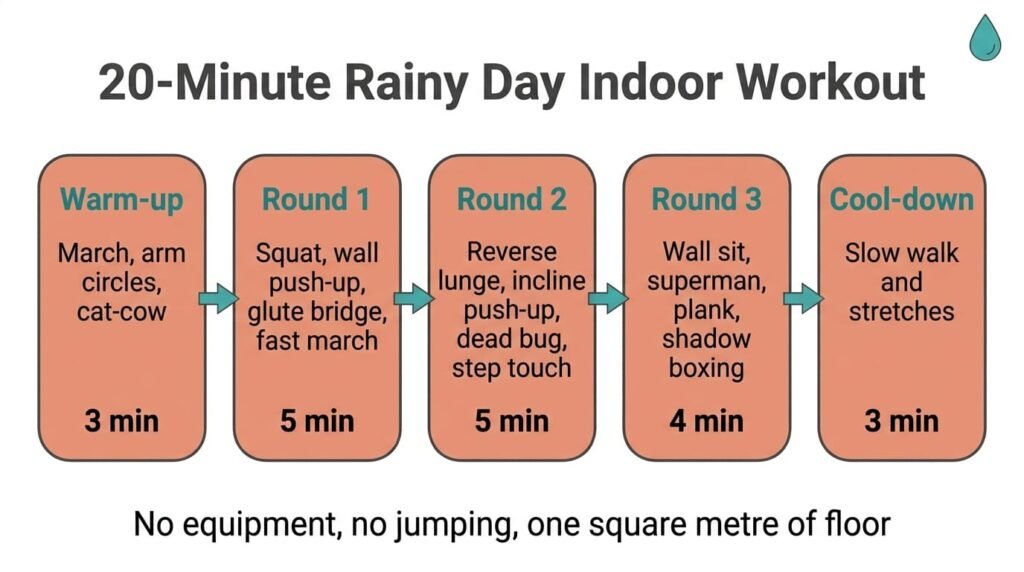
A 20-minute rainy-day routine you can follow right now
Here is the whole thing in order. Set a timer, put something on in the background, and work through it. If you only ever use one indoor workout, make it this one.
| Block | What to do | Time |
|---|---|---|
| Warm-up | Marching 60 sec, arm circles 40 sec, cat-cow 8 reps | 3 min |
| Round 1 | Squat ×10 · wall push-up ×10 · glute bridge ×12 · fast marching 45 sec | 5 min |
| Round 2 | Reverse lunge ×8 each · incline push-up ×8 · dead bug ×8 each · step touches 45 sec | 5 min |
| Round 3 | Wall sit 20 sec · superman ×8 · forearm plank 20 sec · shadow boxing 45 sec | 4 min |
| Cool-down | Slow walking on the spot, then gentle hamstring, chest and calf stretches | 3 min |
Rest whenever you need to. The times are a guide, not a test. If a round takes six minutes because you paused twice, the workout still happened, and that is the entire point.
Listen to your body. This is general information, not medical advice. Stop if anything sharp or unfamiliar shows up, and speak to your doctor first if you are pregnant, recovering from injury, managing a heart condition or high blood pressure, or have been inactive for a long time. See our medical disclaimer.
Quick workouts: the 5-minute and 10-minute versions
On the days when twenty minutes will not happen, a mini workout keeps the habit alive. These are the two I fall back on.
| Version | What to do | Time |
|---|---|---|
| 5-minute mini workout | Marching 60 sec · squat ×10 · wall push-up ×10 · glute bridge ×10 · forearm plank 20 sec · marching 60 sec | 5 min |
| 10-minute workout | Warm-up block, then round 1 and round 2 of the routine above, with a short stretch to finish | 10 min |
Three five-minute blocks spread through a wet day, one before breakfast, one at lunch and one while dinner cooks, add up to the same fifteen minutes as one session. For a beginner, that still counts.
Short on space? Apartment-friendly indoor workouts
Almost every indoor workout article ignores the two things that actually stop flat-dwellers exercising: the neighbour downstairs, and a living room the size of a rug. Both are solvable.
Keeping it quiet
- Cut anything with both feet leaving the floor. Jumping jacks, jump squats, burpees, high knees at speed. Everything in the twelve above is already low-impact.
- Swap fast marching for step touches. Sideways movement is quieter than vertical movement.
- Land softly and stay off your heels. Most workout noise is the impact of a heel on a hard floor, not the exercise itself.
- Use a rug or mat. It absorbs more sound than you would expect, and stops the mat sliding on laminate.
- Train earlier rather than late. The same session at 8pm feels louder to a neighbour than at 8am.
Working in a very small space
If you can lie down with your arms overhead, you have enough room. The moves that need the most floor are the reverse lunge and the plank, and both have compact substitutes.
| If you can’t fit | Do this instead |
|---|---|
| Reverse lunge | Split squat on the spot, or step-ups on the bottom stair |
| Forearm plank | Plank with forearms on a chair or the sofa arm |
| Dead bug | Seated knee lifts in a chair, holding the sides |
| Step touches | Marching on the spot with a heel tap forward |
| Superman | Standing wall angels, back flat against a wall |
More rainy day indoor exercises, if you want variety
The twelve moves are the dependable core. If the rain lasts all week, the same circuit every day gets dull. These are the other indoor options worth knowing, with an honest note on each.
Yoga and stretching
The best choice for a low-energy day, and almost silent. Ten to twenty minutes of slow yoga or a stretching routine loosens the hips and back that tighten when you sit indoors all day. It will not raise your heart rate much, so treat it as recovery, not as your only session of the week. Our stretching routine for beginners and guide on how to improve flexibility give you a sequence to follow.
Dancing
Put on three songs and move for the length of them. That is about ten minutes of real cardio, it needs no skill, and nobody is watching. Keep your feet low if you have neighbours downstairs. Of everything on this list, dancing is the one people are most likely to do again the next day.
Stairs
If you have a staircase, you own a cardio machine. Walk up and down at a steady pace for one minute, rest for one minute, and repeat five to eight times. Hold the rail, wear shoes with grip, and walk down slowly. Climbing stairs is noticeably harder than it sounds, so start with fewer rounds than you think you need.
Low-impact intervals
Interval training does not have to mean jumping. Pick one move, such as fast marching, step touches or shadow boxing. Work hard for 30 seconds, go easy for 30 seconds, and repeat eight times. That is eight minutes. Our HIIT workout for beginners at home explains how to build up safely.
Household items as weights
Two full water bottles are light hand weights. A backpack with a few books in it makes squats and glute bridges harder. A tin in each hand turns arm circles into shoulder work. Check that lids are tight, and keep the loads modest.
If you already own equipment
- Resistance bands. The most useful small item for indoor training, because they add pulling exercises that bodyweight work lacks. See resistance bands for beginners.
- A treadmill or exercise bike. The closest replacement for the walk, run or ride you missed. Our treadmill interval workout and exercise bike guide have beginner sessions.
- A pack of cards. Not gym equipment, but the deck of cards workout turns the twelve exercises above into a game.
| Idea | Best for | Noise | Effort |
|---|---|---|---|
| Yoga and stretching | Low-energy days, stiff backs | Silent | Light |
| Dancing | Mood, and people who dislike workouts | Low to medium | Moderate |
| Stairs | Replacing a run or brisk walk | Medium | Moderate to hard |
| Low-impact intervals | Short on time | Low | Hard in bursts |
| Household weights | Making the circuit harder | Silent | Moderate |
Rainy day with children at home
If the rain has kept the whole family in, a quiet solo circuit is not realistic. Fold the children into it instead. These active indoor games count as exercise for them and, honestly, for you.
- Cushion obstacle course. Crawl under a table, step over cushions, balance along a line of tape, finish with five star jumps. Time each lap.
- Animal walks. Bear crawls down the hallway, frog jumps back, crab walks across the living room.
- Freeze dance. Music on, everybody dances. Music stops, everybody holds a squat until it starts again.
- Balloon keep-up. One balloon, one rule: it must not touch the floor. Ten minutes disappears quickly.
- Follow the leader. Each person picks one exercise and everyone copies it ten times.
Clear the floor first, keep it away from hard furniture corners, and stop while it is still fun. For a proper family session, our guide to the best group exercises at home has a 30-minute plan with three levels for every exercise.
Best indoor exercises to lose weight
A fair number of people looking for rainy day exercises also want to know which indoor exercises are best for weight loss. The honest answer has two parts.
First, the exercises that use the most energy are the ones that move the big muscles of your legs continuously: stair climbing, fast marching, dancing and circuits with short rests. The table gives rough figures for a person of about 70 kg doing 20 minutes. They are estimates based on standard activity values, and your own numbers will differ with your weight and effort.
| Indoor activity | Effort level | Rough calories in 20 minutes |
|---|---|---|
| Gentle yoga or stretching | Light | About 60 |
| Bodyweight circuit, steady pace | Moderate | About 90 |
| Stair climbing, slow pace | Moderate | About 95 |
| Low-impact dance or aerobics | Moderate | About 115 |
| Circuit with short rests, hard effort | Vigorous | About 185 |
Source for the activity values: Ainsworth and colleagues, 2011 Compendium of Physical Activities, Medicine and Science in Sports and Exercise.
Second, no single exercise causes weight loss by itself. One 20-minute session uses roughly the energy in a slice of toast with butter. What changes body weight is doing it regularly, for months, alongside sensible eating. So the best indoor exercise for weight loss is the one you will actually repeat on the next wet day, and the one after that. Our home workout for weight loss guide covers the full picture, and the Calories Burned Calculator gives a figure for your own weight.
Swapping your outdoor plan for an indoor one
If the weather cancelled something specific, match the swap to what you were going to do. It keeps the week balanced instead of turning every wet day into the same generic session.
| You had planned | Indoor swap | Roughly how long |
|---|---|---|
| A 30-minute walk | Fast marching and step touches in 5-minute blocks, in front of the TV | 25 to 30 min |
| A short run | Stair step-ups alternated with the 20-minute routine above | 20 to 25 min |
| A gym strength session | Rounds 1 to 3 above, slower, with an extra round | 25 min |
| A gentle recovery walk | Warm-up block plus stretching only | 10 to 15 min |
If walking is normally your main activity, our walking guide explains how the weekly total is what matters, which is exactly why a substituted indoor session is worth doing rather than skipping.
How to stay consistent when the weather keeps you in
A single rainy day is not the problem. A rainy fortnight in November is. Four things make the difference, and none of them require motivation.
- Decide the indoor session in advance. Not “I’ll do something inside,” but “if it rains, I do the 20-minute routine.” Pre-deciding removes the argument with yourself.
- Keep the space ready. A mat leaning against the wall you can drop in ten seconds beats a mat in a cupboard behind the hoover.
- Lower the bar on bad days. The warm-up block alone, three minutes, still counts as showing up. Streaks survive on small days, not big ones.
- Track the week, not the day. Missing Tuesday matters far less if you know Thursday and Saturday are already planned.
Our Workout Schedule Planner will lay out a realistic week for you in about thirty seconds, and How to Stay Consistent With Working Out goes deeper on the habit side. If you want to know what an indoor session is actually burning, the Calories Burned Calculator gives a sensible estimate.
Common mistakes with indoor workouts
- Treating it as second best. An indoor bodyweight circuit is not a consolation prize. For a beginner it is often better than the walk it replaced, because it includes strength work the walk did not.
- Going too hard because it is “only bodyweight.” Thirty squats and forty lunges on day one produces two days of soreness and a quiet decision never to do it again.
- Skipping the warm-up because you are already indoors and warm. Room temperature is not the same as warm muscles.
- Copying a high-impact routine in a flat. If you spend the session worrying about noise you will cut it short. Use the quiet swaps above from the start.
- Rushing the reps to finish faster. Slow and controlled is harder and safer, which is a rare combination worth taking.
- Doing it once and waiting for the next storm. Repeat it on purpose and it stops being an emergency workout and starts being your routine.
We cover the wider set in 8 Common Beginner Workout Mistakes.
How to progress over the next four weeks
If wet weather is going to be a fixture for a while, give the routine somewhere to go. Change one thing a week and it stays challenging without ever becoming daunting.
| Week | Change | Why |
|---|---|---|
| 1 | Do the routine as written, twice | Learn the moves while fresh |
| 2 | Add two reps to each strength move | Volume is the gentlest way to progress |
| 3 | Slow the lowering phase to three seconds | Harder without adding weight or noise |
| 4 | Lower the incline push-up surface, add a fourth round | Real progression toward a floor push-up |
Once four weeks feels comfortable, the 4-Week Beginner Program gives you a structured version of the same idea with the thinking already done.
Stuck inside with the whole household? Try the best group exercises at home instead.
If you have a treadmill indoors, the 12-3-30 workout is worth knowing.
If the weather keeps you in often, a rebounder earns its corner. See mini trampoline exercises.
Want this routine on paper? The 5-minute and 20-minute versions are on our printable workouts page, one page each.
Frequently asked questions
What can I do instead of my walk or run when it rains?
Fast marching on the spot, step touches and stair step-ups are the closest indoor equivalents, because they keep the same steady, repetitive rhythm. Do them in five-minute blocks to roughly match the length of the walk you missed, or use the 20-minute routine above if you want strength work in there too.
Are indoor workouts as good as exercising outside?
For fitness, yes. Your body responds to effort, not to fresh air, and activity guidelines do not distinguish between indoors and outdoors. Outdoor exercise does have genuine extra benefits for mood and daylight exposure, so it is worth getting outside when you can, but a rainy day indoors is not a lesser workout.
How do I exercise indoors without disturbing my neighbours?
Remove every move where both feet leave the floor, land through the whole foot rather than the heel, use a rug or mat to absorb impact, and choose step touches over fast marching. All twelve exercises in this guide are already low-impact, and most are completely silent.
How long should an indoor workout be for a beginner?
Twenty minutes is a good target and enough to count. On a difficult day, three minutes of the warm-up block is still worth doing. Consistency across the week matters far more than the length of any single session.
Do I need any equipment for an indoor workout?
No. Every exercise here uses your bodyweight, a wall and a chair. A mat makes floor work more comfortable but a folded towel does the same job.
What indoor exercises work in a really small space?
If you can lie down with your arms above your head, you have enough room. Squats, wall push-ups, glute bridges, wall sits, dead bugs and marching all fit in about one square metre. Swap reverse lunges for split squats on the spot and planks for chair-supported planks.
Can I do this every day while the weather is bad?
You can move every day, but not at this intensity. Three sessions a week with easier days in between, gentle stretching or marching, works better for a beginner. We go into it properly in Is It Bad to Work Out Every Day?
What are the best indoor exercises to lose weight?
Exercises that keep the large leg muscles working continuously use the most energy indoors: stair climbing, fast marching, dancing and bodyweight circuits with short rests. No single exercise causes weight loss, though. Regular sessions over months, combined with sensible eating, are what make the difference.
What can I do for exercise on a rainy day with kids?
Turn it into a game. A cushion obstacle course, animal walks down the hallway, freeze dance with squat holds, and balloon keep-up all raise the heart rate for children and adults. Clear the floor first and keep sessions to about 15 to 20 minutes.
What is a good 5-minute indoor workout?
March on the spot for 60 seconds, then do 10 squats, 10 wall push-ups, 10 glute bridges and a 20-second plank, and finish with another 60 seconds of marching. It needs no equipment and about one square metre of floor.
Your rainy day, sorted
The weather is going to keep doing this. What changes the outcome is having one indoor workout you already know, that needs nothing, fits your space and does not annoy anyone downstairs. That is what the twelve exercises and the 20-minute routine above are for.
Pick a wet day this week and run the routine once. Not perfectly, not for long, just once. The version of this habit that survives winter is the one you have already practised before you needed it.
Want it on paper next to the mat?
Our free printable beginner home workout plan lays out a full week you can stick on the fridge, no sign-up needed. Or start from the beginning with the complete guide to home workouts for beginners.
Where to go next
- Home Workouts for Beginners: The Complete Guide, the pillar that ties it all together
- 15-Minute Full-Body Home Workout if twenty minutes is too long today
- Low-Impact Workout for Beginners for joint-friendly and quiet options
- The Warm-Up Routine to Do Before Every Workout
- How Many Days a Week Should You Work Out?
- What to Do on Rest Days, useful when the rain lasts all week
Explore more beginner guides in Home Workouts.
Sources and further reading: World Health Organization, Physical activity fact sheet · NHS, Physical activity guidelines for adults aged 19 to 64 · CDC, Adult Activity: An Overview.
What’s next?
Reading is the easy part. Pick one of these and do it today.