Long Head Bicep Exercises: 10 Best Moves for a Bigger Biceps Peak
When people flex their arm and look at the bump on top, they are mostly looking at the long head of the biceps. It is the outer of the two heads, and it is the one that gives the muscle its peak.
For a long time I did not know there were two heads at all. I did the same standing curl every week and wondered why my arms looked wide from the front but flat from the side. A small change, curling with my arms hanging behind my body on an incline bench, was the first time I felt the outer part of the muscle doing real work.
This guide explains what the long head is, how arm position and grip change which head works hardest, what you can and cannot change about the shape of your biceps, the ten best exercises, and three workouts.
At a glance
- The biceps has two heads. The long head is on the outside of the arm and forms most of the peak
- Both heads work in every curl. You can shift the emphasis but not isolate one
- The long head works hardest when your upper arm is behind your body, or when you use a narrower grip
- Incline curls, drag curls and curls with the cable behind you are the classic long head exercises
- The height of your biceps peak is largely genetic. Training makes the muscle bigger, which makes the peak you have more visible
- Add 4 to 8 sets a week of long head work to your normal training
- Lower every rep slowly and keep your elbows from drifting forward
The two heads of the biceps
The full name of the muscle is biceps brachii, meaning two-headed muscle of the arm. Both heads start at the shoulder blade, merge into one muscle belly, and attach to the forearm just below the elbow.
| Feature | Long head | Short head |
|---|---|---|
| Position on the arm | Outer side | Inner side |
| Where it starts | Above the shoulder socket, with its tendon running over the top of the upper arm bone | The coracoid process, a bony point at the front of the shoulder blade |
| Contribution to shape | The peak, seen from the side | Width and thickness, seen from the front |
| Role at the shoulder | Helps lift the arm forward and out to the side, and helps steady the shoulder joint | Helps lift the arm forward and bring it across the body |
| Works hardest when | The upper arm is behind the body, or the grip is narrow | The upper arm is in front of the body, or the grip is wide |
Both heads bend the elbow and turn the palm upward. Because both also cross the shoulder joint, the position of your upper arm changes how stretched each one is, and therefore how much it contributes.
Our guide to short head bicep exercises covers the other half, and brachialis exercises covers the muscle underneath.
How to shift the work to the long head
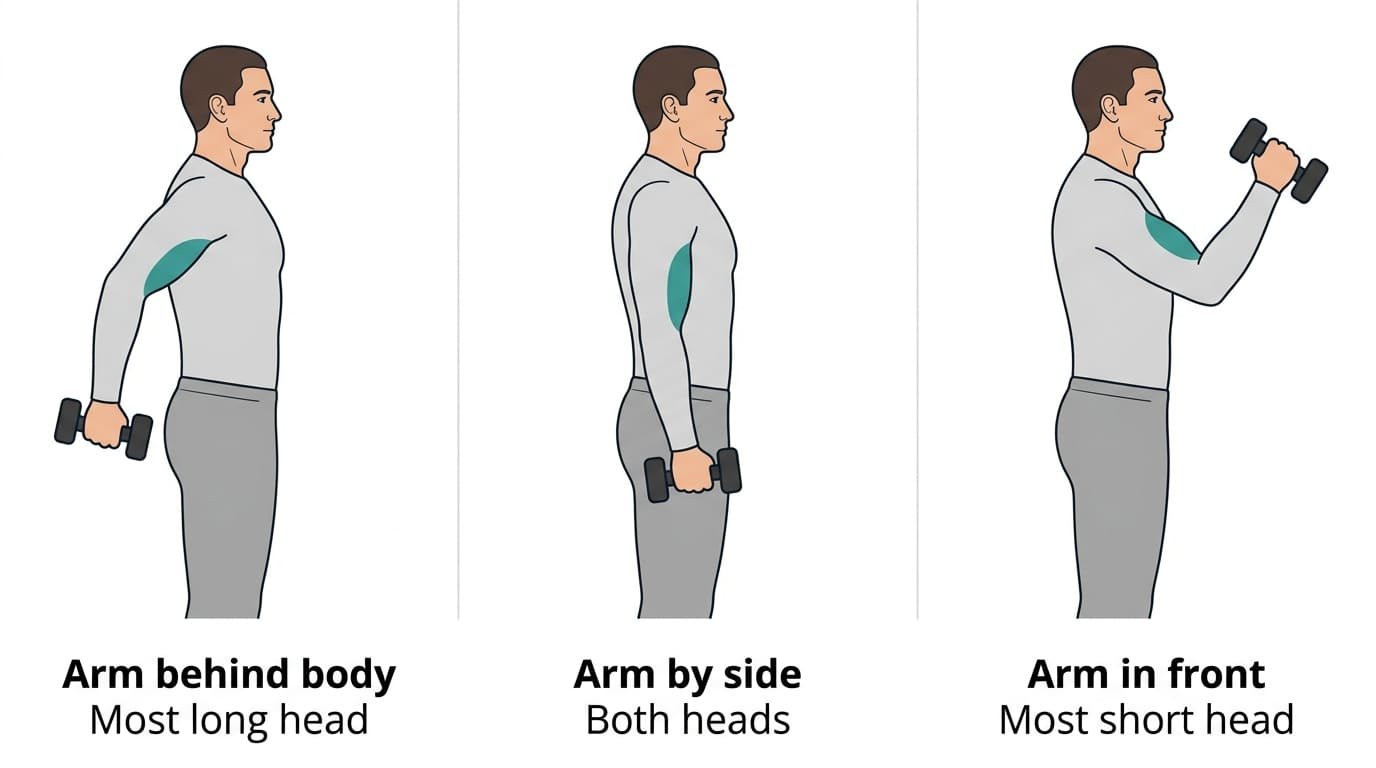
Three things move the emphasis. None of them switches the short head off.
| Variable | Favours the long head | Favours the short head |
|---|---|---|
| Upper arm position | Behind the body: incline curl, drag curl, cable curl facing away | In front of the body: preacher curl, spider curl |
| Grip width on a bar | Narrow, inside shoulder width | Wide, outside shoulder width |
| Forearm position | Neutral, thumbs up, as in a hammer curl | Fully palm-up |
| Shoulder rotation | Arm turned slightly inward | Arm turned outward |
Why arm position matters most
When your upper arm is behind your trunk, the long head is stretched across the front of the shoulder. A muscle that is trained while lengthened tends to work hard and, as a growing body of research suggests, to grow well.
A study that measured biceps activity in different dumbbell curls supports the practical point. In the incline curl and the standard standing curl, the biceps stayed highly active through the whole range of movement. In the preacher curl, with the arm in front of the body, high activity was limited to a short part of the range near the start.
A note on the evidence. Studies of this kind measure the biceps as a whole, and reliably separating the two heads is technically difficult. The advice on targeting the long head rests mainly on anatomy and on long-standing coaching practice, not on trials that compared head-specific growth. It is sensible guidance, held with appropriate modesty.
Can you build a bigger biceps peak?
Partly. It helps to separate two things.
- The shape of your biceps is inherited. Where the muscle belly ends and the tendon begins is set by your genetics. A short muscle belly with a long tendon gives a high, pointed peak with a gap near the elbow. A long muscle belly gives a fuller, flatter arm that fills the space to the elbow. Neither can be changed by training
- The size of your biceps is trainable. A bigger long head makes whatever peak you have taller and more visible
So training the long head will not turn a long, full biceps into a short, peaked one. It will make your arm bigger, and it will bring out the shape you already have.
| What you can change | What you cannot change |
|---|---|
| The size of both heads | Where the muscle attaches |
| The balance between the long and short head | The length of the muscle belly and tendon |
| Body fat, which affects how visible the shape is | The basic outline of your peak |
| The size of the brachialis underneath, which pushes the biceps up | How your arm compares with someone else’s |
The 10 best long head bicep exercises
For every exercise: keep your upper arms still, straighten your arms fully at the bottom, and take two to three seconds to lower the weight.
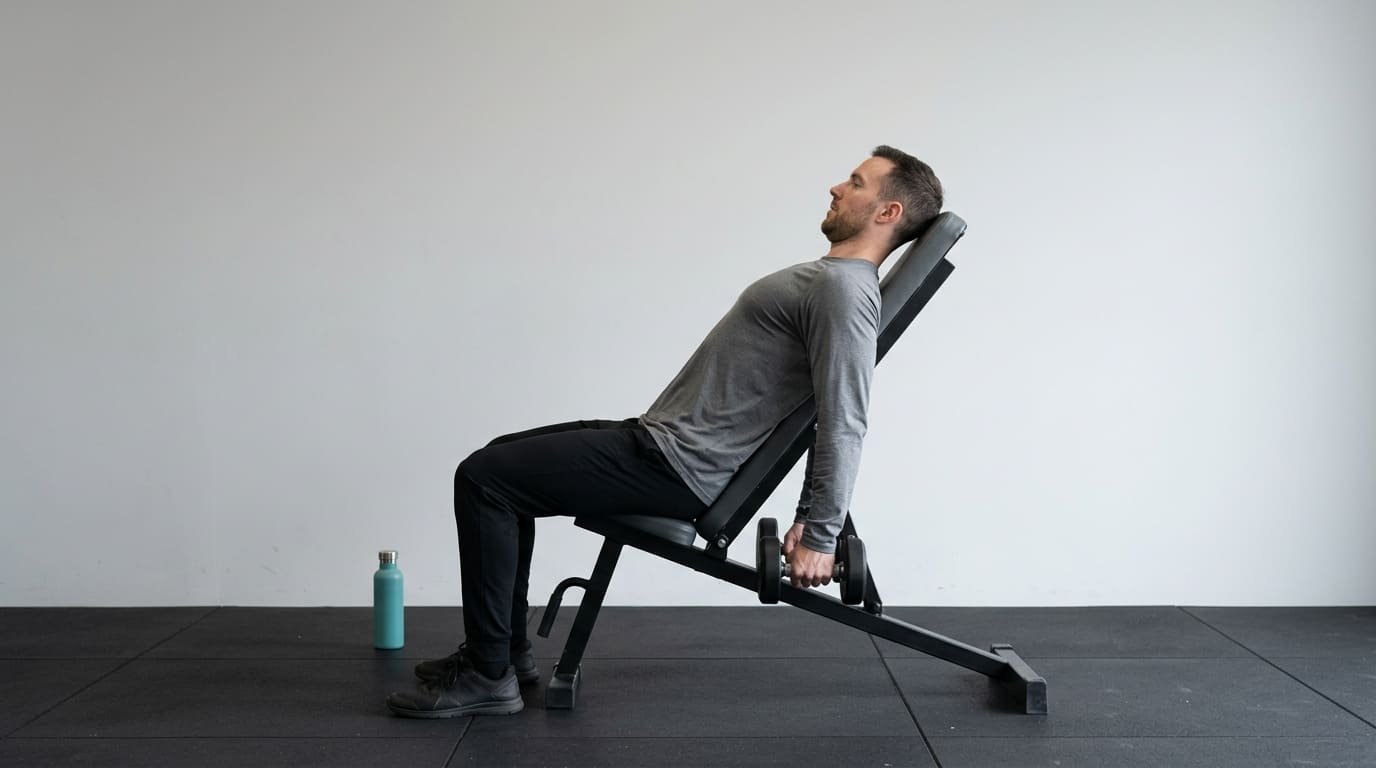
1. Incline dumbbell curl
The classic long head exercise. Your arms hang behind your body, which puts the long head on stretch.
- Set a bench to between 45 and 60 degrees and sit back with your head and shoulders against it
- Let your arms hang straight down, palms facing forward
- Keeping your upper arms vertical and still, curl both dumbbells toward your shoulders
- Squeeze briefly at the top
- Lower slowly to a full stretch
Sets and reps: 3 sets of 8 to 12.
Use lighter weights than for standing curls. If the stretch bothers the front of your shoulder, raise the bench a notch. At home: lean back against the arm of a sofa or prop yourself on cushions.
2. Drag curl
- Stand holding a barbell, an EZ-bar or two dumbbells against your thighs, palms forward
- Instead of curling the weight out in front of you, pull your elbows straight back behind you
- Drag the weight up the front of your body, keeping it in contact with your torso, to about the bottom of your chest
- Lower along the same path
Sets and reps: 3 sets of 8 to 12.
The elbows travelling behind the body is what makes this a long head exercise. It will feel shorter and stranger than a normal curl. That is correct.
3. Behind-the-body cable curl
Sometimes called the Bayesian curl. It is the cable version of the incline curl, with resistance through the whole range.
- Set a cable pulley at its lowest point and attach a single handle
- Face away from the machine and take the handle in one hand
- Step forward so your arm is drawn slightly behind your body, and stagger your feet for balance
- Keeping your upper arm still, curl the handle forward and up
- Lower slowly until your arm is straight and behind you
Sets and reps: 3 sets of 10 to 12 per arm.
With a band: anchor a resistance band low behind you, at the bottom of a closed door, and do the same movement.
4. Close-grip barbell curl
- Hold a barbell or EZ-bar with your hands inside shoulder width, about a hand’s width apart, palms up
- Stand tall with your elbows by your sides
- Curl the bar to your shoulders without letting your elbows drift forward
- Lower slowly
Sets and reps: 3 sets of 8 to 10.
The narrow grip turns the upper arms slightly inward, which is thought to favour the outer head. If your wrists complain, use an EZ-bar.
5. Hammer curl
- Stand with a dumbbell in each hand, palms facing each other
- Curl the weights up, keeping your thumbs on top
- Lower slowly
Sets and reps: 3 sets of 10 to 12.
The neutral grip shifts some work to the long head and a good deal to the brachialis and the top of the forearm. All three add to the appearance of the arm from the side.
6. Incline hammer curl
The incline curl with a neutral grip. It combines the stretched position with the hammer grip.
- Sit back on a bench set to about 60 degrees, arms hanging, palms facing in
- Curl both dumbbells with your thumbs on top
- Lower to a full stretch
Sets and reps: 2 to 3 sets of 10 to 12.
7. Supinating dumbbell curl
- Stand with dumbbells at your sides, palms facing your thighs
- As you curl, rotate your forearm so your palm faces up by the halfway point
- At the top, turn your little finger slightly higher than your thumb
- Reverse the rotation as you lower
Sets and reps: 3 sets of 8 to 12.
Turning the palm up is one of the main jobs of the biceps, so adding the rotation trains the muscle more completely than a fixed grip.
8. Close-grip chin-up
- Hang from a bar with your palms facing you and your hands a little inside shoulder width
- Pull up until your chin is over the bar, leading with your chest
- Lower slowly to a full hang
Sets and reps: 3 sets of 3 to 8.
Chin-ups load the biceps far more heavily than any curl. If you cannot do one yet, use slow lowering or a band. Our pull-up alternatives guide explains the progression.
9. Resistance band drag curl
- Stand on the middle of a long band with your feet hip-width apart, holding an end in each hand, palms forward
- Pull your elbows back and drag your hands up the front of your body
- Lower slowly, resisting the band
Sets and reps: 3 sets of 12 to 15.
10. Lying dumbbell curl
A way to get the behind-the-body position with no adjustable bench.
- Lie on your back along a flat bench or the edge of a bed, holding a light dumbbell in each hand
- Let your arms hang down toward the floor on either side, palms forward, so your upper arms are below the level of your body
- Keeping your upper arms still, curl the weights up
- Lower slowly to a full stretch
Sets and reps: 2 to 3 sets of 10 to 12.
Start very light. The stretch at the bottom is considerable.
Choosing by equipment
| Equipment | Best long head exercises |
|---|---|
| Dumbbells only | Supinating curl, hammer curl, dumbbell drag curl, lying curl |
| Dumbbells and an incline bench or sofa | Incline curl, incline hammer curl |
| Resistance bands | Band drag curl, behind-the-body band curl, band hammer curl |
| Pull-up bar | Close-grip chin-up, slow lowering |
| Gym | Behind-the-body cable curl, close-grip EZ-bar curl, barbell drag curl |
| Nothing | Towel curl with your elbow held behind your side, backpack drag curl |
Our bicep workout without weights has more no-equipment options.
Three long head bicep workouts
Add one of these to the end of a pull day or an upper-body day, or use it as part of an arm session. Rest 60 to 90 seconds between sets.
Workout 1: dumbbells at home
| Exercise | Sets | Reps |
|---|---|---|
| Incline dumbbell curl, against a sofa or bench | 3 | 8 to 12 |
| Dumbbell drag curl | 3 | 10 to 12 |
| Hammer curl | 2 | 10 to 12 |
Workout 2: bands and a bar
| Exercise | Sets | Reps |
|---|---|---|
| Close-grip chin-up, or slow lowering | 3 | 3 to 8 |
| Behind-the-body band curl | 3 | 10 to 12 per arm |
| Band drag curl | 2 | 12 to 15 |
Workout 3: gym
| Exercise | Sets | Reps |
|---|---|---|
| Incline dumbbell curl | 3 | 8 to 12 |
| Behind-the-body cable curl | 3 | 10 to 12 per arm |
| Close-grip EZ-bar curl | 2 | 8 to 10 |
| Hammer curl | 2 | 10 to 12 |
For a complete arm session, see our bicep and tricep workout.
Sets, reps and how often
| Question | Answer |
|---|---|
| How many direct biceps sets per week? | 6 to 12 in total, with 4 to 8 of them emphasising the long head |
| How many exercises per session? | 2 to 3 |
| How many reps? | 8 to 15 |
| How often? | Once or twice a week |
| Tempo | One second up, two to three seconds down |
| How hard? | End each set with one or two good reps left |
| Where in the session? | After your rows and pull-ups |
Remember that rows, pull-ups and chin-ups already train the biceps. Count that work before adding a long list of curls.
Balance the heads. A good biceps routine includes one exercise with the arms behind the body, one with the arms by the sides and, if you like, one with the arms in front. Training only the long head is no better than ignoring it.
| Your plan | Where to add long head work |
|---|---|
| Full body, three days | One long head exercise at the end of two sessions |
| Upper lower | An incline curl on one upper day and a drag curl on the other |
| Push pull legs | Two biceps exercises on each pull day, one for each arm position |
| Arm day | Start with the incline curl while you are fresh |
Our guides to the upper lower split and the pull day workout show where these fit.
How to progress
- Add a rep to one or more sets each session
- When every set reaches the top of the range, move up by the smallest weight available
- If the next dumbbell is too heavy, slow the lowering to four seconds or add a one-second pause in the stretched position
- Keep the same exercises for at least eight weeks
| Week | Incline dumbbell curl, target 3 sets of 8 to 12 | Action |
|---|---|---|
| 1 | 7 kg: 9, 8, 8 | Start |
| 2 | 7 kg: 10, 10, 9 | Add reps |
| 3 | 7 kg: 12, 11, 10 | Add reps |
| 4 | 7 kg: 12, 12, 12 | Top of range |
| 5 | 8 kg: 9, 8, 8 | Add weight |
Our sets and reps guide explains the method.
Common mistakes
- Letting the elbows drift forward, which removes the behind-the-body position that targets the long head
- Swinging the weights with the hips and back
- Going too heavy on incline curls and losing the full stretch
- Half reps. Straighten the arms at the bottom
- Dropping the weight on the way down
- Shrugging the shoulders forward at the top
- Curling the wrists to finish the rep
- Only doing long head work and neglecting the short head and brachialis
- Expecting training to change the shape of the muscle
- Too many sets. The biceps is a small muscle
Looking after your shoulders and elbows
The long head tendon runs through a groove at the front of the shoulder, and it can become irritated if you load it too enthusiastically in a stretched position.
- Warm up with a light set of 15 to 20 reps
- Start incline and lying curls with a weight that feels almost too easy
- Do not force the stretch at the bottom. Go to where the muscle is taut, not to pain
- If you feel a sharp or pinching pain at the front of the shoulder, raise the bench angle or switch to drag curls
- Build weekly sets gradually
- See a physiotherapist for front-of-shoulder pain that does not settle within two weeks
The bottom line
The long head is the outer part of the biceps and the main contributor to its peak. You cannot isolate it, but you can ask more of it by curling with your upper arm behind your body, by using a narrower grip, and by including neutral-grip work.
Add an incline curl and a drag curl to your week, four to eight sets in total, and keep a standard curl or a chin-up alongside them. Use lighter weights than you think, straighten your arms fully, and lower slowly.
Your genetics set the outline of your peak. Training decides how much muscle fills it.
Frequently asked questions
What is the long head of the bicep?
It is the outer of the two heads of the biceps brachii. It starts above the shoulder socket and runs down the outside of the upper arm. It contributes most of the biceps peak, the height of the muscle when the arm is flexed and viewed from the side.
What is the best exercise for the long head of the bicep?
The incline dumbbell curl is the most widely recommended, because your arms hang behind your body and the long head is trained in a stretched position. Drag curls and behind-the-body cable curls work on the same principle.
Can you isolate the long head of the biceps?
No. Both heads work in every curl. You can shift the emphasis toward the long head by curling with the upper arm behind the body, using a narrower grip or a neutral grip, but the short head always contributes.
Do hammer curls work the long head?
Yes, to a degree. The neutral grip shifts some work to the long head, and a larger share to the brachialis and brachioradialis. All three improve how the arm looks from the side, so hammer curls are a useful addition.
Can I increase my biceps peak?
You can make the muscle bigger, which makes your existing peak taller and more visible. You cannot change the shape, which is set by the length of the muscle belly and where it attaches. Those are determined by genetics.
How often should I train the long head of the biceps?
Once or twice a week. Four to eight sets of long head work within 6 to 12 total weekly biceps sets is enough for most people, on top of the work the biceps gets from rows, pull-ups and chin-ups.
What is the difference between the long head and short head of the bicep?
The long head is on the outside of the arm and forms the peak. The short head is on the inside and adds width and thickness. The long head works harder with the arm behind the body, and the short head with the arm in front.
Can I train the long head at home without a bench?
Yes. Do drag curls with dumbbells or a band, lean back against a sofa for incline curls, try lying curls on the edge of a bed, or use close-grip chin-ups on a doorway bar. All place the upper arm behind the body or use a narrow grip.
What’s next?
Reading is the easy part. Pick one of these and do it today.