Bicep and Tricep Workout: 12 Best Exercises and 4 Arm Routines
Training your biceps and triceps together is one of the most satisfying sessions there is. The exercises are simple, the muscles are easy to feel, and because the two groups do opposite jobs, one rests while the other works. You can get a great deal done in half an hour.
I used to think arm training meant curls, more curls, and a few half-hearted triceps exercises at the end if there was time. Then I learned that the triceps make up roughly two thirds of the upper arm. I had been spending most of my effort on the smaller muscle.
This guide covers what each muscle does, the twelve best exercises with clear steps, and four complete routines for whatever equipment you have: dumbbells, resistance bands, bodyweight only, or a gym.
At a glance
- The biceps bend the elbow and turn the palm up. The triceps straighten the elbow
- The triceps are the larger of the two, so give them at least as much work
- Biceps and triceps pair well because they are opposing muscles and do not tire each other out
- Do 2 to 3 arm exercises for each muscle, 2 to 3 sets of 8 to 15 reps
- Train arms directly once or twice a week, on top of the work they get from presses and rows
- Include one overhead triceps exercise and one curl with the arms behind the body for full development
- Slow, controlled reps beat heavy, swinging ones
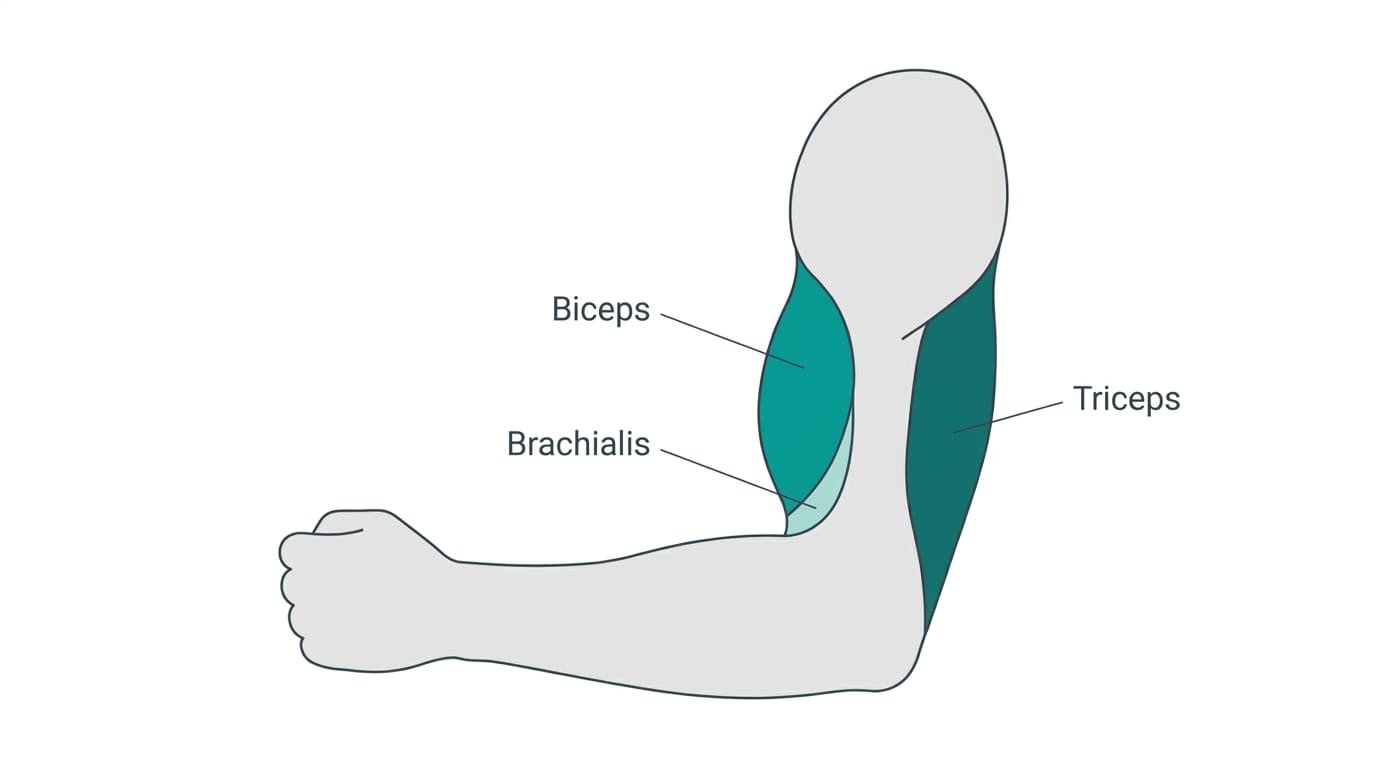
The muscles of the upper arm
| Muscle | Where it is | What it does | Best trained by |
|---|---|---|---|
| Biceps brachii, long head | Outer front of the upper arm | Bends the elbow, turns the palm up | Incline curls, curls with elbows behind the body |
| Biceps brachii, short head | Inner front of the upper arm | Bends the elbow, turns the palm up | Preacher curls, concentration curls, wide-grip curls |
| Brachialis | Underneath the biceps | Bends the elbow in any hand position | Hammer curls, reverse curls |
| Brachioradialis | Top of the forearm | Helps bend the elbow | Hammer curls, reverse curls |
| Triceps, long head | Inner back of the upper arm, attaches to the shoulder blade | Straightens the elbow, helps bring the arm down | Overhead extensions |
| Triceps, lateral head | Outer back of the upper arm | Straightens the elbow | Pushdowns, kickbacks, close-grip push-ups |
| Triceps, medial head | Deep, lower back of the upper arm | Straightens the elbow | All triceps exercises |
Two practical points follow from this.
The triceps are bigger. Three heads against two, and roughly twice the muscle mass. If you want larger or firmer arms, the back of the arm matters most.
Arm position changes which part works hardest. The long head of the triceps and the long head of the biceps both cross the shoulder joint, so moving your upper arm changes how much they are stretched. That is why a good arm routine uses more than one arm angle. Our guides to short head bicep exercises and tricep exercises at home go deeper into each head.
Why train biceps and triceps together
- They are opposing muscles. While you curl, your triceps rest. While you extend, your biceps rest
- You can pair exercises back to back, which roughly halves the time a session takes
- Neither is tired from earlier work, as they would be after chest or back training
- The elbow gets balanced work on both sides of the joint
- It is a short, enjoyable session that is easy to add to a week
Do you need direct arm training?
Your arms already work whenever you press or pull. Rows and pull-ups train the biceps, and push-ups and presses train the triceps. For beginners, that is often enough to make them grow.
In one study, untrained men did either lat pulldowns or biceps curls for ten weeks. Both groups increased the size and strength of their elbow flexors by similar amounts.
So direct arm work is not essential at the start. It becomes more useful when:
- You have trained for six months or more and your arms are lagging
- Your programme is short on pulling or pressing
- You want to emphasise parts that compound lifts miss, such as the long head of the triceps
- You simply enjoy it, which is a perfectly good reason
The 12 best bicep and tricep exercises
Six for each muscle. For every one: keep your upper arms still, move only at the elbow, and take about two seconds to lower the weight.
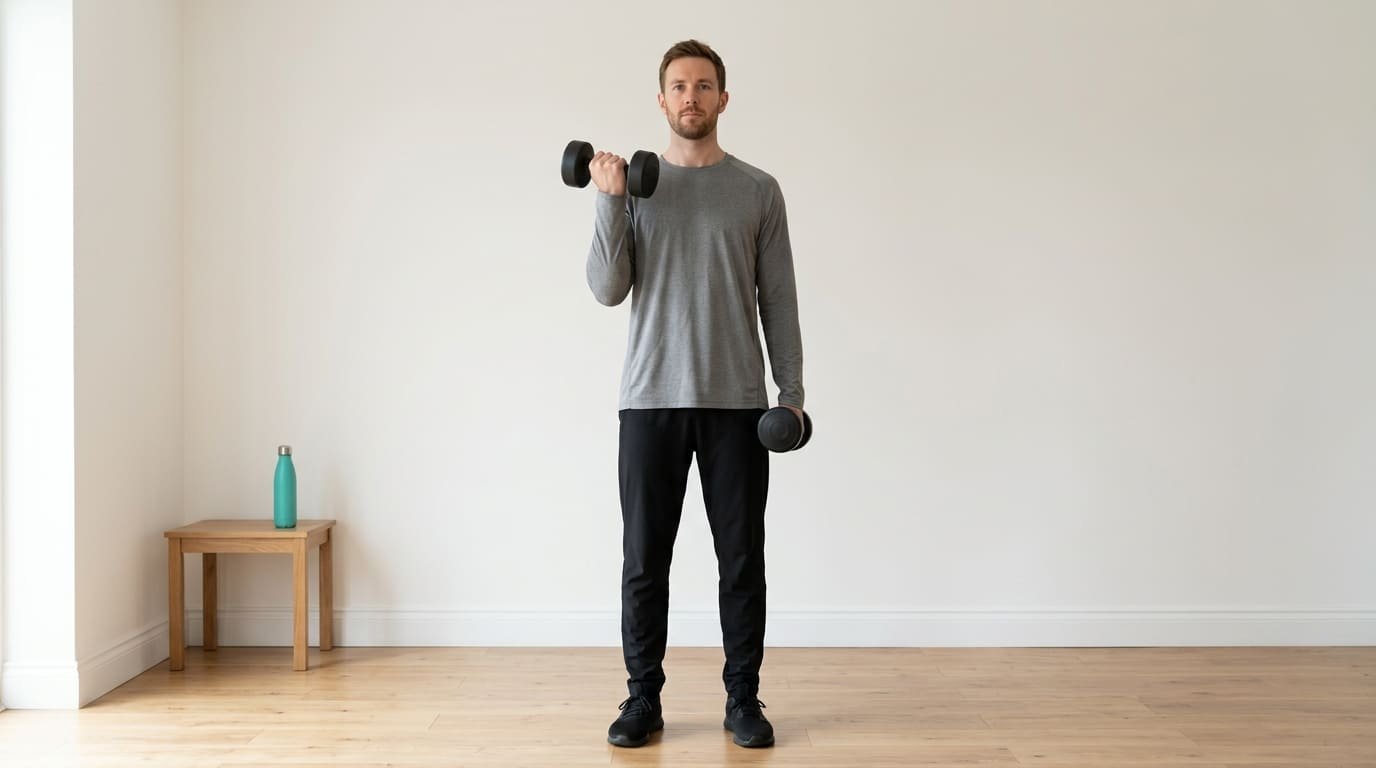
1. Dumbbell curl
The foundation. It trains both heads of the biceps through a full range.
- Stand tall with a dumbbell in each hand, arms straight, palms facing forward
- Pin your elbows to your sides
- Curl the weights toward your shoulders without letting your elbows drift forward
- Squeeze at the top for a moment
- Lower slowly until your arms are completely straight
Sets and reps: 3 sets of 8 to 12.
Form cue: if you have to lean back or swing to lift it, the weight is too heavy.
2. Hammer curl
- Hold the dumbbells with your palms facing each other, like holding two hammers
- Keep your elbows at your sides and curl the weights up, keeping your palms facing in
- Lower under control
Sets and reps: 2 to 3 sets of 10 to 12.
This shifts work toward the brachialis and the top of the forearm, which adds thickness to the arm. Our forearm workout at home has more for that area.
3. Incline dumbbell curl
- Sit back on a bench set to about 60 degrees, or lean back against the arm of a sofa
- Let your arms hang straight down behind your body, palms forward
- Curl the weights up without letting your elbows swing forward
- Lower slowly to a full stretch
Sets and reps: 2 to 3 sets of 10 to 12.
With your arms behind your body, the biceps start from a stretched position. Use lighter weights than for standing curls.
4. Concentration curl
- Sit on a chair with your feet wide apart
- Hold a dumbbell in one hand and rest the back of that upper arm against the inside of your thigh
- Curl the weight toward your shoulder, turning your little finger slightly upward at the top
- Lower slowly until your arm is straight
Sets and reps: 2 sets of 10 to 12 per arm.
The thigh stops your arm from swinging, so it is very hard to cheat.
5. Resistance band curl
- Stand on the middle of a long band with your feet hip-width apart
- Hold an end in each hand, palms forward, arms straight
- Curl your hands to your shoulders with your elbows at your sides
- Lower slowly, resisting the band
Sets and reps: 3 sets of 12 to 15.
The band is hardest at the top of the movement, where dumbbells are easiest, so the two complement each other well.
6. Chin-up or towel curl
The best bodyweight biceps exercise is the chin-up, with palms facing you. If you cannot do one yet, use a slow lowering from the top, or a band for assistance.
No bar? Try a towel curl. Sit on a chair, loop a towel under one foot, hold both ends, and curl against the resistance of your own leg pushing down. Our bicep workout without weights guide has more options.
Sets and reps: 3 sets of 3 to 8 chin-ups, or 3 sets of 10 to 12 towel curls per arm.
7. Overhead triceps extension
If you do only one direct triceps exercise, make it this one. A study that compared triceps training with the arms overhead against the same exercise with the arms by the sides found substantially more muscle growth in the overhead position, particularly in the long head.
- Sit or stand tall holding one dumbbell with both hands
- Press it overhead until your arms are straight
- Keeping your upper arms close to your ears and pointing up, bend your elbows and lower the weight behind your head
- Go down until you feel a deep stretch in the back of your arms
- Straighten your arms without letting your elbows flare wide
Sets and reps: 3 sets of 10 to 12.
8. Close-grip push-up
- Set up in a push-up position with your hands directly under your shoulders or slightly closer
- Keep your body in a straight line
- Lower your chest, keeping your elbows tucked close to your ribs and pointing back
- Press up until your arms are straight
Sets and reps: 3 sets of 8 to 15.
Make it easier: put your hands on a counter or a chair. You do not need to form a diamond with your hands. That position bothers many people’s wrists and adds little.
9. Bench dip
- Sit on the edge of a sturdy chair or sofa, hands gripping the edge beside your hips
- Slide your hips forward off the seat, knees bent, feet flat
- Bend your elbows and lower your hips until your upper arms are about parallel to the floor
- Press back up
Sets and reps: 2 to 3 sets of 10 to 15.
Take care: do not sink lower than is comfortable for your shoulders, and keep your back close to the chair. Our dip exercise guide explains the form and the harder versions.
10. Triceps kickback
- Hold a light dumbbell in one hand and hinge forward with your other hand on a chair for support
- Raise your upper arm until it is level with your trunk, elbow bent
- Straighten your arm behind you without moving the upper arm
- Pause for a second with the arm fully straight, then lower
Sets and reps: 2 sets of 12 to 15 per arm.
This is hardest at the top, where the triceps are fully shortened. Use a light weight and hold the squeeze.
11. Lying triceps extension
Often called the skull crusher.
- Lie on your back on the floor or a bench with a dumbbell in each hand, arms straight up over your shoulders, palms facing each other
- Keeping your upper arms still, bend your elbows and lower the weights beside your head
- Straighten your arms again
Sets and reps: 3 sets of 10 to 12.
Form cue: tilt your upper arms slightly back toward your head at the start. It keeps tension on the triceps for the whole rep.
12. Band pushdown
- Fix a long band over the top of a closed door, or to a high anchor point
- Face the anchor and hold the band with both hands, elbows bent and pinned to your sides
- Press your hands down until your arms are straight
- Return slowly until your forearms are just above parallel to the floor
Sets and reps: 3 sets of 12 to 15.
Our resistance band tricep workout has more band exercises for the back of the arm.
Four bicep and tricep routines
Each routine pairs a biceps exercise with a triceps exercise. Do a set of the first, rest about 30 to 45 seconds, do a set of the second, rest again, and repeat. This is called a superset, and it lets you finish in 25 to 30 minutes.
Routine 1: dumbbells at home
| Pair | Exercise | Sets | Reps |
|---|---|---|---|
| A1 | Dumbbell curl | 3 | 8 to 12 |
| A2 | Overhead triceps extension | 3 | 10 to 12 |
| B1 | Incline dumbbell curl | 3 | 10 to 12 |
| B2 | Lying triceps extension | 3 | 10 to 12 |
| C1 | Hammer curl | 2 | 10 to 12 |
| C2 | Triceps kickback | 2 | 12 to 15 per arm |
Routine 2: resistance bands
| Pair | Exercise | Sets | Reps |
|---|---|---|---|
| A1 | Resistance band curl | 3 | 12 to 15 |
| A2 | Band pushdown | 3 | 12 to 15 |
| B1 | Band hammer curl, standing on the band with palms facing in | 3 | 12 to 15 |
| B2 | Band overhead extension, standing on the band and pressing up behind your head | 3 | 12 to 15 |
| C1 | Band curl with a 2-second squeeze at the top | 2 | 10 to 12 |
| C2 | Close-grip push-up | 2 | As many good reps as possible |
Our guide to the best resistance bands for beginners explains which type to buy.
Routine 3: no equipment
| Pair | Exercise | Sets | Reps |
|---|---|---|---|
| A1 | Chin-up, slow lowering, or towel curl | 3 | 3 to 8, or 10 to 12 per arm |
| A2 | Close-grip push-up | 3 | 8 to 15 |
| B1 | Inverted row under a sturdy table, palms facing you | 3 | 8 to 12 |
| B2 | Bench dip | 3 | 10 to 15 |
| C1 | Towel curl with a 3-second lowering | 2 | 8 to 10 per arm |
| C2 | Pike push-up or incline close-grip push-up | 2 | 8 to 12 |
Routine 4: gym
| Pair | Exercise | Sets | Reps |
|---|---|---|---|
| A1 | Barbell or EZ-bar curl | 3 | 8 to 10 |
| A2 | Close-grip bench press or dips | 3 | 6 to 10 |
| B1 | Incline dumbbell curl | 3 | 10 to 12 |
| B2 | Cable overhead triceps extension | 3 | 10 to 12 |
| C1 | Cable or preacher curl | 2 | 12 to 15 |
| C2 | Cable pushdown | 2 | 12 to 15 |
Sets, reps and how often to train arms
| Question | Answer |
|---|---|
| How many exercises? | 2 to 3 for biceps and 2 to 3 for triceps |
| How many sets per exercise? | 2 to 3 |
| How many reps? | 8 to 15. Arms respond well to moderate and higher reps |
| Direct sets per week | 6 to 12 for each muscle, in addition to presses and rows |
| How often? | Once or twice a week |
| Rest between sets | 30 to 45 seconds within a pair, 60 to 90 seconds between pairs |
| How hard? | Finish each set with one or two good reps left |
Count the indirect work. If your week already includes several sets of rows, pull-ups, presses and push-ups, your arms are getting a good amount of training before you do a single curl. Six to eight direct sets each on top of that is plenty for most people.
Where an arm day fits in your week
| Your plan | Where to put arms |
|---|---|
| Full body, three days | Add one pair of arm exercises to the end of two sessions |
| Upper lower, four days | Arms are already at the end of each upper day. Add a set if they lag |
| Push pull legs | Triceps on push day, biceps on pull day |
| Five days, with room for a short session | A separate 30-minute arm day, at least a day away from your hardest upper session |
| Shoulders and arms day | Train shoulders first, then the arm pairs |
See our guides to the upper lower split, the push pull legs workout and which muscle groups to work out together. Our shoulder and bicep workout and chest and tricep workout show other pairings.
How to progress
- Add a rep to one or more sets each session until you reach the top of the range
- Then add the smallest weight you can. For arms, that jump is often large in percentage terms, so expect your reps to drop
- If the next dumbbell up is too heavy, slow the lowering phase to three or four seconds or add a pause at the hardest point instead
- Change one exercise per muscle every eight to twelve weeks, not every session
| Week | Dumbbell curl, target 3 sets of 8 to 12 | Action |
|---|---|---|
| 1 | 8 kg: 9, 8, 8 | Start |
| 2 | 8 kg: 10, 10, 9 | Add reps |
| 3 | 8 kg: 12, 11, 10 | Add reps |
| 4 | 8 kg: 12, 12, 12 | Top of range |
| 5 | 9 kg or 10 kg: 8, 8, 7 | Add weight |
Common mistakes
- Swinging the weights. If your hips and back are moving, your arms are doing less
- Moving the elbows. In curls, they stay by your sides. In extensions, they stay pointing where they started
- Half reps. Straighten your arms fully at the bottom of curls and the top of extensions
- Dropping the weight on the way down. The lowering phase builds as much muscle as the lifting
- All biceps, little triceps. Give the larger muscle equal or greater attention
- No overhead triceps work, which leaves the long head undertrained
- Too much, too often. Arms are small and are already worked by your other lifts
- Gripping too tightly and letting the wrists bend back, which tires the forearms first
Looking after your elbows
Arm training is hard on the elbow tendons when volume rises too quickly.
- Warm up with one light set of 15 to 20 reps for each muscle before your working sets
- Increase weekly sets gradually
- If straight-bar curls bother your wrists or elbows, use dumbbells or an angled bar so your hands can rotate
- If lying extensions hurt, lower the weights beside your head with palms facing in, or switch to overhead extensions or pushdowns
- Persistent pain on the inside or outside of the elbow is a reason to cut back and, if it does not settle in a couple of weeks, to see a physiotherapist
The bottom line
Biceps and triceps make a natural pair. They sit on opposite sides of the same joint, so you can alternate between them and get a full arm session done in half an hour.
Choose two or three exercises for each, making sure one triceps exercise has your arms overhead and one curl starts with your arms behind your body. Do two or three sets of 8 to 15 slow reps, once or twice a week, on top of your normal pressing and pulling. Keep your elbows still and lower every rep under control.
Give the triceps at least as much attention as the biceps. They are most of your arm.
To add thickness under the biceps, see our guide to brachialis exercises.
To give the biceps peak more attention, see our guide to long head bicep exercises.
Frequently asked questions
Can you train biceps and triceps on the same day?
Yes, and it works very well. They are opposing muscles, so one rests while the other works. You can alternate between a biceps exercise and a triceps exercise with short rests, which makes for an efficient session of about 30 minutes.
Should I train biceps or triceps first?
It makes little difference when you alternate between them. If you do all of one before the other, start with the muscle you most want to improve, because you will be freshest for it. Many people begin with triceps, since it is the larger muscle.
How many exercises should I do for biceps and triceps?
Two or three for each is enough, with two or three sets per exercise. That gives roughly 6 to 9 sets per muscle in a session. More than that rarely adds anything, because your arms are also worked by rows, pull-ups, presses and push-ups.
How often should I do a bicep and tricep workout?
Once or twice a week. Arms recover fairly quickly, but they also work during upper-body training on other days. Leave at least a day between a dedicated arm session and a hard pressing or pulling session.
What is the best bicep and tricep workout with dumbbells?
Pair dumbbell curls with overhead triceps extensions, incline curls with lying triceps extensions, and hammer curls with kickbacks. Do two or three sets of 8 to 12 reps for each pair. That covers every head of both muscles in about 30 minutes.
Can I build my arms without weights?
Yes. Chin-ups and inverted rows with palms facing you train the biceps, and close-grip push-ups and bench dips train the triceps. Resistance bands add curls, pushdowns and overhead extensions for very little cost.
Why are my arms not growing?
The usual reasons are too little progression, swinging the weights, short ranges of motion, neglecting the triceps, or not eating enough protein and calories. Arms also grow from heavy rows and presses, so make sure your overall programme is progressing too.
Are triceps bigger than biceps?
Yes. The triceps have three heads and make up roughly two thirds of the muscle in the upper arm, while the biceps have two heads. For larger or firmer arms, triceps training contributes more than biceps training.
What’s next?
Reading is the easy part. Pick one of these and do it today.


