Resistance Band Tricep Workout: 10 Exercises for All 3 Heads
Resistance bands are genuinely well suited to triceps, and not just because they are cheap and portable. The triceps get stronger as the elbow straightens, and a band gets harder as it stretches. Those two curves line up almost perfectly, which is why a band pushdown can feel harder at lockout than the same movement with a dumbbell.
This guide covers ten exercises organised by which of the three tricep heads they emphasise, how to pick the right band, two complete routines, and an eight-week progression plan. It also covers the parts most band articles skip entirely: how to make a band harder when you have run out of bands, what to do about elbow pain, and how band training genuinely compares to weights.
At a glance
- Your triceps have three heads, and only one of them is fully trained with your arms overhead
- Bands provide ascending resistance, which matches the tricep strength curve well
- Train triceps 2 to 3 times a week with 10 to 20 reps per set
- You can increase difficulty without buying more bands by shortening, doubling or changing the anchor
- Long head work, meaning overhead extensions, is the most commonly skipped piece
- Bands and weights produce comparable muscle growth when effort is matched
The three tricep heads and why they matter
The triceps brachii is one muscle with three separate heads. They share a tendon at the elbow but attach differently at the top, and that difference decides which exercises train which head.
| Head | Where it attaches at the top | Share of tricep size | Best trained by |
|---|---|---|---|
| Long head | The shoulder blade, so it crosses the shoulder joint | Largest, roughly half the muscle | Overhead extensions, any arms-overhead position |
| Lateral head | The back of the upper arm bone | Middle | Pushdowns, kickbacks, close-grip presses |
| Medial head | The back of the upper arm bone, deeper and lower | Smallest | All pressing, especially reverse grip and full lockout |
The key point, and the one that explains most stalled tricep training, is the long head. Because it attaches to the shoulder blade, it only reaches a fully stretched position when your arm is raised overhead. Pushdowns and kickbacks, with the upper arm hanging by your side, barely stretch it at all.
If your routine consists of pushdowns and nothing else, you are training roughly half your triceps properly and leaving the largest head undertrained. That is why overhead extensions are non-negotiable in the routines below.
The triceps make up roughly two thirds of your upper arm. If your goal is bigger arms, tricep volume matters more than bicep volume, which surprises most people the first time they hear it.
Why bands work well for triceps
- The resistance curve matches. A band is easiest where the muscle is weakest, at the stretched position, and hardest at lockout where the tricep is strongest
- Constant tension. A band never goes slack at the top of a rep the way a dumbbell does when the forearm goes vertical
- Joint friendly. The load is lightest in the deep, stretched position where elbows are most vulnerable
- Angles are free. Move the anchor point and you change the exercise, which is not possible with a dumbbell
- Portable and cheap. A full set of bands weighs less than a single small dumbbell
The honest limitation: bands make it harder to measure progress. There is no number on a band the way there is on a dumbbell, so you need to track reps, band type and anchor position deliberately. The progression section below handles this.
Choosing the right band
Band terminology is confusing because three different products are all called resistance bands.
| Band type | What it looks like | Best for triceps | Notes |
|---|---|---|---|
| Loop band, long | A continuous 41-inch loop | Excellent | The most versatile for pushdowns and overhead work |
| Tube band with handles | A tube with clip handles | Excellent | Most comfortable grip, good for pressdowns |
| Mini loop band | A small 12-inch loop | Poor | Too short for most tricep movements |
| Therapy band, flat | A flat sheet with no handles | Usable | Light resistance, good for warm-ups and rehab |
Which resistance to buy: bands are colour coded, but the colours are not standardised between brands, so buy by stated resistance rather than colour.
| Your situation | Suggested range | Why |
|---|---|---|
| Complete beginner | 4 to 15 kg | Enough for 15 to 20 rep overhead extensions |
| Some training experience | 10 to 25 kg | Covers pushdowns and pressing variations |
| Experienced, bigger arms | 15 to 40 kg | Needed for heavier pressdowns and close-grip work |
| Best value | A set of 3 to 5 | Lets you progress without buying again |
A set of three to five long loop bands costs less than one adjustable dumbbell and covers every exercise in this article. For a broader comparison, see our guide to the best resistance bands for beginners.
A 3-minute elbow warm-up
Triceps work loads the elbow joint directly, and the elbow is one of the easier joints to irritate with a sudden jump in volume. Three minutes solves most of this.
- Arm circles: 20 seconds each direction
- Elbow flexion and extension: 15 reps, no resistance, moving through full range
- Band pull-aparts: 15 reps with a light band, which warms the shoulder and upper back
- Wrist circles: 10 each direction
- Light overhead reach: 10 slow reps reaching both arms straight overhead
- One very light set of pushdowns, 20 reps, using your lightest band
Skipping the warm-up on band work is particularly unwise because the resistance is highest at lockout, which is exactly where an unprepared elbow feels it most.
10 resistance band tricep exercises
Grouped by which head each one emphasises, so you can build a complete routine rather than three variations of the same thing.
Long head: overhead work
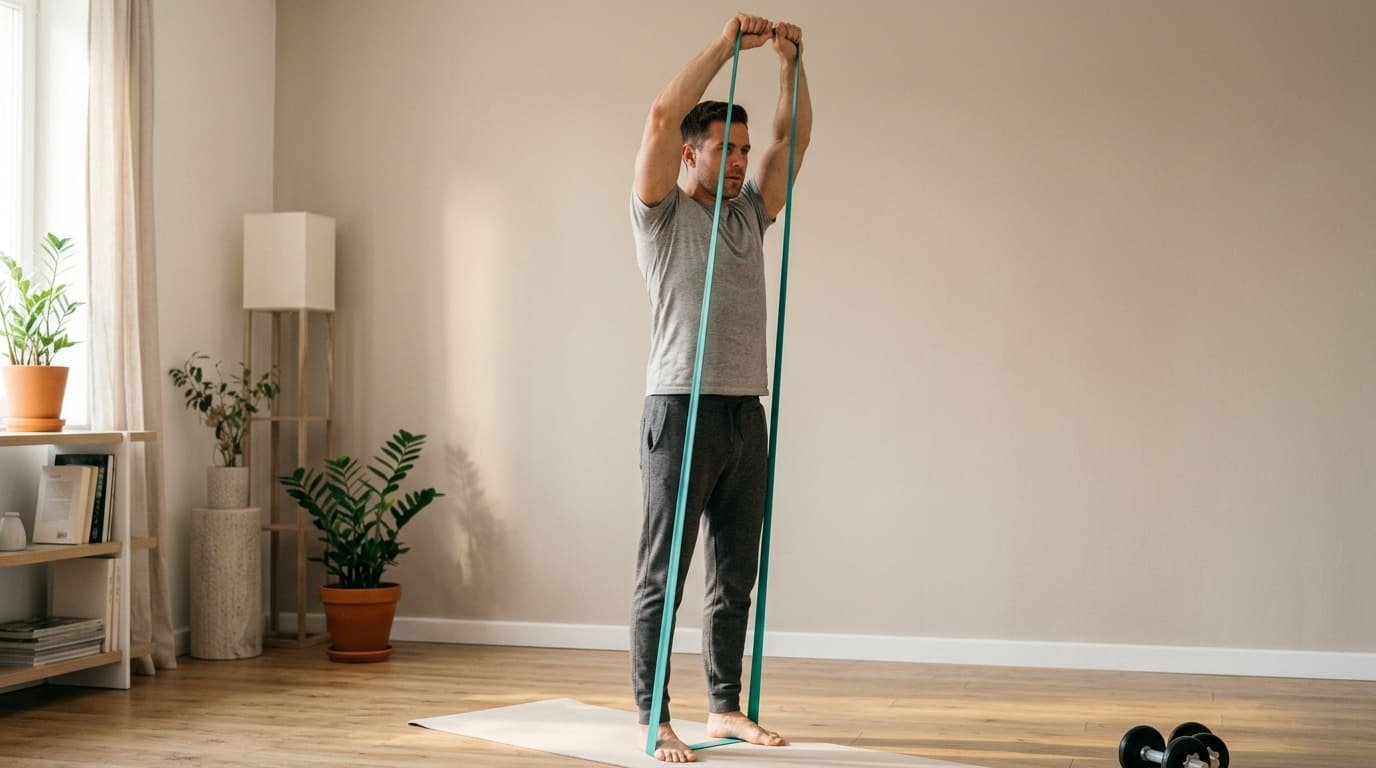
1. Standing overhead tricep extension
Stand on the middle of a band, bring the ends behind your head with elbows pointing forward, and extend your arms straight up. Keep the elbows close to your head.
- Sets and reps: 3 sets of 12 to 20
- Cue: the upper arms stay still, only the forearms move
- Mistake to avoid: letting the elbows flare wide, which shifts the work to the shoulders
2. Single-arm overhead extension
Same movement, one arm at a time, holding the band behind your back with the other hand to set the tension. Excellent for finding and fixing side-to-side differences.
- Sets and reps: 3 sets of 12 to 15 each arm
3. Band skull crusher
Lie on your back with the band anchored behind your head, or held under your shoulders. Start with arms straight up, bend at the elbow to lower your hands toward your forehead, then extend.
- Sets and reps: 3 sets of 12 to 15
- Cue: slow on the way down, three seconds
4. Crossbow extension
Hold the band with both hands, one arm out to the side and fixed in place, the other extending across and away from the body. This trains all three heads at once and is one of the more useful band-only exercises.
- Sets and reps: 3 sets of 10 to 15 each side
Lateral head: pushdowns and kickbacks
5. Tricep pushdown
Anchor the band overhead, on a door anchor or over a sturdy bar. Keep the elbows pinned to your sides and push down until the arms are straight.
- Sets and reps: 3 sets of 15 to 20
- Cue: the elbows do not move forward or back at any point
6. Rope-style pushdown with a spread
Same as above, but spread your hands apart at the bottom of each rep as if pulling a rope. The extra spread increases the contraction at lockout.
- Sets and reps: 3 sets of 12 to 15
7. Tricep kickback
Stand on the band, hinge forward at the hips, keep the upper arm parallel to your torso, and extend the forearm back until the arm is straight. Hold the top for a full second.
- Sets and reps: 3 sets of 12 to 15 each arm
- Cue: the pause at the top is the whole point of this exercise
8. Crossbody pressdown
Anchor the band high, take it in one hand, and press down and across your body toward the opposite hip. The diagonal path changes which fibres take the load.
- Sets and reps: 3 sets of 12 to 15 each arm
Medial head and compound work
9. Close-grip band press
Loop the band across your upper back and under your armpits, hold the ends at chest height with hands close together, and press forward until your arms lock out.
- Sets and reps: 3 sets of 12 to 20
- Why it works: the close grip loads the triceps far more than a standard press
10. Band-resisted close-grip push-up
Loop the band across your back, hold an end under each palm, and perform a push-up with your hands close together. The band adds resistance that increases as you push up, which is exactly where the triceps do the most work.
- Sets and reps: 3 sets of 8 to 15
- Scaling: do it with your hands on a step or counter if full push-ups are hard
For versions of these movements without any equipment, our guide to tricep exercises at home covers bodyweight progressions in depth.
Two complete band tricep routines
Routine A: the 15-minute add-on
Do this at the end of an upper body or push session, twice a week.
| Exercise | Sets | Reps | Rest |
|---|---|---|---|
| Tricep pushdown | 3 | 15 to 20 | 45 sec |
| Standing overhead extension | 3 | 12 to 15 | 60 sec |
| Tricep kickback | 3 | 12 each arm | 45 sec |
| Close-grip band press | 2 | 15 to 20 | 45 sec |
Routine B: the full arm session
A standalone tricep session, once or twice a week, roughly 30 minutes.
| Exercise | Sets | Reps | Rest |
|---|---|---|---|
| Close-grip band press | 4 | 12 to 15 | 75 sec |
| Standing overhead extension | 4 | 12 to 15 | 60 sec |
| Tricep pushdown | 3 | 15 to 20 | 45 sec |
| Band skull crusher | 3 | 12 to 15 | 60 sec |
| Crossbody pressdown | 3 | 12 each arm | 45 sec |
| Kickback with a 1-second hold | 3 | 15 each arm | 45 sec |
Notice the order: the compound press comes first while you are fresh, then the long head work, then the isolation exercises. Reversing that order means your pressing is limited by already-tired triceps.
Getting stronger without buying more bands
This is the question band training raises that dumbbell training does not, and almost no article answers it properly. You cannot add 2 kg to a band. But you have six other levers.
| Method | How to do it | Difficulty added |
|---|---|---|
| Shorten the band | Stand further onto it, or wrap it around your hand once | Large |
| Double the band | Fold it in half for the same movement | Very large |
| Add a second band | Use two lighter bands together | Moderate to large |
| Change the anchor | Move further from the anchor point to pre-stretch it | Moderate |
| Slow the tempo | Take 3 to 4 seconds on the lowering phase | Moderate |
| Pause at lockout | Hold the fully extended position for 2 seconds | Moderate |
| Add reps | Go from 12 to 20 before increasing resistance | Small, but reliable |
Here is an eight-week plan using those levers.
| Weeks | Main press and overhead work | Pushdowns and isolation |
|---|---|---|
| Weeks 1 to 2 | 3 sets of 12, comfortable band | 3 sets of 15 |
| Weeks 3 to 4 | 3 sets of 15 to 18 | 3 sets of 20 |
| Weeks 5 to 6 | Shorten the band or go heavier, back to 3 sets of 12 | 3 sets of 15 with a 2-second lockout hold |
| Weeks 7 to 8 | 4 sets of 12 to 15 at the new tension | 4 sets of 15, slow 3-second lowering |
Keep a note of which band you used and how far you stood onto it. Without that, band training becomes impossible to progress deliberately, and most people simply do the same session for months.
Bands versus dumbbells: an honest comparison
| Factor | Resistance bands | Dumbbells |
|---|---|---|
| Muscle growth potential | Comparable when effort is matched | Comparable when effort is matched |
| Resistance curve | Hardest at lockout | Hardest at mid-range, often slack at the top |
| Measuring progress | Difficult, needs careful notes | Easy, the weight is printed on it |
| Joint stress in stretch | Low | Higher, particularly on skull crushers |
| Cost and storage | Very low | Higher |
| Portability | Excellent | Poor |
| Maximum resistance | Limited by band availability | Effectively unlimited |
The research on this is more reassuring than most people expect. When training effort and volume are matched, elastic resistance and conventional weights produce broadly similar strength and muscle gains. Bands are not a compromise for beginners, they are a legitimate training tool with a different resistance profile.
If your elbows hurt
Tricep training is a common source of elbow discomfort, and none of the band articles I read address it.
Pain at the back or point of the elbow during extensions usually relates to the tricep tendon, often after a jump in volume or too much hard lockout work.
What generally helps:
- Reduce the resistance, not the frequency. Tendons respond well to lighter, controlled loading and badly to complete rest followed by a sudden return
- Cut the hard lockout holds temporarily, since this is where band tension is highest
- Slow the lowering phase to three or four seconds with a light band
- Keep the elbows tucked on overhead work rather than flaring them
- Warm up properly, which is a bigger factor on bands than on dumbbells
- Give it 8 to 12 weeks. Tendon adaptation is slower than muscle adaptation
Sharp pain, numbness, tingling or weakness in the hand deserves a proper assessment rather than a guess. See a physiotherapist or doctor if symptoms persist beyond a few weeks.
Seven common mistakes
- Skipping overhead work. Pushdowns alone undertrain the long head, which is the largest of the three
- Letting the elbows drift. On pushdowns and extensions, the upper arm should stay completely still
- Using a band that is far too light. If you can do 40 reps, the band is not providing a training stimulus
- Snapping through reps. The lowering phase is where a large share of the growth stimulus sits, and bands make it very easy to let it snap back
- Never changing the anchor height. High, mid and low anchors produce genuinely different exercises
- Training triceps before chest or shoulders on a push day, which means your pressing is limited by tired triceps
- Not checking the band for wear. A band that snaps under tension near your face is a real risk. Replace anything with nicks, cracks or thin patches
How often to train triceps with bands
| Your training week | Tricep sessions | Where to put them |
|---|---|---|
| 2 sessions a week | 2 | At the end of each full body session |
| 3 sessions a week | 2 | After push day, plus one short standalone session |
| 4 or more sessions | 2 to 3 | After pressing days, never before |
| Arms are a priority | 3 | Two short sessions plus one full arm session |
Ten to sixteen working sets per week is a reasonable range for tricep growth, including the sets they get indirectly from pressing. Beginners should start nearer ten. Leave at least 48 hours between hard tricep sessions.
If you pair arms with your chest work, our chest and tricep workout guide covers how to order the session so your pressing does not suffer.
The bottom line
A resistance band tricep workout is not a downgrade from weights. The band’s resistance curve suits the triceps particularly well, the stretched position is easier on the elbow, and the research shows comparable results when effort is matched.
Train all three heads, which means including overhead extensions rather than living on pushdowns. Keep your elbows still. Control the lowering phase. Use the six progression levers rather than waiting until you can afford a heavier band. And write down which band you used, because that single habit is the difference between eight weeks of progress and eight weeks of the same workout.
Frequently asked questions
Can you build triceps with resistance bands?
Yes. Research comparing elastic resistance with conventional weights finds comparable strength and muscle gains when training effort and volume are matched. Bands work particularly well for triceps because the resistance increases as you extend the elbow, which lines up with where the triceps are strongest.
How often should I do a resistance band tricep workout?
Two to three times a week, leaving at least 48 hours between hard sessions. Two sessions is enough for most people, with 10 to 16 total working sets per week including the tricep work you get indirectly from pressing exercises. Beginners should start at the lower end.
What resistance band should I use for triceps?
A long loop band or a tube band with handles, rated between 4 and 15 kg if you are a beginner and 10 to 25 kg with some training experience. Buy by stated resistance rather than colour, since colour coding is not standardised between brands. A set of three to five bands covers every exercise.
Which band exercise hits the long head of the triceps?
Overhead extensions, in any variation. The long head attaches to the shoulder blade, so it only reaches a fully stretched position when your arm is raised overhead. Standing overhead extensions, single-arm overhead extensions and band skull crushers all load it, while pushdowns and kickbacks barely do.
How do I make a resistance band harder without buying a heavier one?
Stand further onto the band to shorten it, fold it in half, combine two lighter bands, move further from the anchor point to pre-stretch it, slow the lowering phase to three or four seconds, or pause for two seconds at full extension. Shortening and doubling add the most resistance.
Are bands or dumbbells better for triceps?
Neither is clearly better. Bands give constant tension, a resistance curve that matches the triceps well, and less stress on the elbow in the stretched position. Dumbbells make progress far easier to measure and allow unlimited loading. Using both is the practical answer if you have the option.
How many reps should I do for triceps with bands?
Ten to twenty reps per set for most exercises, going toward the higher end on pushdowns and isolation work. Bands make very low rep training awkward because the resistance varies through the range, so higher reps taken close to failure are the more reliable approach.
Should I train triceps before or after chest?
After. Your triceps assist every pressing movement, so training them first means your bench press, floor press and push-ups all end early because the triceps gave out rather than the chest. Do pressing first, then dedicated tricep work at the end of the session.