
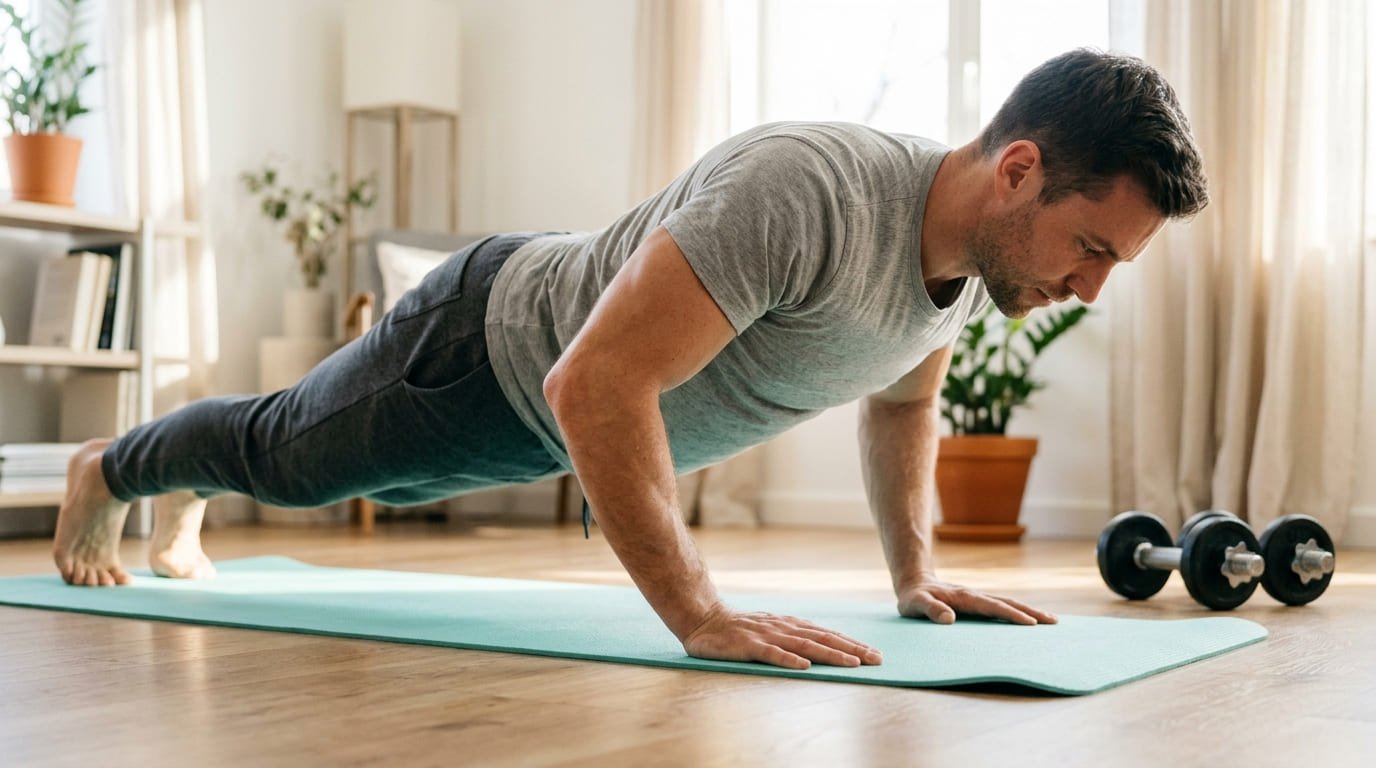
Chest and Abs Workout: 3 Routines and Why the Pairing Works
Chest and abs is one of the more sensible ways to pair muscle groups, and not for the reason most people assume. It is not just that both sit on the front of your body. It is that your core works hard as a stabiliser during almost every serious chest exercise, so the two are already linked whether you plan it or not.
This guide covers why the pairing works, the anatomy that explains which exercises hit what, three complete routines for different equipment situations, and the programming details, sets, reps, rest, frequency and progression, that most articles on this topic leave vague. It also covers the part almost everyone skips: how much of visible abs comes from training versus body fat.
At a glance
- Your core stabilises the torso during pressing, so chest and abs pair naturally
- Train the combination 2 to 3 times a week, with at least 48 hours between sessions
- Chest responds to 8 to 12 reps, abs to 10 to 20 reps plus timed holds
- Supersetting chest and abs saves time without reducing chest performance
- Visible abs depend far more on body fat than on ab training volume
- Three routines below: no equipment, dumbbells only, and full gym
Why train chest and abs together
Muscle pairings usually fall into one of three logics: opposing muscles, muscles that work together, or simple convenience. Chest and abs is mostly the second one, with a bit of the third.
- Your core already stabilises every press. During a push-up, a bench press or a dumbbell press, the abdominals and obliques resist your torso rotating and your lower back arching. They are working whether you intend it or not
- Neither one limits the other. Chest work does not meaningfully pre-fatigue your abs, and abs work does not compromise your pressing, unlike pairing chest with triceps where the triceps tire first
- It is time efficient. You can superset an ab exercise during the rest period of a chest exercise and cut session length by a third
- Both suit similar equipment. Push-up variations and floor ab work need nothing, which makes this the easiest pairing to run at home
The one thing to be clear about: pairing chest and abs does not create some special fat-burning effect on your midsection. Spot reduction is not a real mechanism. Training abs builds abdominal muscle, and body fat comes off across your whole body, in an order largely set by genetics.
The anatomy, briefly
Knowing what each muscle does makes exercise selection obvious instead of arbitrary.
The chest
| Muscle | Where it sits | What it does | Best trained by |
|---|---|---|---|
| Pectoralis major, sternal head | The bulk of the chest | Brings the arm across and down | Flat press, push-ups, flyes |
| Pectoralis major, clavicular head | Upper chest, below the collarbone | Brings the arm up and across | Incline press, decline push-ups |
| Pectoralis minor | Beneath pec major | Pulls the shoulder blade forward and down | Dips, push-up plus |
| Serratus anterior | Along the ribs under the armpit | Holds the shoulder blade to the ribcage | Push-up plus, overhead work |
The practical takeaway is that a single flat pressing angle is not enough. Include at least one incline or decline variation so the upper chest gets loaded properly.
The core
| Muscle | Where it sits | What it does | Best trained by |
|---|---|---|---|
| Rectus abdominis | The front sheet, the “six pack” | Flexes the spine, tilts the pelvis | Crunches, leg raises, hollow holds |
| Obliques, internal and external | The sides of the waist | Rotate and side-bend the torso | Side planks, Russian twists, woodchops |
| Transverse abdominis | The deepest layer, wrapping around | Compresses the abdomen, stabilises | Planks, dead bugs, hollow holds |
| Hip flexors | Front of the hip | Lift the leg, assist in leg raises | Leg raises, knee tucks |
A complete ab routine trains three things: flexion, anti-extension and rotation. Most people only do the first. That is why sit-ups alone produce a core that looks trained but does not feel particularly strong.
A 5-minute warm-up
Pressing loads the shoulder joint, so the warm-up matters more here than in most sessions.
- Arm circles: 20 seconds forward, 20 seconds back
- Shoulder dislocates with a towel or band: 10 slow reps
- Cat cow: 8 reps, moving the spine slowly through its range
- Scapular push-ups: 10 reps, arms straight, moving only the shoulder blades
- Dead bugs: 8 each side, to switch on the deep core
- Incline push-ups: 10 reps at a comfortable height
- One light set of your first pressing exercise
Scapular push-ups and dead bugs are the two that matter most. They prepare the shoulder blade and the deep core for the stabilising work they are about to do.
Routine 1: no equipment at all
Everything here needs a floor and, ideally, a sofa or chair. Three rounds, resting 60 seconds between exercises.
| Exercise | Sets | Reps or time | Rest |
|---|---|---|---|
| Push-up, or incline push-up | 3 | 8 to 15 | 60 sec |
| Hollow body hold | 3 | 20 to 40 sec | 45 sec |
| Decline push-up, feet on a chair | 3 | 6 to 12 | 60 sec |
| Leg raise, or bent-knee raise | 3 | 10 to 15 | 45 sec |
| Wide push-up | 3 | 8 to 15 | 60 sec |
| Side plank | 3 | 20 to 40 sec each side | 45 sec |
| Plank to push-up | 3 | 8 to 12 | 60 sec |
If push-ups are still too hard: start with hands on a kitchen counter, then a chair, then a step, then the floor. This progression works, and it works faster than doing knee push-ups indefinitely. Our guide to incline and decline push-ups lays out the full ladder.
Routine 2: dumbbells at home, no bench
You do not need a bench. The floor changes the range of motion slightly, which is actually easier on the shoulders for most beginners.
| Exercise | Sets | Reps | Rest |
|---|---|---|---|
| Floor press | 4 | 8 to 12 | 90 sec |
| Dead bug with a dumbbell held overhead | 3 | 10 each side | 45 sec |
| Dumbbell squeeze press | 3 | 10 to 15 | 75 sec |
| Weighted crunch, dumbbell on the chest | 3 | 12 to 15 | 45 sec |
| Decline push-up, feet elevated | 3 | 8 to 15 | 60 sec |
| Dumbbell side bend | 3 | 12 each side | 45 sec |
| Renegade row to push-up | 3 | 6 to 10 each side | 75 sec |
The dumbbell squeeze press is underrated. Press two dumbbells together hard throughout the set and you get constant tension on the inner chest without any equipment beyond the weights. For more options in this format, see our dumbbell chest workout without a bench.
Routine 3: full gym
| Exercise | Sets | Reps | Rest |
|---|---|---|---|
| Barbell or dumbbell bench press | 4 | 6 to 10 | 2 to 3 min |
| Hanging knee raise | 3 | 10 to 15 | 60 sec |
| Incline dumbbell press | 3 | 8 to 12 | 90 sec |
| Cable woodchop | 3 | 12 each side | 45 sec |
| Cable crossover or pec deck | 3 | 12 to 15 | 60 sec |
| Cable crunch | 3 | 12 to 15 | 60 sec |
| Weighted dip or machine press | 3 | 8 to 12 | 90 sec |
| Ab wheel rollout or long lever plank | 3 | 8 to 12, or 20 to 30 sec | 60 sec |
Note the rest periods on the heavy pressing. Two to three minutes feels long, but pressing is a strength movement, and cutting rest to 60 seconds means your third and fourth sets happen at a much lower load. That trade is rarely worth it.
How to superset chest and abs properly
This is the main practical advantage of the pairing, and it is worth doing deliberately rather than randomly.
The principle: pair a chest exercise with an ab exercise that does not compete for the same stabilisers, and perform the ab work during what would otherwise be your rest period.
| Chest exercise | Pair it with | Why it works |
|---|---|---|
| Bench or floor press | Hanging or lying leg raise | Lower body focused, leaves the shoulders alone |
| Incline press | Side plank | Different plane, no overlap with pressing |
| Push-up variation | Weighted crunch | Simple flexion, no shoulder load |
| Cable crossover | Cable woodchop | Same station, no equipment change |
| Dips | Dead bug | Restores neutral spine after an extended position |
What not to superset with pressing: plank to push-up, renegade rows, ab wheel rollouts or anything else that loads the shoulders and triceps. Those compete directly with your chest work and will reduce your pressing performance.
If your goal is maximum chest strength, do not superset your heaviest pressing sets. Keep supersets for the accessory work later in the session and take full rest on the main lift.
Sets, reps and rest: the actual numbers
Every competing article I read on this topic gave exercises but almost none gave complete programming. Here it is.
| Goal | Chest sets per week | Chest reps | Ab sets per week | Ab reps | Rest |
|---|---|---|---|---|---|
| Build strength | 10 to 14 | 4 to 8 | 6 to 10 | 8 to 12 weighted | 2 to 3 min on chest |
| Build muscle size | 12 to 18 | 8 to 15 | 8 to 14 | 10 to 20 | 60 to 90 sec |
| General fitness | 8 to 12 | 10 to 15 | 6 to 10 | 12 to 20 | 45 to 60 sec |
| Endurance and conditioning | 8 to 12 | 15 to 25 | 8 to 12 | 20 or timed | 30 to 45 sec |
A few rules that apply across all of them:
- Leave 1 to 3 reps in reserve on most sets. Training to absolute failure on every set adds fatigue faster than it adds progress
- Cover at least two pressing angles. Flat plus incline, or flat plus decline
- Train abs in three ways: flexion, anti-extension and rotation
- Add load to ab work. Abs are muscles like any other. Endless bodyweight crunches stop being a stimulus once you can do 40 of them
How often should you train chest and abs?
| Your training week | Chest and abs frequency | How to structure it |
|---|---|---|
| 2 sessions a week total | Both sessions | Full body, with chest and abs as part of each |
| 3 sessions a week | 2 sessions | Upper, lower, full body |
| 4 sessions a week | 2 sessions | Two upper body days, each with chest and abs |
| 5 or more sessions | 2 to 3 sessions | Push, pull, legs, with abs added twice |
Leave at least 48 hours between chest sessions. Abs recover faster and can handle three sessions a week, but they still need a day between hard sessions, particularly if you are loading them with weight. Our guide on whether you can train abs every day covers the recovery question in detail.
An 8-week progression plan
Listing exercises is the easy part. This is how you actually get stronger at them over two months. Use double progression: add reps until you hit the top of the range, then add weight and start again at the bottom.
| Weeks | Main press | Accessory chest | Ab work |
|---|---|---|---|
| Weeks 1 to 2 | 3 sets of 8, moderate weight | 3 sets of 10 | 3 sets of 12, bodyweight |
| Weeks 3 to 4 | 3 sets of 10 to 12 | 3 sets of 12 | 3 sets of 15, or add a light weight |
| Weeks 5 to 6 | Add weight, back to 4 sets of 8 | 3 sets of 12 with a 2-second lowering | 3 sets of 12 weighted |
| Weeks 7 to 8 | 4 sets of 10 to 12 | 4 sets of 12 | 3 sets of 15 weighted, plus a 45-second hold |
Write down what you lift. Chest strength moves in small increments, and without a log you will genuinely forget whether you pressed 14 kg or 16 kg three weeks ago.
The honest truth about visible abs
This section exists because it is the actual question behind most searches for a chest and abs workout, and almost nobody answers it directly.
Everyone has abdominal muscles. Whether you can see them is determined mostly by how much body fat covers them, not by how many crunches you have done.
| Body fat range (men) | Body fat range (women) | What is typically visible |
|---|---|---|
| Above 20 percent | Above 28 percent | No ab definition |
| 15 to 20 percent | 24 to 28 percent | Slight outline when flexed |
| 12 to 15 percent | 20 to 24 percent | Upper abs visible, some definition |
| 10 to 12 percent | 17 to 20 percent | Clear four to six pack |
| Below 10 percent | Below 17 percent | Full definition including lower abs |
Training abs is still worth doing. It builds the muscle thickness that makes definition appear at a higher body fat level than it otherwise would, and it builds genuine core strength. But if abs are your goal, the food side of the equation does most of the work. Our article on what body fat percentage abs show at goes into this properly.
Eight mistakes that limit progress
- Only pressing flat. One angle leaves the upper chest underdeveloped, which is the most common reason a chest looks flat despite regular training
- Flaring the elbows to 90 degrees. Keep them at roughly 45 degrees to the torso. It is easier on the shoulder and generally stronger
- Bouncing the weight. Momentum reduces the work your chest does and increases the risk to the joint
- Cutting the range short. A half-range press builds half the result. Lower until your upper arms are roughly parallel to the floor, or until your chest is near the floor on a push-up
- Never adding load to ab work. Once you can do 30 crunches, more crunches is not progressive overload
- Pulling on your neck during crunches. Hands at the temples, elbows wide, chin slightly tucked
- Training abs before pressing. A fatigued core destabilises your pressing and makes heavy work less safe
- Expecting abs to appear from ab training alone. Body fat decides this, not crunch volume
Recovery, soreness and when to train again
Chest is one of the muscle groups most likely to leave you sore, particularly after dips, deep push-ups or flyes, all of which load the muscle in a lengthened position.
- Soreness peaks 24 to 48 hours after training and is normal, particularly on a new exercise
- Mild soreness is not a reason to skip a session. Light movement often reduces it
- Significant soreness lasting beyond 72 hours suggests you did too much too soon
- Do not train chest hard two days in a row. The muscle needs the gap even if the soreness has gone
- Abs recover faster and can usually handle a third session in a week
If shoulder pain appears during pressing, that is different from muscle soreness and worth addressing. Reduce the range of motion, use dumbbells rather than a barbell, narrow your grip slightly, and if it persists beyond a couple of weeks, get it assessed.
The bottom line
Chest and abs is a genuinely good pairing. Your core is already stabilising every press you do, neither muscle group limits the other, and supersetting the two lets you finish a complete upper body session in half an hour.
Pick the routine that matches your equipment. Press at two angles. Train your abs through flexion, anti-extension and rotation rather than crunches alone. Add weight or reps every couple of weeks and write it down. Then accept that how visible your abs become is mostly a nutrition question, and treat your ab training as what it is: building a muscle that will show when the body fat allows it.
Frequently asked questions
Is it good to work chest and abs together?
Yes. Your core stabilises the torso during every pressing movement, so the two are already linked, and neither muscle group fatigues the other. That makes the pairing efficient: you can perform ab work during the rest periods of your chest exercises and finish a complete session in around 30 minutes.
How many times a week should I do a chest and abs workout?
Two to three times a week, with at least 48 hours between chest sessions. Two sessions a week is enough to build chest muscle for most people, and abs recover faster so they tolerate a third session. Training chest hard on consecutive days will limit progress rather than accelerate it.
Can you get abs from chest workouts alone?
No. Pressing works the core as a stabiliser, which builds some deep core strength, but it does not load the rectus abdominis enough to build visible thickness. More importantly, whether your abs show is determined mostly by body fat percentage, which is driven by your overall calorie intake rather than by any exercise.
What is the best chest and abs workout at home?
A combination of push-up variations at different angles, incline, flat and decline, paired with hollow holds, leg raises and side planks. Elevating your feet increases chest loading, and adding a dumbbell to crunches keeps ab training progressive. Routine 1 in this article uses no equipment at all.
Should I do abs before or after chest?
After. Your abdominals stabilise your torso during pressing, and a pre-fatigued core makes heavy pressing both less effective and less safe. The exception is a short core activation drill such as dead bugs in your warm-up, which primes the core without fatiguing it.
How long should a chest and abs workout take?
Between 30 and 50 minutes. A bodyweight or superset-based session takes around 30 minutes, while a gym session with heavy pressing and two to three minutes of rest between sets runs closer to 50. Longer sessions usually mean too much volume rather than better results.
Why is my upper chest not growing?
Almost always because you only press at a flat angle. The clavicular head of the pectoralis major is loaded best by incline pressing and decline push-ups, where your hands are below shoulder level relative to your body. Adding one incline movement per session usually resolves this within a couple of months.
How many sets of chest and abs per week?
For muscle growth, 12 to 18 working sets for chest and 8 to 14 for abs per week, spread across two or three sessions. Beginners should start at the lower end, around 10 sets for chest, and add volume gradually. More is not automatically better, since recovery capacity limits how much useful volume you can absorb.


