Dumbbell Chest Workout Without a Bench (Floor Only, at Home)
You can build a strong chest with dumbbells and no bench at all, because the floor press, the floor fly and a few push-up variations cover nearly everything a bench would give you. The floor takes away the bottom few centimetres of the movement, which sounds like a loss but is actually easier on beginner shoulders and lets you press a bit more weight.
For my first year of training at home, a bench was the thing I kept telling myself I needed before I could train my chest properly. Then I read that plenty of lifters use floor presses deliberately, tried it for a month, and my push-ups got noticeably better. The bench went from essential to nice to have.
This guide gives you six floor-based dumbbell chest exercises, a complete workout, how to work the upper chest without an incline, and what to do if you only own one dumbbell.
At a glance
- Equipment: a pair of dumbbells and floor space, plus a mat if your floor is hard
- Session length: 30 to 40 minutes
- Exercises: 5 or 6
- Sets and reps: 3 sets of 8 to 12 on the main moves
- How often: once or twice a week, 48 hours apart
- What the floor changes: shorter range at the bottom, kinder on the shoulders
- Upper chest trick: elevate your feet on push-ups rather than chasing an incline press
What changes when you train chest without a bench
Three things are different on the floor, and only one of them is a real drawback.
Your range of motion is shorter. On a bench, your elbows can travel below your torso. On the floor, they stop when they touch the ground. You lose the deepest part of the stretch, which is the part that contributes most to chest growth, so floor pressing alone is slightly less effective for pure size.
Your shoulders are safer. That same limit stops your shoulders rolling forward into the position where a lot of beginners develop aching at the front of the joint. If bench pressing has ever left your shoulders sore, the floor press often feels immediately better.
You can usually press a little more. Shorter range, stronger position, and the floor gives you something to brace against.
The practical answer is not to worry about the missing few centimetres. You make up for it with push-up variations, which give you a full range and a great stretch, and with slower tempo and higher reps on the floor work.
Which muscles you are training
| Muscle | What it does in these exercises |
|---|---|
| Pectoralis major (chest) | Brings your upper arms towards the midline and presses forward |
| Anterior deltoid (front shoulder) | Assists on every press, leads on incline-style push-ups |
| Triceps | Straighten the elbow at the top of every press |
| Serratus anterior | Stabilises the shoulder blade, especially in push-ups |
| Core | Keeps your ribs down and your body rigid |
The chest is one muscle, not an upper and lower half you can isolate at will, but the angle you press at does change which fibres do most of the work. That is why the workout below includes a flat press, a fly and an elevated push-up rather than three versions of the same thing. If you want more on that, my inner chest workout guide explains what you can and cannot target.
What you need
- A pair of dumbbells. Adjustable ones are ideal, because the weight you fly with is far lighter than the weight you press with. My guide to the best adjustable dumbbells for home covers what to look for.
- A mat or carpet. Your elbows touch the floor on most reps, and a hard floor gets old quickly.
- Optional: a sofa, sturdy box or bottom stair. Useful for elevating your feet on push-ups.
- Optional: a cushion or foam roller. Lying along a foam roller lengthways gives your shoulder blades a little room and slightly more range, if you have one.
A short warm-up
Give your shoulders five minutes before you load them:
- Arm circles, 20 seconds each direction
- Wall slides, 10 slow reps
- Band pull-aparts or reverse flys with no weight, 15 reps
- 10 easy push-ups against a counter
- One light set of floor presses with a much lighter weight
There is a fuller version in my warm-up before a workout guide if you want one routine for every session.
Six chest exercises you can do on the floor
1. Dumbbell floor press
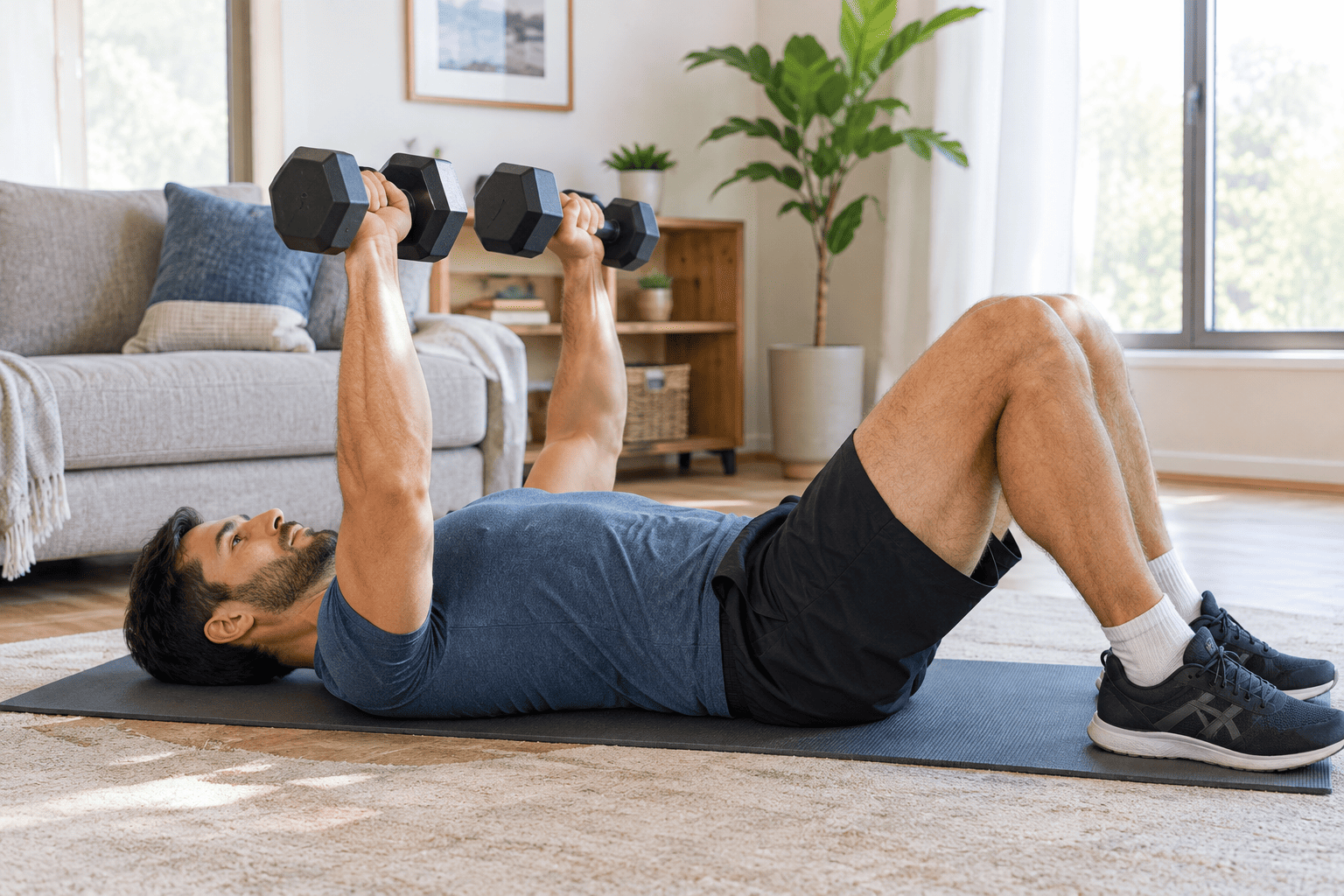
The main lift of the session. Lie on your back with knees bent and feet flat. Hold a dumbbell in each hand with your upper arms at about 45 degrees from your body, not flared straight out. Press up until your arms are straight above your chest, then lower until your upper arms rest on the floor.
Pause for a second when your elbows touch. Do not bounce. That pause is what makes the exercise honest, because it removes any momentum and forces your chest to start the rep from a dead stop.
2. Dumbbell floor fly
This is the exercise that replaces the stretch you lose from not having a bench. Lie in the same position with lighter dumbbells held above your chest, palms facing each other, elbows slightly bent. Open your arms out to the sides in a wide arc until your upper arms touch the floor, then bring them back together over your chest.
Keep the slight elbow bend fixed the whole time. Go much lighter than you think, because the leverage at the bottom is brutal, and the shoulder does not enjoy being surprised here.
3. Dumbbell squeeze press
Hold two dumbbells together over your chest, palms facing each other, and press them hard into each other for the whole set. Keeping that inward pressure, lower them to your chest and press back up.
The squeeze is the point. It keeps your chest under tension through the entire rep, including at the top where a normal press gets easy. This one is excellent when your dumbbells are lighter than you would like.
4. Single arm floor press
Same as the floor press, but one arm at a time with the other arm out to the side for balance. Your core has to fight to stop your body twisting, and any strength difference between sides becomes obvious fast.
Do the weaker side first and match the reps on the stronger side. Most people have a difference. Training one arm at a time is the simplest way to even it out.
5. Feet-elevated push-ups
Put your feet on a sofa, chair or bottom stair and do push-ups with your hands on the floor. Raising your feet shifts more of your body weight forward, which loads the upper chest and shoulders in a way that mimics an incline press.
This is my honest answer to the “how do I train upper chest without a bench” question. You do not need an adjustable bench. You need your feet higher than your hands. My guide to incline and decline push-ups walks through the full progression.
6. Dumbbell pullover on the floor
Lie on your back holding one dumbbell with both hands above your chest. Keeping a slight bend in your elbows, lower the dumbbell back over your head towards the floor, then pull it back over your chest.
Go slowly and only as far as your shoulders comfortably allow. It works the chest and the lats together, and it makes a nice finisher.
The complete no-bench chest workout
| Exercise | Sets | Reps | Rest |
|---|---|---|---|
| Dumbbell floor press | 4 | 8 to 12 | 90 seconds |
| Feet-elevated push-ups | 3 | As many good reps as possible, stopping 2 short of failure | 90 seconds |
| Dumbbell floor fly | 3 | 12 to 15 | 75 seconds |
| Dumbbell squeeze press | 3 | 12 to 15 | 60 seconds |
| Single arm floor press | 2 | 10 per side | 60 seconds |
| Dumbbell pullover | 2 | 12 | 60 seconds |
That is about 35 minutes with the warm-up. If you are short on time, do the first four exercises and stop.
The one dumbbell version
If you only have a single dumbbell, you can still get a proper session.
| Exercise | Sets | Reps |
|---|---|---|
| Single arm floor press | 4 | 8 to 12 per side |
| Squeeze press with one dumbbell held vertically | 3 | 12 to 15 |
| Feet-elevated push-ups | 3 | As many good reps as possible |
| Dumbbell pullover | 3 | 12 |
| Slow push-ups, 4 seconds down | 2 | 8 to 10 |
How to hit the upper chest with no incline
This comes up constantly, so here are the options ranked by how well they actually work at home:
- Feet-elevated push-ups. The closest thing to an incline press without equipment. Higher feet means more upper chest.
- Floor press with your hips bridged up. Lift your hips into a glute bridge and press. The slight change in torso angle shifts a little work upwards. Keep your ribs down.
- Low incline using a sofa or stairs. Lie with your upper back on a low, firm surface like the bottom stair or a sturdy step. Only do this if the surface is completely stable.
- Push-ups on parallel handles. If you have push-up handles, the extra depth gives more stretch.
What I would not do is stack cushions to make a makeshift incline bench. They shift, your shoulder ends up in a strange position, and dropping a dumbbell on a wobbly surface is how people get hurt.
Sets, reps and progression
| Stage | Sets | Reps | Rest |
|---|---|---|---|
| First 3 to 4 weeks | 2 to 3 | 10 to 12, comfortable | 60 to 90 seconds |
| Building strength | 3 to 4 | 8 to 12 | 90 seconds |
| Flys and isolation work | 2 to 3 | 12 to 15 | 60 seconds |
Progress with double progression. Pick a rep range, start at the bottom of it, add a rep or two each session, and when you hit the top of the range on every set, add weight and drop back down.
If your dumbbells are too light to make 12 reps hard, use these instead of buying heavier ones:
- Slow the lowering phase to 4 seconds
- Pause for 2 seconds with your elbows on the floor
- Add a 1 second squeeze at the top of each rep
- Reduce rest to 45 seconds
- Move to single arm versions
Why push-ups still matter when you have dumbbells
It is tempting to treat push-ups as the thing you did before you owned dumbbells. That would be a mistake, and here is why.
Push-ups give you the full range the floor press takes away. Your chest gets a proper stretch at the bottom because your torso can travel between your hands, and your shoulder blades are free to move the way they naturally do, which they cannot when your back is pinned against the floor or a bench.
They also scale endlessly without buying anything. Hands on a counter, then a sofa arm, then a low step, then the floor, then feet elevated, then one arm assisted. That is years of progression sitting in your living room.
The practical approach is to use both in the same session. Press with dumbbells while you are fresh, since that is where you can load the muscle hardest. Then do push-ups second, where the stretch and the higher reps do a different job. The workout above is built exactly that way.
If push-ups are still difficult, do not skip them and hope. Work through the progression properly. My guide to incline and decline push-ups lays out each stage, and the beginner upper body workout shows how to build the strength around them.
A simple 4-week starting plan
If you want something concrete to follow, here is how I would introduce this workout from scratch. Do it once or twice a week.
| Week | What to do | Focus |
|---|---|---|
| Week 1 | 2 sets of each exercise, lighter than you think | Learn the positions, find your weights |
| Week 2 | 2 sets, add 1 to 2 reps where you can | Smooth reps, a real pause on the floor |
| Week 3 | 3 sets of the first four exercises | Build volume, keep the tempo honest |
| Week 4 | 3 sets, add reps or a small weight increase | Start double progression properly |
Write down every session. Exercise, weight, sets, reps. It takes half a minute and it is the difference between training and just moving dumbbells around. After four weeks you will have a clear picture of which exercises are progressing and which need a lighter weight and better technique.
A realistic expectation: most beginners add a few reps per set within the first month, and notice the weights feeling more controlled before they notice anything in the mirror. Visible change in the chest usually takes a few months of consistent work, which is completely normal and not a sign anything is wrong.
Common mistakes
- Flaring the elbows to 90 degrees. Keep them around 45 degrees from your body to protect the front of your shoulder.
- Bouncing the elbows off the floor. It turns a controlled press into a rebound, and it stings.
- Going too heavy on flys. The most common way people hurt a shoulder at home.
- Only ever pressing. Without the fly and push-up variations, you are training a narrow slice of the movement.
- Skipping the back work. Chest training without rowing tends to pull your shoulders forward over time. My chest and back workout balances both in one session.
- Training chest four times a week. Twice is plenty, with at least 48 hours between.
Use tempo when the weights run out
The most common problem with home chest training is not technique, it is that your heaviest dumbbells eventually become too light. Buying heavier ones is one answer. Changing how you lift is the cheaper one, and it works better than people expect.
- Slow the lowering. Take four seconds to lower the dumbbells and one to press. The muscle spends far longer under tension, and the same weight suddenly feels considerably heavier.
- Pause at the bottom. Two full seconds with your elbows resting on the floor kills all momentum.
- Add a squeeze at the top. One second of pressing the dumbbells together turns an easy lockout into work.
- Do one and a half reps. Press all the way up, lower halfway, press again, then lower fully. That counts as one rep and it is brutal in the best way.
- Shorten your rest. Dropping from 90 seconds to 45 makes a light weight feel heavy by the third set.
Pick one of these at a time rather than all five at once. Otherwise you cannot tell what made the difference, and you will simply be exhausted.
Where it fits in your week
| Days per week | How to use this workout |
|---|---|
| 2 days | One chest and back day, one lower body and core day |
| 3 days | Push day, pull day, legs. This workout becomes the chest part of push day |
| 4 days | Upper, lower, upper, lower. Use this on one upper day and a lighter version on the other |
If you train with the push, pull and legs approach, this session slots straight into my push day workout, which adds the shoulder and tricep work. For a broader plan that includes everything, the dumbbell workout plan for beginners is the simplest place to start. And if you want an upper body session that covers more than chest, try the upper body dumbbell workout.
If your shoulders complain
Chest pressing is one of the most common sources of shoulder niggles in beginners, and it is usually fixable.
- Tuck your elbows closer to your body
- Turn your palms slightly towards each other rather than fully forward
- Reduce the weight and slow the rep down
- Warm the shoulders up properly before the first working set
- Add upper back work, which changes how your shoulder blades sit
Sharp pain, clicking that hurts or pain that lingers for days is worth getting assessed rather than training around.
Frequently asked questions
Can you train chest with dumbbells without a bench?
Yes. The dumbbell floor press, floor fly, squeeze press and push-up variations cover the chest well. You lose a small amount of range at the bottom compared with a bench, which you can make up for with feet-elevated push-ups and slower tempos.
Is the floor press as good as the bench press?
For pure chest size, the bench press has a slight edge because of the deeper stretch. For beginners training at home, the floor press is close enough to be a genuine substitute, and it is usually kinder on the shoulders.
How do I work my upper chest without an incline bench?
Raise your feet instead of your torso. Feet-elevated push-ups shift the load towards the upper chest and front shoulders. Pressing with your hips bridged up also changes the angle slightly.
How many chest exercises should I do without a bench?
Four to six exercises is plenty. Start with a press, add a push-up variation and a fly, then finish with one or two accessory moves like the squeeze press or pullover.
Can I build a chest with just dumbbells at home?
Yes. Chest muscle responds to progressive load and enough total sets, not to a specific piece of equipment. Add reps, slow your tempo or increase the weight over time and your chest will keep developing.
How often should I train chest?
Once or twice a week for most beginners, with at least 48 hours between sessions. Twice a week with moderate volume usually produces better results than one very long session.
What if I only have one dumbbell?
Use single arm floor presses, squeeze presses with the dumbbell held vertically, pullovers and slow push-ups. Training one side at a time also evens out strength differences between your arms.
Why do my shoulders hurt during dumbbell presses?
Most often because the elbows are flared out to 90 degrees, the weight is too heavy or the shoulders were not warmed up. Tuck your elbows to about 45 degrees, turn your palms slightly inward and lighten the load. If pain persists, get it checked.
Source: NHS, Physical activity guidelines for adults aged 19 to 64