Home Workouts for Beginners: The Complete Guide
So you want to start working out at home, but every plan you find seems built for people who are already fit, already own a rack of dumbbells, or already know what an AMRAP is. I’ve been there, staring at my living room floor with no clue what to do, and it’s exactly why I put this together. This is the complete, no-nonsense guide to home workouts for beginners: no gym, no fancy equipment, and honestly no experience required.
I’m Atif, and I’m not a personal trainer. I’m someone who started at absolute zero and slowly figured out what actually works when you’re new to all of this. In this guide I’ll walk you through why home workouts are perfect for beginners, exactly what you need to start (spoiler: almost nothing), a safe bodyweight routine you can do today, how often to train, the mistakes to skip, and how to keep going once that first burst of motivation fades.
No pressure, no jargon, and no shame. Let’s take your first step together, and set you up for your fiftieth too.
Why home workouts work so well for beginners
When you’re just starting out, the biggest battle isn’t strength or fitness. It’s simply showing up. And that’s exactly where working out at home quietly wins.
- No commute, no excuses. Rolling out a mat in your living room takes ten seconds. There’s no bag to pack, no drive, and no reason to talk yourself out of it.
- No one is watching. Gym anxiety is real, and it stops a lot of people before they even begin. At home you can be as wobbly, sweaty, and beginner as you like, and nobody sees a thing.
- It costs nothing. Your own body weight is a genuinely excellent gym. You can build real strength for zero dollars.
- You go at your own pace. Pause the video, repeat a move, or rest for a minute. There’s no class to keep up with and no one rushing you.
- It builds a habit that sticks. Because it’s so convenient, working out at home is far easier to repeat, and repetition is what turns exercise from a chore into a routine.
Here’s the part beginners often miss: your own body weight is more than enough to get started. You don’t need to lift heavy to get stronger, feel better, and build momentum. You just need to begin. If you like browsing routines by type, my home workouts section is built entirely around this idea.
What you actually need to start (spoiler: almost nothing)
Let’s clear the shopping list out of the way, because this is where a lot of beginners stall, convinced they need to buy things first. You don’t. Here’s the honest, complete list:
- Comfortable clothes you can move in.
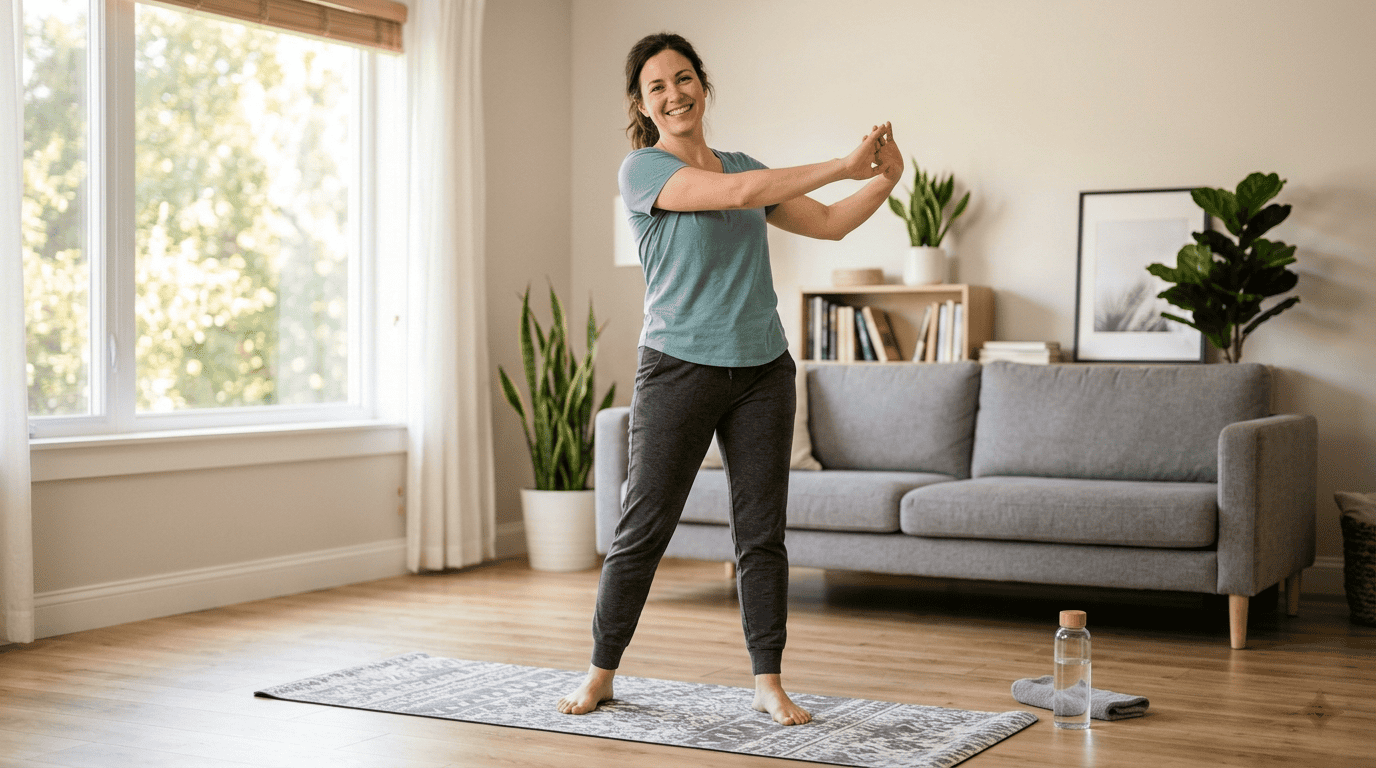
- A small patch of floor, roughly the size of a bath towel.
- A bottle of water within reach.
- Optional: a mat, rug, or folded towel, so your knees and back are comfortable on the floor.
- Optional: supportive shoes, though barefoot is completely fine for most of what is below.
That’s genuinely it. Later, when you want a little more variety, a set of resistance bands is the best few dollars you can spend, and I cover honest options in my equipment guides. But please don’t let gear be the reason you wait. Start with your body, today.
A quick, honest note before we start. I’m a fellow beginner sharing what worked for me, not a doctor or a trainer, and everything here’s general information, not medical advice. If you have an injury or a health condition, are pregnant, or you’re simply not sure, please check with your doctor before starting a new exercise routine. And whatever you do, listen to your body: a bit of effort and mild muscle fatigue is normal and good, but sharp pain, dizziness, or chest pain means stop and rest. You can read my full medical disclaimer here.
A safe beginner bodyweight routine you can do today
This is a full-body routine designed for complete beginners. It uses gentle, foundational movements, gives you an easier option for every exercise, and takes about fifteen to twenty minutes including the warm-up. Don’t rush it. Good, controlled movement beats fast, sloppy reps every single time.
Step 1: Warm up for three minutes (never skip this)
Warming up wakes up your muscles and joints and genuinely lowers your risk of tweaking something. Spend about three minutes doing gentle, easy movement:
- March in place for 30 seconds.
- Roll your shoulders and make slow arm circles.
- Do slow, gentle torso twists side to side.
- Step side to side to get your legs moving.
- Swing each leg gently front to back, holding a wall for balance.
You should feel a little warmer and looser afterwards, not tired. For more ideas, my stretching and mobility section has full warm-up and cool-down routines you can follow along with.
Step 2: The beginner full-body circuit
Do each exercise below in order, resting for 30 to 60 seconds between them. Once you finish all six, that’s one round. Beginners can start with just one round and build up to two or three over the coming weeks. Only add a round when the previous one feels genuinely doable.
1. Bodyweight squats (8 to 12 reps)
Stand with your feet about shoulder-width apart. Push your hips back as if you’re sitting into a chair, keeping your chest up and your weight in your heels, then stand back up. Go only as low as feels comfortable. Easier option: place a real chair behind you and lightly tap it with your bum on each rep. How it should feel: your thighs and glutes working, never sharp pain in your knees.
2. Wall or incline push-ups (6 to 10 reps)
Full push-ups on the floor are tough for most beginners, and that’s completely fine. Instead, place your hands on a wall or a sturdy countertop, step your feet back, and bend your elbows to bring your chest toward the surface, then push away. The more upright you’re, the easier it’s. How it should feel: your chest, shoulders, and arms working, while you keep your body in one straight line from head to heels.
3. Glute bridges (10 to 12 reps)
Lie on your back with your knees bent and feet flat on the floor. Squeeze your glutes and lift your hips toward the ceiling until your body forms a gentle straight line from knees to shoulders, then lower slowly. This one is brilliant for anyone who sits a lot during the day. How it should feel: your glutes doing the work, not your lower back.
4. Standing knee lifts (20 total, alternating)
Stand tall and march on the spot, lifting each knee up toward hip height in a slow, controlled way. Hold onto a wall or chair for balance if you need to. This gently raises your heart rate and works your core and hips. Easier option: lower the knee height and slow the whole thing right down.
5. Bird-dog (6 to 8 per side)
Start on your hands and knees, hands under your shoulders and knees under your hips. Slowly extend your right arm forward and your left leg back at the same time, keeping your hips level and your core gently braced, then return and switch sides. This builds the deep core and back strength that makes everyday movement easier. How it should feel: steady and controlled, with no wobbling or arching your back.
6. Modified plank (hold 10 to 20 seconds)
From your hands and knees, walk your hands slightly forward and hold your body in a straight line from head to knees, resting on your forearms if that’s comfier. Keep your core tight and keep breathing. Build the time up slowly, week by week. Easier option: hold the plank standing, leaning into a wall or countertop instead.
Step 3: Cool down and stretch
Finish with two or three minutes of gentle stretching while your muscles are still warm. Reach for your toes, open your chest, stretch your thighs and calves, and take a few slow breaths. It helps you feel good afterwards, and feeling good is what keeps you coming back. The stretching and mobility section has full cool-down routines if you want to follow along.
How to progress over time
When one round starts to feel easy, add a second. When two rounds feel easy, add a third, or add a couple of reps to each exercise, or simply slow your movements down to make them harder. That slow, steady build is the entire secret. You don’t need a brand-new program every week, you just need to keep gently nudging these same simple movements forward.
How often should a beginner work out?
For most beginners, two to three short sessions a week is the sweet spot. It’s enough to build real strength and a real habit, without leaving you so sore or exhausted that you dread the next one.
Leave at least one rest day between sessions at first, for example Monday, Wednesday, and Friday. Rest days aren’t lazy days, they are when your body actually adapts and gets stronger. On the days in between, a gentle walk is a wonderful and underrated way to stay active and lift your mood.
If two or three days feels like a lot right now, start with one. A single workout a week that you actually do beats a five-day plan you abandon by Thursday. For more on the habit side of things, my habits and motivation section is all about staying consistent.
Common beginner mistakes to avoid
I made most of these myself, so please learn from my stumbles:
- Doing too much, too soon. The classic. Five hard days in week one leads to being too sore to move in week two, and quitting by week three. Start smaller than you think you need to.
- Skipping the warm-up or rest days. Both feel optional. Neither is. Skipping them is the fast track to aches and burnout.
- Chasing reps over form. Ten sloppy squats do less for you, and risk more, than six slow and controlled ones. Quality first, always.
- All-or-nothing thinking. Missed a workout, or a whole week? That’s not failure, it’s just life. Pick up exactly where you left off, no guilt required.
- Comparing yourself to people online. The person doing one-arm push-ups was a beginner once too. Your only fair comparison is you, last month.
- Expecting overnight results. Real change takes weeks and months, not days, which leads nicely into the next section.
How to actually stay consistent
Motivation is fun but unreliable. It shows up loud in week one and quietly slips out by week three. Consistency is what is left when motivation clocks out, and the good news is that you can build it on purpose.
- Start ridiculously small. A five-minute workout you’ll actually do is infinitely better than a perfect plan you’ll not.
- Schedule it like an appointment. Pick your days and a rough time, and treat them as non-negotiable as brushing your teeth.
- Stack it onto an existing habit. Work out right after your morning coffee or before your evening shower, so a routine you already have reminds you.
- Track your streak. Tick a box or mark a calendar every time you finish. Watching the chain grow is weirdly and wonderfully motivating.
- Be kind on the off days. The people who succeed aren’t the ones who never miss. They are the ones who restart quickly, without beating themselves up.
That’s the whole game, really: show up, keep it small, be kind to yourself, and let the results catch up to you. They will. If you would like to know a bit more about the person nudging you along, here’s a little about me and this site.
Frequently asked questions
How do I start working out at home as a beginner?
Start with the simple warm-up and beginner circuit above, just one round, two or three times a week. Focus on showing up and moving with control rather than pushing hard. You can build up the number of rounds and reps gradually as it starts to feel easier.
Can I really get fit at home with no equipment?
Absolutely. For a beginner, your own body weight provides plenty of resistance to build strength, stamina, and confidence. Movements like squats, glute bridges, and push-ups work your whole body. Equipment can add variety later, but it’s genuinely optional when you’re starting out.
How long should a beginner workout be?
About fifteen to twenty minutes, including your warm-up and cool-down, is a great starting point. Short and consistent beats long and occasional every time. As you get fitter you can add rounds to make sessions a little longer, but you never have to.
How often should beginners work out?
Two to three sessions a week, with a rest day in between, works well for most beginners. If that feels like too much right now, start with one session a week and build from there. Gentle walks on your off days are a lovely bonus.
What if I’m very unfit or overweight? Is this still for me?
Yes. This routine is designed to be gentle, and every exercise has an easier option, so you can scale it to wherever you’re today. Go slowly, use the modifications, and stop if anything hurts. If you have any health concerns, please check with your doctor first, as always.
How soon will I see results?
You’ll likely feel results, such as more energy, a better mood, and a sense of momentum, within a week or two. Visible changes in strength and body shape take longer, usually a couple of months of consistency. Focus on how you feel and on simply not missing, and the rest tends to follow.
Your first step starts now
You don’t need to be fit to start. You just need to start in order to get fit. Roll out a towel, do one gentle round today, and you’re officially a person who works out at home. I’m genuinely rooting for you.
Ready for more? Browse beginner-friendly routines in home workouts and beginner workouts. And remember, everything here’s general information to help you get moving, not medical advice, so listen to your body and check with a professional if you’re ever unsure.