Desk Exercises: 18 Simple Moves You Can Do at Work Without Breaking a Sweat
Desk exercises are short, quiet movements you can do at your desk or right beside it, without changing clothes or breaking a sweat. They will not replace a proper workout, but they do something a workout cannot: they break up the long hours of sitting that leave your neck stiff, your back aching and your energy flat by mid-afternoon.
I spent years at a desk job convinced that my evening gym sessions cancelled out the day. They did not. By four o’clock I was stiff from my neck to my hips, no matter how fit I was. What actually changed things was embarrassingly simple: a timer on my phone every 30 minutes, and two minutes of the moves below each time it went off. My colleagues thought it was odd for about a week. Then two of them joined in.
This guide covers 18 desk exercises for your neck, shoulders, back, wrists and legs, standing desk exercises, short routines for busy days, what desk exercise equipment is worth buying, and what the research says about breaking up sitting.
At a glance
- Long, unbroken sitting is linked to stiffness and poorer health, even in people who exercise
- Breaking up sitting every 20 to 30 minutes with a couple of minutes of movement helps
- The most useful desk exercises loosen the neck, upper back and hips, and wake up the legs
- Every exercise here can be done in work clothes in a normal office
- A 2-minute routine every half hour is more valuable than one long stretch at the end of the day
- A standing desk helps you sit less, but standing all day is not the goal either. Variety is
- Under-desk pedals or steppers add movement, but walking breaks are free and just as useful
Why desk exercises matter
What long sitting does
- Stiffness. Muscles held in one position for hours tighten and ache, especially the neck, upper back, hip flexors and lower back
- Posture drift. The head creeps forward and the upper back rounds as you lean toward the screen
- Blood sugar. In a laboratory study of overweight and obese adults, breaking up five hours of sitting with two minutes of light or moderate walking every 20 minutes lowered the rise in blood glucose and insulin after a meal compared with sitting the whole time
- Long-term health. A very large analysis of over one million adults found that high sitting time was linked to a higher risk of death, and that about 60 to 75 minutes a day of moderate activity seemed to eliminate that extra risk
The World Health Organization’s guidelines now recommend that adults limit sedentary time and replace some of it with physical activity of any intensity.
What desk exercises can and cannot do
| Desk exercises can | Desk exercises cannot |
|---|---|
| Ease stiffness in the neck, back and hips | Replace your weekly exercise |
| Break up long periods of sitting | Undo a whole day of sitting in one go |
| Improve how you feel through the afternoon | Fix a badly set up workstation on their own |
| Build small amounts of strength over time | Build significant fitness |
Think of them as maintenance between proper workouts, not instead of them.
Desk exercises for the neck and shoulders
1. Chin tuck
Sit tall, eyes level, and glide your head straight back, as if making a double chin. Hold for 5 seconds.
Dose: 10 reps. The single best antidote to leaning toward a screen. Our chin tuck exercise guide shows the progressions.
2. Neck side stretch
Let one ear drop toward the same shoulder, keeping the other shoulder down. Hold for 20 seconds per side.
3. Shoulder rolls
Lift your shoulders toward your ears, roll them back and down, and relax. Do 10 slow circles, then reverse.
4. Shoulder blade squeeze
Gently draw your shoulder blades back and down, hold for 5 seconds and relax.
Dose: 10 reps. Strengthens the mid back muscles that hold good posture. Our mid back exercises guide has more.
5. Seated upper trap stretch
Sit on your right hand to anchor the shoulder, tilt your left ear toward your left shoulder and turn your nose slightly down. Hold for 20 seconds, then swap.
Desk exercises for the back
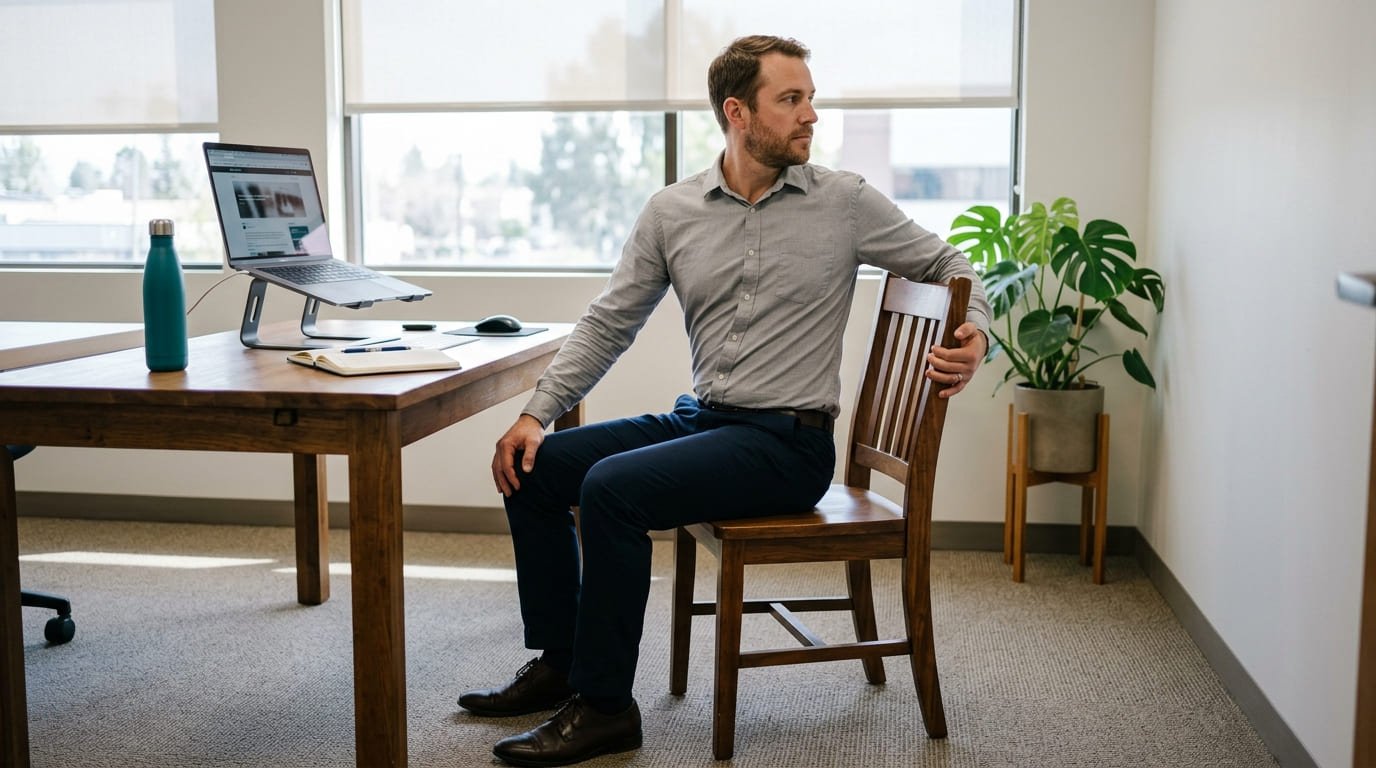
6. Seated twist
Sit tall, feet flat. Turn your upper body to the right, holding the back of the chair lightly. Hold for 20 seconds, then turn left. Avoid this in a chair that swivels; brace a foot or use a fixed chair.
7. Chair back extension
Clasp your hands behind your head and gently lean back over the top of the chair back, lifting your chest. Do 10 slow reps. Only use a sturdy chair with a solid backrest.
8. Upper back hug
Wrap your arms around yourself, round your upper back and breathe into the space between your shoulder blades for 20 seconds.
9. Seated cat-cow
Sit on the front of your chair, hands on your knees. Round your back as you breathe out, then arch and lift your chest as you breathe in. Do 10 slow reps.
Our thoracic mobility exercises and back stretching exercises guides have longer routines for the back.
Desk exercises for wrists and hands
10. Wrist flexor stretch
Hold one arm straight in front of you, palm up. With the other hand, gently bend the fingers back toward you. Hold for 15 to 20 seconds per side.
11. Wrist extensor stretch
The same, palm down, gently bending the hand down toward you.
12. Finger spreads and fists
Make a tight fist, then spread your fingers as wide as possible. Do 10 reps. Good for anyone who types or uses a mouse all day.
Desk exercises for the legs and hips
13. Seated march
Sit tall and lift one knee, then the other, as if marching. Do 30 seconds. Quietly gets the blood moving.
14. Seated leg extension
Straighten one knee until the leg is level, squeeze the thigh, hold for 3 seconds and lower. Do 10 per leg.
15. Heel and toe raises
Seated or standing, lift your heels, then lift your toes. Do 15 to 20. The calf muscles help pump blood back from the legs.
16. Glute squeeze
Squeeze your buttocks, hold for 5 seconds and relax. Do 10 reps. Nobody will notice.
17. Chair squat
Stand up from your chair without using your hands, then sit back down slowly. Do 10 reps. If your chair has wheels, lock them or place it against a desk.
18. Standing hip flexor stretch
Stand with one foot a step behind the other, tuck your tailbone and shift your hips gently forward until you feel a stretch at the front of the back hip. Hold for 20 to 30 seconds per side. Tight hip flexors are one of the main side effects of sitting.
| Exercise | Area | Seated or standing | Time |
|---|---|---|---|
| Chin tuck | Neck | Either | 1 minute |
| Neck side stretch | Neck | Either | 40 seconds |
| Shoulder rolls | Shoulders | Either | 30 seconds |
| Shoulder blade squeeze | Upper back | Either | 1 minute |
| Upper trap stretch | Neck and shoulders | Seated | 40 seconds |
| Seated twist | Back | Seated | 40 seconds |
| Chair back extension | Upper back | Seated | 30 seconds |
| Upper back hug | Upper back | Either | 20 seconds |
| Seated cat-cow | Whole spine | Seated | 40 seconds |
| Wrist stretches | Wrists | Either | 1 minute |
| Finger spreads and fists | Hands | Either | 20 seconds |
| Seated march | Hips and legs | Seated | 30 seconds |
| Seated leg extension | Thighs | Seated | 1 minute |
| Heel and toe raises | Calves and shins | Either | 30 seconds |
| Glute squeeze | Buttocks | Seated | 1 minute |
| Chair squat | Legs | Standing | 40 seconds |
| Hip flexor stretch | Hips | Standing | 1 minute |
Exercises you can do at your desk: three routines
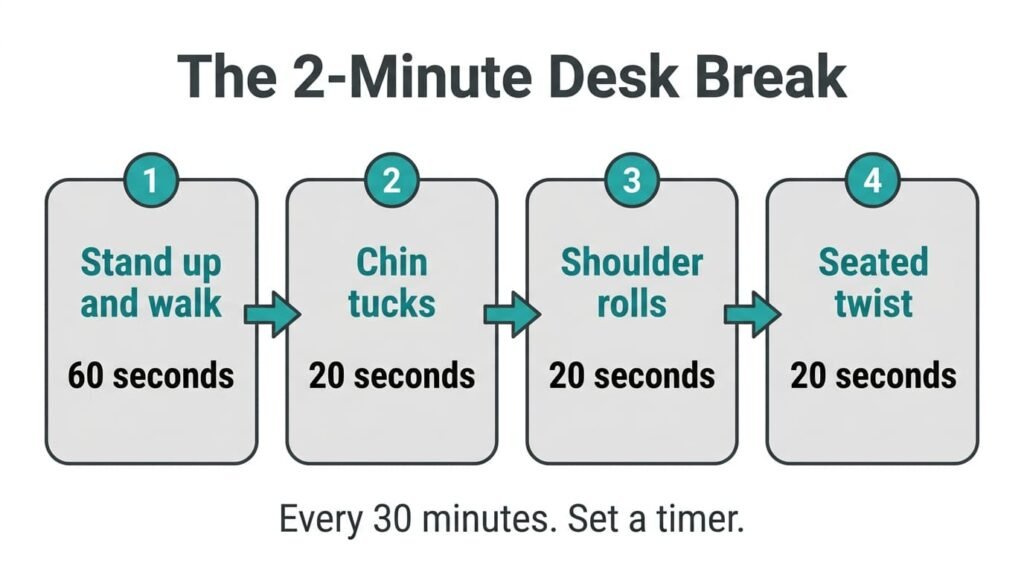
The 2-minute break, every 30 minutes
| Exercise | Time |
|---|---|
| Stand up and walk, to the water cooler, a window or the stairs | 60 seconds |
| Chin tucks | 20 seconds |
| Shoulder rolls | 20 seconds |
| Seated or standing twist | 20 seconds |
Set a timer. This one small habit makes more difference than any of the individual exercises you can do at your desk.
The 5-minute neck and back reset
| Exercise | Dose |
|---|---|
| Chin tuck | 10 x 5-second holds |
| Neck side stretch | 20 seconds per side |
| Shoulder blade squeeze | 10 x 5-second holds |
| Chair back extension | 10 reps |
| Seated twist | 20 seconds per side |
| Upper back hug | 20 seconds |
The 10-minute lunch break routine
| Exercise | Dose |
|---|---|
| Brisk walk outside | 5 minutes |
| Chair squats | 2 x 10 |
| Desk push-ups, hands on a sturdy desk edge | 2 x 10 |
| Standing hip flexor stretch | 30 seconds per side |
| Heel raises | 20 reps |
| Seated cat-cow | 10 reps |
Desk push-ups only on a solid, non-wheeled desk that cannot move. If in doubt, push against a wall instead.
Standing desk exercises
A standing desk lets you change position, which is the real benefit. A Cochrane review found low-quality evidence that sit-stand desks reduce sitting time at work in the short and medium term, but little is known about the long term. Standing still for hours has its own downsides, so the aim is to alternate.
These standing desk exercises keep you moving while you stand:
| Exercise | How | Dose |
|---|---|---|
| Calf raises | Rise onto your toes and lower slowly | 20 reps |
| Weight shifts | Shift your weight slowly from one foot to the other | 30 seconds |
| Standing marches | Lift each knee gently in turn | 30 seconds |
| Mini squats | Bend the knees a little and stand up | 10 reps |
| Hip circles | Hands on hips, circle the hips slowly | 10 each way |
| Standing hip flexor stretch | Split stance, tuck the tailbone, shift forward | 30 seconds per side |
| Single-leg balance | Stand on one leg, holding the desk lightly | 20 seconds per side |
| Desk push-ups | Hands on a solid desk edge, body straight | 10 reps |
A simple rhythm that works for many people: sit for about 30 minutes, stand for a while, move for a couple of minutes, and repeat. Change position before you feel stiff rather than after.
Desk exercise equipment: what is worth it?
You need nothing for any of the exercises above. If you want to add movement while you work, here is an honest look at the common desk exercise equipment.
| Equipment | What it does | Worth it? |
|---|---|---|
| Sit-stand desk or converter | Lets you change position through the day | Useful if you remember to use it |
| Under-desk pedal exerciser | Lets you pedal gently while seated | Adds light movement. Check it fits under your desk and is quiet |
| Under-desk walking pad | A slow treadmill for a standing desk | Good for some people, but takes space and can affect typing |
| Mini stepper | Small stepping machine | Fine for short breaks, noisy for open offices |
| Resistance band | Light band for rows, pull-aparts and stretches | Cheap, quiet and useful |
| Balance cushion | Inflatable cushion to sit or stand on | Adds a little movement. No strong evidence for posture benefits |
| Exercise ball chair | Sitting on a stability ball | Not a substitute for a good chair. Use for short periods only |
| Hand grip trainer | Squeezes for the hands and forearms | Useful for grip, not much else |
The best desk exercise equipment is the cheapest: a timer and a reason to stand up. A resistance band in your drawer is a good second. Our resistance bands guide explains which to buy.
Desk exercises for common complaints
| Complaint | Best desk exercises | Also try |
|---|---|---|
| Stiff neck by mid-afternoon | Chin tucks, neck side stretch, upper trap stretch | Raise your screen to eye level |
| Aching between the shoulder blades | Shoulder blade squeeze, upper back hug, chair back extension | Rows or band pull-aparts at home |
| Lower back stiffness | Seated cat-cow, seated twist, standing hip flexor stretch | Stand up every 30 minutes |
| Tight wrists and forearms | Wrist flexor and extensor stretches, finger spreads | Check keyboard height and mouse position |
| Heavy, restless legs | Seated march, heel and toe raises, chair squats | Walk to refill your water |
| Afternoon energy slump | A 2-minute walk, chair squats, calf raises | Daylight, ideally outdoors |
| Tension headaches | Chin tucks, shoulder rolls, neck stretches | Regular screen breaks and enough water |
If a complaint keeps coming back despite desk exercises and a good setup, it is worth seeing a doctor or physiotherapist.
Set up your desk to need fewer stretches
| Setting | Aim |
|---|---|
| Screen | Top of the screen at or just below eye level, about an arm’s length away |
| Keyboard and mouse | Close to you, elbows bent around 90 degrees, shoulders relaxed |
| Chair | Feet flat on the floor, hips slightly higher than knees, lower back supported |
| Laptop | Use a stand plus a separate keyboard and mouse if you work on it for long |
| Phone | Hold it up toward eye level, or use a headset for long calls |
A good setup reduces the strain. Desk exercises deal with what is left.
Habits that make it stick
- Set a timer for every 30 minutes. Phone, watch or a simple app
- Link moves to triggers: chin tucks after every email you send, a walk with every coffee
- Take calls standing or walking
- Use the stairs and the furthest toilet
- Walk to a colleague instead of messaging
- Drink water, which means more trips to refill and to the toilet
- Do the 2-minute routine with someone. It is easier when you are not the only one
Short daily efforts add up. In one trial, as little as two minutes a day of resistance exercise reduced neck and shoulder pain in office workers with frequent symptoms over ten weeks.
And outside work, a regular walk and a couple of short strength sessions each week do the heavy lifting. Our walking guide and 10-minute morning workout are good places to start.
Desk exercises for remote workers
Working from home often means even less movement: no walk to the station, no trip to a meeting room, sometimes no reason to leave the kitchen table all day. A few changes help.
- Fake the commute. Walk for 10 minutes before you start and after you finish
- Move between rooms. Take calls in a different room, standing up
- Use the stairs. If you live in a house or a block of flats, a few flights between tasks is a quick way to raise your heart rate
- Keep a resistance band on the desk and do a set of rows or pull-aparts after each meeting
- Do a proper lunch break routine. Ten minutes of the lunch routine above, then eat away from the screen
- Avoid the sofa and bed for work. They are the worst setups for the neck and back
If you work at a kitchen table, a cushion on the chair and a stack of books under the laptop, with a separate keyboard, makes a big difference.
Common mistakes
- Saving all your movement for the end of the day
- Stretching into pain, especially the neck
- Using a wheeled office chair for squats, dips or twists without securing it
- Standing still all day at a standing desk instead of alternating
- Buying equipment and not using it
- Forgetting the eyes: every 20 minutes, look at something about 6 metres away for 20 seconds
- Assuming desk exercises replace a workout
Safety notes
Desk exercises are gentle and suit almost everyone. Stop and seek advice if a movement causes sharp pain, if you have neck pain with numbness or tingling in the arms, or if you feel dizzy when turning your head. If you are pregnant, have recently had surgery or have a joint or back condition, ask your doctor or physiotherapist which moves suit you.
This article is general information, not medical advice. See our medical disclaimer.
The bottom line
Desk exercises are small, quiet moves that break up sitting and ease the stiffness of long working days. The research is clear that long, unbroken sitting is worth interrupting, and that frequent short breaks help.
Set a timer for every 30 minutes, stand up and do two minutes of movement: a short walk, chin tucks, shoulder rolls and a twist. Add a 5-minute neck and back reset when you need it, and a 10-minute routine at lunch. If you have a standing desk, alternate rather than standing all day. Keep a resistance band in your drawer, and save your money on most other gadgets.
Frequently asked questions
What are the best desk exercises?
Chin tucks, shoulder rolls, shoulder blade squeezes, seated twists, chair back extensions, wrist stretches, seated marches, chair squats and standing hip flexor stretches. Together they cover the areas that stiffen most when you sit.
What exercises can you do at your desk without anyone noticing?
Chin tucks, shoulder blade squeezes, glute squeezes, seated leg extensions, heel and toe raises and finger spreads are almost invisible. They can all be done while you read or listen in a meeting.
How often should I do desk exercises?
Aim for two minutes of movement every 20 to 30 minutes. Research shows that frequent short breaks from sitting have benefits that one long break at the end of the day does not.
What are good standing desk exercises?
Calf raises, weight shifts, standing marches, mini squats, hip circles, standing hip flexor stretches, single-leg balance and desk push-ups on a solid desk. Alternate standing with sitting and short walks.
Is desk exercise equipment worth buying?
Some is. A sit-stand desk helps you change position, and a resistance band is cheap and useful. Under-desk pedals and walking pads add light movement for some people. None is essential, and regular walking breaks are free.
Can desk exercises help with back pain?
They can ease stiffness from sitting, especially gentle twists, back extensions and hip flexor stretches. For persistent back pain, combine them with regular walking and strength work, and see a professional if it does not improve.
Do desk exercises burn calories?
Only a few. Their main value is breaking up sitting and reducing stiffness. For weight management, regular walking and full workouts matter much more.
Is it bad to sit all day if I exercise?
Exercise helps a lot, and high levels of daily activity appear to offset much of the risk linked to long sitting. But stiffness and blood sugar benefits still come from breaking up sitting, so do both.
What’s next?
Reading is the easy part. Pick one of these and do it today.