Back Stretching Exercises: 14 Gentle Stretches for Lower and Upper Back
Back stretching exercises are often the first thing people reach for when their back feels tight, and for good reason. A few minutes of gentle stretching can ease stiffness, make it easier to get moving in the morning and take the edge off a long day at a desk.
My own back taught me the limits as well as the benefits. For years I treated every twinge with the same three stretches and nothing else. They felt good for an hour, and then the stiffness came back. What finally helped was keeping the stretches but adding a few simple strengthening moves and a daily walk. The stretches became part of the fix rather than the whole of it.
If you came here looking for a stretching exercise back specialists would actually approve of, you are in the right place. Everything below is gentle, simple and safe for most people with everyday stiffness.
So this guide is honest about what stretching can and cannot do. It covers 14 back stretching exercises for the lower and upper back, how to do each one safely, a 10-minute routine, what the research says about back pain, and when you should stop stretching and see someone.
At a glance
- Back stretching exercises ease stiffness and help you move more comfortably
- For lower back stiffness, knee-to-chest, child’s pose, cat-cow, the lying twist and hip stretches are the gentle basics
- For the upper back, thread the needle, the upper back hug, the doorway chest stretch and the side reach are the most useful
- Hold each stretch for 20 to 30 seconds, breathing slowly, and never push into sharp pain
- Research shows stretching works best combined with strengthening and general activity
- A 10-minute routine, most days, is enough
- See a doctor for back pain with numbness, weakness, bladder or bowel changes, fever, or pain after a fall
What back stretches can and cannot do
It helps to be clear about this before you start.
| What the research suggests | What it means for you |
|---|---|
| Exercise in general helps chronic low back pain | Movement is one of the best-supported treatments |
| Stretching alone was the one type of exercise that did not clearly reduce chronic low back pain in a large comparison | Do not rely on stretches on their own |
| Strength, core and Pilates programmes did best for pain | Pair stretches with a few strengthening moves |
| Strengthening plus stretching or aerobic exercise, two to three times a week, reduced the risk of future back pain | Stretch and strengthen regularly, not just when it hurts |
| Yoga gave small improvements compared with no exercise | Yoga-style stretching is a reasonable option, not a cure |
None of that makes back stretching exercises pointless. They relieve stiffness, they are a gentle way to start moving when your back feels locked up, and they make a good warm-up and cool-down. They simply work best as one part of a routine.
How to stretch your back safely
- Move slowly into each stretch. No bouncing
- Aim for a mild pull, about 3 or 4 out of 10. Never sharp pain
- Hold for 20 to 30 seconds and breathe slowly throughout
- Do each stretch two or three times
- Stop if pain spreads down a leg or you feel numbness or tingling
- Warm up first if you can. A five-minute walk makes stretching more comfortable
- Use a mat or carpet for the floor stretches
- Come out of each stretching exercise back to a neutral position slowly, rather than snapping out of it
Find the right stretching exercise for your back
Back stiffness is not all the same. Use this table to match where you feel it with the stretches most likely to help. Pick two or three, not all of them.
| Where you feel tight | Try these first | Also helpful |
|---|---|---|
| Across the middle of the lower back | Pelvic tilt, cat-cow, double knee-to-chest | Child’s pose |
| One side of the lower back | Lying twist, standing side reach | Figure-four on the same side |
| Buttock and back of the hip | Figure-four hip stretch | Hamstring stretch |
| Front of the hips after sitting | Kneeling hip flexor stretch | A short walk |
| Between the shoulder blades | Upper back hug, thread the needle | Seated chair twist |
| Chest and front of the shoulders | Doorway chest stretch | Band pull-aparts |
| Neck and top of the shoulders | Neck side stretch | Chin tucks |
| Whole back stiff in the morning | Pelvic tilt, cat-cow, child’s pose | A 5-minute walk |
Cat-cow is a stretching exercise back physiotherapists often give for morning stiffness, because it moves the whole spine gently without holding any one position for long. If you only learn one movement from this guide, make it that one.
Back stretching exercises for lower back
These seven are gentle enough for most people with everyday stiffness.
1. Single knee-to-chest
- Lie on your back with both knees bent and feet flat
- Hold one knee with both hands and gently draw it toward your chest
- Keep the other foot on the floor and your lower back relaxed
- Hold for 20 to 30 seconds, then swap
Dose: 2 to 3 times per side.
2. Double knee-to-chest
- Lie on your back and bring both knees toward your chest
- Hold behind the thighs, not on top of the knees
- Rock gently from side to side if it feels good
Dose: 2 to 3 holds of 20 to 30 seconds.
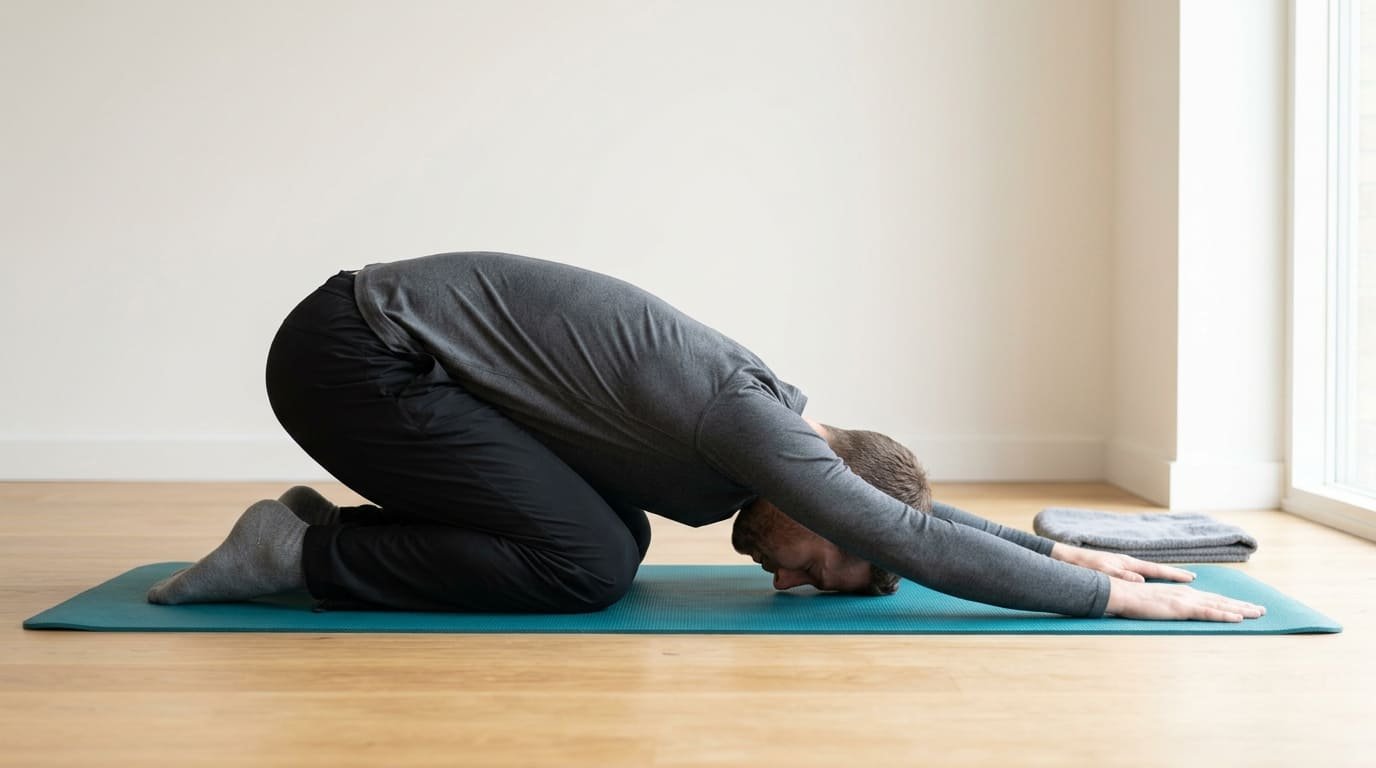
3. Child’s pose
- Kneel on the floor with your big toes together and knees apart
- Sit back toward your heels and walk your hands forward, letting your chest sink toward the floor
- Rest your forehead on the floor or a cushion
Dose: 2 to 3 holds of 30 seconds. Place a cushion between your heels and buttocks if your knees complain.
4. Cat-cow
- Start on all fours, hands under shoulders and knees under hips
- Breathe out and round your back toward the ceiling, tucking your tailbone
- Breathe in and let your belly sink, lifting your chest and tailbone
Dose: 10 slow repetitions. This is movement rather than a hold, which many stiff backs prefer.
5. Lying twist
- Lie on your back with your knees bent and arms out to the sides
- Keeping your shoulders on the floor, slowly lower both knees to one side
- Hold, then bring them back through the middle to the other side
Dose: 2 holds of 20 to 30 seconds per side. Lower only as far as is comfortable.
6. Pelvic tilt
- Lie on your back with knees bent
- Gently flatten your lower back into the floor by tilting your pelvis, then let it arch slightly
- Move slowly between the two
Dose: 10 to 15 slow tilts. A good gentle start on a bad morning.
7. Figure-four hip stretch
- Lie on your back with knees bent
- Cross your right ankle over your left knee
- Lift the left foot and draw the left thigh toward you until you feel a stretch in the right buttock
- Hold, then swap
Dose: 2 holds of 30 seconds per side. Tight buttock muscles are a common contributor to lower back stiffness.
Two hip stretches that help the lower back
- Hamstring stretch: lie on your back and raise one straight leg, holding behind the thigh or using a towel around the foot
- Kneeling hip flexor stretch: half-kneel, tuck your tailbone and shift your hips gently forward until you feel a stretch at the front of the back hip
Tight hamstrings and hip flexors both pull on the pelvis. Our quad stretches cover the front of the thigh in more detail.
If you want a full routine for your hips and pelvis, our anterior pelvic tilt exercises guide combines these stretches with glute and core work.
Upper back stretching exercises
Upper back stiffness usually comes from sitting, screens and rounded shoulders. These upper back stretching exercises target the area between the shoulder blades, the chest and the sides of the trunk.
8. Thread the needle
- Start on all fours
- Slide one arm along the floor under your body, palm up, until your shoulder and the side of your head rest on the floor
- Hold, breathing into the upper back, then unwind from the stretching exercise back to all fours
Dose: 2 holds of 20 to 30 seconds per side.
9. Upper back hug
- Sit or stand tall
- Wrap your arms around yourself as if giving yourself a hug, hands reaching toward the shoulder blades
- Round your upper back gently and let your head drop forward a little
- Breathe into the space between your shoulder blades
Dose: 2 to 3 holds of 20 seconds. Swap which arm is on top.
10. Doorway chest stretch
- Stand in a doorway with your forearms on the frame, elbows at shoulder height
- Step one foot through and gently lean forward until you feel a stretch across the chest
- Keep your ribs down and your lower back still
Dose: 2 to 3 holds of 30 seconds. Tight chest muscles pull the shoulders forward and the upper back into a slump.
11. Standing side reach
- Stand with feet hip-width apart
- Reach one arm overhead and lean gently to the opposite side
- Keep your hips still and feel the stretch along the side of your trunk
Dose: 2 holds of 20 seconds per side.
12. Neck side stretch
- Sit tall and let one ear drop toward the same shoulder
- Keep the opposite shoulder relaxed and down
- For a little more stretch, rest the hand of the tilted side lightly on your head
Dose: 2 holds of 20 seconds per side. Never pull hard on the head.
13. Sphinx
- Lie face down and prop yourself up on your forearms
- Let your lower back relax and your chest lift
- Breathe slowly
Dose: 2 to 3 holds of 20 to 30 seconds. Some people with lower back pain find this soothing, and some do not. Skip it if it increases pain.
14. Seated chair twist
- Sit tall on a chair with feet flat
- Turn your upper body to one side, holding the back of the chair lightly
- Grow tall as you breathe in, and turn a little further as you breathe out
Dose: 2 holds of 20 seconds per side. Easy to do at work.
For deeper work on the upper back, our thoracic mobility exercises guide adds extension and rotation drills, many of them movements rather than holds.
Upper back pain exercises and stretches
If your upper back aches after long days at a screen, combine stretches with a little strengthening. Stretching opens the front of the body; strengthening helps the upper back hold a better position.
| Stretch | Pair it with | Why |
|---|---|---|
| Doorway chest stretch | Band pull-aparts, 2 x 15 | Opens the chest, then strengthens the muscles that pull the shoulders back |
| Upper back hug | Prone Y raise, 2 x 10 | Relieves tension, then trains the lower trapezius |
| Thread the needle | Rows, 2 x 12 | Restores rotation, then builds the mid back |
| Neck side stretch | Chin tucks, 2 x 10 | Eases neck tension, then improves head position |
A trial in adults with frequent neck and shoulder pain found that as little as two minutes a day of progressive resistance exercise reduced pain and tenderness over ten weeks. Short strengthening sessions can make a real difference alongside your upper back pain exercises and stretches.
Our mid back exercises and posture exercises guides go further.
Physiotherapy for upper back pain exercises
When I finally saw a physiotherapist about the ache between my shoulder blades, I expected a long list of stretches. What I got was shorter and more useful: two stretches, two strengthening moves and a plan to build up over a month. That is typical of physiotherapy for upper back pain exercises. The stretching exercise back clinicians choose is usually paired with strength work, because a loose upper back that is still weak tends to slump again.
Here is a 4-week home plan built on the same idea. It is not a replacement for an assessment, but it reflects the structure most physio programmes follow.
| Week | Stretches (daily) | Strength (3 times a week) | Goal |
|---|---|---|---|
| 1 | Doorway chest stretch, upper back hug | Chin tucks, 2 x 10 | Learn the positions and ease tension |
| 2 | Add thread the needle | Add band pull-aparts, 2 x 12 | Restore rotation and start strengthening |
| 3 | Same stretches, 3 holds each | Add prone Y raise, 2 x 8 | Train the lower trapezius |
| 4 | Same stretches | Rows, 3 x 12, plus the moves above | Build endurance in the mid back |
A physiotherapist will usually also look at your desk set-up, how long you sit without a break and how you sleep. Small changes there often matter as much as the exercises. Good reasons to book an appointment rather than going it alone include pain that has lasted more than six weeks, pain that wakes you at night, or pain that spreads into an arm.
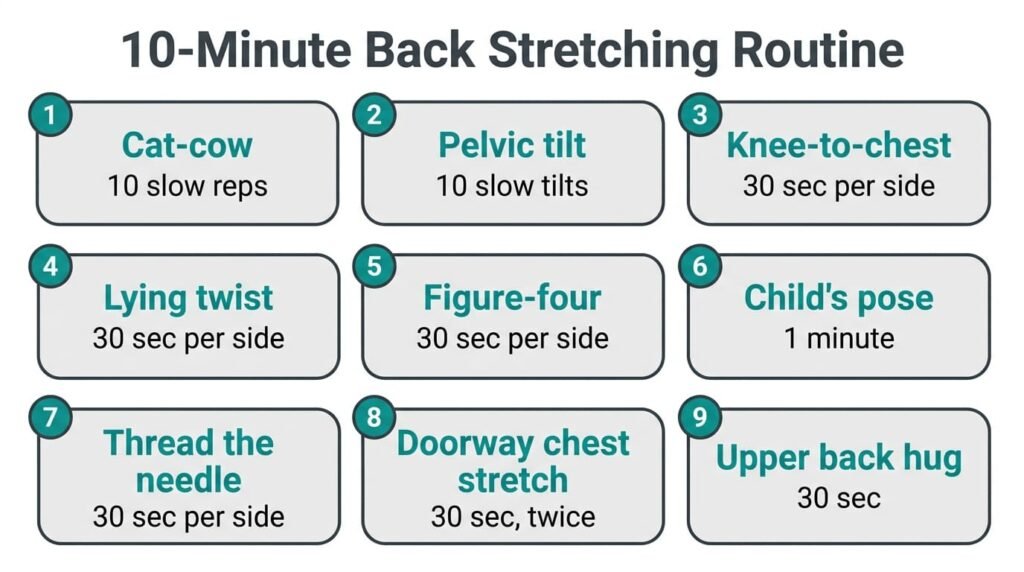
A 10-minute back stretching routine
| Order | Stretch | Time |
|---|---|---|
| 1 | Cat-cow | 10 slow reps, about 1 minute |
| 2 | Pelvic tilt | 10 slow tilts, about 1 minute |
| 3 | Single knee-to-chest | 30 seconds per side |
| 4 | Lying twist | 30 seconds per side |
| 5 | Figure-four hip stretch | 30 seconds per side |
| 6 | Child’s pose | 1 minute |
| 7 | Thread the needle | 30 seconds per side |
| 8 | Doorway chest stretch | 30 seconds, twice |
| 9 | Upper back hug | 30 seconds |
Do each stretching exercise back to back with the one below it, so the routine flows without long pauses. Do it once a day, most days. Mornings suit people who wake up stiff. Evenings suit people whose backs tighten through the day. If you only have three minutes, do cat-cow, child’s pose and thread the needle.
A 3-minute desk routine
| Stretch | Time |
|---|---|
| Seated chair twist | 20 seconds per side |
| Upper back hug | 20 seconds |
| Neck side stretch | 20 seconds per side |
| Standing side reach | 20 seconds per side |
| Stand up and walk | 1 minute |
Repeat every hour or two during long sitting days. If you sit all day, bring one stretching exercise back into every hour of your working day. Even 30 seconds of the chair twist breaks up the stiffness.
Standing back stretches when you cannot get on the floor
Not everyone can get down to the floor easily, and not every moment allows it. These four standing stretches use a wall or a kitchen counter.
Counter-top hinge
- Stand facing a kitchen counter and place both hands on the edge, shoulder-width apart
- Walk your feet back until your arms are straight and your body forms an upside-down L
- Let your chest sink gently toward the floor, keeping a soft bend in the knees
- Hold for 20 to 30 seconds, then walk your feet back in
This stretches the upper back, the shoulders and the backs of the legs at the same time.
Standing cat-cow
- Stand with feet hip-width apart, knees soft, and hands resting on your thighs
- Breathe out and round your back, tucking your tailbone
- Breathe in and gently arch, lifting your chest
Dose: 8 to 10 slow repetitions. A good option after a long drive.
Standing knee hug
- Stand near a wall for balance
- Lift one knee and hug it gently toward your chest
- Hold for 10 to 15 seconds, then swap
Wall slides
Stand with your back against a wall and slide your arms up and down, keeping them close to the wall. Our guide to wall angels explains this movement in detail.
When you finish any standing stretch, move from that stretching exercise back into normal standing slowly, especially if you have been leaning forward. A quick head rush is common when you stand up fast.
Back stretches in bed
On mornings when getting up feels hard, start in bed. Do 10 pelvic tilts, then a single knee-to-chest on each side, then a lying twist. A firm mattress works best. It takes three minutes and makes the first steps of the day much easier.
Back stretches for everyday situations
Different moments call for different stretches. Pick the set that matches your day.
| Situation | Best stretches | Time |
|---|---|---|
| Waking up stiff | Pelvic tilts, cat-cow, single knee-to-chest, child’s pose | 5 minutes, before getting dressed |
| After a long drive | Standing side reach, seated chair twist, kneeling hip flexor stretch, a short walk | 3 to 5 minutes |
| After a workout | Child’s pose, figure-four, hamstring stretch, doorway chest stretch | 5 minutes |
| After gardening or lifting | Double knee-to-chest, lying twist, cat-cow | 3 minutes, then rest |
| Before bed | Lying twist, double knee-to-chest, slow breathing | 3 to 5 minutes |
Chair-based back stretches
If getting down to the floor is difficult, most of these back stretching exercises have a seated version.
| Floor stretch | Chair version |
|---|---|
| Knee-to-chest | Sit tall, hug one knee toward your chest |
| Child’s pose | Sit, feet wide, and let your chest fold forward between your knees, hands sliding down your shins |
| Cat-cow | Sit on the front of the chair, hands on knees, and round then arch your back |
| Lying twist | Seated chair twist |
| Figure-four | Sit, cross one ankle over the other knee and lean gently forward |
Our core exercises for seniors include more seated options.
Helpful extras
You need nothing but the floor, but a few household items make stretching easier.
- A towel or strap loops around a foot for hamstring stretches, so you do not have to reach
- A cushion under the knees or forehead makes kneeling stretches comfortable
- A firm chair for seated versions and balance
- A foam roller is optional and mainly useful for the upper back. Our stretching routine for beginners covers the rest of the body
Easier and harder versions of each stretch
If a stretch feels too strong or too easy, adjust it rather than skipping it. Keep the easier version until it feels comfortable, then bring the harder stretching exercise back into your routine a week later.
| Stretch | Easier version | Harder version |
|---|---|---|
| Knee-to-chest | Hold behind the thigh, not the shin | Lift your head gently toward the knee |
| Child’s pose | Cushion under the hips or chest | Walk the hands to one side for a side stretch |
| Cat-cow | Smaller range | Pause for 3 seconds at each end |
| Lying twist | Lower the knees only halfway | Straighten the top leg |
| Figure-four | Keep the bottom foot on the floor | Draw the bottom thigh closer |
| Thread the needle | Stop with the shoulder above the floor | Reach the top arm up to the ceiling |
| Doorway chest stretch | Elbows lower than shoulders | Step further through the doorway |
| Sphinx | Rest on a pillow under the chest | Straighten the arms slowly, only if comfortable |
Add strength for lasting results
Because stretching alone is not enough for most back pain, add two or three of these, two or three times a week.
| Exercise | What it trains | Sets and reps |
|---|---|---|
| Glute bridge | Buttocks and lower back | 2 x 10 to 12 |
| Bird dog | Back and core control | 2 x 6 per side |
| Dead bug | Deep core | 2 x 6 per side |
| Side plank from the knees | Side of the trunk | 2 x 15 to 20 seconds per side |
| Band row | Upper and mid back | 2 x 12 |
Our McGill Big 3 is a well-known back-friendly core routine, and our erector spinae exercises build the muscles along the spine. A daily walk is one of the simplest things you can add. Our walking guide has a progression.
When to stretch, and when not to
| Situation | Approach |
|---|---|
| General stiffness, no pain | Stretch freely, most days |
| Mild ache after sitting or activity | Gentle stretches and a walk. Keep moving |
| New back pain without warning signs | Stay as active as you comfortably can. Gentle movement and heat often help. Most cases improve within a few weeks |
| Pain that spreads down a leg | Choose only stretches that do not increase the leg symptoms, and get it assessed if it persists |
| Back pain with warning signs (below) | Do not stretch. Get medical help |
A clinical guideline from the American College of Physicians notes that most acute and subacute low back pain improves over time, and recommends non-drug treatments such as heat, and for longer-lasting pain, exercise, yoga and similar approaches as first options.
This article is general information, not medical advice. Seek urgent medical help for back pain with numbness around the groin or buttocks, new problems controlling your bladder or bowel, weakness in the legs, fever, unexplained weight loss, a history of cancer, or pain after a fall or accident. See a doctor for pain that is severe, worsening, or not improving after a few weeks. See our medical disclaimer.
How quickly do back stretches help?
| Timescale | What usually changes |
|---|---|
| Straight away | Most people feel looser for a few hours after stretching |
| 1 to 2 weeks | Mornings feel less stiff if you stretch most days |
| 4 to 6 weeks | Measurable gains in flexibility, such as reaching further in the hamstring stretch |
| 2 to 3 months | Fewer flare-ups of everyday stiffness, especially when you add strength work and walking |
These are typical patterns, not promises. Back pain that is not improving after a few weeks deserves a professional opinion.
Common mistakes
- Bouncing into a stretch
- Pushing into pain in the hope that more is better
- Holding your breath
- Rushing from one stretching exercise back into the next without a few slow breaths
- Stretching only when it hurts instead of regularly
- Relying on stretches alone, with no strengthening or walking
- Pulling hard on the neck during neck stretches
- Rounding the lower back hard under load, such as touching your toes with straight legs while already sore
- Ignoring warning signs such as leg numbness or weakness
The bottom line
Back stretching exercises are a simple, safe way to ease stiffness and get moving. For the lower back, knee-to-chest, child’s pose, cat-cow, the lying twist and hip stretches are the gentle basics. Upper back stretching exercises such as thread the needle, the upper back hug and the doorway chest stretch counter the effects of sitting and screens.
If you are unsure where to begin, pick the stretching exercise back care experts most often suggest for stiffness, cat-cow, and build from there. Hold each stretch for 20 to 30 seconds, breathe, and keep it comfortable. Then add a few strengthening moves and regular walking, because that combination is what the research supports for back pain.
If your back pain comes with numbness, weakness, bladder or bowel changes or fever, stop stretching and get it checked straight away.
If your neck tightens along with your upper back, add the chin tuck exercise to your routine.
Frequently asked questions
What are the best back stretching exercises?
For the lower back, knee-to-chest, child’s pose, cat-cow, the lying twist and the figure-four hip stretch. For the upper back, thread the needle, the upper back hug, the doorway chest stretch and the standing side reach. Choose the ones that feel comfortable.
What are good back stretching exercises for lower back stiffness?
Start with pelvic tilts and cat-cow to get moving, then single and double knee-to-chest, child’s pose, the lying twist and the figure-four stretch. Hold each for 20 to 30 seconds. Add hamstring and hip flexor stretches if those areas are tight.
How long should I hold a back stretch?
Hold each stretch for 20 to 30 seconds and repeat it two or three times. Moving stretches such as cat-cow and pelvic tilts are done as 10 slow repetitions instead.
Do back stretches help back pain?
They can ease stiffness and help you move, but research suggests stretching alone is less effective for chronic low back pain than strength, core or Pilates exercise. The best results come from combining stretches with strengthening and regular walking.
What are the best upper back stretching exercises?
Thread the needle, the upper back hug, the doorway chest stretch, the standing side reach and the seated chair twist. Pair them with a few rows or band pull-aparts so the upper back stays strong as well as loose.
How often should I do back stretching exercises?
Most days, for about 10 minutes. People who sit for long periods benefit from short desk stretches every hour or two as well.
Should I stretch if my back hurts?
Gentle movement usually helps everyday back pain, so choose comfortable stretches and stay active. Stop any stretch that makes pain worse or spreads it down a leg, and get urgent help if you have numbness, weakness, or bladder or bowel changes.
Is it better to stretch in the morning or evening?
Either works. Morning stretching helps if you wake up stiff, while evening stretching helps if your back tightens through the day. Consistency matters more than timing.
What is the best stretching exercise back pain sufferers can do at home?
For most people with everyday stiffness, cat-cow is the best place to start, because it gently moves the whole spine. Add child’s pose and a knee-to-chest stretch for the lower back, or thread the needle for the upper back.
What does physiotherapy for upper back pain exercises usually include?
Usually a few stretches, such as the doorway chest stretch and thread the needle, combined with strengthening moves such as chin tucks, band pull-aparts, prone Y raises and rows. A physiotherapist also looks at posture, sitting time and desk set-up, then builds the programme up over several weeks.
Can I do back stretches if I cannot get down on the floor?
Yes. Use the standing and chair versions in this guide: the counter-top hinge, standing cat-cow, standing knee hug, wall slides and the seated chair twist. You can also do pelvic tilts and knee-to-chest stretches in bed.
How do I know which back stretch is right for me?
Match the stretch to where you feel tight. Use the table near the top of this guide, pick two or three stretches and try them for a week. Keep the ones that leave you feeling looser and drop any that increase pain.
What’s next?
Reading is the easy part. Pick one of these and do it today.


