Erector Spinae Exercises: 12 Moves for a Stronger Lower Back
The erector spinae are the long ropes of muscle you can feel either side of your spine when you arch your back. They run from your pelvis all the way up to your skull, and their job is deceptively simple: hold your spine upright and stop it folding forward when you bend, lift or carry anything.
Most people never train them deliberately. They get some work from deadlifts and rows, and that is usually the extent of it. Then a stiff lower back after gardening or a long drive arrives, and the assumption is that the back needs stretching.
Often it needs the opposite. A lower back that aches after sustained positions is frequently a back that lacks endurance rather than one that is too tight. This guide covers what these muscles actually do, a simple endurance test you can run at home that has genuine research behind it, twelve exercises in a sensible progression, and an honest section on what back training can and cannot do for pain.
At a glance
- The erector spinae are three muscle columns running the length of your spine
- They are built for endurance, so they respond well to holds and higher reps
- A simple home test tells you whether your back endurance is below average
- Start with bodyweight holds, then loaded hinges, then heavy carries
- Stretching a sore lower back often helps less than strengthening it
- Sharp pain, leg symptoms or numbness need assessment, not a training plan
What the erector spinae actually are
This is not one muscle. It is a group of three columns running either side of the spine, and they sit from deepest to most superficial in a specific arrangement.
| Column | Position | Runs from | What it does |
|---|---|---|---|
| Iliocostalis | Outermost | Pelvis and sacrum up to the ribs and neck | Extends the spine, bends it sideways |
| Longissimus | Middle, and the largest | Sacrum and lumbar spine up to the ribs, neck and skull | Extends and rotates the spine and neck |
| Spinalis | Innermost, closest to the spine | Lower thoracic and lumbar spine up to the upper back and skull | Extends the spine |
A useful memory aid from the outside in: I Love Spine, for Iliocostalis, Longissimus and Spinalis.
What matters more than the names is the function. These muscles do three distinct jobs:
- They extend the spine, which is the arching movement you make standing up from a bend
- They resist flexion, holding your spine in position as you bend forward. This is the big one, and it is what they spend most of their day doing
- They assist side bending and rotation
The second one is the key insight. During a deadlift, a row or simply carrying shopping, your erector spinae are not shortening and lengthening much. They are holding an isometric contraction to stop your spine rounding. That is a job of endurance, not of maximum force, and it changes how you should train them.
Why these muscles need endurance training
The erector spinae contain a high proportion of slow-twitch, fatigue-resistant muscle fibres. That makes sense, because they work constantly all day just to keep you upright.
The practical consequence is that a programme built only around heavy sets of five will underserve them. They respond well to:
- Isometric holds, which mimic exactly what they do in life
- Higher rep ranges, in the 10 to 20 region for direct work
- Longer time under tension, with slow, controlled movements
- Loaded carries, which demand sustained bracing under real weight
That does not mean heavy work is useless. Deadlifts and other hinges build the strength ceiling. But if your back gets stiff and sore from sitting or standing rather than from lifting, the missing quality is almost certainly endurance.
Test your back endurance at home
None of the competing articles give you a way to measure where you stand. This one is worth doing, because low back extensor endurance is one of the better-studied physical measures relating to back trouble.
The prone extension hold
- Lie face down on a bed or bench with your upper body hanging off from the hips, or lie flat on the floor if you have nothing suitable
- Have someone hold your legs, or hook your feet under something solid
- Cross your arms over your chest
- Raise your upper body until it is level with your hips, in a straight line, and hold
- Time how long you can hold that position before your body drops or your form breaks
| Hold time | What it suggests |
|---|---|
| Under 30 seconds | Low endurance, a clear priority to train |
| 30 to 60 seconds | Below average, worth building |
| 60 to 100 seconds | Reasonable for most people |
| Over 100 seconds | Good endurance |
| Over 150 seconds | Strong |
These ranges are rough guides for general adults rather than clinical thresholds, and they vary with age, body weight and build. What matters is your own change over time. Retest every six to eight weeks.
Do not do this test if you currently have back pain, and stop immediately if it produces any sharp sensation. A test is not worth an aggravation.
Should you stretch or strengthen?
This deserves a direct answer because the instinct is almost always to stretch.
A lower back that feels tight is not necessarily short. Muscles that are working hard to stabilise a spine they cannot comfortably support will feel tight, because they are holding tension. Stretching gives temporary relief, then the feeling returns within hours because nothing about the underlying capacity changed.
| What you feel | More likely cause | What usually helps more |
|---|---|---|
| Stiff and achy after sitting or standing a long time | Low endurance | Strengthening and holds, plus moving more often |
| Stiff first thing in the morning, eases with movement | Normal, or general stiffness | Gentle mobility, then movement |
| Tight on one side only | Asymmetry or muscle guarding | Single-side work and assessment |
| Genuinely restricted range when bending | Reduced mobility | Mobility work alongside strengthening |
| Sharp pain with specific movements | Needs assessment | See a professional rather than self-treating |
The general pattern: stretching for comfort is fine and harmless, but it rarely changes anything on its own. Strengthening is what changes capacity, and capacity is what stops the feeling coming back.
12 erector spinae exercises
Arranged in three progressive stages. Work through them in order rather than jumping to the loaded work.
Stage 1: control and endurance
1. Prone superman hold
Lie face down, arms extended overhead. Lift your chest, arms and legs a few centimetres off the floor and hold. Keep your neck neutral by looking at the floor rather than forward.
- Sets and time: 3 holds of 15 to 30 seconds
- Key point: lift only a few centimetres. Cranking into a big arch is not the goal
2. Bird dog
On hands and knees, extend one arm forward and the opposite leg back until both are level with your torso. Hold for 3 seconds, then swap.
- Sets and reps: 3 sets of 8 each side
- Why it matters: it trains the erectors to resist rotation as well as flexion, and it is one of the gentlest entry points
3. Dead bug
On your back, arms up and knees bent over your hips. Lower one arm and the opposite leg, stopping before your lower back lifts off the floor.
- Sets and reps: 3 sets of 8 each side
- This pairs with the deep core work in our transverse abdominis exercises guide
4. Prone Y and W raise
Lie face down and raise your arms in a Y shape, then in a W with elbows bent and squeezed back. These bring the upper erectors and mid-back into the work.
- Sets and reps: 3 sets of 10 each position
Stage 2: hinging and loading
5. Bodyweight hip hinge
Stand with a slight knee bend, push your hips back and lower your torso toward horizontal while keeping your back flat, then stand up. Hold a broomstick along your spine to check it stays in contact at your head, upper back and tailbone.
- Sets and reps: 3 sets of 12
- Master this before adding any weight. Every loaded hinge is this pattern with resistance
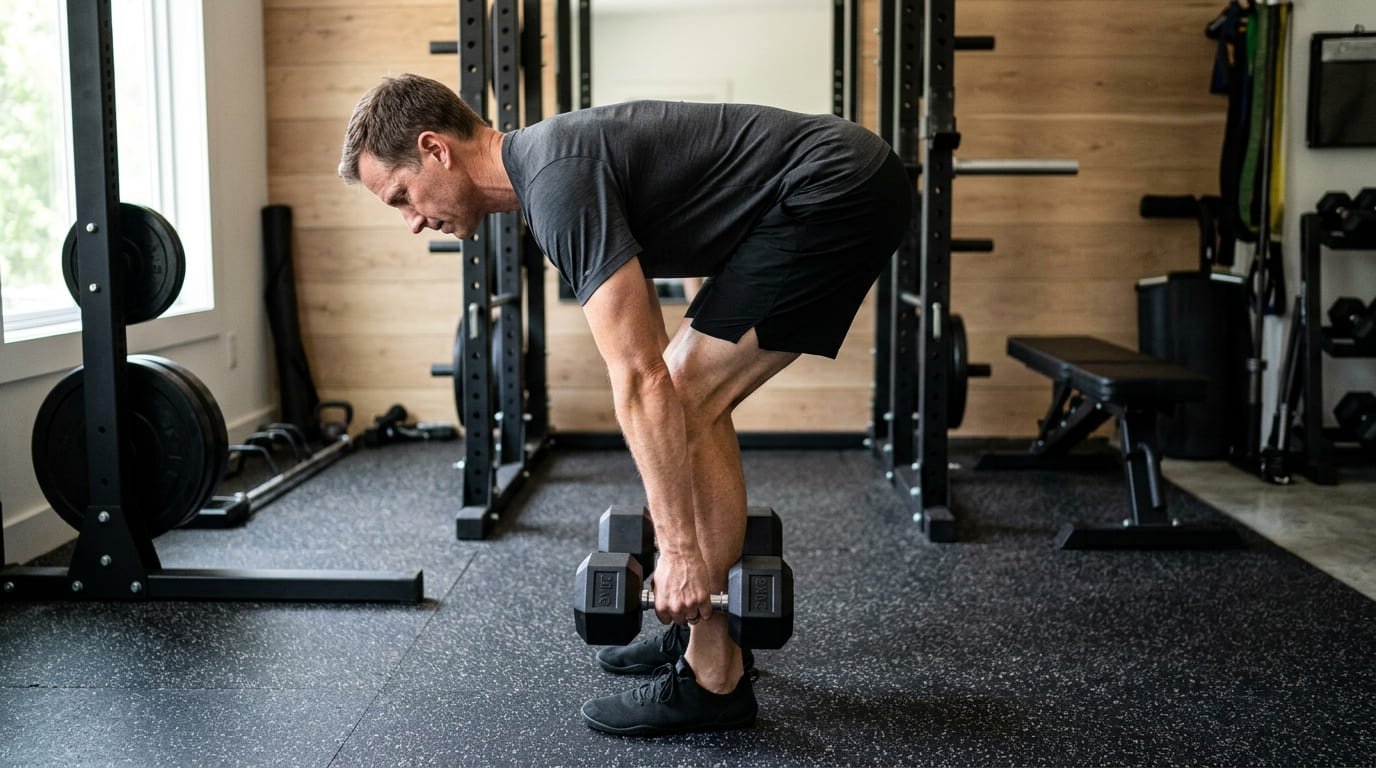
6. Romanian deadlift
The same hinge holding dumbbells, a loaded backpack or a barbell. Keep the weight close to your legs and your back flat throughout.
- Sets and reps: 3 sets of 8 to 12
- The single best erector spinae exercise for most people, because it loads the muscles in exactly the way they work in life
7. Good morning
The same hinge with the weight held across your upper back rather than in your hands. The longer lever makes it considerably harder at a much lighter load.
- Sets and reps: 3 sets of 10 to 12, light
- Our good morning exercise guide covers the form in detail, including how to do it without a barbell
8. Back extension
On a back extension bench, a Roman chair, or lying face down on a bed with your upper body hanging off. Lower under control and raise until your body is straight, not beyond.
- Sets and reps: 3 sets of 12 to 15
- Do not hyperextend. Stopping in a straight line is the whole range you need
Stage 3: heavy and functional
9. Deadlift
The heaviest loading available for the posterior chain. Conventional or trap bar, both work.
- Sets and reps: 3 to 4 sets of 5 to 8
- Prerequisite: a confident hip hinge and a comfortable Romanian deadlift first
10. Farmer’s carry and suitcase carry
Walk holding heavy weights, either one in each hand or a single one on one side. The suitcase version forces the erectors to resist side bending.
- Sets and time: 3 to 4 carries of 30 to 45 seconds
- Our farmer’s carry guide covers loading and distances
11. Kettlebell or dumbbell swing
A fast, hinge-driven movement that trains the erectors to work rapidly and repeatedly under load.
- Sets and reps: 4 sets of 15 to 20
- Note: this is a hinge, not a squat, and the power comes from the hips rather than the arms
12. Reverse hyperextension or a floor equivalent
Lying face down on a raised surface with your legs hanging off, raise your legs until they are level with your torso. If you have no bench, do this on the floor as a leg-only superman.
- Sets and reps: 3 sets of 12 to 15
Two routines
Routine A: no equipment, 15 minutes
Three times a week. Everything here uses the floor and your body weight.
| Exercise | Sets | Reps or time | Rest |
|---|---|---|---|
| Bird dog | 3 | 8 each side | 45 sec |
| Prone superman hold | 3 | 20 to 30 sec | 45 sec |
| Bodyweight hip hinge | 3 | 12 | 45 sec |
| Prone Y and W raise | 3 | 10 each | 30 sec |
| Dead bug | 3 | 8 each side | 45 sec |
| Glute bridge hold | 3 | 30 sec | 45 sec |
Routine B: with weights, 25 minutes
Twice a week, ideally on your lower body or pull days.
| Exercise | Sets | Reps | Rest |
|---|---|---|---|
| Romanian deadlift | 4 | 8 to 12 | 2 min |
| Back extension | 3 | 12 to 15 | 60 sec |
| Good morning, light | 3 | 10 to 12 | 75 sec |
| Suitcase carry | 3 | 40 sec each side | 60 sec |
| Bird dog | 2 | 10 each side | 45 sec |
An 8-week plan
| Weeks | Focus | What to do |
|---|---|---|
| Weeks 1 to 2 | Build control | Routine A three times a week, no weight at all |
| Weeks 3 to 4 | Add endurance | Routine A, extending holds by 10 seconds and adding a set |
| Weeks 5 to 6 | Introduce load | Routine A twice plus Routine B once, light weights |
| Weeks 7 to 8 | Build strength | Routine B twice plus Routine A once, adding weight on the hinges |
Retest your prone extension hold at the end of week eight. Most people who start below 30 seconds reach 60 or more within this timeframe, and the change in how their back feels during daily tasks usually arrives before the number does.
Back pain: an honest section
Many people arrive at this topic because their lower back hurts, so this needs saying clearly and carefully.
What the evidence broadly supports:
- Exercise in general helps with ongoing non-specific low back pain, and it also reduces the likelihood of recurrence
- Staying active is better than resting. Prolonged rest tends to make ordinary back pain worse rather than better
- No single exercise type has proven clearly superior. Strength work, general aerobic activity, Pilates and motor control exercise all show benefit, which suggests that doing something you will stick with matters more than picking the perfect method
What is less certain than commonly claimed:
- The idea that a weak core directly causes back pain is far less established than the fitness industry suggests
- Specific “corrective” exercises have not been shown to outperform general exercise for most people
- Imaging findings such as disc bulges are extremely common in people with no pain at all, so a scan result rarely tells the whole story
The practical takeaway: build general strength and keep moving, start gently, progress gradually, and do not expect a single exercise to fix anything.
When to see a professional
Training is not the answer to everything. Get proper assessment if you have:
- Pain that radiates down a leg, especially below the knee
- Numbness, tingling or weakness in a leg or foot
- Back pain following a fall, accident or significant injury
- Pain that wakes you at night or does not ease in any position
- Any change in bladder or bowel control, or numbness around the groin and inner thighs. This combination needs urgent medical attention
- Unexplained weight loss, fever or a history of cancer alongside new back pain
- Pain that has not improved at all after several weeks
Everything in this guide assumes a healthy back you want to strengthen, not an injured one you are trying to treat.
Seven common mistakes
- Hyperextending on back extensions and supermans. Stop at straight. Cranking into a deep arch compresses the joints at the back of the spine without adding benefit
- Only stretching. It feels good and changes little on its own
- Rounding the back on hinges. Learn the pattern with a broomstick before you load it
- Only training heavy. These are endurance muscles, so holds and higher reps belong in the programme
- Skipping straight to deadlifts without a confident hip hinge
- Ignoring the glutes and hamstrings. They share the hinge with the erectors, and a weak posterior chain pushes more work onto the lower back. Our hamstring exercises at home guide covers that side
- Training them hard the day before a heavy leg session, since the lower back is the shared link between both
How often, and what soreness to expect
Two to three sessions a week works well, with at least 48 hours between the loaded ones. The erectors recover reasonably quickly from endurance work but more slowly from heavy deadlifts.
- A dull ache the day after heavy hinges is normal muscular soreness
- A tight, guarded feeling that limits bending suggests you went too heavy or your form broke down
- Do not deadlift heavy twice in three days when you are starting out
- Light movement helps a sore lower back more than lying still
The bottom line
Your erector spinae hold your spine upright every hour you are awake, and they are built for endurance rather than for single maximum efforts. That is why the training that helps most is a combination of holds, controlled hinging and loaded carries, rather than heavy pulling alone.
Test your prone extension hold first so you know where you stand. Spend two weeks on bird dogs, supermans and bodyweight hinges before touching a weight. Then build toward Romanian deadlifts and carries over the following six weeks and retest.
If your back feels tight, try strengthening it before you stretch it again. And if anything radiates, tingles or feels sharp, that is a question for a clinician rather than a training plan.
For a short daily routine that trains the front, sides and back of the trunk together, see our guide to the McGill Big 3.
To balance strength with flexibility, add a few of our back stretching exercises at the end of each session.
Frequently asked questions
What are the best erector spinae exercises?
Romanian deadlifts and back extensions load them most directly, while bird dogs and prone superman holds build the endurance they rely on day to day. Loaded carries, particularly suitcase carries, train the bracing they perform during real-world lifting. A complete programme uses all three types rather than one.
How do I strengthen my erector spinae at home?
Start with bird dogs, prone superman holds, prone Y and W raises and bodyweight hip hinges, three times a week. Add load with a backpack or dumbbells for Romanian deadlifts once the hinge pattern feels solid, and use a bed edge for back extensions if you have no bench.
Should I stretch or strengthen a tight lower back?
Strengthening usually helps more. A lower back that feels tight after sitting or standing is often lacking endurance rather than being short, so stretching relieves the sensation for an hour or two while leaving the cause unchanged. Stretching for comfort is fine, but strengthening is what changes capacity.
How often should I train my lower back?
Two to three times a week, leaving at least 48 hours between heavy sessions. Endurance work such as holds and bird dogs can be done more frequently because it recovers quickly. Heavy deadlifting demands more recovery, so avoid loading it hard twice within three days.
Do deadlifts work the erector spinae?
Yes, heavily. The erectors work isometrically throughout a deadlift to stop the spine rounding, which is exactly how they function in daily life. Deadlifts alone are not a complete programme though, since these muscles also benefit from endurance work and higher-rep direct exercises.
Why does my lower back hurt after deadlifts?
Usually either the load was too heavy for your current capacity, or your back rounded during the lift. A dull muscular ache for a day or two is normal soreness. A tight, guarded feeling that limits bending suggests you exceeded what your back could control, so reduce the weight and rebuild the hinge pattern.
Can strengthening the erector spinae fix back pain?
Exercise helps many people with ongoing non-specific back pain and reduces the chance of recurrence, but no single exercise reliably fixes it, and the claim that weak core muscles directly cause back pain is weaker than commonly stated. Start gently, progress gradually, and see a clinician for any radiating pain or numbness.
How long should you hold a superman?
Fifteen to thirty seconds for three sets when you are starting out, building toward 45 seconds. Lift only a few centimetres off the floor and keep your neck neutral by looking down. Height is not the point, and arching hard adds compression without adding benefit.
What’s next?
Reading is the easy part. Pick one of these and do it today.