Calisthenics Back Workout: 12 Exercises and 3 Routines by Level
The back is the hardest part of the body to train with bodyweight alone. You can push the floor away for your chest, and you can squat for your legs, but there is nothing on the floor to pull.
That is why so many home routines quietly skip it. Mine did. For most of a year I did push-ups, planks and squats, and my shoulders slowly rolled forward. The fix was not complicated. I needed something to hang from or lean back against, and a set of exercises that started well below a full pull-up.
This guide gives you both. It covers what the back muscles do, twelve calisthenics exercises from floor drills to pull-ups, what to use when you have no bar, and three routines by level.
At a glance
- The back needs pulling exercises. You pull horizontally with rows and vertically with pull-ups
- The inverted row is the most useful bodyweight back exercise for beginners
- You can train your back with no bar at all, using a table, a door, a towel and the floor
- A pull-up bar or a pair of rings makes progress much easier and costs very little
- Start every pull by drawing your shoulder blades back and down
- Do 3 to 5 exercises, 3 sets each, two or three times a week
- Balance every pushing exercise in your week with a pulling one
The back muscles and what they do
| Muscle | Where it is | Main job | Best bodyweight exercises |
|---|---|---|---|
| Latissimus dorsi (lats) | The large muscles down the sides of the back | Pull the arms down and back | Pull-ups, chin-ups, rows |
| Trapezius (traps) | From the neck across the shoulders to the mid-back | Move and steady the shoulder blades | Rows, scapular pulls, Y raises |
| Rhomboids | Between the shoulder blades | Pull the shoulder blades together | Rows, reverse snow angels |
| Rear deltoids | The back of the shoulders | Pull the arms backward | Wide rows, T raises, face pulls |
| Erector spinae | Two columns either side of the spine | Hold the spine upright and extend it | Supermans, back extensions |
| Teres major and rotator cuff | Around the shoulder blade | Assist the lats and stabilise the shoulder | Pull-ups, rows, hangs |
| Biceps and forearms | The arms | Bend the elbows and grip | Every pulling exercise |
Two movement directions cover all of them.
| Direction | What it looks like | Emphasis | Examples |
|---|---|---|---|
| Horizontal pull | Pulling your chest toward your hands | Mid-back, rhomboids, rear shoulders, lats | Inverted row, table row, door row |
| Vertical pull | Pulling your body up toward your hands | Lats, lower traps, biceps | Pull-up, chin-up, hang |
| Spinal extension | Lifting the chest or legs against gravity | Lower back, glutes | Superman, back extension |
A good back workout includes at least one horizontal pull and, once you have a bar, one vertical pull.
Why train your back
- Posture. Strong upper-back muscles hold your shoulders back and your chest open
- Balanced shoulders. Pushing without pulling tightens the front of the shoulder and weakens the back of it
- A stronger everything else. A stable upper back makes push-ups, carries and squats better
- Everyday strength. Lifting, carrying, climbing and pulling open a heavy door are all back work
- Appearance. A developed back makes the waist look narrower and the shoulders wider
Bodyweight training is a legitimate way to build this muscle. Progressive calisthenics has been shown to produce strength and muscle gains comparable to weight training over the short term, provided the exercises keep getting harder.
What to pull on
| Option | What you can do | Cost | Notes |
|---|---|---|---|
| Nothing | Floor exercises: supermans, reverse snow angels, Y and T raises, prone pulls | Free | Good for posture muscles. Limited for the lats |
| A sturdy table | Table rows | Free | Test that it cannot tip. Heavy dining tables work best |
| A door and a towel | Door rows | Free | Loop the towel around both handles of an open door and brace the door with your feet |
| A bed sheet in a door | Rows at any angle | Free | Knot one end, shut it over the top of a solid door that closes toward you |
| Resistance bands | Band rows, pulldowns, pull-aparts, assisted pull-ups | Low | Anchor to a door or post |
| Gymnastic rings or a suspension trainer | Rows at any angle, face pulls, later pull-ups | Low to moderate | The most versatile choice |
| A doorway pull-up bar | Hangs, pull-ups, chin-ups, leg raises | Low | Check the door frame is solid |
If you buy one thing, a pair of rings on a door anchor or a doorway bar transforms what you can do. Our guide to bodyweight exercise equipment explains the options and the safety checks.
Always test whatever you pull on before trusting it with your body weight. Pull hard with your feet on the floor first. Tables can tip, door handles can break, and towels can slip.
The one cue that fixes most back exercises
Before you bend your arms in any pulling exercise, set your shoulder blades.
- Start with your arms straight
- Without bending your elbows, pull your shoulders down away from your ears and draw your shoulder blades slightly together
- Then pull with your arms, leading with your elbows
- At the end of the rep, let your shoulder blades spread again under control
This small movement switches the work from your arms to your back. If you only ever feel rows and pull-ups in your biceps, this is usually the missing piece.
12 calisthenics back exercises
They run from easiest to hardest. Lower every rep slowly, over two to three seconds.
1. Superman
No equipment. Trains the lower back, glutes and upper back.
- Lie face down with your arms stretched overhead and your legs straight
- Squeeze your glutes and lift your arms, chest and legs a few centimetres off the floor
- Keep your neck long, looking at the floor
- Hold for two seconds, then lower slowly
Sets and reps: 3 sets of 10 to 12.
Our erector spinae exercises guide has more for the lower back.
2. Reverse snow angel
No equipment.
- Lie face down with your arms by your sides, palms down
- Lift your chest and hands slightly off the floor
- Keeping your arms straight and off the floor, sweep them out and around in a wide arc until they are overhead
- Sweep them back to your sides
Sets and reps: 3 sets of 8 to 10.
3. Prone Y, T and W raises
No equipment. Excellent for the muscles between and below the shoulder blades.
- Lie face down with your forehead resting on a folded towel
- Y: arms overhead in a Y shape, thumbs up. Lift them a few centimetres, hold for two seconds, lower
- T: arms straight out to the sides, thumbs up. Lift, hold, lower
- W: elbows bent and tucked toward your ribs, hands by your shoulders. Squeeze your shoulder blades together and lift, hold, lower
Sets and reps: 2 to 3 rounds of 6 to 8 in each position.
4. Prone pulldown
No equipment. It mimics a pull-up while lying down.
- Lie face down with your arms stretched overhead
- Lift your chest and arms slightly
- Pull your elbows down and back toward your ribs, squeezing your shoulder blades together, as if pulling a bar to your chest
- Reach forward again
Sets and reps: 3 sets of 10 to 12.
5. Door or towel row
Needs a sturdy door and a towel, or rings or a sheet in a door.
- Loop a towel around both handles of an open door, or hold a pair of rings set at chest height
- Place your feet close to the door and lean back until your arms are straight and your body is in a straight line
- Set your shoulder blades, then pull your chest toward your hands, elbows close to your sides
- Lower slowly
Sets and reps: 3 sets of 10 to 15.
Make it harder: walk your feet further forward so you lean back more.
6. Inverted row
The cornerstone of bodyweight back training. Use a sturdy table, a low bar or rings.
- Lie under the table or bar and grip it with your hands just wider than your shoulders
- Keep your body in a straight line from head to heels, with your heels on the floor
- Set your shoulder blades and pull your chest up to the edge or bar
- Pause for a second at the top
- Lower slowly until your arms are straight
Sets and reps: 3 sets of 6 to 12.
Make it easier: bend your knees and put your feet flat, or raise the bar so you are more upright. Make it harder: raise your feet on a chair.
Research comparing rowing exercises found the inverted row produced the highest activation of the lats and upper back muscles of the three tested, with the lowest load on the lower spine. That makes it an excellent choice for beginners and for anyone whose lower back complains during bent-over rows.
7. Wide-grip row and face pull
- Set up as for an inverted row or ring row, with your hands wider than your shoulders and palms facing your feet
- Pull with your elbows flared out to the sides at shoulder height
- On rings, pull your hands toward your ears, so your fists finish beside your head. This is a face pull
- Lower slowly
Sets and reps: 3 sets of 8 to 12.
This shifts the work to the rear shoulders and upper traps, which improves posture. Our posture exercises guide explains why these muscles matter.
8. Dead hang and scapular pull
Needs a bar.
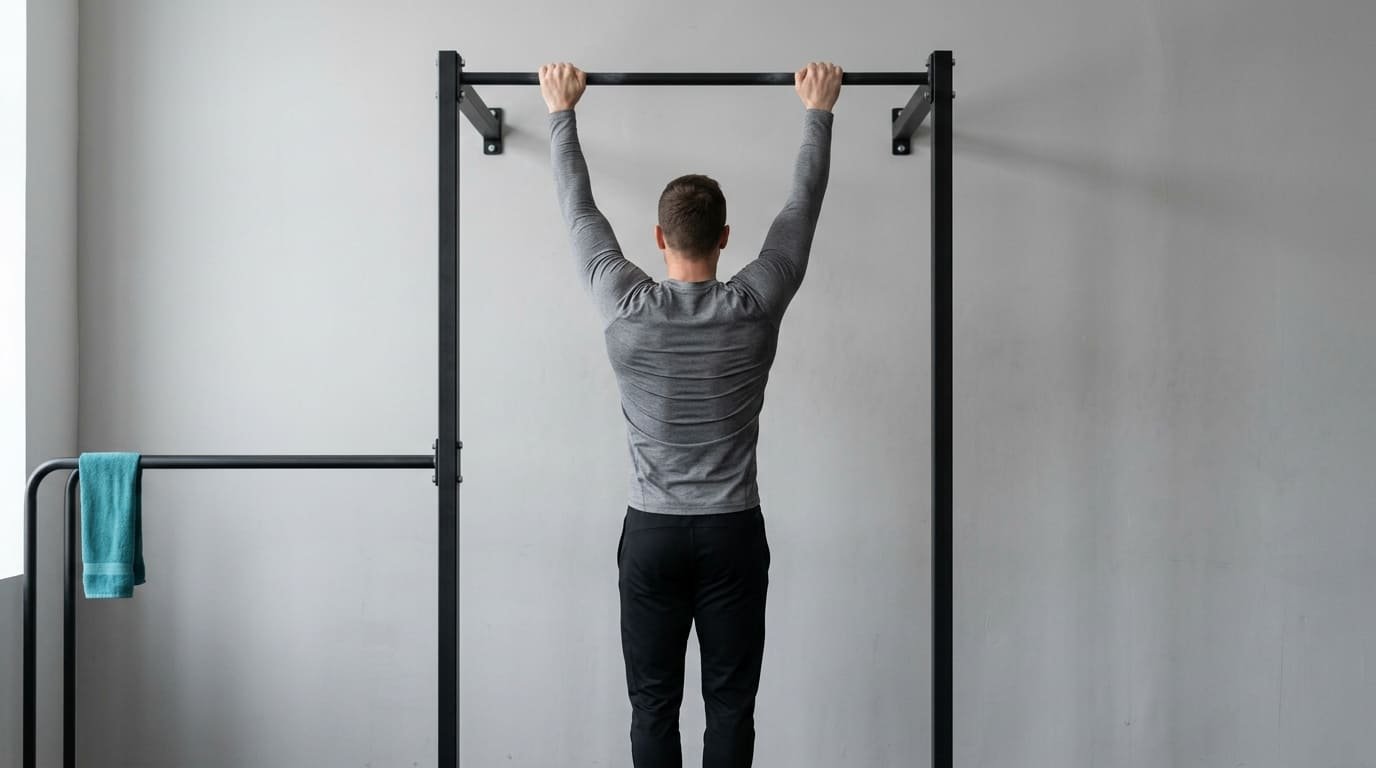
- Hang from a bar with your hands shoulder-width apart and your arms straight
- For the hang, simply hold on with your shoulders gently pulled down, for 20 to 40 seconds
- For the scapular pull, keep your arms straight and pull your shoulder blades down and together, so your body rises a few centimetres
- Lower under control and repeat
Sets and reps: 3 hangs of 20 to 40 seconds, or 3 sets of 6 to 10 scapular pulls.
9. Negative pull-up
The fastest way to build toward a first pull-up.
- Use a step or a jump to get your chin above the bar
- Hold the top for one second
- Lower yourself as slowly as you can, aiming for five seconds, until your arms are straight
- Step back up and repeat
Sets and reps: 3 to 4 sets of 3 to 5.
10. Band-assisted pull-up
- Loop a long resistance band over the bar and place one foot or knee in it
- Start from a full hang with shoulder blades set
- Pull until your chin clears the bar
- Lower slowly to a full hang
Sets and reps: 3 sets of 5 to 8. Use a thinner band as you get stronger.
11. Chin-up
Palms facing you, hands shoulder-width apart. Most people find this easier than the pull-up, because the biceps are in a stronger position.
- Hang with your arms straight and shoulder blades set
- Pull your chest toward the bar, driving your elbows down toward your ribs
- Bring your chin clearly over the bar
- Lower slowly to a full hang
Sets and reps: 3 sets of 3 to 8.
12. Pull-up
Palms facing away, hands just wider than your shoulders.
- Hang with your arms straight
- Set your shoulder blades
- Pull your elbows down and back until your chin is over the bar
- Lower slowly to a full hang
Sets and reps: 3 sets of 3 to 8.
A study measuring muscle activity found the lats work very hard in both the pull-up and the chin-up. The chin-up produced more biceps and chest activity, and the pull-up more lower trapezius activity. In practice, they are close cousins, and using both is ideal.
Our pull-up alternatives guide covers the full path to a first pull-up.

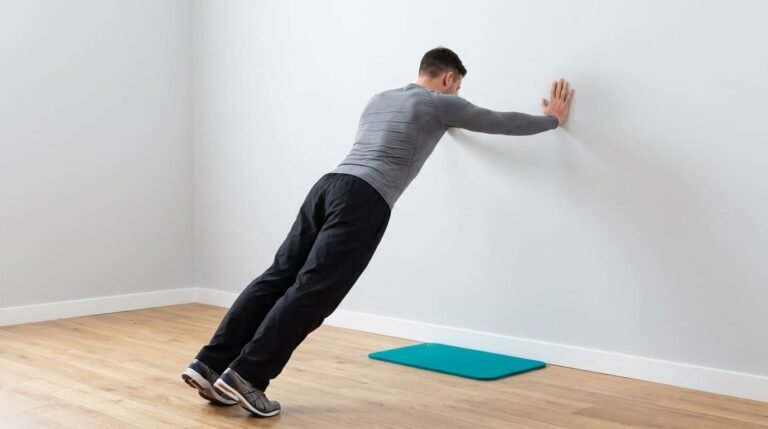
The diagram shows body angle only. In a real row, the bar or rings sit above your chest, and your arms reach straight toward them.
How to make rows easier or harder
The inverted row has a built-in dial: the angle of your body.
| Body angle | Difficulty | How to set it up |
|---|---|---|
| Nearly upright | Easiest | Hands at chest height, feet under your hands |
| About 45 degrees | Moderate | Hands at waist height, feet walked forward |
| Nearly horizontal | Hard | Hands at knee to hip height, body under the bar |
| Horizontal with feet raised | Hardest | Feet on a chair |
Start at an angle where you can do ten clean reps, and lower your body angle a little whenever twelve becomes easy.
Three calisthenics back workouts
Rest 60 to 90 seconds between sets.
Workout 1: no equipment (15 minutes)
| Exercise | Sets | Reps |
|---|---|---|
| Prone pulldown | 3 | 10 to 12 |
| Reverse snow angel | 3 | 8 to 10 |
| Prone Y, T and W raises | 2 | 6 each position |
| Superman, 2-second hold | 3 | 10 |
| Table row or door row, if you have a safe option | 3 | 8 to 12 |
Workout 2: beginner, with a table, rings or bar (20 minutes)
| Exercise | Sets | Reps |
|---|---|---|
| Inverted row, knees bent if needed | 4 | 6 to 10 |
| Door row or ring row, more upright | 3 | 10 to 15 |
| Dead hang, or scapular pull | 3 | 20 to 30 seconds, or 6 to 8 |
| Prone Y, T and W raises | 2 | 6 each position |
| Superman | 2 | 12 |
Workout 3: intermediate, with a bar (25 minutes)
| Exercise | Sets | Reps |
|---|---|---|
| Pull-up, or band-assisted pull-up | 4 | 3 to 8 |
| Inverted row, feet raised if possible | 4 | 6 to 10 |
| Negative pull-up, 5 seconds down | 3 | 3 to 5 |
| Wide-grip row or ring face pull | 3 | 10 to 12 |
| Dead hang | 2 | As long as possible |
To complete an upper-body session, pair any of these with our bodyweight chest workout or bodyweight shoulder workout.
Sets, reps and how often
| Question | Answer |
|---|---|
| How many exercises? | 3 to 5 per session |
| How many sets? | 3 to 4 for the main pulls, 2 to 3 for the smaller exercises |
| How many reps? | 5 to 12 for rows and pull-ups, 8 to 15 for floor exercises |
| How often? | 2 to 3 times a week, with a day between |
| Total weekly sets | About 10 to 16 hard sets of pulling |
| Tempo | One second up, a pause, two to three seconds down |
| How hard? | Stop each set with one or two good reps left |
Match your pushing. If you do nine sets of push-ups and dips in a week, do at least nine sets of rows and pull-ups. Many coaches recommend slightly more pulling than pushing for healthy shoulders.
How to progress without adding weight
- Add reps until you reach the top of the range on every set
- Slow the lowering phase to four or five seconds
- Add a two-second pause at the top of each rep
- Change the angle or leverage: more horizontal for rows, less band assistance for pull-ups
- Move to a harder exercise
- Later, add load with a backpack or a weighted vest
| Stage | Rowing path | Vertical path |
|---|---|---|
| 1 | Door or ring row, upright | Dead hang |
| 2 | Inverted row, knees bent | Scapular pull |
| 3 | Inverted row, legs straight | Negative pull-up |
| 4 | Inverted row, feet raised | Band-assisted pull-up |
| 5 | One-arm assisted row, or weighted row | Chin-up, then pull-up |
Our sets and reps guide explains how to progress, and the calisthenics workout plan for beginners shows how back work fits into a full week.
Common mistakes
- Skipping back training altogether because it needs a little equipment
- Pulling with the arms only. Set the shoulder blades first
- Shrugging the shoulders toward the ears
- Half reps. Start from straight arms and pull until your chest reaches your hands or your chin clears the bar
- Letting the hips sag in inverted rows
- Swinging or kicking in pull-ups
- Dropping quickly on the way down
- Craning the neck to get the chin over the bar
- Only doing supermans. They train the lower back well but do little for the lats
- Using unsafe anchors. Test everything first
Safety
- Check doors, tables, bars and straps every session
- Build up hanging time gradually. The skin of the hands, the elbows and the shoulders all need time to adapt
- If hanging hurts your shoulders, keep your feet on a step to take some weight and work on rows first
- Stop any exercise that causes sharp pain in the shoulder, elbow or lower back
- Get medical advice before starting if you have a shoulder injury, a disc problem or have had recent surgery
The bottom line
Your back needs pulling, and pulling needs something to hold. That is the only real obstacle, and a table, a door, a pair of rings or a doorway bar solves it.
Start with the floor exercises and an upright row. Move to the inverted row and make it harder by lowering your body angle. When you have a bar, add hangs, scapular pulls and slow negatives, and work toward chin-ups and pull-ups.
Set your shoulder blades before every rep, lower slowly, and train your back at least as much as you train your chest.
If your shoulder blades lift off your ribs during push-ups, work through our winged scapula exercises first.
For more ways to strengthen the muscles between the shoulder blades, including band and dumbbell options, see our mid back exercises.
Frequently asked questions
Can you build a strong back with calisthenics?
Yes. Inverted rows, pull-ups and chin-ups train every major back muscle, and you can keep making them harder by changing the angle, slowing the tempo or adding weight. Research shows progressive bodyweight training builds strength and muscle comparably to weights in the short term.
How can I train my back without a pull-up bar?
Use table rows under a sturdy table, door rows with a towel looped around both handles, or rows with a bed sheet knotted and shut in a door. Add floor exercises such as prone pulldowns, reverse snow angels and supermans.
What is the best calisthenics exercise for the back?
The inverted row for beginners and the pull-up for intermediate trainees. The inverted row works the lats and upper back hard with little stress on the lower spine, and its difficulty is easy to adjust by changing your body angle.
How often should I do a calisthenics back workout?
Two or three times a week, with at least a day between sessions. Aim for roughly 10 to 16 hard sets of pulling across the week, and match or slightly exceed the amount of pushing you do.
Are pull-ups or chin-ups better for the back?
Both work the lats very hard. Chin-ups involve the biceps more and are usually easier. Pull-ups involve the lower trapezius a little more. Using both gives the most complete development, so start with whichever you can do.
Why do I only feel rows and pull-ups in my arms?
Usually because the shoulder blades are not moving. Before bending your elbows, pull your shoulders down and back with your arms straight, then pull by driving your elbows toward your ribs. Slower reps and a pause at the top also help.
Do supermans build back muscle?
They strengthen the lower back, glutes and upper-back postural muscles, and they are useful for beginners. They do little for the lats, the largest back muscles, which need pulling exercises such as rows and pull-ups.
How long does it take to do a pull-up?
Most beginners need between two and six months of regular practice, depending on body weight and starting strength. Inverted rows, dead hangs, slow negatives and band-assisted pull-ups, done two or three times a week, are the most reliable path.
What’s next?
Reading is the easy part. Pick one of these and do it today.