Calisthenics Leg Workout: 14 Exercises and 3 Routines by Level
There is a running joke that people who train with bodyweight have big arms and small legs. It has some truth in it, and the reason is simple. Your legs are already strong. They carry you around all day, so thirty bodyweight squats is a warm-up for them, not a workout.
I fell into that trap. I kept doing sets of twenty squats and wondering why nothing changed. The answer was that I had outgrown the exercise within a month and never moved on. Legs respond to bodyweight training very well, but only when you make the exercises harder, and with legs that means training one at a time.
This guide shows you how. It covers the leg muscles and movements, fourteen exercises from chair squats to pistol squats, how to progress without weights, and three routines by level.
At a glance
- Bodyweight leg training works when the exercises are hard enough. Two-legged squats stop being hard quickly
- The answer is single-leg work: split squats, step-ups, single-leg bridges and single-leg squats
- A complete leg workout covers squatting, hinging, single-leg work and calves
- Low loads build muscle as long as sets are taken close to failure
- Slow lowering, pauses and extra range make any exercise harder
- Train legs 2 to 3 times a week, with 3 to 4 sets of 6 to 15 reps
- The hamstrings need special attention, because few bodyweight exercises train them
Can calisthenics build your legs?
Yes, with a condition. Muscle grows when it is worked hard against resistance, and the resistance does not have to be heavy. A review that pooled studies comparing light and heavy loads found that muscle growth was similar across a wide range of loads, provided sets were taken close to the point of failure. Heavy loads were better for maximum strength.
So the question is not whether bodyweight is enough. It is whether a given exercise brings you close to failure in a reasonable number of reps. If you can do forty bodyweight squats, the exercise is too easy to be efficient. A Bulgarian split squat that stops you at ten reps is doing the job.
Single-leg training is a proven substitute for heavier two-legged lifting. In one study, rugby players who trained with rear-foot-elevated split squats improved their strength and sprint speed as much as a group using the conventional two-legged squat.
The honest limit is at the advanced end. Someone who already squats heavy weights will not replace that with bodyweight alone. For beginners and intermediates, calisthenics can build strong, muscular legs for a long time.
The leg muscles and movements
| Muscle group | Where it is | Main job | Best bodyweight exercises |
|---|---|---|---|
| Quadriceps | Front of the thigh | Straighten the knee | Squats, split squats, step-ups, single-leg squats |
| Glutes | Buttocks | Extend the hip and steady the pelvis | Bridges, hip thrusts, lunges, step-ups |
| Hamstrings | Back of the thigh | Bend the knee and extend the hip | Single-leg bridges, sliding curls, Nordic curls |
| Adductors | Inner thigh | Pull the leg inward, help in deep squats | Deep squats, side lunges, Cossack squats |
| Calves | Back of the lower leg | Point the foot, push off the ground | Calf raises |
| Hip abductors | Outer hip | Hold the pelvis level on one leg | All single-leg exercises, side-lying raises |
| Movement | What it trains | Examples |
|---|---|---|
| Squat | Quadriceps, glutes | Bodyweight squat, split squat, pistol squat |
| Hinge | Hamstrings, glutes | Bridge, hip thrust, single-leg Romanian deadlift |
| Knee flexion | Hamstrings | Sliding curl, Nordic curl |
| Lateral | Adductors, outer hips | Side lunge, Cossack squat |
| Calf raise | Calves | Single-leg calf raise |
A balanced leg workout takes at least one exercise from the first three rows, plus calves.
Six ways to make bodyweight leg exercises harder
This is the heart of calisthenics leg training. Use them in roughly this order.
- Go deeper. A full-depth squat works the glutes and inner thighs far more than a half squat
- Slow down. Take three to five seconds to lower
- Pause. Hold the hardest point for two to three seconds
- Shift to one leg. A split squat puts most of your weight on one leg. A single-leg squat puts all of it there
- Add range. Raise your front foot on a step in a split squat, or lower your heel below a step in a calf raise
- Add speed. Jumps train power. Use them for a few sets, not as your main work
On the first point, research comparing squat depths found that full squats grew the glutes and inner thigh muscles more than half squats, while the front of the thigh grew similarly in both.
14 calisthenics leg exercises
They are grouped by movement and ordered from easier to harder within each group.
1. Bodyweight squat
- Stand with your feet shoulder-width apart, toes turned out slightly
- Sit your hips down and back, keeping your chest lifted and your whole foot on the floor
- Go as deep as you can with your heels down and your back position steady
- Drive up through your whole foot
Sets and reps: 3 sets of 12 to 20.
Easier: squat to a chair. Harder: take four seconds to lower and pause for two seconds at the bottom. When you can do 20 slow reps, move on.
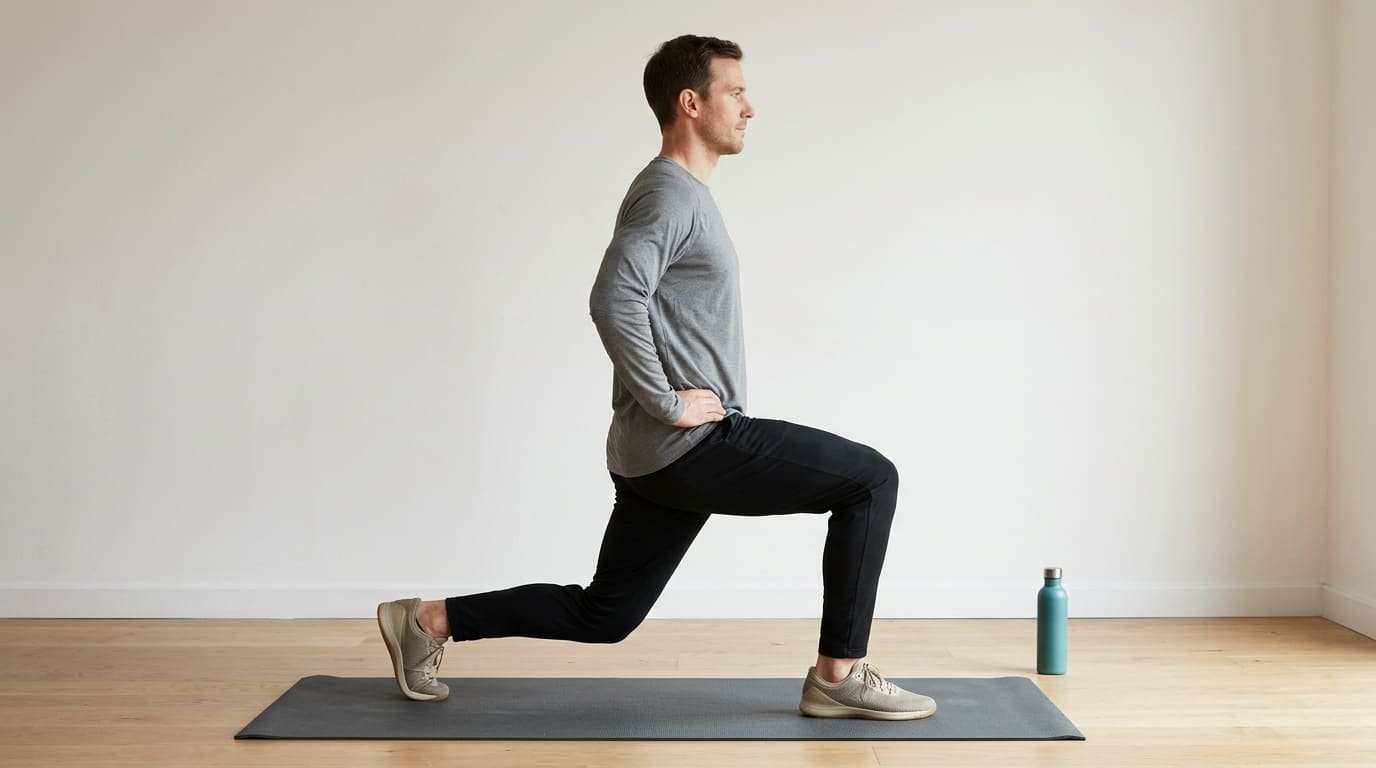
2. Split squat
- Stand in a long stride, one foot forward and one back, feet hip-width apart
- Keeping your trunk upright, lower straight down until your back knee is just above the floor
- Push through your front foot to stand
- Complete your reps, then switch legs
Sets and reps: 3 sets of 8 to 12 per leg.
3. Reverse lunge
- Stand tall with your feet hip-width apart
- Step one foot back and lower until both knees are bent to about 90 degrees
- Push through the front heel to return to standing
Sets and reps: 3 sets of 8 to 12 per leg.
Stepping back is easier on the knees than stepping forward. Our lunge alternatives guide compares the directions.
4. Bulgarian split squat
The best bodyweight exercise for building the quadriceps and glutes.
- Stand about a stride in front of a chair or sofa and rest the top of one foot on it behind you
- Keep most of your weight on the front leg
- Lower straight down until your front thigh is at least parallel to the floor
- Push up through the front foot
Sets and reps: 3 sets of 6 to 12 per leg.
Emphasis: an upright trunk and a shorter stride works the quadriceps more. A slight forward lean and a longer stride works the glutes more. Research has found that single-leg squats with the rear foot supported produce more glute and hamstring activity than two-legged squats, which work the quadriceps harder.
5. Step-up and step-down
- Stand facing a sturdy step, chair or bench. A higher step is harder
- Place one whole foot on it
- Stand up by pushing through that foot, without springing off the back leg
- Lower slowly, taking three seconds, until your back toe lightly touches the floor
Sets and reps: 3 sets of 8 to 12 per leg.
The slow lowering is the valuable part. It builds the control you need for single-leg squats.
6. Cossack squat
- Stand with your feet very wide apart, toes turned out slightly
- Shift your weight to one side and bend that knee, sitting your hips back and down
- Keep the other leg straight, letting its toes lift toward the ceiling
- Go as low as your mobility allows, then push back to the centre and repeat on the other side
Sets and reps: 3 sets of 6 to 8 per side.
This trains the inner thighs and hips through a large range. Hold a door frame for balance at first.
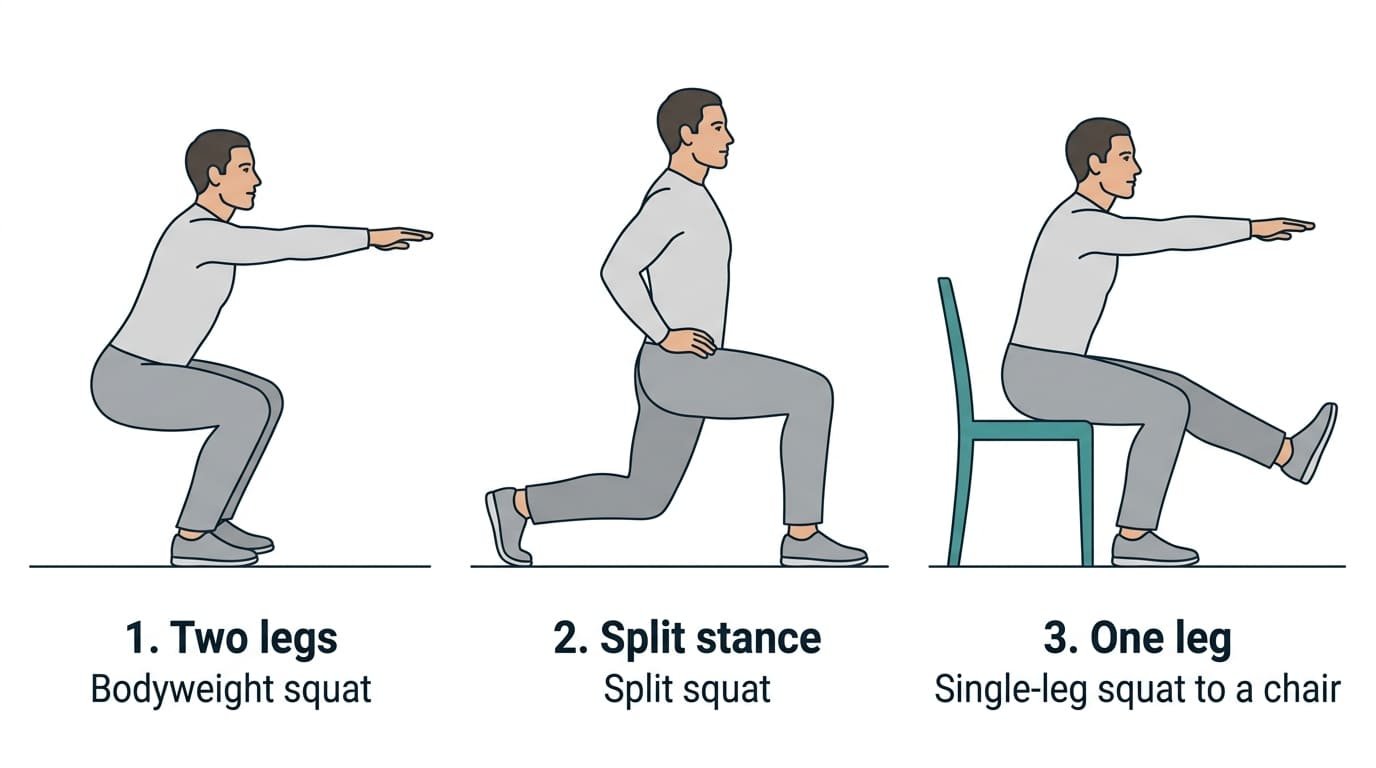
7. Single-leg squat to a chair, then pistol squat
The goal exercise for many people. Take it in stages.
| Stage | Exercise | Move on when you can do |
|---|---|---|
| 1 | Single-leg sit-down to a chair, stand up with two legs | 3 sets of 8 per leg, taking 3 seconds down |
| 2 | Single-leg squat to a chair, down and up on one leg | 3 sets of 6 per leg |
| 3 | The same to a lower surface, such as a stool or a step | 3 sets of 6 per leg |
| 4 | Assisted pistol squat, holding a door frame or a strap | 3 sets of 5 per leg |
| 5 | Pistol squat | Build from 1 rep per leg |
Form: extend your free leg in front of you, reach your arms forward as a counterweight, keep your standing heel down and your knee in line with your toes. Our single-leg squat guide covers every step in detail.
8. Glute bridge and single-leg glute bridge
- Lie on your back with your knees bent and feet flat, hip-width apart
- Press through your heels and lift your hips until your body is straight from shoulders to knees
- Squeeze your glutes for two seconds, then lower
- For the single-leg version, extend one leg and do the same on the other
Sets and reps: 3 sets of 15 to 20 on two legs, or 10 to 15 per leg.
9. Single-leg hip thrust
- Sit on the floor with your upper back against the edge of a sofa
- Bend one knee with the foot flat, and lift the other foot off the floor
- Drive your hips up until your trunk and thigh are level
- Pause, then lower under control
Sets and reps: 3 sets of 8 to 12 per leg.
The extra range of motion makes this harder than the floor bridge. Our comparison of the glute bridge and hip thrust explains the difference.
10. Single-leg Romanian deadlift
- Stand on one leg with a soft knee, a hand resting lightly on a wall if needed
- Hinge forward from the hip, letting your free leg rise behind you in line with your trunk
- Keep your hips square to the floor and your back flat
- Stop when your trunk is near parallel to the floor, then squeeze your glute to stand
Sets and reps: 3 sets of 8 to 10 per leg.
11. Sliding hamstring curl
Needs a smooth floor and two small towels, or socks on a hard floor.
- Lie on your back with your heels on the towels and your knees bent
- Lift your hips into a bridge
- Keeping your hips high, slide your heels away until your legs are nearly straight
- Pull your heels back toward you
Sets and reps: 3 sets of 6 to 10.
Easier: slide out slowly, lower your hips to the floor, and reset. Harder: use one leg.
12. Nordic curl
The hardest bodyweight hamstring exercise, and one of the most studied. A review covering more than 8,000 athletes found that programmes including Nordic curls roughly halved the rate of hamstring injuries.
- Kneel on a cushion with your ankles held firmly: under a heavy sofa, or by a partner
- Keep your body straight from knees to head, hips forward
- Lower your trunk toward the floor as slowly as you can
- Catch yourself with your hands when you can no longer hold it, and push back up
Sets and reps: 2 to 3 sets of 3 to 6.
Only the slow lowering matters at first. Start with one or two sets. This exercise causes a lot of soreness when it is new. Our hamstring exercises at home guide has gentler options.
13. Single-leg calf raise
- Stand on the edge of a step on the ball of one foot, holding a wall for balance
- Lower your heel below the step for a full stretch
- Rise as high as you can onto your toes and pause for a second
- Lower slowly
Sets and reps: 3 sets of 10 to 15 per leg.
Our calf workout at home has a full routine.
14. Jump squat
- Squat to about a quarter or half depth, swinging your arms back
- Jump straight up as high as you can
- Land softly and quietly, absorbing the landing with your hips and knees
- Reset before the next rep
Sets and reps: 3 sets of 5 to 6, at the start of a session.
Jumps train power, not size. Keep the reps low and the quality high. Our plyometric workout guide explains how to progress them safely.
Three calisthenics leg workouts
Rest 60 to 90 seconds between sets, and up to two minutes on the hardest single-leg exercises.
Workout 1: beginner (20 minutes)
| Exercise | Sets | Reps |
|---|---|---|
| Bodyweight squat, 3 seconds down | 3 | 12 to 15 |
| Reverse lunge | 3 | 8 to 10 per leg |
| Glute bridge, 2-second squeeze | 3 | 15 |
| Step-up onto a low step | 2 | 10 per leg |
| Calf raise, two legs | 3 | 15 to 20 |
Workout 2: intermediate (30 minutes)
| Exercise | Sets | Reps |
|---|---|---|
| Bulgarian split squat | 4 | 8 to 10 per leg |
| Single-leg glute bridge, or single-leg hip thrust | 3 | 10 to 12 per leg |
| Step-down, 3 seconds down | 3 | 8 per leg |
| Sliding hamstring curl | 3 | 6 to 10 |
| Cossack squat | 2 | 6 per side |
| Single-leg calf raise | 3 | 10 to 15 per leg |
Workout 3: advanced (35 minutes)
| Exercise | Sets | Reps |
|---|---|---|
| Jump squat | 3 | 5 |
| Pistol squat, or single-leg squat to a low chair | 4 | 4 to 8 per leg |
| Bulgarian split squat, 4 seconds down with a pause | 3 | 8 per leg |
| Nordic curl, lowering only | 3 | 4 to 6 |
| Single-leg hip thrust | 3 | 10 to 12 per leg |
| Single-leg calf raise, with a 2-second pause at the top | 3 | 12 to 15 per leg |
For easier starting points, see our beginner leg workout at home.
Sets, reps and how often
| Question | Answer |
|---|---|
| How many exercises? | 4 to 6 per session |
| How many sets? | 3 to 4 for the main exercises, 2 to 3 for the rest |
| How many reps? | 6 to 12 per leg for single-leg work, 12 to 20 for two-legged exercises |
| How hard? | End each set one to three reps short of failure |
| How often? | 2 to 3 times a week, with at least a day between |
| Weekly sets | About 10 to 16 hard sets each for quadriceps and glutes, 6 to 10 for hamstrings and calves |
| Tempo | Two to four seconds down, a brief pause, then up with purpose |
Start with your weaker leg on single-leg exercises, and match its reps with the stronger one. This evens out differences over time.
When to move to a harder exercise
Use this rule: when you can complete every set at the top of the rep range with two reps in hand, move one step along the path.
| Path | Step 1 | Step 2 | Step 3 | Step 4 | Step 5 |
|---|---|---|---|---|---|
| Squat | Chair squat | Bodyweight squat | Split squat | Bulgarian split squat | Pistol squat |
| Hinge | Glute bridge | Single-leg bridge | Hip thrust | Single-leg hip thrust | Single-leg Romanian deadlift |
| Hamstring curl | Bridge walk-out | Sliding curl, lowering only | Sliding curl | Single-leg sliding curl | Nordic curl |
| Calves | Two-leg raise on the floor | Two-leg raise on a step | Single-leg raise on the floor | Single-leg raise on a step | Single-leg raise with a pause |
If the next step is too big a jump, stay where you are and slow the lowering or add a pause for a couple of weeks first. When you run out of steps, add load with a backpack or a weighted vest. Our weighted vest training guide explains how.
Fitting leg training into your week
| Your routine | Where legs go |
|---|---|
| Full body, three days | One squat-type and one hinge-type exercise every session |
| Upper lower, four days | Two full leg sessions, using Workout 2 or 3 |
| Push pull legs | Leg day once or twice a week |
| Calisthenics only | Two leg days, on non-consecutive days, alongside upper-body sessions |
Our calisthenics workout plan for beginners shows a full week, and the upper lower split explains the four-day structure. For your upper body, see the calisthenics back workout.
Common mistakes
- Staying on two-legged squats long after they stop being hard
- Chasing high reps. Fifty easy squats is endurance work
- Shallow range. Half squats and short lunges leave a lot behind
- Neglecting the hamstrings. Squats and lunges are mostly quadriceps and glutes
- Rushing the lowering phase
- Knees collapsing inward. Keep them in line with your toes
- Heels lifting in squats, usually from tight ankles. Our ankle dorsiflexion exercises help
- Skipping calves
- Jumping into pistol squats or Nordic curls before building the base
- Skipping leg day, because upper-body skills are more fun
Safety
- Use a stable chair, step or sofa that cannot slide. Push it against a wall
- Hold a support for balance until single-leg exercises feel steady
- Some knee discomfort in deep single-leg squats usually means the step up was too soon. Go back a stage
- Build up Nordic curls and jump training gradually. Both cause heavy soreness when new
- Stop for sharp pain in the knee, hip or lower back
- Get advice first if you have a knee or hip injury, arthritis, or balance problems
The bottom line
Calisthenics can build strong legs, as long as you keep moving past exercises that have become easy. For legs, that means going deeper and slower, and then training one leg at a time.
Cover a squat, a hinge, a hamstring exercise and calves in every session. Start with slow bodyweight squats, reverse lunges and bridges. Move on to Bulgarian split squats, single-leg bridges and sliding curls. Work toward pistol squats and Nordic curls over months, not weeks.
Train your legs two or three times a week, and never leave them out because the upper-body exercises are more fun.
For more on the teardrop muscle above the knee, read our guide to VMO exercises.
Frequently asked questions
Can you build leg muscle with calisthenics?
Yes. Research shows light loads build muscle comparably to heavy ones when sets are taken close to failure. The key is using exercises that are hard enough, which for legs means single-leg work such as Bulgarian split squats, step-ups and single-leg hip thrusts.
What is the best calisthenics leg exercise?
The Bulgarian split squat is the best all-round choice for the quadriceps and glutes. For the hamstrings, the sliding curl and the Nordic curl are the most effective. A complete routine uses one squat-type and one hamstring or hinge exercise.
How often should I do a calisthenics leg workout?
Two or three times a week, with at least one day between sessions. Aim for roughly 10 to 16 hard sets a week for the quadriceps and glutes, and 6 to 10 each for the hamstrings and calves.
Are bodyweight squats enough to build legs?
Only for the first few weeks. They become too easy quickly, and doing very high reps is inefficient. Slow the tempo and add pauses to extend their usefulness, then move to split squats and single-leg exercises to keep progressing.
How do I train hamstrings with no equipment?
Use single-leg glute bridges, single-leg Romanian deadlifts and sliding hamstring curls with towels on a smooth floor. Nordic curls, with your ankles held under a sofa, are the most demanding option. Start with the slow lowering phase only.
How long does it take to do a pistol squat?
Most people need two to six months, depending on strength, balance and ankle mobility. Work through single-leg sit-downs to a chair, single-leg squats to lower surfaces, and assisted pistol squats before attempting the full movement.
Is calisthenics or weights better for legs?
Weights make it easier to keep adding load, which matters most for advanced trainees and maximum strength. For beginners and intermediates, calisthenics builds strong, muscular legs effectively and improves balance. Many people combine both.
Why are my legs not growing from bodyweight training?
Usually because the exercises are too easy, the range of motion is shallow, or nothing has been made harder for weeks. Switch to single-leg exercises, lower slowly, finish sets close to failure, and make sure you eat enough protein.
What’s next?
Reading is the easy part. Pick one of these and do it today.


