VMO Exercises: 10 Best Moves for the Inner Quad Above the Knee
The VMO is the teardrop-shaped muscle on the inside of your thigh, just above the knee. Search for it and you will find two kinds of promise. One is that a special exercise will build the teardrop. The other is that strengthening it will fix your knee pain.
When my own knee started aching on stairs, I went looking for the magic VMO exercise and did hundreds of the wrong thing: tiny leg lifts with my foot turned out, because a video said that would target it. The knee did not change. What helped, months later, was plain, progressive leg strengthening, done through a full range of motion.
So this guide is honest about what the research shows. It explains what the VMO is, whether it can really be isolated, the ten exercises that train it best, and three workouts to follow.
At a glance
- VMO stands for vastus medialis oblique, the lower inner part of the quadriceps
- It helps straighten the knee and steadies the kneecap
- Research has not found a reliable way to activate the VMO separately from the rest of the quadriceps
- It grows and strengthens when you train your quadriceps hard, especially through deep knee bends
- Step-downs, split squats, heel-elevated squats and terminal knee extensions are the most useful exercises
- For knee pain, strengthening the hips as well as the thighs works better than chasing one muscle
- Train two or three times a week and progress slowly
What the VMO is
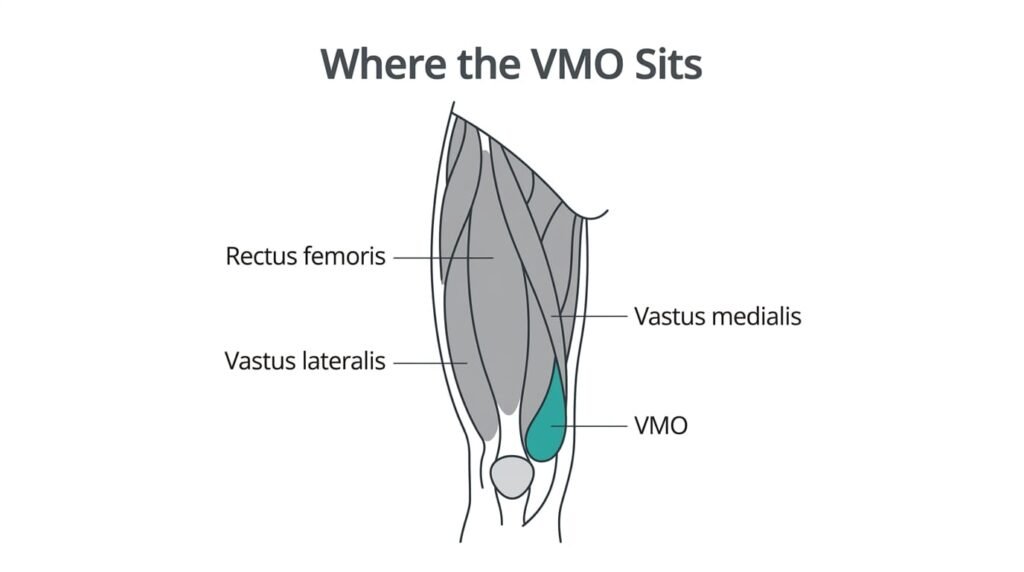
Your quadriceps is a group of four muscles on the front of the thigh. All four join into one tendon that wraps over the kneecap and attaches to the shin.
| Muscle | Where it is | Main job |
|---|---|---|
| Rectus femoris | Down the centre of the thigh | Straightens the knee and helps lift the thigh at the hip |
| Vastus lateralis | The outer thigh | Straightens the knee. The largest of the four |
| Vastus intermedius | Deep, under the rectus femoris | Straightens the knee |
| Vastus medialis | The inner thigh | Straightens the knee |
The vastus medialis is often described in two parts. The upper fibres run more or less straight down the thigh. The lower fibres angle inward toward the kneecap at a slant, and those slanted fibres are what people call the vastus medialis oblique, or VMO. They form the visible teardrop above the inside of the knee.
What it does
- Straightens the knee, together with the other three quadriceps muscles
- Pulls the kneecap inward. Because of the angle of its fibres, the VMO is thought to balance the outward pull of the larger outer quad, helping the kneecap track in its groove
- Contributes to the last part of knee extension, along with the rest of the quadriceps
That second job is why the VMO features so heavily in discussions of knee pain.
Can you isolate the VMO?
This is the question that matters, and the evidence does not support the popular answer.
For decades, people have been told that turning the foot out, squeezing a ball between the knees, or working only the last few degrees of knee extension will switch on the VMO separately. A systematic review examined the electromyographic studies testing these ideas. It concluded that there was insufficient evidence that any of these methods preferentially activates the VMO over the rest of the quadriceps.
In plain terms: the VMO works when the quadriceps works. The four muscles share a nerve supply and act as a team. You cannot ask one to do the job while the others watch.
That is good news, because it makes training simpler. To build and strengthen your VMO, train your quadriceps well.
| Popular claim | What the evidence suggests |
|---|---|
| Turning your feet out targets the VMO | Not shown to change the balance between VMO and outer quad reliably |
| Squeezing a ball between your knees isolates it | It works the inner thigh adductors. The VMO is not selectively increased |
| Only the last 30 degrees of extension work the VMO | The VMO is active through the whole range of knee extension |
| A weak VMO is the cause of most knee pain | Knee pain has many contributors, including hip strength, load and training errors |
| You can spot-train the teardrop | It grows with overall quadriceps growth, and shows more as body fat falls |
Why train it anyway?
If you cannot isolate it, why read on? Because some exercises are better than others at loading the quadriceps in the positions where the knee needs it most.
- Stronger, more stable knees. Strong quadriceps absorb force on stairs, slopes and landings
- Better kneecap control. A strong inner quad, together with strong hips, helps the knee track well
- A more developed thigh. The teardrop is a mark of well-trained quadriceps
- Better squats, lunges and jumps
- Protection as you age. Quadriceps strength is closely tied to getting out of chairs, climbing stairs and avoiding falls
VMO exercises and knee pain
Pain around or behind the kneecap is common, especially in runners and people who do a lot of stairs or squatting. It is often called patellofemoral pain or runner’s knee.
An international panel of experts reviewed the research and issued a consensus statement. Their main recommendations were:
- Exercise therapy is the treatment of choice
- Combining hip and knee strengthening is preferred over knee exercises alone
- Education about managing load matters
So the modern approach is not to hunt for a VMO exercise. It is to strengthen the whole thigh and the muscles around the hip, the glutes especially, and to build up activity gradually.
This article is general information, not a diagnosis. See a doctor or physiotherapist if you have knee pain that lasts more than two weeks, swelling, locking, a knee that gives way, pain after an injury, or pain at night. Do not train through sharp pain.
The 10 best VMO exercises
They run roughly from easiest to hardest. For all of them, keep your knee in line with your second toe. Do not let it collapse inward.
1. Quad set
The gentlest starting point, used early in knee rehabilitation.
- Sit on the floor with one leg straight and a rolled towel under the knee
- Tighten the thigh muscle and press the back of the knee down into the towel
- Hold for five seconds, watching the teardrop above the knee firm up
- Relax
Sets and reps: 3 sets of 10 holds per leg.
2. Terminal knee extension
Needs a resistance band.
- Anchor a band at knee height and loop it behind one knee
- Step back until the band is taut, facing the anchor, with that knee slightly bent
- Straighten the knee fully against the band, squeezing the thigh
- Hold for two seconds, then let it bend again
Sets and reps: 3 sets of 12 to 15 per leg.
This is a good warm-up exercise and a useful option when deeper knee bends are uncomfortable.
3. Wall sit
- Stand with your back against a wall and walk your feet forward
- Slide down until your thighs are parallel to the floor, or as low as is comfortable
- Keep your knees over your ankles and your back flat on the wall
- Hold
Sets and reps: 3 holds of 20 to 45 seconds.
Start higher on the wall if the full position bothers your knees.
4. Step-up
- Stand facing a step
- Place one whole foot on it
- Stand up by pushing through that foot, without springing off the back leg
- Lower slowly
Sets and reps: 3 sets of 10 to 12 per leg.
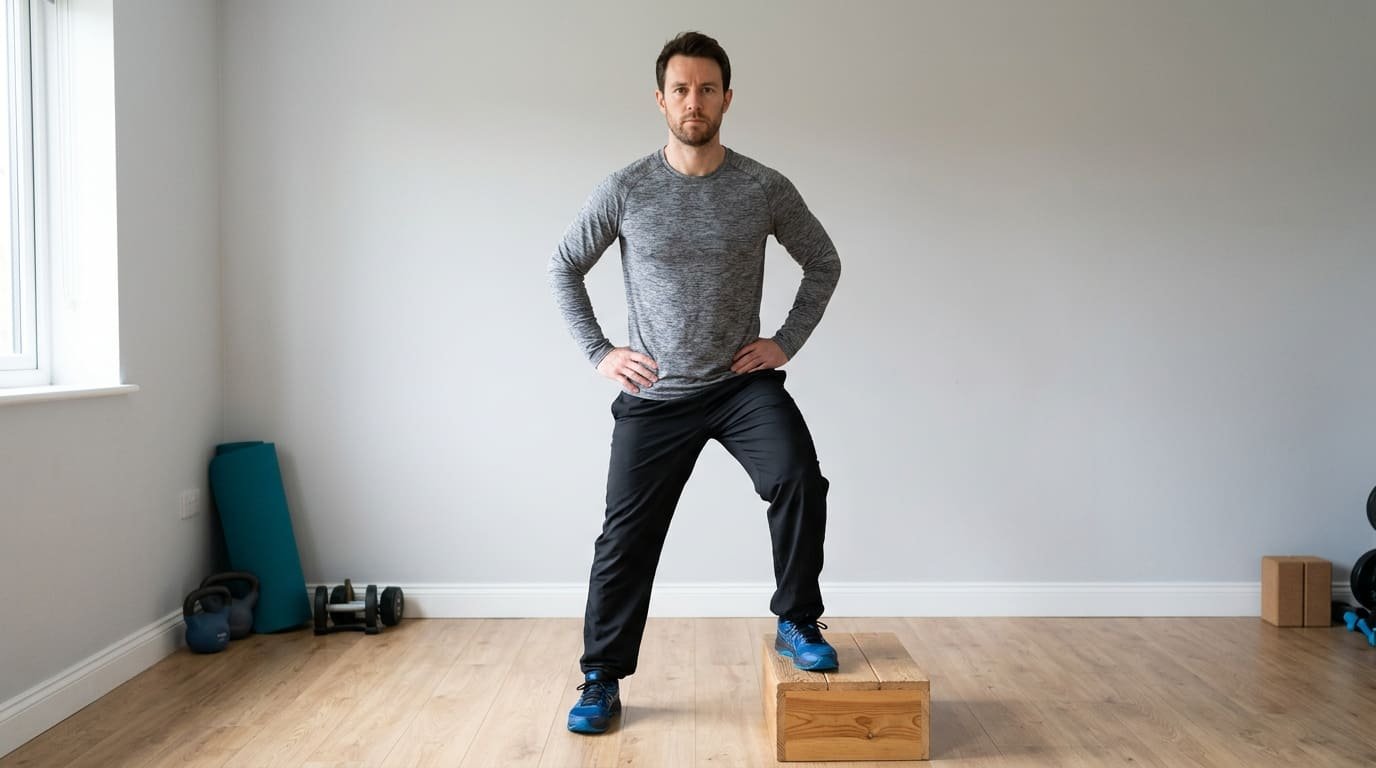
5. Lateral step-down
One of the most useful exercises for quadriceps strength and knee control.
- Stand sideways on a low step, with one foot on it and the other hanging off the side
- Keep your hips level and your standing knee over your second toe
- Bend the standing knee slowly, taking three seconds, until the other heel lightly touches the floor
- Straighten up
Sets and reps: 3 sets of 8 to 10 per leg.
Use a mirror at first. If your knee drifts inward or your hip drops, lower the step.
6. Split squat
- Stand in a long stride, feet hip-width apart
- Lower straight down until your back knee is just above the floor
- Let your front knee travel forward over your toes, keeping the heel down
- Push up through the front foot
Sets and reps: 3 sets of 8 to 12 per leg.
A slightly shorter stride with the front knee moving forward puts more of the work on the quadriceps. Our lunge alternatives guide covers the variations.
7. Heel-elevated squat
- Stand with your heels on a wedge, a weight plate or a thick book, about 3 to 5 cm high, feet hip-width apart
- Hold a weight at your chest if you have one
- Keeping your trunk upright, squat straight down, letting your knees travel forward
- Go as deep as you comfortably can, then stand
Sets and reps: 3 sets of 10 to 15.
Raising the heels lets the knees bend further with an upright trunk, which shifts more of the load to the quadriceps.
8. Bulgarian split squat
- Stand a stride in front of a chair and rest the top of one foot on it behind you
- Lower straight down until your front thigh is at least parallel to the floor
- Push up through the front foot
Sets and reps: 3 sets of 8 to 10 per leg.
9. Leg extension
With a machine, a band or an ankle weight.
- Sit on a high chair or bench with your thighs supported
- Straighten one knee fully, squeezing the thigh
- Hold for one second, then lower over three seconds
Sets and reps: 3 sets of 12 to 15 per leg.
This isolates the quadriceps as a group. If it causes pain at the front of the knee, work only in a comfortable part of the range or use a different exercise.
10. Slant-board step-down and reverse sled or backward walking
Two more advanced options.
- Slant-board or heel-raised step-down. A step-down with the heel raised on a wedge, allowing the knee to travel well forward. Sometimes called the Poliquin step-up
- Backward walking uphill, on a treadmill set to an incline or dragging a sled. It loads the quadriceps through the end of knee extension with very little impact
Sets and reps: 3 sets of 8 to 10 per leg for step-downs, or 3 to 5 minutes of backward walking.
Add hip exercises
Since the knee is controlled from above as well as below, include one or two of these in every session.
| Exercise | What it trains | Sets and reps |
|---|---|---|
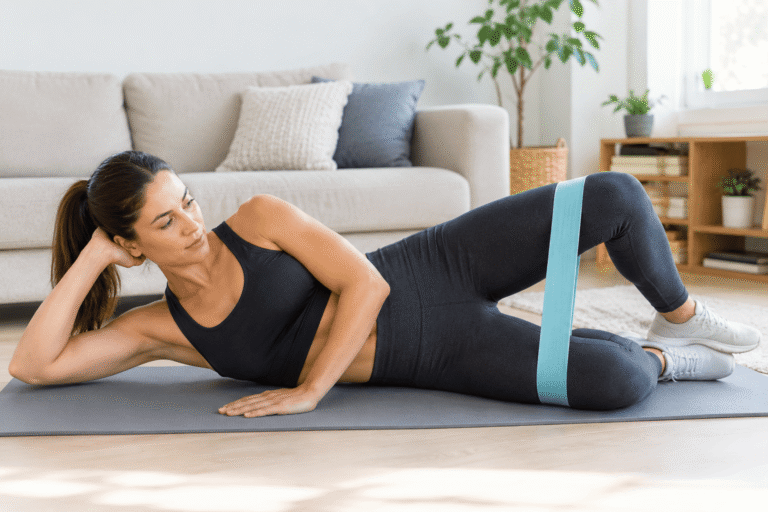
| Side-lying leg raise | Gluteus medius | 3 sets of 12 to 15 per side |
| Clamshell | Hip rotators | 3 sets of 15 per side |
| Lateral band walk | Outer hips | 3 sets of 10 steps each way |
| Single-leg glute bridge | Glutes | 3 sets of 10 to 12 per leg |
Our guides to outer thigh exercises, the clamshell exercise and upper glute exercises explain these in detail.
Three VMO workouts
Do your chosen workout two or three times a week, with a day between sessions. Rest 60 seconds between sets.
Workout 1: gentle start, or sensitive knees
| Exercise | Sets | Reps |
|---|---|---|
| Quad set | 3 | 10 holds of 5 seconds per leg |
| Terminal knee extension with a band | 3 | 12 to 15 per leg |
| Wall sit, high position | 3 | 20 to 30 seconds |
| Side-lying leg raise | 3 | 12 per side |
| Glute bridge | 3 | 12 |
Workout 2: home strength
| Exercise | Sets | Reps |
|---|---|---|
| Step-up | 3 | 10 to 12 per leg |
| Lateral step-down, 3 seconds down | 3 | 8 to 10 per leg |
| Split squat | 3 | 8 to 12 per leg |
| Wall sit | 3 | 30 to 45 seconds |
| Lateral band walk | 3 | 10 steps each way |
Workout 3: build the teardrop
| Exercise | Sets | Reps |
|---|---|---|
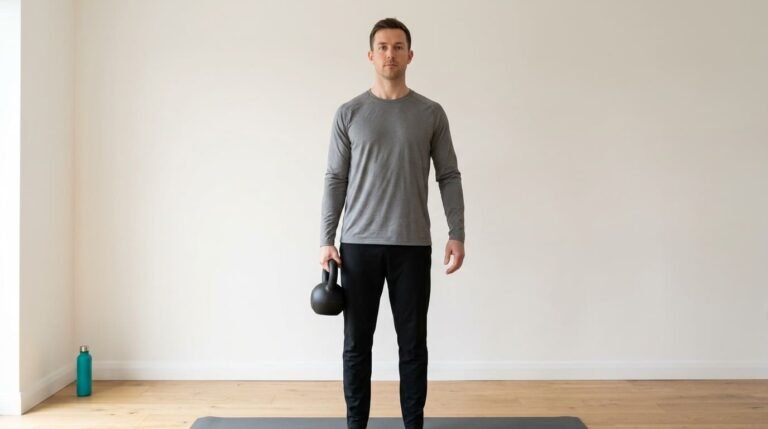
| Heel-elevated goblet squat | 4 | 10 to 15 |
| Bulgarian split squat | 3 | 8 to 10 per leg |
| Heel-raised step-down | 3 | 8 per leg |
| Leg extension, with a 1-second squeeze | 3 | 12 to 15 |
| Single-leg glute bridge | 3 | 10 to 12 per leg |
For complete lower-body sessions, see our beginner leg workout at home and calisthenics leg workout.
Why depth and tempo matter
- Go as deep as you comfortably can. Deeper knee bends ask more of the quadriceps. Research comparing squat depths has found that full squats build the muscles of the thigh and hip at least as well as partial ones, and better for some
- Lower slowly. Three seconds on the way down keeps tension on the muscle and builds control
- Finish each rep. Straighten the knee fully at the top, without snapping it back
- Train one leg at a time. Single-leg exercises stop the stronger leg from doing more of the work
Should your knees go past your toes?
For most healthy knees, yes, they can. The old rule that the knees must never pass the toes makes squats and step-downs more awkward and shifts stress to the hips and lower back. Letting the knees travel forward is a normal part of walking downstairs, and it is how the quadriceps are loaded.
Build up to it gradually. If you have knee pain, start with a shallower range and less forward travel, and increase as it becomes comfortable.
Warm-up for knee-friendly leg training
Five minutes makes the first working set feel far better, especially in cold weather or first thing in the morning.
- Two minutes of easy walking, cycling or marching on the spot
- Ten quad sets per leg, holding each for three seconds
- Ten terminal knee extensions per leg with a light band
- Ten bodyweight squats to a comfortable depth, each a little deeper than the last
- Five slow step-downs per leg from a low step
Our workout warm-up guide has a general routine, and quad stretches are useful afterward if the front of your thighs feels tight.
Everyday habits that help your knees
Training is two or three hours a week. What you do with the other hours counts as well.
- Increase activity gradually. Sudden jumps in running distance, hill walking or stair climbing are a common trigger for kneecap pain. Add a little each week
- Break up long sitting. Knees that ache after sitting with them bent usually feel better if you stand and move every 30 to 45 minutes
- Use the stairs as practice. Go down slowly, with your knee tracking over your second toe. That is a step-down done many times a day
- Keep a healthy body weight. Each kilogram lost takes several kilograms of force off the knee with every step
- Wear shoes that suit you. Worn-out trainers change how the leg loads
Sets, reps and progression
| Question | Answer |
|---|---|
| How often? | 2 to 3 times a week |
| How many quadriceps exercises? | 3 to 4 per session |
| How many sets? | 3 per exercise |
| How many reps? | 8 to 15 |
| How hard? | The last two or three reps should be challenging |
| Weekly quadriceps sets | About 10 to 16 |
Progress in this order: more reps, slower lowering, deeper range, a higher step, then added weight. Our sets and reps guide explains the method.
A pain guide for sensitive knees: mild discomfort of up to about 3 out of 10 that settles within a day is generally acceptable. Pain above that, pain that worsens during the session, or pain that is worse the next morning means you did too much. Reduce the depth, the load or the number of sets.
How long until you see a difference?
| Timescale | What usually changes |
|---|---|
| 2 to 4 weeks | Better control on step-downs. The knee feels steadier on stairs |
| 6 to 8 weeks | Measurable strength gains: more reps, a higher step, more weight |
| 8 to 12 weeks | Visible change in the thigh for most people training consistently |
| 3 to 6 months | A clearer teardrop, provided body fat is moderate and you are eating enough protein |
These are typical ranges from general training experience, not guarantees. Early gains are mostly your nervous system learning the movements. Muscle growth follows more slowly.
Common mistakes
- Chasing isolation tricks instead of training the whole quadriceps
- Only doing short-range exercises and never bending the knee deeply
- Letting the knee cave inward
- Rushing the lowering phase
- Ignoring the hips
- Adding load before control
- Training through sharp pain
- Expecting a visible teardrop without overall leg development and a reasonably low body fat
- Doing the exercises daily. The muscle needs rest days to adapt
The bottom line
The VMO is the lower inner part of your quadriceps, the teardrop above the knee. It helps straighten the knee and steady the kneecap. Despite decades of claims, research has not found a way to work it separately from the rest of the quadriceps.
That simplifies things. Train your quadriceps hard and through a full range, with step-downs, split squats, heel-elevated squats and extensions. Strengthen your hips alongside them. Lower slowly, keep your knee over your toes, and build up gradually.
If your knee hurts, get it assessed. A good programme of thigh and hip strengthening is the best-supported treatment for the most common kind of knee pain, and it builds the teardrop along the way.
The home strength session is on our printable workouts page as a one-page sheet.
If your knee already aches on stairs or after sitting, start with my guide to gentle exercises for knee pain, then come back to these VMO moves once the basics feel easy.
Frequently asked questions
What does VMO stand for?
Vastus medialis oblique. It is the lower, slanted part of the vastus medialis, one of the four quadriceps muscles. It sits on the inner thigh just above the knee and forms the teardrop shape visible in well-developed legs.
What is the best exercise for the VMO?
There is no single best one, because the VMO works with the whole quadriceps. Lateral step-downs, split squats and heel-elevated squats are among the most effective, since they load the quadriceps through a deep knee bend with good control.
Can you isolate the VMO?
No. A systematic review of electromyographic studies found insufficient evidence that the VMO can be activated preferentially over the rest of the quadriceps, whether by turning the foot out, squeezing the knees or limiting the range.
Do VMO exercises help knee pain?
Strengthening the quadriceps helps the most common type of kneecap pain, and experts recommend combining it with hip strengthening. It is the overall programme that helps, not targeting one muscle. See a professional for persistent or severe knee pain.
How do I build the teardrop muscle above my knee?
Train your quadriceps two or three times a week with deep, controlled knee bends: heel-elevated squats, split squats, step-downs and leg extensions. Add weight over time. The teardrop also shows more clearly as body fat comes down.
Is it bad for knees to go past the toes in a squat?
Not for healthy knees. Forward knee travel is normal and is how the quadriceps are loaded. Build up to it gradually. If you have knee pain, start with a shallower range and increase as comfort allows.
How often should I do VMO exercises?
Two or three times a week, with at least a day between sessions. Use three or four quadriceps exercises for three sets each. Gentle exercises such as quad sets can be done daily during early rehabilitation, if advised.
Do terminal knee extensions work the VMO?
They work the whole quadriceps at the end of knee extension, including the VMO, with little stress on the joint. They are a useful warm-up or early rehabilitation exercise, but deeper, heavier movements are needed to build significant strength.
What’s next?
Reading is the easy part. Pick one of these and do it today.