Clamshell Exercise: How to Do It So You Actually Feel It in the Right Place
The clamshell is a side-lying exercise where you keep your feet together and open your top knee like a clam shell, and it trains the gluteus medius, the muscle on the side of your hip that keeps your pelvis level when you walk. Done properly, you feel a burn on the side of the hip within about 10 reps. Done the way most people do it, you feel almost nothing, because the pelvis rolls backwards and the work shifts somewhere else entirely.
I dismissed clamshells for a long time as a physio exercise that could not possibly do much. Then a running friend showed me what it should feel like when the hips stay stacked, and I could barely finish twelve reps. The exercise had been fine all along. My technique had been quietly cheating.
This guide covers where you should feel it, the small details that make the difference, the variations worth knowing, and how to fit clamshells into a real routine.
At a glance
- Main muscle: gluteus medius, the side of your hip
- Equipment: none, or a mini resistance band above the knees
- Reps: 10 to 20 per side, 2 to 3 sets
- Where you should feel it: the outside of the hip, not the front of the thigh or the lower back
- The key detail: keep your hips stacked and still
- Great for: warm-ups, hip stability, knee comfort, walkers and runners
- Not great for: building glute size on its own
What the clamshell is and why it matters
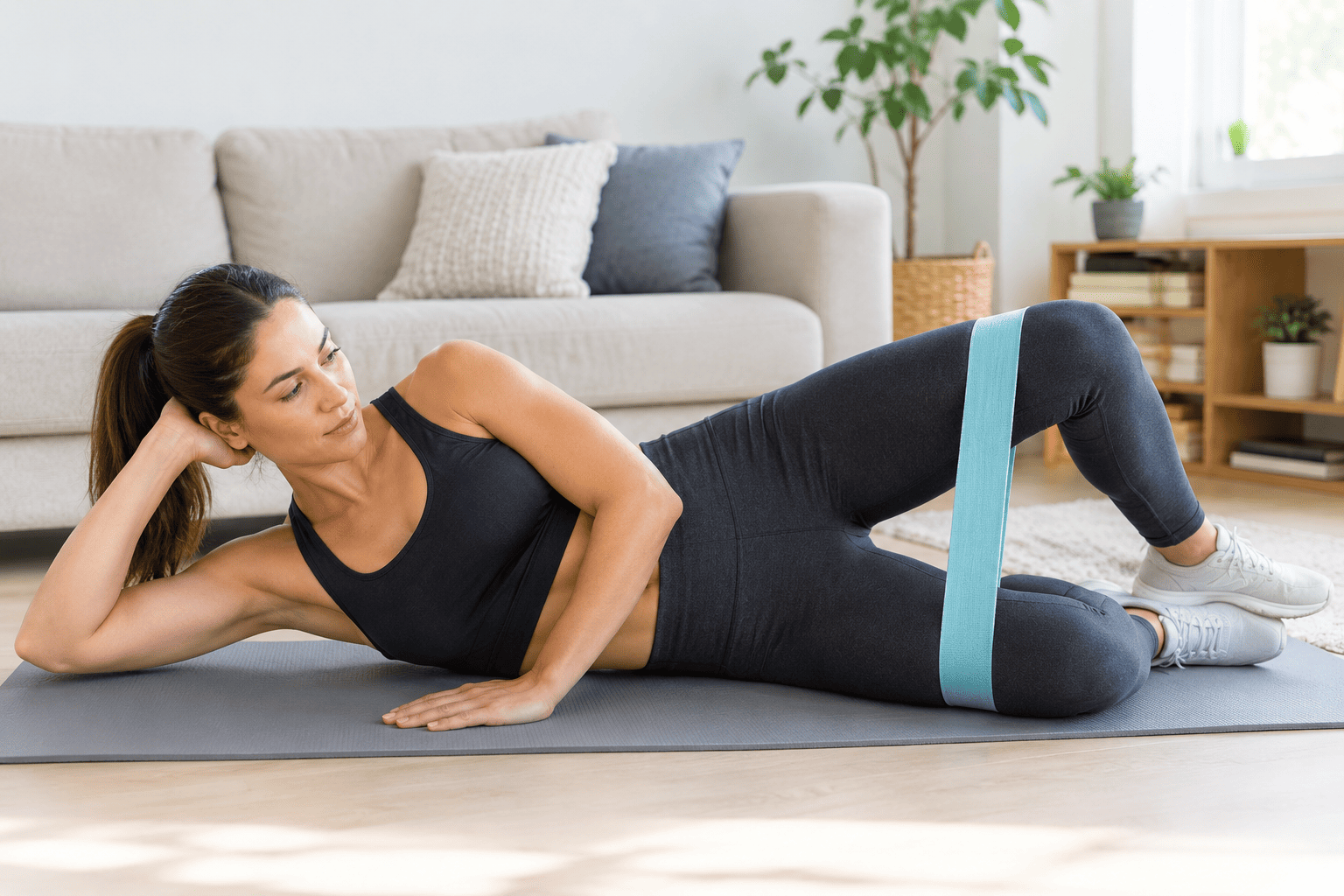
Lie on your side with your knees bent to about 45 degrees, hips and shoulders stacked, feet together. Keeping your feet touching, lift the top knee away from the bottom one, then lower it under control. That opening and closing motion is where the name comes from.
The muscle doing the work is the gluteus medius, which sits on the outside of your hip rather than on the back of your backside. Its main job in everyday life is not glamorous: it stops your pelvis dropping on one side every time you stand on one leg. Which, if you think about walking, is roughly every second step you take.
When that muscle is weak or lazy, other things pick up the slack. People often notice it as:
- Knees that drift inwards during squats, or when landing from a jump
- Hips that feel unsteady on stairs
- One-sided aches in the hip, outer knee or lower back after longer walks
- A wobble when standing on one leg to put socks on
That is why clamshells turn up in so many warm-ups and rehab programmes. They are a simple way to wake up a muscle that tends to go quiet.
Muscles worked
| Muscle | Role in the clamshell |
|---|---|
| Gluteus medius | Main mover, lifts the knee away from the midline |
| Gluteus minimus | Assists underneath the medius |
| Deep hip rotators | Help rotate the thigh outwards |
| Obliques and deep core | Keep the pelvis from rolling backwards |
| Gluteus maximus | Small contribution, mainly in wider variations |
Notice what is not on that list: your quads, your lower back and your hip flexors. If you feel the exercise mostly in the front of your thigh or your lower back, that is the clearest sign something in your setup needs fixing.
How to do a clamshell correctly
- Lie on your side with your knees bent about 45 degrees and your feet in line with your bottom.
- Stack your hips. One hip directly above the other, both pointing straight ahead at the wall in front of you.
- Support your head on your bottom arm or a cushion. Put your top hand on the floor in front of your chest, without pushing yourself over.
- Rest your top hand on your hip for the first few reps so you can feel if it rolls.
- Brace gently. A light tightening of your stomach, nothing dramatic.
- Open the top knee slowly, keeping your feet pressed together, until you feel the side of your hip working. For most people that is a modest opening, not a huge one.
- Pause for a second at the top.
- Lower slowly without letting the knees rest together at the bottom.
Aim for a two-second lift, a one-second hold and a two-second lower. It is a slow exercise. Fast clamshells are almost always cheated ones.
Where you should feel it
Put your fingers on the bony point at the side of your hip, then slide them slightly back and up. That soft area is the gluteus medius. If you hold your fingers there while you do a rep, you should feel the muscle tighten under them.
Within 8 to 15 reps you should feel a distinct burn in that spot. If you reach 25 reps and feel nothing, the problem is nearly always one of the mistakes below.
The seven mistakes that ruin the clamshell
- Rolling the top hip backwards. This is the big one. As the knee opens, the pelvis rotates back so the movement comes from the spine instead of the hip. Keep your hips stacked and imagine a glass of water balanced on your top hip.
- Opening too far. A big range looks impressive but usually comes from rolling. Stop where the hip stays still, even if the knee does not travel far.
- Going too fast. Momentum does the work instead of the muscle. Slow everything down.
- Letting the feet come apart. Heels stay together the whole time, or the movement changes completely.
- Using a band that is too heavy. A strong band forces you to roll the hips to move at all. Start with no band, or a light one.
- Propping up with the top hand. Pushing into the floor lets your torso lean back and hides the rolling.
- Holding your breath. Breathe out as you lift, in as you lower.
If you cannot feel the side of your hip at all, try lying with your back against a wall so your hips and shoulders touch it. The wall gives you instant feedback, because you feel your hip press into it the moment you roll backwards. It fixed the movement for me within a single set.
Clamshell variations worth knowing
Work through these roughly in order. There is no rush to move on, and the basic version stays useful forever as a warm-up.
| Variation | How it changes things | Best for |
|---|---|---|
| Basic clamshell | The standard version | Everyone, warm-ups |
| Banded clamshell | Mini band just above the knees adds resistance | Progression once 20 reps feel easy |
| Feet-elevated clamshell | Lift both feet a few centimetres off the floor and hold | More demand on the deep hip muscles |
| Clamshell with hip raise | Lift your bottom hip off the floor as you open the knee | Adding side-body and core work |
| Reverse clamshell | Keep the knees together and lift the top foot instead | A different angle on the rotators |
| Side plank clamshell | Perform the clam while holding a side plank on your forearm | Advanced, strong core demand |
| Standing clam | Band above the knees, standing, push one knee outwards | Practising the same muscle upright |
Adding a band
A mini loop band just above the knees is the usual way to make clamshells harder. Two details matter: put the band above the knee rather than on the joint, and pick a band light enough that you can still do 15 slow reps without rolling backwards. Most people jump straight to a heavy band and immediately lose the technique they just learned.
If you are building a home set of bands, my guide to the best resistance bands for beginners explains which types are worth having.
Why this muscle goes quiet in the first place
It is worth understanding why the gluteus medius needs waking up at all, because it explains why clamshells feel oddly hard for something so small.
Most of us spend the day in positions that ask almost nothing of it. Sitting switches it off completely. Walking on flat, even pavements asks for very little. Cycling barely touches it. Even a lot of gym training misses it, because squats, lunges and deadlifts all move your legs forwards and backwards rather than out to the side, which is the direction this muscle actually works in.
So the muscle is not usually damaged or unusually weak. It has just had very little to do, and your brain has got used to solving balance problems in other ways: gripping with the outside of your thigh, leaning your torso, or letting the pelvis drop and catching yourself with your lower back.
That is why the first few sessions feel strange. You are not only strengthening the muscle, you are relearning how to use it deliberately. Two things speed that up:
- Touch the muscle while you work it. Putting your fingers on the side of your hip genuinely helps your brain find it.
- Do the exercise slowly and often, rather than heavily and rarely. Frequent light work builds the connection faster than one brutal session a week.
If you sit for most of the day, adding clamshells to a morning routine works well. They take three minutes, need no equipment and no warm-up, and they set your hips up better for whatever the day involves.
Clamshells for walkers and runners
This is where clamshells earn their reputation. Every single step you take while walking or running is a moment where you stand on one leg, and the gluteus medius on that side has to stop your opposite hip dropping.
Over a 30-minute walk, that is several thousand small repetitions. If the muscle fatigues or was never strong enough, the movement has to come from somewhere else, and the knock-on effects usually show up further down the chain: the knee drifting inwards, the outside of the knee getting sore, or the hip aching on one side only.
If you are building up your walking or starting to run, a few habits help:
- Do a set of clamshells before you head out, as part of your warm-up
- Add a second set with a band on your strength days
- Build your distance gradually rather than jumping up by big amounts
- Pay attention to one-sided aches, which are often a stability issue rather than a strength issue
None of this replaces sensible training progression, and clamshells alone will not fix a painful knee. But as a small, cheap habit for anyone putting in a lot of steps, they are hard to beat. If walking is your main activity, my walking for weight loss plan pairs well with this kind of hip work.
Clamshell vs fire hydrant vs side leg raise
These exercises look related, and people often ask which to pick. They all train hip abduction, but from different positions.
| Exercise | Position | Main difference | Difficulty |
|---|---|---|---|
| Clamshell | Side lying, knees bent | Rotation focus, easiest place to feel the gluteus medius | Easy |
| Fire hydrant | On all fours | Body weight works against gravity from another angle | Moderate |
| Side leg raise | Side lying, leg straight | Longer lever, more load on the same muscle | Moderate |
| Standing band walk | Standing | Closest to walking and running | Moderate |
You do not need all four in one session. A sensible approach is clamshells in your warm-up, then one loaded hip exercise in your main workout. My guide to the fire hydrant exercise covers that variation in detail, and inner thigh exercises covers the muscles on the opposite side of the hip, which are worth training too.
How many reps and sets
| Goal | Sets | Reps per side | Notes |
|---|---|---|---|
| Warm-up before legs | 1 to 2 | 10 to 15 | No band or a light band, slow |
| Building hip strength | 3 | 12 to 20 | Band, last few reps should burn |
| Rehab-style work | 2 to 3 | 15 to 20 | Follow any advice from your physio first |
| Advanced | 3 | 10 to 12 | Feet elevated or side plank version |
Clamshells are safe to do most days because the load is small. Three or four times a week is plenty, and doing them as part of a warm-up is the easiest way to stay consistent with them.
When to do them in a workout
The clamshell works best in two places.
In your warm-up. One or two sets before a leg session wakes up the hip stabilisers so your knees track better when you squat and lunge. This is how I use them most often, straight after the general movement in my warm-up routine.
As accessory work at the end. Two or three sets with a band after your main exercises, when you can give them proper attention without tiring yourself out for squats.
What they are not is a main exercise for building muscle. The gluteus medius also responds to loaded work like side-lying raises, step-ups and single leg work. Clamshells make those better rather than replacing them. My single leg squat progression is a natural next step once your hips feel stable.
A simple 10-minute hip routine
Do this two or three times a week, or use the first three exercises as a warm-up before leg day.
| Exercise | Sets | Reps |
|---|---|---|
| Clamshell | 2 | 15 per side |
| Glute bridge | 2 | 15 |
| Side-lying leg raise | 2 | 12 per side |
| Fire hydrant | 2 | 12 per side |
| Side plank | 2 | 20 to 30 seconds per side |
Keep everything slow, and stop any exercise that causes sharp pain rather than muscle burn. For more glute-focused work once this feels easy, my upper glute exercises guide goes further, and glute bridges vs hip thrusts explains how to load the bigger glute muscle properly.
Who benefits most from clamshells
- Walkers and runners, because every stride is a single leg balance moment
- Anyone whose knees cave inwards during squats or on stairs
- People with outer hip or knee ache after longer walks, alongside proper advice
- Beginners starting leg training, as a way to build stability before load
- Anyone sitting all day, since the hip stabilisers do almost nothing in a chair
If you have ongoing hip, knee or back pain, or you are recovering from an injury, get an assessment before self-prescribing exercises. Clamshells are gentle, but knowing the right exercise for your situation beats guessing.
When the clamshell is not the right exercise
A quick word on expectations, because clamshells get recommended for almost everything.
They are a small, light exercise for a small muscle. If your goal is bigger glutes, a stronger squat or more general lower body strength, clamshells are a warm-up, not a plan. Loaded exercises do that job, and no amount of side-lying work replaces them.
They also will not fix pain on their own. If your knee or hip hurts, weak hip stabilisers may be part of the picture, but so might load, footwear, how quickly you increased your walking, or something that needs assessing properly. Doing more clamshells in the hope that pain disappears is a common and frustrating detour.
Where they genuinely shine is as a two-minute habit at the start of leg training, or as part of a short hip routine done a few times a week. Used that way, they quietly make everything else work better.
How to know it is working
Because the clamshell is small and unglamorous, progress is easy to miss. Look for these signs instead of chasing numbers.
- You feel it sooner. The burn arrives at rep 8 instead of rep 20.
- You can use a stronger band while keeping the hips stacked.
- Single leg balance improves. Try standing on one leg with your eyes closed and see how long you last.
- Your knees track better in squats and lunges, and stop drifting inwards.
- Post-walk niggles settle. Often the first thing people notice.
Give it four to six weeks of consistent work before judging it. Small muscles that have been quiet for years take a little time to join in again.
Frequently asked questions
What does the clamshell exercise work?
The clamshell mainly works the gluteus medius on the side of your hip, with help from the gluteus minimus and the deep hip rotators. Its job is keeping your pelvis level when you stand on one leg, which is why it matters for walking, running and stairs.
How do I know if I am doing clamshells correctly?
You should feel a burn on the outside of your hip within 8 to 15 slow reps, and your top hip should stay stacked directly above the bottom one throughout. If you feel it in the front of your thigh or your lower back, you are probably rolling your pelvis backwards.
How many clamshells should I do?
Two or three sets of 12 to 20 reps per side is a good target. Use one or two lighter sets in a warm-up, or three sets with a band if you are training hip strength directly.
Why can I not feel clamshells in my glutes?
The usual reason is that your hips roll backwards as the knee opens, which turns it into a spinal rotation instead of a hip movement. Slow down, open the knee less far, and try lying with your back against a wall so you can feel any rolling.
Should I use a resistance band for clamshells?
Once you can do 20 slow reps with good form, a light mini band above the knees is the natural progression. Choose a band light enough that you can keep your hips stacked, because a heavy band usually forces the technique to break down.
Are clamshells enough to build glutes?
No. Clamshells build stability and endurance in the gluteus medius, but building noticeable glute size needs heavier work like hip thrusts, squats and step-ups. Use clamshells as a warm-up or accessory exercise alongside those.
Can I do clamshells every day?
Yes, for most people. The load is light, so daily sets are fine, especially as a warm-up. If you are using a heavy band and the muscle feels sore, leave a day between sessions.
Do clamshells help knee pain?
They can help when knee discomfort is linked to weak hip stabilisers letting the knee drift inwards, which is common. They are not a treatment for every knee problem, so if pain is persistent or sharp, get it assessed first.
Source: NHS, Physical activity guidelines for adults aged 19 to 64