Exercises for Knee Pain: 12 Gentle Moves to Strengthen and Calm Sore Knees
The right exercises for knee pain can make a sore knee feel better, not worse. That surprises a lot of people. When my knees started aching on the stairs in my early thirties, my instinct was to rest them and avoid anything that bent them. The ache did not go away. It got worse, and my legs got weaker, which made the stairs feel even harder.
A physiotherapist turned that around in about ten minutes. She pressed on my thigh muscles, had me do a slow sit-to-stand from a chair, and said: “Your knee is not the problem. Your knee is the one paying the bill.” My thigh and hip muscles had gone quiet from years of sitting, so the joint was taking load it was never meant to take on its own. Six weeks of simple strengthening later, I could take the stairs two at a time again.
This guide gives you twelve gentle exercises for knee pain, explains why they work, shows you how to progress them safely and gives you a four-week plan. It also covers knee extension exercises, stretching exercises for runner’s knee, chondromalacia patella exercises and the warning signs that mean you should see a professional first.
At a glance
- Strengthening the thigh and hip muscles is the backbone of most exercises for knee pain
- Research shows exercise reduces pain and improves function in knee osteoarthritis
- Exercise is also the first-line treatment for pain around the kneecap, often called runner’s knee
- Mild discomfort during exercise is usually fine. Sharp pain or swelling the next day is a sign to ease off
- Start with seated and lying moves, then progress to standing and step exercises
- Train three or four times a week and expect changes within four to eight weeks
- See a doctor first if your knee is hot, very swollen, locking, giving way or was recently injured
Why exercise helps a sore knee
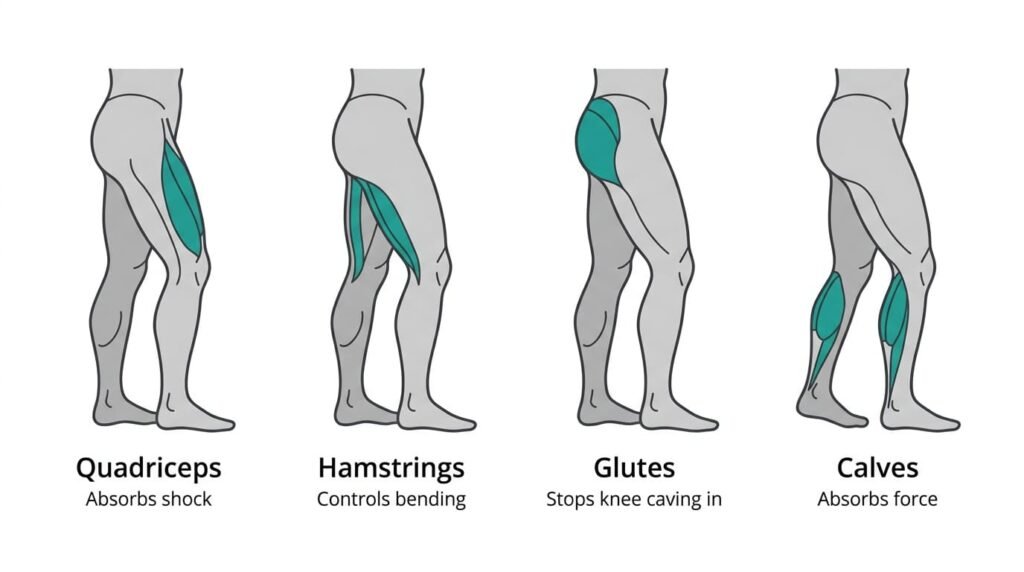
Your knee is a hinge that sits between two long levers: the thigh bone and the shin bone. The muscles around it, mainly the quadriceps at the front of the thigh, the hamstrings at the back and the glutes at the hip, act like shock absorbers. They control how the joint bends, how it lines up and how much force reaches the cartilage.
When those muscles are weak or tired, the knee loses some of that protection. The kneecap may track less smoothly, the joint may wobble inward on stairs, and everyday tasks start to hurt. That is why exercises for knee pain usually focus on the muscles around the knee rather than the knee itself.
| Muscle group | What it does for the knee | Example exercise |
|---|---|---|
| Quadriceps (front of thigh) | Absorbs shock and guides the kneecap | Straight leg raise, seated knee extension |
| Hamstrings (back of thigh) | Controls the knee as it straightens and bends | Hamstring curl, bridge |
| Glutes (hip and buttock) | Stops the knee collapsing inward | Clamshell, side-lying leg raise |
| Calves | Helps absorb force when you walk and climb | Calf raise |
Movement also helps the joint itself. Cartilage has no direct blood supply. It gets its nutrients from the fluid inside the joint, and that fluid moves around when the knee moves and takes load. Gentle, regular activity keeps that process going.
What the research says
- Knee osteoarthritis. A large Cochrane review of 54 trials found high-quality evidence that land-based exercise reduces knee pain and moderate-quality evidence that it improves physical function in people with knee osteoarthritis. The size of the benefit was described as comparable to estimates for anti-inflammatory painkillers
- Pain around the kneecap. An international consensus statement on patellofemoral pain, the type often called runner’s knee, recommended exercise therapy as the main treatment, and specifically recommended combining hip and knee exercises rather than knee exercises alone
- Everyday function. The benefits in the Cochrane review lasted for at least two to six months after formal treatment ended, which suggests the habits you build carry on helping
Common causes of knee pain these exercises can help
Knee pain has many causes, and a professional is the right person to tell you which one you have. These are the common, non-urgent types where exercise is usually part of the plan:
| Type of knee pain | Where it usually hurts | Typical trigger | Exercise focus |
|---|---|---|---|
| Patellofemoral pain (runner’s knee) | Around or behind the kneecap | Stairs, squatting, sitting with bent knees | Quads plus hip strength |
| Chondromalacia patella | Behind the kneecap, sometimes with grinding | Similar to runner’s knee | Quads plus hip strength, gentle range |
| Knee osteoarthritis | Inside or across the whole joint | Stiffness in the morning or after sitting | Strength, range of motion, walking |
| General weakness or stiffness | Vague ache around the knee | Long periods of sitting, low activity | Strength and regular movement |
Chondromalacia patella means softening of the cartilage on the back of the kneecap. In practice, chondromalacia patella exercises look very similar to the exercises for runner’s knee, because both problems respond to stronger thigh and hip muscles and a smoother-tracking kneecap.
The ground rules before you start
A few simple rules make these exercises for knee pain both safer and more effective.
Use the traffic light rule for pain
Physiotherapists often use a simple pain scale from 0 (no pain) to 10 (the worst pain imaginable).
| Pain during exercise | What it means | What to do |
|---|---|---|
| 0 to 2 out of 10 | Safe zone | Carry on |
| 3 to 5 out of 10 | Acceptable for most people, if it settles within a day | Carry on, but do not increase the load yet |
| 6 out of 10 or more | Too much | Stop, make the exercise easier or skip it |
The next morning is the real test. If your knee is more swollen, stiffer or more painful than usual the day after a session, you did too much. Cut the sets or the range for the next session.
Keep the knee in line
For every standing exercise, keep your kneecap pointing in the same direction as your second toe. If the knee caves inward, make the exercise easier until you can control it.
Slow beats fast
Count three seconds down and two seconds up on strengthening moves. Slow movement builds control and keeps the load predictable.
12 exercises for knee pain
The list moves from the gentlest exercises, done sitting or lying, to standing and step exercises. Start at the top and only move down when the earlier exercises feel easy for two sessions in a row.
1. Quad set (thigh tightener)
- Sit on the floor or bed with your legs straight out in front of you
- Place a small rolled towel under the knee you are working
- Tighten the muscle on the front of your thigh, pressing the back of the knee down into the towel
- Hold for 5 seconds, then relax
Dose: 10 reps, two or three times a day. This is the gentlest strengthening exercise for the quadriceps, and a great starting point if your knee is very sore.
2. Straight leg raise
- Lie on your back with one knee bent and the foot flat on the floor
- Tighten the thigh of the straight leg, as in the quad set
- Keeping the knee straight, lift the leg until it is level with the other thigh
- Hold for 2 seconds and lower slowly
Dose: 2 sets of 10. If the knee bends as you lift, the thigh muscle is not yet strong enough. Do more quad sets first.
3. Heel slide
- Lie on your back with both legs straight
- Slowly slide the heel of one foot toward your buttock, bending the knee as far as is comfortable
- Slide it back out again
Dose: 10 to 15 slow reps. This is one of the simplest knee flexion moves and is excellent for stiffness in the morning.
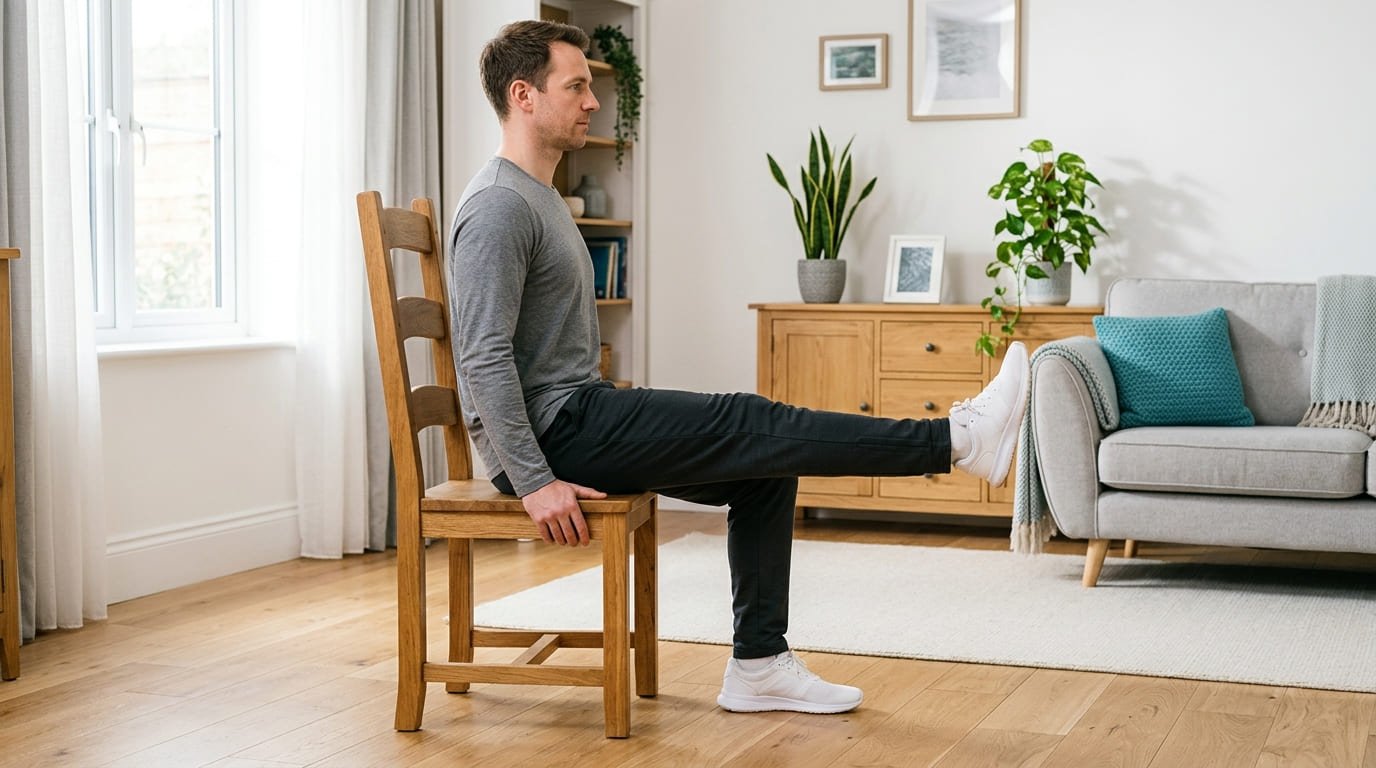
4. Seated knee extension
- Sit tall on a chair with your feet flat on the floor
- Slowly straighten one knee until the leg is straight out in front of you
- Squeeze the thigh for 2 seconds at the top
- Lower slowly over three seconds
Dose: 2 sets of 10 to 15 on each leg. This is the classic member of the family of knee extension exercises. Add a light ankle weight or a resistance band looped around the chair leg when it feels easy.
5. Short arc quad
- Lie on your back with a rolled towel or cushion under one knee, so the knee is slightly bent
- Straighten the knee by lifting your heel off the floor, keeping the back of the knee on the roll
- Hold for 3 seconds, then lower
Dose: 2 sets of 10. Another gentle option among knee extension exercises, working the last part of straightening, which is often the weakest.
6. Glute bridge
- Lie on your back, knees bent, feet flat and hip-width apart
- Press through your heels and lift your hips until your body forms a straight line from shoulders to knees
- Hold for 2 seconds, then lower slowly
Dose: 2 sets of 10 to 12. Bridges strengthen the glutes and hamstrings without putting much load through the front of the knee. Our guide to glute bridges and hip thrusts shows how to progress them.
7. Clamshell
- Lie on your side with your hips and knees bent and your feet together
- Keeping your feet touching, lift your top knee as far as you can without rolling your hips back
- Lower slowly
Dose: 2 sets of 12 to 15 on each side. Clamshells train the muscles on the side of the hip that stop the knee falling inward.
8. Side-lying leg raise
- Lie on your side with your bottom knee bent for balance and your top leg straight
- Lift the top leg toward the ceiling, keeping the toes pointing forward
- Lower slowly
Dose: 2 sets of 10 to 12 on each side. A partner to the clamshell for hip strength.
9. Sit-to-stand
- Sit on a firm chair with your feet hip-width apart
- Lean forward slightly and stand up without using your hands, if you can
- Sit back down slowly, taking three seconds
Dose: 2 sets of 8 to 10. If it hurts, use a higher chair or a cushion. Lower the height over the weeks as your strength improves. This is the move my physiotherapist used to test me, and the one that told me how weak my legs had become.
10. Calf raise
- Stand facing a wall or the back of a chair, holding on lightly
- Rise up onto the balls of your feet
- Lower slowly over three seconds
Dose: 2 sets of 12 to 15. Strong calves help absorb force when you walk, climb and run.
11. Step-up
- Stand facing a low step or the bottom stair, holding the rail
- Step up with one foot, pressing through the heel and keeping the knee in line with your toes
- Bring the other foot up, then step down slowly with the same leg you led with
Dose: 2 sets of 8 on each leg. Start with a very low step, 10 to 15 cm, and only go higher when there is no pain.
12. Wall sit (mini squat)
- Stand with your back against a wall and your feet about 30 cm in front of you
- Slide down until your knees are slightly bent, no further than a quarter squat to start
- Hold for 10 to 20 seconds, then slide back up
Dose: 3 holds. Wall sits are a staple of chondromalacia patella exercises, because a shallow, static squat strengthens the quads with very little kneecap friction. Go deeper only when the shallow version is pain-free.
| Exercise | Muscles worked | Difficulty | Position |
|---|---|---|---|
| Quad set | Quadriceps | Easiest | Sitting or lying |
| Straight leg raise | Quadriceps, hip flexors | Easy | Lying |
| Heel slide | Knee range of motion | Easy | Lying |
| Seated knee extension | Quadriceps | Easy | Sitting |
| Short arc quad | Quadriceps | Easy | Lying |
| Glute bridge | Glutes, hamstrings | Easy | Lying |
| Clamshell | Hip abductors | Easy | Side-lying |
| Side-lying leg raise | Hip abductors | Easy | Side-lying |
| Sit-to-stand | Quads, glutes | Moderate | Chair |
| Calf raise | Calves | Moderate | Standing |
| Step-up | Quads, glutes | Moderate | Step |
| Wall sit | Quadriceps | Moderate | Wall |
Knee extension exercises: why straightening matters
Many people with sore knees slowly lose the ability to straighten the leg fully. It sounds minor, but walking with a slightly bent knee makes the thigh muscles work much harder with every step, which feeds the ache.
Knee extension exercises have two jobs: strengthening the quadriceps and keeping the full range of straightening. Here are three you can add once the basics feel easy:
- Banded terminal knee extension. Loop a band around a sturdy table leg and the back of your knee. Step back until the band is tight, then straighten the knee against the band and squeeze for 2 seconds. 2 sets of 12
- Prone hang. Lie face down on a bed with your kneecap just off the edge. Let gravity gently straighten the knee for 30 to 60 seconds. This is for stiffness, not strength
- Heel prop. Sit with your heel resting on a rolled towel or cushion and let the knee sag gently toward the floor for 30 to 60 seconds. Tighten the thigh at the end
Seated knee extension and short arc quads, from the main list, belong in this group too. Two or three knee extension exercises in each session are plenty.
Stretching exercises for runner’s knee
Runner’s knee, or patellofemoral pain, is not limited to runners. I had it from office work and stairs. Strength work is the main treatment, but gentle stretches can make the knee feel easier and help you move better. These stretching exercises for runner’s knee target the muscles that tug on the kneecap or change how the leg lines up.
Standing quad stretch
Hold the back of a chair, bend one knee and hold your ankle behind you. Keep your knees together and tuck your hips under slightly. Hold for 30 seconds on each side. If grabbing your ankle hurts your knee, loop a towel around the ankle instead. Our quad stretches guide has gentler options.
Seated hamstring stretch
Sit on the edge of a chair with one leg straight out and the heel on the floor. Keeping your back straight, lean forward from the hips until you feel a stretch behind the thigh. Hold for 30 seconds.
Calf stretch against a wall
Stand facing a wall with one foot back, heel down and knee straight. Lean into the wall until you feel a stretch in the calf. Hold for 30 seconds on each side.
Kneeling hip flexor stretch
Kneel on a cushion with one foot forward. Tuck your hips under and shift forward gently until you feel a stretch at the front of the back hip. Hold for 30 seconds. If kneeling is uncomfortable, do the same stretch standing in a split stance.
| Stretch | Muscle | Hold | How often |
|---|---|---|---|
| Standing quad stretch | Quadriceps | 30 seconds x 2 | Daily |
| Seated hamstring stretch | Hamstrings | 30 seconds x 2 | Daily |
| Calf stretch | Calves | 30 seconds x 2 | Daily |
| Kneeling hip flexor stretch | Hip flexors | 30 seconds x 2 | Daily |
Use these stretching exercises for runner’s knee after a walk or a strengthening session, when the muscles are warm. Stretching alone is unlikely to fix the problem, so always pair them with the hip and thigh strengthening exercises above.
Chondromalacia patella exercises: what to change
Because chondromalacia patella involves irritation behind the kneecap, the main goal is to strengthen the legs while keeping kneecap pressure low at first. Three changes make chondromalacia patella exercises kinder to the joint:
- Keep the bend shallow. The deeper your knee bends under load, the more pressure there is behind the kneecap. Start squats and wall sits in the top quarter of the range
- Favour hip work. Clamshells, side-lying leg raises and bridges strengthen the legs with very little kneecap pressure
- Build up stairs and step-ups gradually. Start with a low step and short sets
If you hear grinding or clicking without pain, that is common and usually harmless. Pain, swelling or the knee giving way is different and worth getting checked.
A 4-week plan using these exercises for knee pain
Do the sessions three or four days a week, on non-consecutive days if you can. Each one takes 15 to 20 minutes. On the other days, walk at an easy pace, starting with 10 to 15 minutes if that feels comfortable.
| Week | Exercises | Sets and reps |
|---|---|---|
| Week 1 | Quad set, straight leg raise, heel slide, seated knee extension, glute bridge, clamshell | 2 x 10 |
| Week 2 | Week 1 plus short arc quad, side-lying leg raise and sit-to-stand | 2 x 10 to 12 |
| Week 3 | Drop quad sets. Add calf raise, step-up on a low step, wall sit | 2 to 3 x 10 |
| Week 4 | Seated knee extension with light weight, bridge, clamshell, sit-to-stand, step-up, wall sit, calf raise | 3 x 10 to 12 |
Finish each session with the four stretches. At the end of week four, test yourself on the sit-to-stand: count how many you can do in 30 seconds, and compare it with the start. For most people, that number goes up clearly before the pain fully settles, which is a good sign you are heading in the right direction.
No equipment? No problem
Every one of these exercises for knee pain can be done with a chair, a wall, a step and a towel. A light resistance band is a cheap upgrade for knee extension exercises and clamshells.
How to progress safely
Once an exercise feels easy and pain-free for two sessions in a row, make it a little harder. Change only one thing at a time:
- Add 2 to 3 reps per set
- Add a third set
- Slow the lowering phase to four seconds
- Add a light weight or band
- Increase the range, such as a lower chair or a slightly deeper wall sit
- Move from two legs to one, such as single-leg sit-to-stand or a single-leg squat to a high box
If pain flares up, go back one step for a week, then try again. Recovery is rarely a straight line, and a flare is not a failure.
For general leg strength once your knees have settled, our leg exercises for seniors are a gentle next step, and the VMO exercises guide covers the inner thigh muscle that helps guide the kneecap.
What to avoid while your knee is sore
You do not need to avoid movement, but some things are worth limiting for a few weeks:
- Deep squats and lunges under load until shallow versions feel easy
- Jumping and running downhill, which put large forces through the knee
- Long periods of sitting with the knees bent. Stand up and walk around every 30 to 45 minutes
- Kneeling on hard floors, which can irritate the front of the knee. Use a cushion
- Pushing through sharp pain on any exercise
Walking, cycling and swimming are usually well tolerated and keep you active while you build strength. Our walking plan shows how to build up gradually.
Common mistakes
- Resting completely and waiting for the pain to disappear on its own
- Only doing knee exercises and skipping the hips, which research suggests matter just as much
- Going too hard in week one, then stopping because of a flare
- Letting the knee cave inward on sit-to-stands and step-ups
- Stretching instead of strengthening
- Stopping once the pain eases. Keep a short version of the routine going twice a week to stop the pain coming back
When to see a professional first
Most exercises for knee pain are safe for most people. Get your knee checked by a doctor or physiotherapist before starting, or stop and seek advice, if:
- Your knee pain started after a fall, twist or sports injury
- The knee is very swollen, hot or red, or you have a fever
- The knee locks, catches or gives way
- You cannot put weight on the leg, or cannot straighten the knee
- Pain wakes you at night or is getting worse despite rest
- You have had knee surgery or a joint replacement and have not been given a programme
This article is general information, not medical advice. Seek urgent medical help for a knee that is suddenly very swollen, hot and red, or for pain with fever or calf swelling. See our medical disclaimer.
The bottom line
The best exercises for knee pain are rarely complicated. Strengthen the thigh and hip muscles, keep the knee moving through its full range, and build up gradually using the traffic light rule for pain. Start with quad sets, straight leg raises and seated knee extensions, add hip work and sit-to-stands, and progress to step-ups and wall sits.
Pair the strengthening with knee extension exercises for full straightening and stretching exercises for runner’s knee for comfort. Give it four to eight weeks of consistent practice. When I did exactly that, the stairs stopped being the enemy. I still do a short version of this routine twice a week, because it is much easier to keep a strong knee than to rebuild a weak one.
When the side-lying hip exercises feel easy, monster walks and lateral band walks are a natural next step for knee control while standing.
Frequently asked questions
What are the best exercises for knee pain?
Quad sets, straight leg raises, seated knee extensions, glute bridges, clamshells, sit-to-stands, step-ups and shallow wall sits are among the most useful. They strengthen the thigh and hip muscles that protect the knee. Start with the easiest and progress gradually.
Should I exercise if my knee hurts?
For most common, non-injury knee pain, yes. Mild discomfort up to about 5 out of 10 that settles within a day is usually acceptable. Stop if the pain is sharp or the knee is more swollen the next day, and see a professional if your knee is injured, hot, locking or giving way.
How often should I do exercises for knee pain?
Three or four strengthening sessions a week, each 15 to 20 minutes, work well for most people. Gentle range of motion moves, such as heel slides, can be done daily.
How long does it take for knee exercises to work?
Many people feel some improvement within two to four weeks. Clearer changes in pain and strength usually take four to eight weeks of regular practice, and strength keeps building for months.
What are knee extension exercises?
They are exercises that straighten the knee against resistance or encourage full straightening, such as seated knee extensions, short arc quads, banded terminal knee extensions and heel props. They strengthen the quadriceps and help restore full range.
What stretches help runner’s knee?
Stretches for the quadriceps, hamstrings, calves and hip flexors can help the knee feel easier. Hold each for about 30 seconds. Pair them with hip and thigh strengthening, which is the main treatment for runner’s knee.
What exercises help chondromalacia patella?
Chondromalacia patella exercises focus on strengthening the quads and hips while keeping kneecap pressure low. Good options are quad sets, straight leg raises, clamshells, bridges and shallow wall sits, progressing to deeper squats and step-ups as pain allows.
Is walking good for knee pain?
For most people with osteoarthritis or general knee pain, yes. Start with short, easy walks on flat ground and build up gradually. Supportive shoes help. If walking makes the knee swell or the pain lasts into the next day, shorten the walks for a while.
What’s next?
Reading is the easy part. Pick one of these and do it today.