
Foldable Weight Bench: How to Choose One for a Small Home Gym
A foldable weight bench solves the biggest problem of training at home, which is space. It gives you a proper surface for pressing, rowing and seated work, then folds flat enough to slide under a bed or stand in a cupboard.
My first bench did not fold. It lived in the middle of a spare room for a year, collected laundry, and was eventually sold for a third of what I paid. The folding one that replaced it has been used several times a week ever since, mainly because putting it away takes ten seconds and nobody complains about it.
This guide does not rank brands. Models change every year, and I have not tested them side by side. It explains what actually matters when you choose one: the types, the numbers on the specification sheet, how to check stability, and what each price band buys you.
At a glance
- A foldable bench either has legs that fold under the pad or a frame that collapses flat
- An adjustable folding bench, with several backrest angles, is the most useful type for most people
- Look for a stated capacity of at least 250 to 300 kg including your body weight if you plan to lift seriously
- A pad about 25 to 30 cm wide and a height of about 42 to 45 cm suits most adults
- Check the gap between seat and backrest, the locking mechanism and the footprint of the feet
- Measure where it will be stored before you buy, including the folded thickness
- Expect to pay more for stability, not for extra features
What a foldable weight bench is
It is a training bench designed to reduce to a compact shape for storage. Beyond that, designs vary a great deal.
| Type | How it folds | Best for |
|---|---|---|
| Flat folding bench | Legs fold under a single flat pad | Pressing, rows and step-ups on a tight budget. Very stable for its price |
| Adjustable folding bench | Backrest drops flat, and the frame collapses to a thin package | Most home users. Gives flat, incline and often decline positions |
| Upright-storage bench | Does not collapse, but has wheels and a handle so it stands on end | People who can spare a corner. Usually the most stable adjustable type |
| Folding bench with rack or attachments | Bench with built-in uprights, leg developer or preacher pad | Rarely the best choice. More parts, more wobble, more to store |
The second and third types cover almost everyone. A bench that stands on end takes roughly the floor space of a dining chair, and it avoids the main weakness of collapsing frames, which is play in the hinges.
Why a bench is worth having
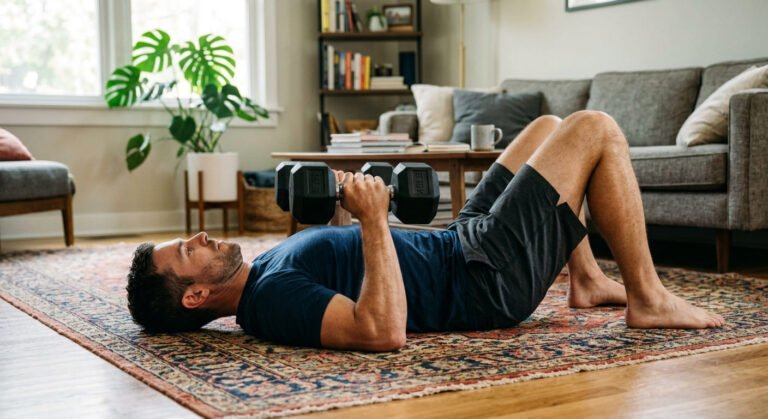
You can train well without one, and our dumbbell chest workout without a bench shows how. A bench still adds a lot.
- Full range for presses. On the floor, your elbows stop at the ground. On a bench they can travel lower, which lengthens the chest under load
- Angles. Incline pressing shifts work toward the upper chest and shoulders. A study comparing five bench angles found that upper chest activity was highest at about 30 degrees, and that the front of the shoulder took over progressively as the bench rose toward 45 and 60 degrees
- Supported rows. Lying chest-down on an incline takes your lower back out of the movement
- Seated work. Overhead presses, curls and lateral raises with back support
- Lower body. Step-ups, Bulgarian split squats, hip thrusts and box squats
Our weight bench dumbbell exercises guide lists what you can do once you have one.
Do you need one yet?
Be honest about where you are, because a bench is not the first thing to buy.
| Your situation | Verdict |
|---|---|
| You train with bodyweight only | Not yet. A sturdy chair or step covers step-ups and dips |
| You have light dumbbells and train once or twice a week | Optional. Floor presses work for now |
| You own dumbbells of 10 kg or more per hand and train regularly | Yes. This is when a bench starts to pay for itself |
| You are planning a barbell and rack | Yes, and buy for stability first |
| You have no storage space at all | Consider a flat folding bench or a sturdy step platform instead |
If you are still building the habit, spend the money on a wider range of weights first. Our adjustable dumbbells for home guide explains what to look for.

Weight capacity
This is the number that matters most, and the one most often misread.
The stated capacity is the total load the bench is built to hold. That means your body weight plus everything you are lifting.
| Your body weight | Weights you press | Total load | Sensible minimum capacity |
|---|---|---|---|
| 70 kg | 2 x 20 kg dumbbells | 110 kg | 200 kg |
| 85 kg | 2 x 30 kg dumbbells | 145 kg | 250 kg |
| 100 kg | 2 x 35 kg dumbbells | 170 kg | 300 kg |
| 90 kg | 100 kg barbell | 190 kg | 350 kg or more |
Leave a wide margin, for three reasons.
- Capacity figures are set by the manufacturer, and methods differ. Some quote a static load that the bench held without moving, which is not the same as repeated use
- The force on the bench rises briefly when you sit down hard or lower a weight quickly
- A bench working near its limit flexes and wobbles long before it fails, and wobble under a heavy press is unsafe
As a working rule, choose a capacity at least 100 to 150 kg above your heaviest realistic total. These margins are my own rule of thumb, not an industry standard.
Pad and frame dimensions
| Measurement | Good range | Why it matters |
|---|---|---|
| Pad width | 25 to 30 cm | Narrower pads leave your shoulder blades unsupported. Much wider ones block your arms |
| Pad length, backrest plus seat | About 115 to 130 cm | Your head and hips should both be supported when lying flat |
| Height, floor to top of pad | 42 to 45 cm | Lets you plant your feet flat with knees at about 90 degrees. Taller benches are awkward for shorter people |
| Pad thickness | 5 to 7 cm of firm foam | Soft foam feels comfortable in the shop and unstable under load |
| Gap between seat and backrest | As small as possible, ideally under 5 cm when flat | A wide gap sits under your lower back or hips when lying flat |
| Bench weight | 15 to 30 kg for a folding adjustable | Heavier usually means steadier. Under about 12 kg, expect some movement |
If you are tall, check the pad length. If you are short, check the height. A bench that is 50 cm high leaves many people unable to push through their feet.
Adjustment positions
| Position | Angle | Used for |
|---|---|---|
| Decline | About minus 10 to minus 20 degrees | Decline presses, some abdominal work. Least used |
| Flat | 0 degrees | Presses, rows, hip thrusts, step-ups |
| Low incline | 15 to 30 degrees | Upper chest pressing, incline curls, chest-supported rows |
| Medium incline | 45 degrees | Incline presses, rows, raises |
| High incline | 60 to 75 degrees | Shoulder presses with some lean |
| Upright | 80 to 90 degrees | Seated shoulder presses, curls, lateral raises |
Four or five backrest positions are enough: flat, about 30, about 45, about 60 and upright. Benches advertising ten or more positions are not more useful, and extra decline settings add little for most people.
An adjustable seat is worth having. Tilting the seat up slightly on incline presses stops you sliding down the bench.
Locking mechanisms
| Mechanism | How it works | Notes |
|---|---|---|
| Ladder | The support bar drops into notched steps | Fast and simple, with few parts to fail. Check the notches are deep |
| Pop pin | A spring-loaded pin locks through a hole | Secure when fully engaged. Always check the pin has clicked home |
| Pull pin and bolt | A loose pin is pushed through aligned holes | Slow, and pins get lost. Common on cheaper benches |
Whichever type you choose, confirm the lock before every set. Most bench accidents at home come from a pin that was not fully seated.
How to check stability
Stability separates a good folding bench from a poor one more than any feature.
- Foot width. Wide rear and front feet resist tipping. A single narrow front post is less steady when you sit on the end
- Three points or four. A tripod base sits steady on uneven floors and gives your feet more room. A four-foot base resists side tipping better
- Steel. Thicker tube, often described by gauge, flexes less. Lower gauge numbers mean thicker steel
- Hinges. Every folding joint is a place for play to develop. Fewer hinges is better
- Rubber feet. They stop sliding on hard floors
A five-point test at home
When the bench arrives, test it before you load it.
- Set it flat and press down hard on each corner. It should not rock
- Sit on the very end of the seat. The other end should not lift
- Lie back and shift your weight from side to side. Note any sway
- Set each incline position and push on the backrest. The lock should not shift or click
- Tighten every bolt, and check them again after two weeks of use
If it fails the second or third test, return it. It will not improve.
Folded size and storage
Measure first. This is the step people skip.
| Storage place | What to measure | Typical requirement |
|---|---|---|
| Under a bed | Clearance from floor to bed frame | Folded thickness usually 20 to 30 cm |
| Cupboard or wardrobe | Width, depth and height | Folded length often 80 to 130 cm |
| Behind a door or sofa | Gap width | Folded thickness plus 5 cm |
| Standing in a corner | Floor area | About 50 by 60 cm for an upright-storage bench |
Other points worth checking:
- Wheels and a handle make a 20 kg bench easy to move for one person
- Folding steps. One or two actions is ideal. If it needs pins removing and bolts loosening, you will stop putting it away
- Assembly. Many folding benches arrive nearly complete. That is a real advantage
- Floor protection. A mat under the bench protects floors and adds grip. Our home gym equipment for beginners guide covers flooring
Pad and upholstery
The pad is the part you touch on every rep, and it is easy to judge badly from a photograph.
- Foam density. Firm, dense foam keeps your shoulder blades steady under load. Press a thumb into it. It should resist and spring back at once
- Cover material. Slightly textured vinyl grips your back better than smooth, shiny vinyl, which lets you slide on incline presses
- Stitching. Look for neat seams underneath, and staples that sit flat. Loose corners tear quickly
- Tapered or straight. Some backrests narrow toward the head. That frees the shoulders during flyes and rows, at the cost of a little support
- Board. A thick plywood base under the foam lasts longer than thin chipboard, which can crack around the bolts
Setting up in a small room
A few details make a folding bench much nicer to live with.
- Leave about a metre of clear space on each side, so you can lower dumbbells safely
- Place the head end away from walls and furniture
- Keep your weights within arm’s reach of the foot end, so you can pick them up from a seated position
- Train on a mat or rubber tiles, both for grip and to protect the floor
- Check the ceiling height before standing presses and step-ups
- Fold it the same way every time, and store pins in the same place
Our upper body dumbbell workout shows how to plan a session around limited kit.
What each price band buys
Prices vary by country and season. Treat these as rough guides in US dollars, based on general market levels and not on a survey.
| Band | Rough price | What to expect | Who it suits |
|---|---|---|---|
| Budget | 50 to 100 dollars | Light frame, thin pad, pull-pin adjustment, stated capacity around 135 to 270 kg, some wobble | Beginners using light to moderate dumbbells |
| Mid-range | 100 to 250 dollars | Heavier steel, ladder or pop-pin adjustment, firmer and wider pad, capacity around 270 to 450 kg | Most home lifters |
| Premium | 250 dollars and up | Thick steel, minimal pad gap, very stable, often upright storage | Heavy lifters and barbell users |
The jump from budget to mid-range buys the most. The jump from mid-range to premium buys refinement that matters mainly under heavy barbell loads.
Buying used
Benches are simple, so second-hand ones can be good value. Check for:
- Cracked welds, especially around the hinge and the feet
- Bent tubing or a twisted frame
- A worn or loose locking mechanism
- Torn upholstery and crumbling foam
- Missing pins and bolts
Walk away from anything with a cracked weld.
Match the bench to your training
| Your training | What to prioritise |
|---|---|
| Light dumbbells, general fitness | A flat folding bench or a budget adjustable. Capacity 200 kg or more |
| Dumbbells up to 30 kg a hand | Mid-range adjustable, ladder lock, capacity 300 kg or more |
| Barbell pressing in a rack | The most stable bench you can store. Check its height and width fit the rack |
| Very limited space | Collapsing adjustable with wheels, folded thickness under 25 cm |
| Shorter than about 165 cm | Bench height of 42 cm or less |
| Taller than about 188 cm | Pad length of 125 cm or more |
| Heavier than about 110 kg | Capacity 350 kg or more, wide feet, firm pad |
What you can do on it
A bench and a pair of dumbbells cover the whole body.
| Area | Exercises |
|---|---|
| Chest | Flat press, incline press, flyes |
| Back | Chest-supported row, single-arm row with a knee on the bench, pullover |
| Shoulders | Seated press, incline lateral raise, reverse flye lying chest-down |
| Arms | Incline curl, seated curl, lying triceps extension, bench dips |
| Legs and glutes | Bulgarian split squat, step-up, hip thrust, box squat |
| Core | Decline sit-up, leg raise holding the bench, bench plank |
For full routines, see our dumbbell workout plan for beginners and push pull legs workout.
Using a folding bench safely
- Check the lock before every set
- Place it on a flat, non-slip surface, and never on a rug that can slide
- Keep your feet planted during presses
- Do not stand on the backrest when it is raised
- Stay within the stated capacity, counting your own weight
- Keep fingers clear of hinges when folding
- Do not bench press a heavy barbell alone without safety bars or a spotter
- Re-tighten bolts every month or two
- Keep children away when the bench is folded and leaning against a wall, because it can fall
Care and maintenance
- Wipe the pad after use. Sweat breaks down vinyl
- Tighten bolts regularly
- Put a drop of light oil on pins and hinges twice a year
- Store it dry. Garages and sheds invite rust
- Replace a pad when the foam no longer springs back
Common buying mistakes
- Buying on features instead of stability
- Forgetting that capacity includes body weight
- Not measuring the storage space
- Choosing a bench that is too tall
- Ignoring the pad gap
- Buying a bench with a built-in rack to save money. The rack is usually too narrow and too light to be safe with real loads
- Paying for a leg developer or preacher attachment that will rarely be used
- Choosing the lightest bench because it is easy to move
- Skipping the stability test during the return period
The bottom line
A foldable weight bench makes home training more complete without giving up a room. For most people, an adjustable folding bench with four or five backrest positions, a ladder or pop-pin lock and a firm pad is the right choice.
Read the capacity as body weight plus load, and leave a wide margin. Check the height, pad width and seat gap against your own build. Measure your storage space before ordering.
Then test it properly when it arrives. A bench that rocks or sways in your living room will do the same under a heavy press, and that is the one fault you cannot fix.
Frequently asked questions
Are foldable weight benches safe?
Yes, when the bench is rated well above your total load, placed on a flat surface, and locked properly before each set. A good folding bench is stable. Problems usually come from cheap, light frames or a locking pin that was not fully engaged.
What weight capacity do I need in a weight bench?
Add your body weight to the heaviest weight you will lift, then choose a bench rated at least 100 to 150 kg above that. For most home lifters using dumbbells, a stated capacity of 250 to 300 kg is a sensible minimum.
Is a flat or adjustable bench better?
An adjustable bench is more versatile, because it adds incline presses, supported rows and seated shoulder work. A flat bench is cheaper and often steadier at the same price. If you can afford a stable adjustable bench, choose that.
How much space does a foldable weight bench need?
In use, allow about 2 metres by 1.5 metres so you can move your arms freely. Folded, most collapsing benches are 80 to 130 cm long and 20 to 30 cm thick. Upright-storage benches need a floor area of about 50 by 60 cm.
Can I bench press with a barbell on a folding bench?
Yes, if the bench is rated for the total load and is stable, and you use it inside a rack with safety bars. Light folding benches are better kept for dumbbells. Never press a heavy barbell alone without safeties or a spotter.
What is the best height for a weight bench?
About 42 to 45 cm from the floor to the top of the pad suits most adults, because it lets you plant your feet flat with your knees bent at roughly 90 degrees. Shorter people should look for 42 cm or lower.
How much should I spend on a foldable weight bench?
A mid-range bench, roughly 100 to 250 US dollars, offers the best value for most people: heavier steel, a firmer pad and a more secure lock. Budget benches suit light dumbbell work. Premium benches matter mainly for heavy barbell training.
Do I need a decline setting?
No. Decline pressing is optional, and flat and incline positions cover the chest well. A decline setting is useful mainly for some abdominal exercises. Do not pay extra or accept a less stable frame to get one.
What’s next?
Reading is the easy part. Pick one of these and do it today.