Military Calisthenics Workout: A 6-Week Beginner Plan (No Gym)
A military calisthenics workout is a no-equipment training session built around the bodyweight exercises armed forces have used for generations: push-ups, squats, lunges, core work, burpees, pull-ups where possible, and running. The appeal is simple. It needs nothing but floor space and determination, it builds practical all-round fitness, and it’s the kind of training that gets people ready for a demanding fitness test.
I got interested in military-style training after watching a friend prepare for a recruitment fitness test in a small flat with no gym membership. His whole routine was push-ups, sit-ups, squats and runs around the block, done with a kind of stubborn consistency I’d never managed. Three months later he passed comfortably, and I was genuinely impressed by how far basic bodyweight work had taken him.
This guide explains what military calisthenics actually involves, the classic exercises, how to do them properly, and a six-week plan that builds you up safely rather than throwing you straight into a boot camp you’ll quit by Wednesday.
At a glance
- What it is: no-equipment bodyweight training in the style of military PT
- Core exercises: push-ups, squats, lunges, planks, sit-ups, burpees, running
- Equipment: none, though a pull-up bar is a useful extra
- Sessions: 3 strength circuits plus 2 runs a week in the plan below
- Session length: 30 to 45 minutes
- Good for: all-round fitness, fitness test preparation, training anywhere
- Most important rule: build volume gradually, not all at once
What military calisthenics actually are
Calisthenics simply means exercises using your own body weight. Military calisthenics are the particular set of bodyweight exercises and training styles that armed forces around the world have relied on to build fitness in large groups of people with very little equipment.
Military physical training tends to share a few features:
- Simple exercises that almost anyone can learn quickly
- High repetitions to build muscular endurance rather than maximum strength
- Circuits and group formats, moving from one exercise to the next with little rest
- Plenty of running, because stamina matters as much as strength
- A focus on functional fitness: carrying, climbing, getting up off the ground and moving for long periods
Modern military fitness programmes have also become more thoughtful about injury prevention, with structured warm-ups, mobility work and core stability drills rather than endless sit-ups alone.
Military fitness tests and standards differ between countries, branches and roles, and they change over time. If you’re preparing for a specific test, always check the current official requirements for your service. This guide builds general military-style fitness rather than coaching for one particular test.
Why military-style training works
- You can do it anywhere. A bedroom, a park, a hotel room.
- It builds muscular endurance. High-rep bodyweight work trains your muscles to keep going.
- It improves your fitness quickly. Circuits with short rest keep your heart rate up.
- It’s easy to measure. Push-ups in two minutes, plank time and run time are simple benchmarks.
- It builds mental toughness. Finishing a hard circuit you didn’t want to do is a skill in itself.
The flip side is that high-volume training can quickly overload beginners. The classic mistake is copying a full military PT session on day one, then being too sore to move for a week. The plan below exists to avoid exactly that.
The classic military calisthenics exercises
Push-ups
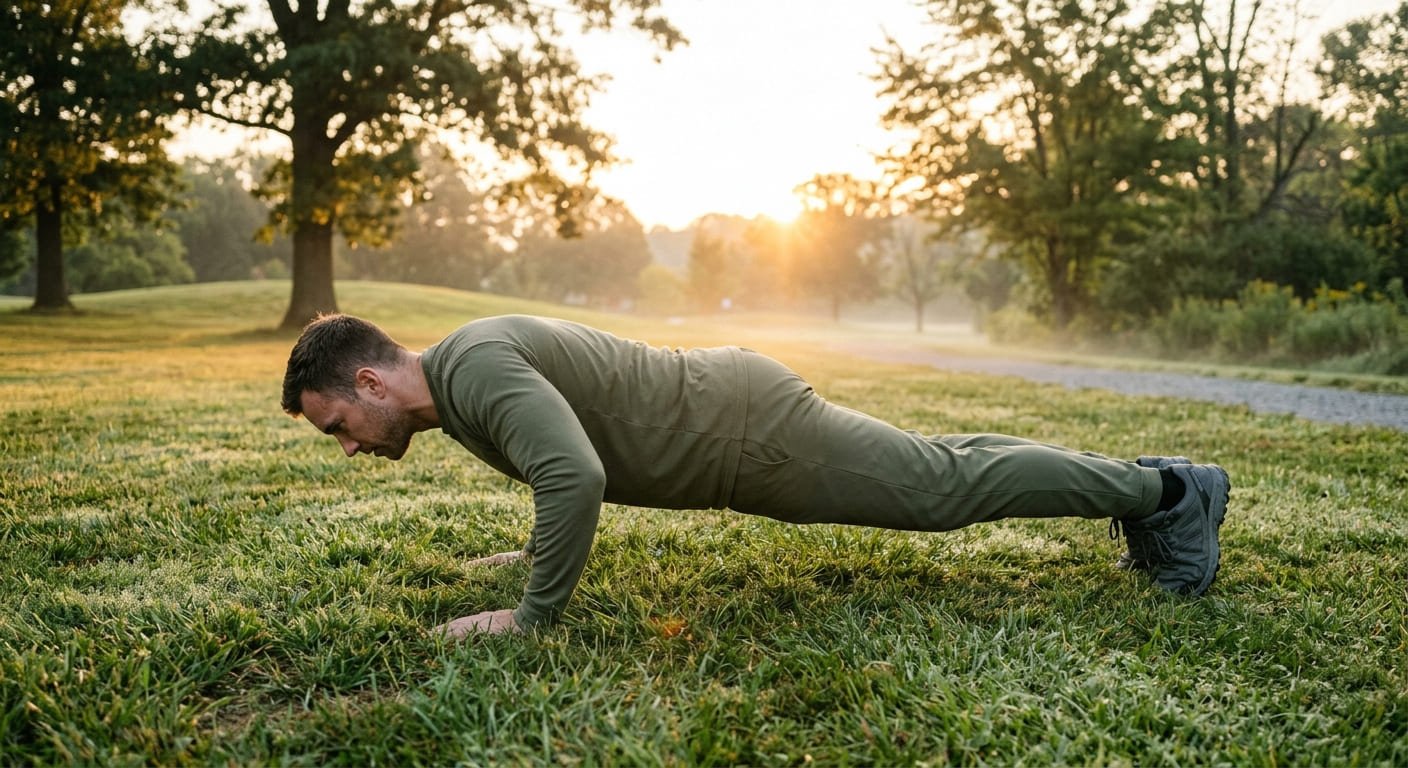
The most famous military exercise, and for good reason. Push-ups build chest, shoulder, tricep and core strength and appear in many fitness tests.
Start in a high plank with your hands slightly wider than your shoulders and your body in a straight line from head to heels. Lower your chest until it’s a few centimetres from the floor, keeping your elbows at about 45 degrees from your body, then push back up. If you can’t do 10 good reps, start with incline push-ups against a sturdy surface. My guide to incline and decline push-ups walks through the full progression.
Some tests use hand-release push-ups, where you lower your chest fully to the floor and briefly lift your hands before pushing back up. It prevents half reps and is well worth practising if your test uses it.
Air squats
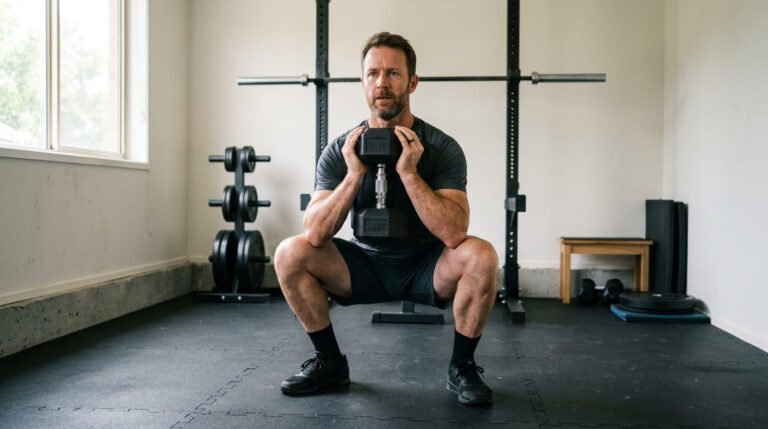
Stand with your feet shoulder width apart. Push your hips back and bend your knees to lower until your thighs are around parallel with the floor, keeping your chest up and heels down, then stand back up. Squats build leg endurance for running, marching and carrying.
Lunges
Step forward, lower your back knee towards the floor, then push back to standing. Alternate legs. Lunges build single-leg strength and balance, which matter a lot for running and uneven ground.
Sit-ups and crunches
Traditional sit-ups still appear in some programmes, though many services have shifted towards planks and other core stability tests. Lie on your back with knees bent, cross your arms on your chest, and curl up until your elbows reach your thighs, then lower with control. Avoid yanking on your neck.
Plank
Forearms on the floor, elbows under your shoulders, body in a straight line. Squeeze your glutes and brace your stomach. Planks build the core stability that protects your back when carrying load. If a plank is part of your test, practise holding good form rather than just surviving.
Flutter kicks
Lie on your back with your hands under your hips. Lift your legs a few inches off the floor and kick them up and down in small, quick movements, keeping your lower back pressed down. A classic military core exercise. Stop if your lower back arches or aches.
Burpees and eight-count bodybuilders
The burpee is a squat, a jump back to a plank, a jump forward and a jump up. The eight-count bodybuilder is a well-known military variation that adds a push-up and a leg spread and close while in the plank. Both are brutal conditioning exercises. Start with a step-back version with no jump if you’re new.
Mountain climbers
In a high plank, drive one knee towards your chest, then switch legs quickly, as if running on the spot in a push-up position. They build conditioning and core strength together.
Jumping jacks
A staple military warm-up. Jump your feet out while raising your arms overhead, then jump back in. A step-out version works if jumping bothers your knees.
Pull-ups (if you have a bar)
Pull-ups build back and arm strength, and they’re common in military training where equipment is available. If you can’t do one yet, don’t worry. Rows under a sturdy table and slow lowering negatives build the strength. My guide to pull-up alternatives has options that need no bar at all.
A military-style warm-up
Modern military PT puts a lot of emphasis on preparation before hard effort. Spend 8 to 10 minutes on something like this before every session:
- March on the spot or jog lightly for 2 minutes
- 20 jumping jacks
- 10 bodyweight squats, slow and controlled
- 10 walking lunges
- 10 arm circles forwards and backwards
- 10 push-ups at an easy level, or 5 if they’re still hard
- 20 seconds of high knees
- 30-second plank
My general warm-up routine covers the same ideas if you want more detail.
The 6-week military calisthenics plan for beginners
This plan uses three circuit days and two run days a week, with two rest days. Do the circuits on non-consecutive days, for example Monday, Wednesday and Friday, with runs on Tuesday and Saturday.
Weeks 1 and 2: Foundation
| Exercise | Reps | Notes |
|---|---|---|
| Push-ups (any level) | 8 to 10 | Incline if needed |
| Air squats | 15 | Slow and controlled |
| Lunges | 8 per leg | Alternate legs |
| Plank | 20 to 30 seconds | Good form only |
| Jumping jacks | 25 | Step-out version is fine |
| Sit-ups or crunches | 12 | Control the lowering |
Do the circuit 3 times, resting 90 seconds between rounds. Run days: 15 to 20 minutes of easy jogging, walking when needed.
Weeks 3 and 4: Building volume
| Exercise | Reps | Notes |
|---|---|---|
| Push-ups | 12 to 15 | Move to floor push-ups if possible |
| Air squats | 20 | Steady pace |
| Lunges | 10 per leg | |
| Mountain climbers | 20 total | |
| Plank | 30 to 45 seconds | |
| Burpees (step-back version) | 8 | No jump yet if new |
| Flutter kicks | 20 total | Stop if your back arches |
Do the circuit 3 to 4 times, resting 75 seconds between rounds. Run days: 20 to 25 minutes, with one day including 4 to 6 short faster efforts of 20 seconds.
Weeks 5 and 6: Military-style conditioning
| Exercise | Reps | Notes |
|---|---|---|
| Push-ups | 15 to 20 | |
| Air squats | 25 | |
| Walking lunges | 12 per leg | |
| Burpees | 10 | Add the jump if comfortable |
| Mountain climbers | 30 total | |
| Plank | 45 to 60 seconds | |
| Sit-ups | 20 | |
| Jumping jacks | 30 |
Do the circuit 4 times, resting 60 seconds between rounds. Run days: 25 to 30 minutes steady, plus one session of intervals. My guide to sprint workouts for beginners has safe interval sessions you can use.
Classic military training formats
Once you’ve built a base, these formats keep training varied. They’re all easy to run on your own or in a group.
| Format | How it works | Example |
|---|---|---|
| Pyramid | Add reps each round, then work back down | Push-ups and squats: 2, 4, 6, 8, 10, 8, 6, 4, 2 |
| Ladder | Increase reps every round until you can’t keep form | Burpees: 1, 2, 3, 4 and keep climbing |
| PT circuit | Move through stations with set reps and short rest | 6 to 8 exercises, 3 to 4 rounds |
| AMRAP | As many rounds as possible in a set time | 12 minutes of push-ups, squats and sit-ups |
| Deck of cards | Suits are exercises, cards are reps | A random, full-body session |
If you enjoy the last two, my guides to the AMRAP workout and the deck of cards workout go into both in more detail.
Preparing for a fitness test
If you’re training for a specific test, a few principles make a big difference:
- Practise the exact test exercises with the exact standards, such as hand-release push-ups or a specific plank position.
- Test yourself every two to four weeks, not every day. Recording your numbers shows progress and keeps motivation up.
- Train the run separately. Timed runs need their own sessions, not just circuits.
- Taper before the test. Reduce your training volume for a few days beforehand so you arrive fresh.
- Check body composition standards if your service uses them. Our Army height and weight calculator checks the current US Army waist-to-height standard.
Don’t neglect the running
Many people who train military calisthenics focus on push-ups and forget that running is usually a huge part of military fitness. Stamina carries over into everything else.
For beginners, start with easy jogging you can sustain while talking, and build duration before speed. If you can’t jog continuously yet, alternate running and walking. My guide to cardio exercises for beginners is a good starting point if running still feels hard.
Build a strong, stable core
Traditional military training leaned heavily on sit-ups. Modern approaches include more stability work, like planks, side planks and exercises that resist twisting, because a stable core protects your back when you carry equipment.
A balanced core session for military-style training might include planks, side planks, flutter kicks, dead bugs and a few sit-ups. My guide to the beginner core workout has clear instructions for the stability exercises.
Useful extras once you have a base
You don’t need anything to follow this plan, but once the foundation weeks are behind you, a few inexpensive additions make military-style training more realistic and more varied.
- A doorway pull-up bar. The single most useful piece of kit. Even short sets of assisted pull-ups or slow negatives build the back and grip strength that bodyweight floor exercises miss.
- A backpack with some weight in it. Walking with a loaded pack, often called rucking, is a staple of military fitness. Start with a light load of 5 to 10 percent of your body weight for 20 to 30 minutes on flat ground, and build very gradually.
- Decent running shoes. Running is a big part of the plan, and worn-out shoes make shin and knee niggles more likely.
- A stopwatch or timer app. For timed tests, circuits and interval runs.
- A notebook. Military training works because it’s measured. Write down your reps, holds and run times.
Rucking deserves a special word of caution. Adding load to walking puts extra stress on your feet, knees and back, so increase either the weight or the distance, never both in the same week, and stop if you develop pain rather than general tiredness.
A sample week in the plan
Here’s how a typical week looks in weeks 3 and 4, once you’ve settled into the routine:
| Day | Session | Approximate time |
|---|---|---|
| Monday | Circuit: 3 to 4 rounds of the weeks 3 and 4 circuit | 35 minutes |
| Tuesday | Easy run: 20 to 25 minutes, conversational pace | 30 minutes |
| Wednesday | Circuit, plus 5 minutes of extra core work | 40 minutes |
| Thursday | Rest or a gentle walk | Optional |
| Friday | Circuit, finished with a push-up and plank test every other week | 35 minutes |
| Saturday | Run with 4 to 6 short faster efforts | 30 minutes |
| Sunday | Rest | None |
It’s a demanding but realistic week, and it leaves space for recovery. If life gets busy and you miss a session, don’t try to cram two into one day. Just pick up the plan where you left off.
Common mistakes
- Starting with too much volume. Hundreds of reps on day one leads to extreme soreness or injury.
- Sloppy push-ups. Half reps won’t count in a test and won’t build real strength.
- Skipping rest days. Recovery is when fitness actually improves.
- Only doing circuits. Running and core stability need their own attention.
- Ignoring pain. Aching muscles are normal. Sharp joint pain is not.
- No warm-up. Especially before burpees, sprints and high-rep push-ups.
- Training hard every day. Intensity needs to be balanced with easier sessions.
Handling soreness when you start
It’s normal to feel sore after your first week, especially in your chest, shoulders, thighs and core. Soreness usually peaks a day or two after a session and fades within a few days. Keep moving with walking and light stretching, stay hydrated, sleep well, and keep the next session at the same level rather than adding more.
If you’re too sore to do a push-up or walk down stairs comfortably, you did too much. Reduce the reps by about a third for the next week. There’s no prize for suffering through week one and quitting in week two.
How to track progress
Test yourself at the start of the plan and again at the end of weeks 3 and 6:
| Test | How to do it | What improvement looks like |
|---|---|---|
| Push-ups | Max good-form reps in 2 minutes | More reps with the same standard |
| Plank | Max hold with good form | Longer hold, steadier position |
| Squats | Max reps in 1 minute | More reps without losing depth |
| Run | Time for a set distance, such as 2 km | Faster time, easier breathing |
Keep your notes simple and honest. If your push-up form breaks down, stop the test there. The numbers only mean something if the standard stays the same each time.
The bottom line
Military calisthenics are simple, effective and endlessly adaptable. You don’t need a gym, expensive equipment or a drill sergeant. You need consistency, sensible progression and a willingness to do the basics well.
Start with the foundation weeks even if you think you’re fitter than that. Build your push-ups, squats, core and running together, test yourself every few weeks, and let the volume rise gradually. Six weeks from now, you’ll be surprised how much stronger and fitter a handful of classic exercises can make you.
Frequently asked questions
What is a military calisthenics workout?
It’s a no-equipment training session built around classic military bodyweight exercises like push-ups, squats, lunges, planks, sit-ups, burpees and running. Sessions are often done as circuits with short rest to build muscular endurance and fitness.
Can beginners do military calisthenics?
Yes, as long as they start with manageable volume. Begin with incline or knee push-ups, fewer rounds and easy runs, then build up over several weeks. Copying a full military PT session straight away usually leads to extreme soreness or injury.
How often should I do military calisthenics?
Three strength circuit sessions a week on non-consecutive days, plus two running sessions, works well for most beginners. Leave at least one or two full rest days so your body can recover and adapt.
What exercises are in military PT?
Common exercises include push-ups, sit-ups, planks, squats, lunges, burpees, mountain climbers, jumping jacks, flutter kicks and pull-ups, along with running. Many modern programmes also include structured warm-ups and core stability drills.
How long does it take to get fit with military calisthenics?
Most beginners notice improvements in push-ups, stamina and core strength within three to four weeks of consistent training. Bigger changes in fitness usually take two to three months.
Do I need a pull-up bar for military calisthenics?
No. A pull-up bar is useful, but you can train your back with rows under a sturdy table and other pull-up alternatives. Most military calisthenics exercises need no equipment at all.
How do I prepare for a military fitness test?
Check the current official requirements for your service, practise the exact test exercises and standards, train running separately, test yourself every few weeks and reduce training volume a few days before the test so you arrive fresh.
Is military calisthenics good for weight loss?
It can help because it combines strength work and conditioning that burn energy and build muscle. Weight loss still depends mainly on your overall eating and activity, so pair training with sensible nutrition.
Source: NHS, Physical activity guidelines for adults aged 19 to 64