Calisthenics Core Workout: 12 Bodyweight Ab Exercises (Beginner to Advanced)
A calisthenics core workout trains your abs, obliques and lower back using only body weight, built around positions like the hollow body hold, plank, leg raises and L-sit rather than endless crunches. The goal isn’t just a strong stomach. It’s the kind of whole-body tension that lets you hold your body rigid, which is what makes push-ups, pull-ups and more advanced bodyweight skills possible.
When I started calisthenics, I assumed my core was fine because I could do a lot of sit-ups. Then I tried a hollow body hold and lasted about eight seconds before my lower back peeled off the floor and my legs started shaking. It was humbling, and genuinely eye-opening. Sit-ups had built endurance for one movement. Calisthenics core training asked my core to do its real job, which is keeping everything still under tension.
This guide covers what makes calisthenics core training different, 12 exercises from complete beginner to advanced, three routines, how to progress towards moves like hanging leg raises and the L-sit, and the mistakes that stop most people improving.
At a glance
- Equipment: none for most exercises, a pull-up bar or two sturdy chairs for some
- Key positions: hollow body, plank, side plank, leg raises, L-sit
- Beginner session: about 10 minutes, 2 to 3 times a week
- Main focus: control and tension, not speed or high reps
- Progress by: longer levers, longer holds and harder variations
- Big milestone: a solid 30-second hollow body hold
- Most common mistake: letting the lower back arch off the floor
What makes a core workout calisthenics?
Any exercise using your own body weight is technically calisthenics, so a crunch counts. But calisthenics training has a particular philosophy about the core, and it shapes the exercises people choose.
Tension over repetition. Instead of doing 50 fast crunches, calisthenics core work focuses on holding positions with your whole body tight. The hollow body hold is the classic example.
Levers instead of weights. You make exercises harder by changing your body position, usually by moving your legs or arms further from your centre. A tucked leg raise becomes a straight leg raise. A plank on your knees becomes a full plank, then a plank with your arms further forward.
Carryover to skills. Core strength in calisthenics is a means to an end. A strong hollow position helps with push-ups, pull-ups, handstands, L-sits and eventually harder skills like front levers.
Anti-movement. Much of the training teaches your core to resist movement: to stop your back arching, your hips twisting or your body sagging.
Why train your core with calisthenics?
- No equipment needed for most of the exercises, so you can train anywhere
- Builds real stability that protects your lower back in daily life
- Improves every other bodyweight exercise, especially push-ups and pull-ups
- Scales from beginner to very advanced, so you never outgrow it
- Short sessions work, because tension-based training is demanding
If you’re still building the basics, my guide to the beginner core workout covers gentler stability exercises that make a great foundation for everything below.
The five jobs your core does, and the exercise for each
Most core routines online are really just ab routines. They train your core to bend forwards and little else. A complete calisthenics core workout trains every job your core actually does.
| Core job | What it means | Calisthenics exercises |
|---|---|---|
| Resisting arching (anti-extension) | Keeping your lower back from sagging | Hollow body hold, plank, rollouts, dead bugs |
| Resisting twisting (anti-rotation) | Staying square when a force tries to turn you | Plank shoulder taps, bird dogs, single-arm planks |
| Resisting side bending (anti-lateral flexion) | Staying upright when loaded on one side | Side plank, side plank reach-through, suitcase-style holds |
| Bending forwards and compression | Curling the spine and lifting the legs towards the torso | Reverse crunches, leg raises, L-sit, hanging knee raises |
| Extending and arching | Strengthening the back of the body | Arch body hold, superman, bird dogs |
If your current routine only covers the fourth row, you’re missing most of what makes a core strong and useful. A balanced session picks at least one exercise from three or four of these rows.
The most important position: the hollow body
If you learn only one calisthenics core position, make it this one.
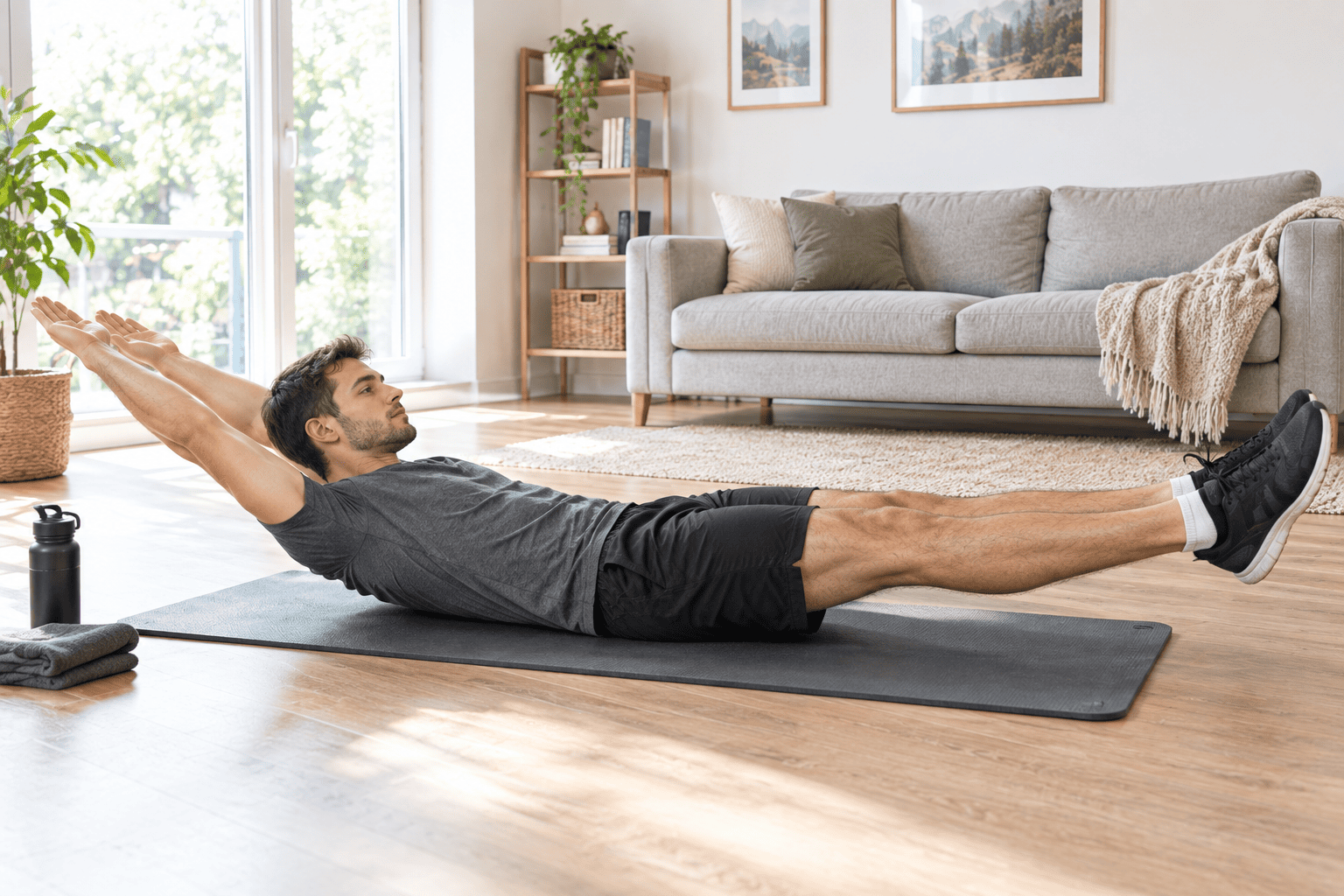
Lie on your back with your arms by your sides. Press your lower back firmly into the floor, so there’s no gap you could slide your hand through. Tuck your chin slightly, lift your shoulders just off the floor, and lift your legs a few centimetres off the ground. Your body should form a gentle banana shape, with your lower back stuck to the floor.
That’s the hollow body. If your lower back lifts, you’ve lost the position. Bend your knees or raise your legs higher until you can hold it with your back flat.
| Level | Hollow body version | Target |
|---|---|---|
| 1 | Knees bent to 90 degrees, arms by sides | 20 to 30 seconds |
| 2 | Legs straight but raised high, arms by sides | 20 to 30 seconds |
| 3 | Legs straight and lower, arms by sides | 20 to 30 seconds |
| 4 | Legs low, arms reaching overhead | 20 to 30 seconds |
| 5 | Full hollow hold, arms overhead, legs just above the floor | 30 to 60 seconds |
A clean 30-second hold at level 4 or 5 is a genuinely impressive milestone, and it’s one of the best signs your core is ready for harder skills.
12 calisthenics core exercises
1. Dead bug (beginner)
Lie on your back with your arms pointing to the ceiling and your knees bent over your hips. Press your lower back into the floor. Slowly lower one arm behind your head and the opposite leg towards the floor, then return and switch sides.
It teaches exactly what the hollow body needs: keeping your lower back down while your limbs move. Go slowly, and stop the rep before your back lifts.
2. Plank (beginner)
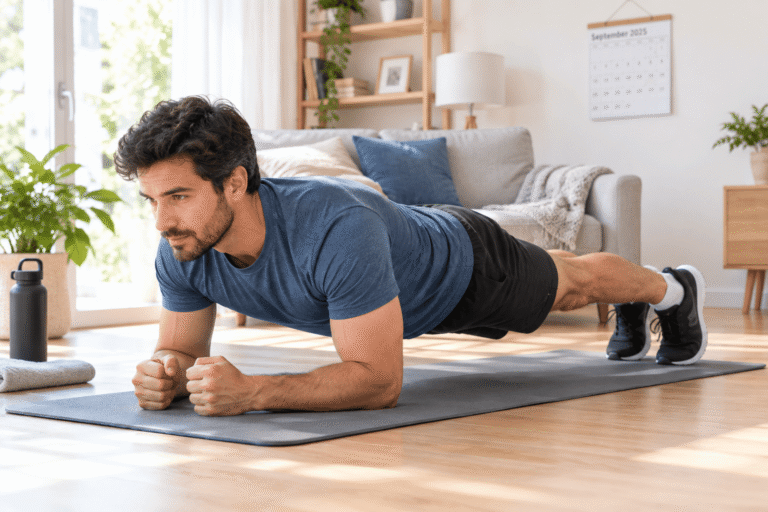
Forearms under your shoulders, body in a straight line from head to heels. Squeeze your glutes, brace your stomach and push the floor away with your forearms. Don’t let your hips sag or pike up.
A plank done with real tension, squeezing everything, is far harder than a relaxed one. Twenty seconds of genuine effort beats a minute of sagging.
3. Side plank (beginner)
Lie on your side with your elbow under your shoulder. Lift your hips so your body forms a straight line. Start on your knees if the full version is too hard. This trains your obliques and the muscles that stop you bending sideways, which regular crunches miss entirely. My guide to oblique exercises has more side-body work.
4. Reverse crunch (beginner)
Lie on your back with your knees bent and feet off the floor. Use your abs to curl your hips off the floor, bringing your knees towards your chest, then lower slowly. Don’t swing. The lowering phase is where most of the work happens. My guide to the lower ab workout at home uses this as a key exercise.
5. Hollow body hold and rock (intermediate)
Once you can hold the hollow position, gently rock back and forth while keeping the exact same shape. If the shape breaks, you’re not ready for the rock yet. It teaches your core to stay rigid while your body moves.
6. Lying leg raise (intermediate)
Lie on your back with your legs straight and your hands under your hips if you need support. Keeping your lower back pressed down, raise your straight legs to vertical, then lower them slowly. Stop lowering before your back arches. Bend your knees slightly to make it easier.
7. Plank shoulder taps (intermediate)
From a high plank, lift one hand to tap the opposite shoulder, then switch, keeping your hips as still as possible. It trains anti-rotation strength. My guide to plank shoulder taps has a fix if your hips keep rocking.
8. Arch body hold (intermediate)
The opposite of the hollow body. Lie on your front, squeeze your glutes and lift your arms, chest and legs slightly off the floor, keeping your neck in line. It trains your lower back and glutes, which balance out all the front-of-core work.
9. Towel or knee rollout (intermediate)
Kneel with your hands on a towel on a smooth floor, or on an ab wheel if you have one. Keeping your core tight and your back flat, slide your hands forward as far as you can control, then pull back to the start. Start with a short range. It’s a powerful anti-extension exercise and one of the best for building a strong hollow position.
10. Hanging knee raise (intermediate)
Hang from a pull-up bar with your shoulders engaged, not fully relaxed. Raise your knees towards your chest, then lower slowly without swinging. If your grip or shoulders aren’t ready for hanging, practise dead hangs first. My guide to pull-up alternatives covers building hanging strength.
11. L-sit progression (advanced)
Sit between two sturdy chairs, or on the floor with your hands beside your hips. Press down hard to lift your bottom off the surface. Start with your knees tucked, then extend one leg, then both, until your body forms an L shape.
| Stage | Position | Target hold |
|---|---|---|
| Foot-supported | Feet stay on the floor, bottom lifted | 10 to 20 seconds |
| Tuck sit | Knees tucked to chest | 10 to 15 seconds |
| Single leg extended | One leg straight, one tucked | 10 seconds per side |
| Full L-sit | Both legs straight in front | 10 to 20 seconds |
It trains your core, hip flexors and shoulders together. Make sure chairs are completely stable before trying it.
12. Hanging leg raise (advanced)
Hang from a bar and raise your straight legs to hip height or higher, then lower with control. This is a major calisthenics milestone. Build towards it with hanging knee raises and lying leg raises first, and don’t use momentum.
The rotation and side work most programmes skip
When I compared the top-ranking calisthenics core guides for this article, I noticed most focus almost entirely on hollow holds, planks and leg raises. They rarely include rotation or side bending, which is a real gap, because those are the directions your core works in when you twist, reach, carry or change direction.
Add one or two of these to your routine:
- Side plank reach-through: from a side plank, reach your top arm under your body and back up again, keeping your hips high. Six to eight slow reps per side.
- Side plank hip dips: lower your hip a few centimetres towards the floor and lift it back up. Eight to ten reps per side.
- Lying windshield wipers: lie on your back with your arms out wide and your knees bent over your hips. Lower both knees to one side, stopping before your shoulders lift, then return and switch. Straighten your legs to make it harder.
- Bodyweight Russian twist: sit leaning back slightly with your chest up, and rotate your ribs, not just your arms, from side to side.
- Bird dog with a pause: reach one arm and the opposite leg long and hold for three seconds without letting your hips tilt.
My guide to oblique exercises covers more side-body options if you want to build this area further.
Breathing and bracing: the skill behind every exercise
Many people hold their breath during core work, which makes holds feel harder and can leave you light-headed. Others relax completely and lose their position. The skill you want sits in between.
- Take a normal breath in through your nose, letting your stomach and sides expand slightly.
- Brace as if someone is about to poke your stomach, a firm but not maximal tension.
- Keep breathing in and out through that brace, using short, controlled breaths during holds.
- Breathe out as you move during dynamic exercises like leg raises, and in as you return.
Practise this during dead bugs and planks first. Once it feels natural, it carries over to every other calisthenics exercise, from push-ups to pull-ups.
Three calisthenics core routines
Beginner routine (about 10 minutes)
| Exercise | Reps or time |
|---|---|
| Dead bug | 8 per side |
| Plank | 20 to 30 seconds |
| Side plank (knees or full) | 15 to 20 seconds per side |
| Reverse crunch | 8 to 10 |
| Hollow body hold, level 1 or 2 | 15 to 20 seconds |
Complete 2 to 3 rounds, resting 45 to 60 seconds between rounds.
Intermediate routine (about 15 minutes)
| Exercise | Reps or time |
|---|---|
| Hollow body hold, level 3 or 4 | 20 to 30 seconds |
| Lying leg raise | 10 |
| Plank shoulder taps | 16 total |
| Arch body hold | 20 seconds |
| Towel or knee rollout | 8 |
| Side plank | 30 seconds per side |
Complete 3 rounds, resting 60 seconds between rounds.
Advanced routine (about 20 minutes)
| Exercise | Reps or time |
|---|---|
| Hollow body rock | 15 |
| Hanging knee raise or leg raise | 8 to 10 |
| L-sit progression | 3 holds of 10 to 15 seconds |
| Full rollout or long-lever plank | 8 or 30 seconds |
| Side plank with leg lift | 8 per side |
| Arch body hold | 30 seconds |
Complete 3 to 4 rounds, resting 75 to 90 seconds between rounds. If you’re building a full bodyweight programme around these, my calisthenics workout plan for beginners shows how core work fits with pushing, pulling and legs.
How to progress your calisthenics core training
Calisthenics progression works a bit differently from lifting weights. Instead of adding kilos, you make the exercise harder by changing the position.
- Lengthen the lever. Straighten your legs, move your arms overhead, or place your hands further forward in a plank.
- Increase time under tension. Add 5 seconds to holds, or slow the lowering phase.
- Add reps up to around 12 to 15 for dynamic exercises.
- Reduce support. Move from floor exercises to hanging exercises, or from bent knees to straight legs.
- Remove momentum. Pause at the top and bottom of each rep.
Only progress when you can complete all your sets with clean form. A sloppy harder variation won’t build the strength that a clean easier one will.
When you’re ready for the next level
One of the biggest gaps in most core guides is knowing when to move on. These criteria keep your progress steady and your lower back safe.
| Before moving to | You should be able to |
|---|---|
| Hollow body hold with straight legs | Hold the bent-knee version for 30 seconds with your lower back flat |
| Lying leg raises | Do 12 slow reverse crunches and a 30-second dead bug sequence without your back lifting |
| Towel or knee rollouts | Hold a 45-second plank with full-body tension |
| Hanging knee raises | Hang from a bar for 20 to 30 seconds with your shoulders engaged |
| L-sit progressions | Hold a foot-supported L-sit for 20 seconds and a tuck sit for 10 seconds |
| Hanging leg raises | Do 3 sets of 10 controlled hanging knee raises with no swinging |
An 8-week calisthenics core plan
| Weeks | Sessions per week | Focus |
|---|---|---|
| 1 to 2 | 2 | Beginner routine, learn bracing, dead bugs, planks and the bent-knee hollow hold |
| 3 to 4 | 2 to 3 | Add reverse crunches, side plank variations and arch holds |
| 5 to 6 | 3 | Intermediate routine, straight-leg hollow holds, leg raises and knee rollouts |
| 7 to 8 | 3 | Add hanging knee raises or L-sit progressions, and test your hollow hold time |
Test yourself at the end of week 4 and week 8: your longest clean hollow hold, your longest side plank on each side and your number of controlled leg raises. Written down, those three numbers show your progress far better than the mirror.
How often to train your core
Two to four sessions a week is plenty for most people. Because calisthenics core work is tension-based and demanding, your core needs recovery just like any other muscle group. Light exercises like dead bugs can be done more often, but hard hollow holds, leg raises and rollouts benefit from rest days.
My guide to whether you can train abs every day explains how to balance daily core habits with harder sessions.
Your core also works hard during push-ups, pull-ups, dips and squats. If you’re following a full calisthenics programme, you may need fewer dedicated core sessions than you’d think.
How core strength carries over to calisthenics skills
One of the most satisfying things about this kind of training is how it unlocks other movements.
| Skill | How core strength helps |
|---|---|
| Push-ups | Stops your hips sagging, so every rep is cleaner |
| Pull-ups | Reduces swinging and wasted energy |
| Dips | Keeps your body stable and controlled |
| Handstands | The hollow position is the foundation of a straight handstand |
| L-sit | Requires strong abs, hip flexors and compression |
| Front lever | Needs an extremely strong hollow body position |
If you’re also training military-style bodyweight fitness, the same core strength makes a huge difference. My military calisthenics workout plan pairs well with these routines.
Warm up your core before hard sessions
Hollow holds, rollouts and hanging leg raises are demanding, so a short warm-up makes them feel better and safer. It doesn’t need to take long:
- Cat-cow: 8 slow reps on all fours, moving through your whole spine
- Dead bugs: 5 slow reps per side
- Glute bridges: 10 reps to wake up the back of your body
- Short plank: 15 to 20 seconds with full-body tension
- Easy hollow hold: 10 to 15 seconds at a level below your working level
Five minutes is enough. The goal is to arrive at your first hard set already feeling where your abs are and how to brace, rather than figuring it out halfway through.
Compression: the missing piece for leg raises and L-sits
Many people have strong enough abs for hanging leg raises and L-sits but still struggle, because they lack compression. Compression is your ability to pull your legs towards your torso using your hip flexors and abs, while your hamstrings are flexible enough to let your legs rise.
Two simple drills build it:
- Seated leg lifts: sit on the floor with your legs straight and your hands beside your knees. Lift both heels a few centimetres off the floor and hold for 2 to 3 seconds. Rest, and repeat 8 to 10 times.
- Pike stretch: sit with your legs straight and fold forward from your hips with a long back, holding for 30 seconds.
Add these two or three times a week, and the L-sit and hanging leg raise usually start to feel far more achievable within a couple of months.
Common calisthenics core mistakes
- Letting the lower back arch. The most common error in hollow holds, leg raises and rollouts. Shorten the lever until your back stays down.
- Chasing reps over control. Fast, swinging reps build very little strength.
- Holding your breath. Breathe steadily, even during holds.
- Using momentum on hanging exercises. Swinging turns an ab exercise into a hip flexor and shoulder exercise.
- Only training the front of your core. Include side planks and arch holds too.
- Progressing too quickly. Harder variations with poor form slow your progress.
- Straining your neck. Keep your chin slightly tucked and let your abs do the work.
If you feel it in your lower back
Feeling core exercises in your lower back usually means your abs are too tired to hold the position, or the variation is too hard. Leg raises and hollow holds are the most common culprits.
Make the exercise easier: bend your knees, raise your legs higher, shorten your range or reduce the hold time. Focus on pressing your lower back into the floor. If you have ongoing back pain, particularly pain that spreads into your legs, get it assessed before training harder core exercises.
Will calisthenics core training give you visible abs?
Calisthenics core training builds strong, well-defined abdominal muscles, but whether you can see them depends mostly on your body fat level. No amount of hollow holds or leg raises will burn fat from your stomach specifically. Visible abs come from consistent training combined with overall eating habits and patience.
My guide to the body fat percentage where abs show gives realistic numbers if that’s your goal.
The bottom line
Calisthenics core training is about control, tension and position, not endless crunches. Start with dead bugs, planks, side planks and the hollow body hold. Build a clean 30-second hollow position, then progress to leg raises, rollouts, hanging knee raises and eventually the L-sit and hanging leg raise.
Train your core two to four times a week, progress by lengthening levers rather than rushing, and always keep your lower back under control. You’ll build a core that doesn’t just look strong but makes every other bodyweight exercise better.
Frequently asked questions
What is a calisthenics core workout?
A calisthenics core workout uses only body weight to train your abs, obliques and lower back, focusing on positions like the hollow body hold, plank, side plank, leg raises and L-sit. It emphasises tension and control rather than high-rep crunches.
What is the best calisthenics ab exercise?
The hollow body hold is one of the most valuable because it teaches the whole-body tension used in almost every other bodyweight skill. Hanging leg raises, rollouts and L-sits are excellent advanced exercises once you have a solid hollow position.
Can calisthenics give you abs?
Calisthenics can build strong, well-developed abdominal muscles. Whether they’re visible depends mainly on your body fat level, which comes down to overall eating and activity rather than core exercises alone.
How often should I do calisthenics core workouts?
Two to four sessions a week works well for most people. Hard exercises like hollow holds, leg raises and rollouts benefit from rest days, while gentle exercises like dead bugs can be done more often.
How do I progress calisthenics core exercises?
Make exercises harder by lengthening the lever, such as straightening your legs or moving your arms overhead, increasing hold times, slowing the reps and moving from floor exercises to hanging exercises. Only progress when your form stays clean.
Why do I feel core exercises in my lower back?
Usually because your lower back is arching when your abs get tired or the variation is too hard. Bend your knees, raise your legs higher or shorten the hold, and keep your lower back pressed into the floor.
How long does it take to do an L-sit?
It varies a lot, but many beginners need several months of consistent core, hip flexor and shoulder training. Work through foot-supported holds, tuck sits and single-leg extensions before trying the full L-sit.
Do I need a pull-up bar for calisthenics core training?
No. Most calisthenics core exercises need no equipment. A pull-up bar is useful for hanging knee raises and leg raises, but floor exercises like hollow holds, leg raises and rollouts build excellent core strength on their own.
Source: NHS, Physical activity guidelines for adults aged 19 to 64