Deck of Cards Workout: How It Works (Plus 4 Beginner Versions)
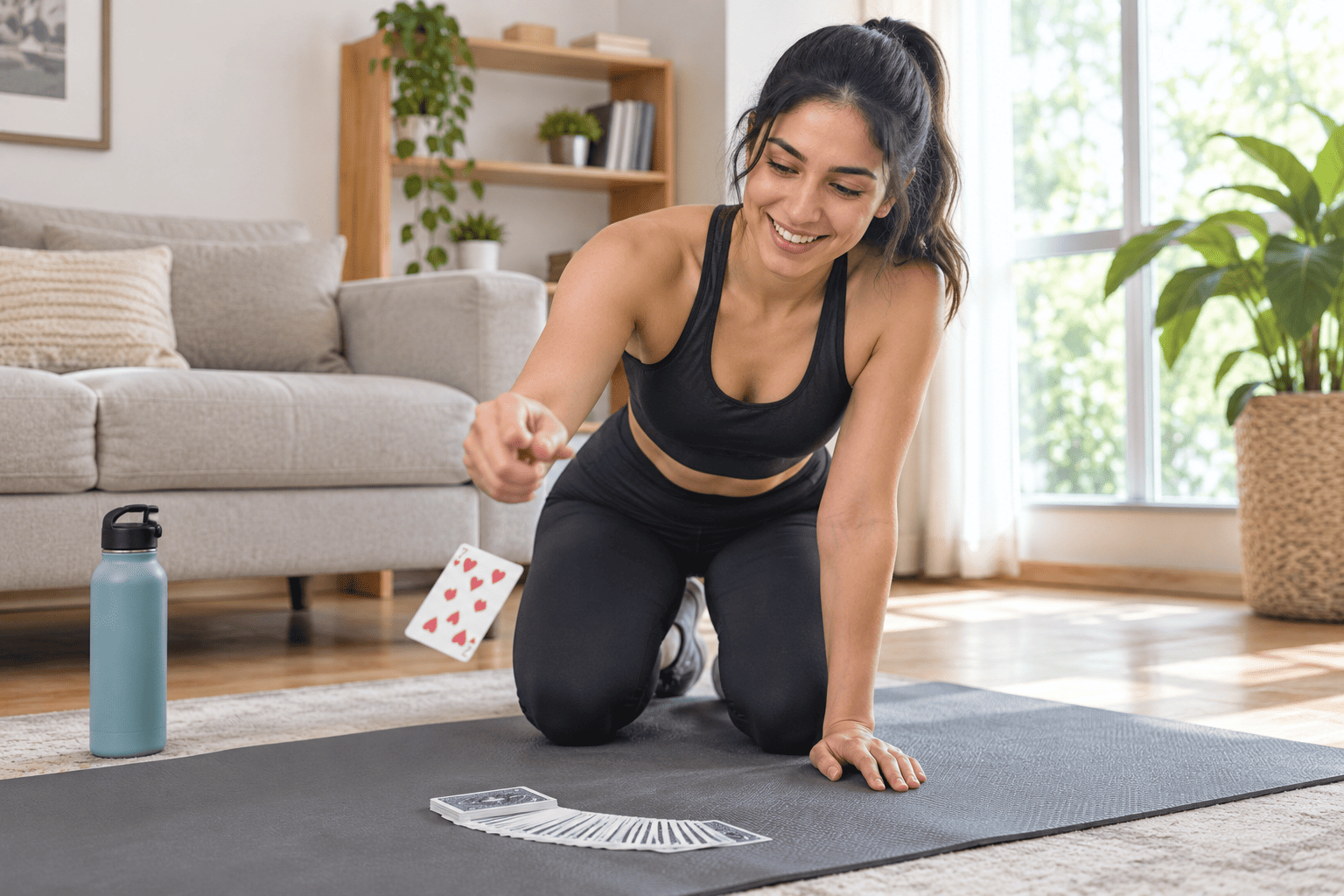
A deck of cards workout is simple: you give each suit an exercise, shuffle the deck, flip one card at a time and do as many reps as the number on the card. Hearts might be squats, spades push-ups, and so on. You keep flipping until the deck is gone, or until your timer runs out.
I love this workout, and I think it’s one of the best things a beginner can have in their back pocket. It needs no equipment except a pack of cards, it’s different every single time you do it, and the randomness does something clever to your motivation. You stop thinking about how much is left and start thinking about the next card. On days when I couldn’t face my usual routine, the deck of cards got me moving more times than I can count.
There’s one catch nobody mentions, though. A full deck is a lot of reps. More than most beginners should do in one go. So below I’ll explain exactly how the maths works, how to set it up so it suits your level, and four versions you can start with today.
At a glance
- What you need: a standard 52-card deck and a bit of floor space
- How it works: each suit is an exercise, each card is the number of reps
- Full deck total: about 340 reps, which is too many for most beginners
- Beginner starting point: half a deck, face cards worth 5 reps
- Time: 15 to 30 minutes depending on the version
- Best for: variety, motivation and workouts you can do anywhere
How the deck of cards workout works
Here’s the basic setup that almost every version uses.
- Pick four exercises, one for each suit.
- Decide what the face cards and aces are worth.
- Shuffle the deck and put it face down.
- Flip the top card. Do that exercise for that many reps.
- Rest as briefly as you need, then flip the next card.
- Keep going until you’ve finished the deck, the portion of the deck you chose, or your time limit.
That’s it. A 7 of hearts means 7 of your hearts exercise. A king of spades means whatever you decided a king is worth, of your spades exercise.
Standard card values
| Card | Usual value | Beginner-friendly value |
|---|---|---|
| 2 to 10 | The number on the card | The number on the card |
| Jack, Queen, King | 10 reps each | 5 reps each |
| Ace | 11 reps, or 1 rep | 1 rep |
| Joker (optional) | A challenge, like 30 seconds of jumping jacks | A 30-second rest |
People set these rules differently, and that’s part of the fun. Some treat aces as a reward and some treat them as a punishment. What matters is that you decide before you start, not halfway through when an ace would be convenient.
Why a full deck is too much for most beginners
This is the part I really want you to read, because it’s where most people go wrong with this workout.
Let’s add up one suit using the usual values. The cards 2 through 10 add up to 54. The jack, queen and king are 10 each, which adds 30. The ace is 1 or 11. So one suit is 85 to 95 reps.
Multiply that by four suits and a full deck comes to 340 to 380 reps. If one of your exercises is push-ups, that’s roughly 85 push-ups in a single session. For someone who can do 8 or 10 push-ups in a row, that’s not a workout. That’s a recipe for being sore for a week, or for your form falling apart by card 20.
| Setup | Reps per suit | Total reps |
|---|---|---|
| Full deck, face cards 10, ace 11 | 95 | 380 |
| Full deck, face cards 10, ace 1 | 85 | 340 |
| Full deck, face cards 5, ace 1 | 70 | 280 |
| Half deck (26 cards), face cards 5, ace 1 | About 35 | About 140 |
| Quarter deck (13 cards), face cards 5, ace 1 | About 18 | About 70 |
That’s why I always recommend beginners start with half a deck and face cards worth 5. Around 140 reps spread across four exercises is a solid, honest workout for most people who are new to training. You can always build up.
The first time I tried this, I did the whole deck with face cards at 10. I finished, but my squats at the end looked nothing like my squats at the start, and I couldn’t walk downstairs normally for three days. Half a deck would have been the better workout.
Choosing exercises for each suit
The best deck of cards workouts balance your body. A good default is one lower body exercise, one upper body push, one core exercise and one exercise that gets your heart rate up. That way no single muscle group does all the work, and you don’t have to rest as much between cards.
| Suit | Body area | Easier option | Standard option | Harder option |
|---|---|---|---|---|
| Hearts | Legs | Chair squats | Bodyweight squats | Jump squats |
| Spades | Upper body push | Wall or counter push-ups | Knee or full push-ups | Decline push-ups |
| Diamonds | Core | Dead bugs (each side counts as 1) | Crunches or bicycle crunches | Plank shoulder taps |
| Clubs | Cardio | Step jacks | Jumping jacks | Burpees |
A couple of tips on picking exercises:
- Choose moves you can do with good form while tired. The randomness means you might get three 10s in a row of the same suit.
- Avoid pairing two exercises for the same muscle. Push-ups and tricep dips in the same deck means your arms are doing half the workout.
- Burpees are sneaky. Ten burpees takes a lot longer and a lot more energy than ten squats. If you use them, consider halving the card value for that suit.
- Count each side properly. For exercises done one side at a time, like lunges or dead bugs, decide whether a rep means one side or both sides.
If you’re not sure how to do any of these, my no-equipment home workout guide shows the basics, and the beginner exercise library has instructions for every common move.
Four deck of cards workouts to try
Here are four complete versions. Start with the first, and move to the others once it feels comfortable.
Version 1: The beginner half deck (about 20 minutes)
This is where I’d start if you’re new to exercise, coming back after a long break, or just want an easy introduction.
| Suit | Exercise |
|---|---|
| Hearts | Chair squats |
| Spades | Counter or wall push-ups |
| Diamonds | Dead bugs |
| Clubs | Marching on the spot (1 card value = that many marches per leg) |
Rules: take out half the deck at random, face cards are worth 5, aces are worth 1, no jokers. Rest whenever you need to. Aim to finish, not to rush.
Version 2: The standard full body deck (about 25 minutes)
Once version 1 feels easy, use regular bodyweight exercises and a bigger portion of the deck.
| Suit | Exercise |
|---|---|
| Hearts | Bodyweight squats |
| Spades | Knee or full push-ups |
| Diamonds | Bicycle crunches (each side counts as 1) |
| Clubs | Jumping jacks |
Rules: three-quarters of the deck, face cards worth 5, aces worth 1. When you can finish comfortably in under 25 minutes, move to the full deck, then to face cards worth 10.
Version 3: Legs and cardio (about 25 minutes)
Great for a day when your upper body is sore, or as the leg day in a weekly plan.
| Suit | Exercise |
|---|---|
| Hearts | Squats |
| Spades | Reverse lunges (each leg counts as 1) |
| Diamonds | Glute bridges |
| Clubs | High knees (1 card value = that many per leg) |
Rules: half to three-quarters of the deck, face cards worth 5. Lunges are harder than squats, so if they’re wiping you out, swap them for step-ups onto a low step. My guide to lunge alternatives has more options.
Version 4: The partner deck (about 30 minutes)
This is the version I do with a friend, and it turns a workout into something closer to a game.
Rules: split the deck in half. Take turns flipping a card. The person who flips does the reps while the other rests, or you both do the reps together for a harder session. Use the version 2 exercises. Whoever finishes their half of the deck first picks the exercises next time.
It’s simple, but it works beautifully. Nobody wants to be the one who slows down. If you like working out with other people, there are more ideas in my guide to group exercises at home.
How long does a deck of cards workout take?
It depends heavily on the exercises you choose and how much you rest, but these are realistic ranges for most people.
| Version | Cards | Typical time |
|---|---|---|
| Quarter deck | 13 | 8 to 12 minutes |
| Half deck | 26 | 15 to 20 minutes |
| Three-quarter deck | 39 | 20 to 30 minutes |
| Full deck | 52 | 30 to 45 minutes |
Burpees and push-ups slow things down a lot. Jumping jacks and squats move quickly. If you only have 15 minutes, set a timer and stop when it goes off, even if cards are left. Then next time, see if you can get further through the deck in the same time. That’s a great, simple way to track your fitness.
Keeping your form good when you’re tired
The randomness is what makes this workout fun, but it’s also what makes form slip. You can’t plan for three hard cards in a row. So set yourself a couple of rules before you start.
- Break big cards into chunks. A 10 of spades can be 5 push-ups, a breath, then 5 more. There’s no prize for doing them unbroken.
- Swap to an easier version mid-workout. If your push-ups turn ugly, move to knee push-ups for the rest of the deck. That’s smart training, not quitting.
- Slow reps count more than fast reps. Rushing squats to get through a card doesn’t make you fitter. It just makes the reps worse.
- Stop if anything hurts. Muscle burn is fine. Sharp pain in a joint is not.
I find it helpful to say the card out loud when I flip it. It sounds silly, but it gives me a second to reset my posture before I start.
Scaling the workout to your level
One of the best things about this workout is how easy it is to adjust. Here are all the levers you can pull, from easiest to hardest.
| To make it easier | To make it harder |
|---|---|
| Use fewer cards | Use more cards, then the full deck |
| Make face cards worth 5 | Make face cards worth 10, aces worth 11 |
| Choose easier exercise versions | Choose harder versions, like jump squats |
| Rest freely between cards | Set a time limit and try to beat it |
| Treat jokers as a rest | Treat jokers as a 1-minute challenge |
| Halve the value for burpees or push-ups | Add a second deck on a different day of the week |
Change one thing at a time. If you go from half a deck with face cards at 5 to a full deck with face cards at 10 in one week, you’ve more than doubled the workout overnight.
Tracking your progress
Because every deck is shuffled differently, you can’t compare workouts rep for rep. But you can compare them in a few useful ways.
- Time to finish. Use the same exercises and the same number of cards, and write down how long it took.
- Cards in a fixed time. Set a 20-minute timer and count how many cards you got through.
- Rest needed. Notice whether you need fewer breaks than last time.
- Exercise level. Track when you move from wall push-ups to knee push-ups to full push-ups.
I keep a note on my phone with the date, the version, the number of cards and the time. After a month or two, it’s genuinely satisfying to scroll back through. The workout streak tracker is also handy if what you need most is a reason to keep showing up.
Why the deck of cards workout works so well
It’s easy to dismiss this as a gimmick, but I think it works for a few real reasons.
It kills boredom. Doing the same routine over and over is one of the main reasons people stop exercising. A shuffled deck is different every time, so there’s always a little bit of curiosity about what’s next.
It shrinks the workout in your head. Thinking “I have to do 140 reps” feels heavy. Thinking “I just have to do this 6” feels completely doable. You only ever face one card at a time. If motivation is something you struggle with, my guide on how to stay motivated to work out goes into more of these tricks.
It’s naturally a form of interval training. Big cards push your heart rate up, small cards give you a bit of a breather, and the constant switching between exercises keeps you moving. It sits somewhere between strength training and circuit training, which makes it good all-round conditioning. If you enjoy that feeling, you’ll probably like my beginner HIIT workout at home as well.
You can do it anywhere. A deck of cards fits in a pocket. Hotel rooms, holidays, the park, a small living room. There’s no excuse left.
Common mistakes to avoid
- Doing the full deck on day one. Start with half. Really.
- Choosing four hard exercises. Burpees, push-ups, jump squats and mountain climbers in one deck is brutal. Mix in something easier.
- Changing the rules mid-workout. Decide what aces and face cards mean before you flip the first card.
- Racing through the reps. Speed is only useful if the reps are still good.
- Doing it every day. Two or three times a week is plenty, with rest days or different workouts in between.
- Ignoring your warm-up. Jumping straight into 10 jump squats with cold legs is asking for trouble. Take five minutes to warm up first.
Adding equipment when bodyweight gets easy
Once a full deck of bodyweight exercises stops feeling like a challenge, you don’t have to abandon the workout. You just give the suits harder jobs. A pair of dumbbells or a resistance band opens up a lot of options.
| Suit | With dumbbells | With a resistance band |
|---|---|---|
| Hearts | Goblet squats | Banded squats |
| Spades | Floor press | Banded push-ups |
| Diamonds | Weighted crunches | Banded dead bugs |
| Clubs | Dumbbell thrusters | Band pull-aparts |
When you add weight, lower the card values. I halve every card, so a 10 becomes 5 reps and a king becomes 5 as well. Loaded reps are much harder than bodyweight reps, and the randomness of the deck means you can’t plan your rest the way you would in a normal strength workout. If you’re choosing weights for the first time, my dumbbell workout plan for beginners explains how to find a sensible starting load.
Doing a deck of cards workout with kids or family
This is one of the few workouts I’ve seen actually work with a whole household. Kids tend to love it because it feels like a game, and adults like it because nobody has to follow a complicated routine.
A few tweaks make it work for mixed ages and fitness levels:
- Everyone uses the same card, but different exercises. A 6 of hearts might be 6 squats for an adult and 6 star jumps for a child.
- Let the youngest person flip the card. It keeps them involved, even during the rest.
- Swap in silly moves. Bear crawls, frog jumps and crab walks make clubs much more fun for kids.
- Cap every card at 5 or 6 reps. The goal is fun and movement, not exhaustion.
- Stop while everyone’s still enjoying it. A quarter deck that ends with laughing beats a full deck that ends in a sulk.
For children, general play and movement matter far more than structured reps, so treat this as a fun way to be active together rather than a training plan. It’s also a brilliant rainy day option. My guide to indoor workouts for rainy days has a few more ideas along the same lines.
Fitting it into your week
The deck of cards workout works well as a stand-alone session or as one part of a bigger plan. Here are two simple ways to use it.
| Plan | Monday | Wednesday | Friday | Weekend |
|---|---|---|---|---|
| Deck only | Version 2 deck | Version 3 deck | Version 2 deck | A long walk |
| Mixed | Full body workout | Deck of cards | Full body workout | Deck of cards with a partner |
If you’re just starting out, the mixed plan is my favourite. You get structured strength work twice a week from something like the 15-minute full body workout, plus a fun, unpredictable session to keep things interesting.
If you like the idea of a session with a score you can beat, the AMRAP workout works the same way but with a timer instead of a deck.
Frequently asked questions
How does a deck of cards workout work?
You assign an exercise to each of the four suits, shuffle the deck and flip one card at a time. The suit tells you which exercise to do and the number on the card tells you how many reps. Face cards and aces are given a value you decide before you start.
How many reps is a full deck of cards workout?
With face cards worth 10 and aces worth 1, a full deck is 340 reps, split evenly across your four exercises. With aces worth 11, it rises to 380. That is a lot for a beginner, which is why starting with half a deck is a good idea.
What exercises are best for a deck of cards workout?
Pick one exercise for your legs, one for your upper body, one for your core and one for cardio. A good beginner set is squats for hearts, push-ups for spades, crunches for diamonds and jumping jacks for clubs.
How long does a deck of cards workout take?
A half deck usually takes 15 to 20 minutes and a full deck takes 30 to 45 minutes, depending on your exercises and how much you rest. Burpees and push-ups take longer than squats and jumping jacks.
Is a deck of cards workout good for beginners?
Yes, as long as you scale it. Use half a deck, make face cards worth 5 reps, choose easier exercise versions and rest when you need to. Build up to a full deck gradually over several weeks.
What do aces and jokers mean in a card workout?
There is no official rule. Aces are commonly worth either 1 or 11 reps. Jokers are optional and are often used as either a short rest or a bonus challenge, like 30 seconds of jumping jacks. Just decide before you start.
How often should I do a deck of cards workout?
Two or three times a week is plenty for most people, with at least one day between sessions. You can also use it once a week alongside other workouts to add variety.
Can I do a deck of cards workout with a partner?
Yes, and it is a lot of fun. Split the deck, take turns flipping cards, and either do the reps together or take turns doing them while the other person rests.
Source: NHS, Physical activity guidelines for adults aged 19 to 64