
Monster Walks: How to Do Them, Lateral Band Walks and 8 Variations for Stronger Hips
Monster walks look a little silly. You loop a mini band around your legs, sink into a half squat and waddle forward and sideways like a cartoon monster. The first time a physiotherapist asked me to do them, for a niggly knee that ached on long runs, I felt ridiculous. Then, about thirty seconds in, the sides of my hips started burning in a way no squat or lunge had ever made them burn.
That burn was the point. Monster walks and lateral band walks target the muscles on the side of your hips, mainly the gluteus medius, which keep your pelvis level and your knees tracking in line when you walk, run, climb stairs and land from jumps. After six weeks of doing them three times a week, my knee stopped aching, and my running felt more stable.
This guide explains how to do monster walks properly, how they differ from lateral band walks, where to place the band, the muscles worked, eight variations, a simple glute routine and the mistakes that stop most people from feeling them in the right place.
At a glance
- Monster walks are banded walking steps taken in a half squat, forward, backward or diagonally
- Lateral band walks are the side-stepping version
- They mainly work the gluteus medius and gluteus maximus, with help from the hip muscles at the front and side
- Research shows moving the band lower, from knees to ankles to feet, makes the glutes work harder
- A slight squat posture increases glute activity compared with standing upright
- Do 2 to 3 sets of 10 to 15 steps in each direction, two or three times a week
- Great as a warm-up before leg day or a run, and as part of knee and hip rehab programmes
What are monster walks?
A monster walk exercise is a resisted walking drill. You place a small loop band around your legs, take a wide, athletic stance with your knees slightly bent, and step forward or backward while keeping tension on the band. Each step pushes your knees out against the band, which makes the muscles on the outside of your hips work hard.
| Name | Direction | Main focus |
|---|---|---|
| Monster walks | Forward and backward, often on a diagonal | Gluteus medius and maximus, hip stability |
| Lateral band walks | Sideways | Gluteus medius, hip abductors |
| Banded monster walk with squat | Forward with a deeper squat | More glute and quad work |
| Banded side steps | Sideways, small steps | Gentle activation and rehab |
People use the terms loosely. Lateral band walks are sometimes called banded side steps, crab walks or band shuffles. Whatever you call them, the goal is the same: strong, controlled hips.
Why your hip muscles matter
The gluteus medius sits on the side of your hip. Every time you stand on one leg, which happens with every step you take, it stops your pelvis dropping on the other side and stops your knee collapsing inward. When it is weak, you may notice:
- Your knee drifting inward when you squat, lunge or land from a jump
- Your hip dipping to one side when you walk or run
- Knee pain at the front of the knee, especially on stairs
- Aching on the outside of the hip after long walks
Monster walks are one of the simplest ways to train this muscle with almost no equipment.
Muscles worked by monster walks
| Muscle | Role in the exercise |
|---|---|
| Gluteus medius | Main hip abductor. Pushes the leg out and stabilises the pelvis |
| Gluteus maximus | Assists with hip extension and external rotation, especially in a squat posture |
| Gluteus minimus | Deep hip stabiliser |
| Tensor fasciae latae (TFL) | Front of the hip. Helps abduction, but can take over if your form slips |
| Quadriceps | Holds the half squat |
| Core | Keeps your trunk steady as you step |
What the research says
- Band placement changes everything. A study of two common banded exercises found that moving the band from the knees to the ankles to the forefoot progressively increased gluteus medius activity. Placing the band around the forefoot selectively boosted the gluteal muscles relative to the TFL at the front of the hip
- Posture matters. A study of resisted side stepping found that gluteal activity was higher, and TFL activity lower, when people stepped in a squat posture rather than standing upright. Muscle activity was also higher in the standing leg than in the moving leg
- Feet work best for glutes. A study of men and women doing resisted side steps found that moving the band from the ankles to the feet increased gluteus maximus and medius activity without increasing TFL activity
Where to put the band
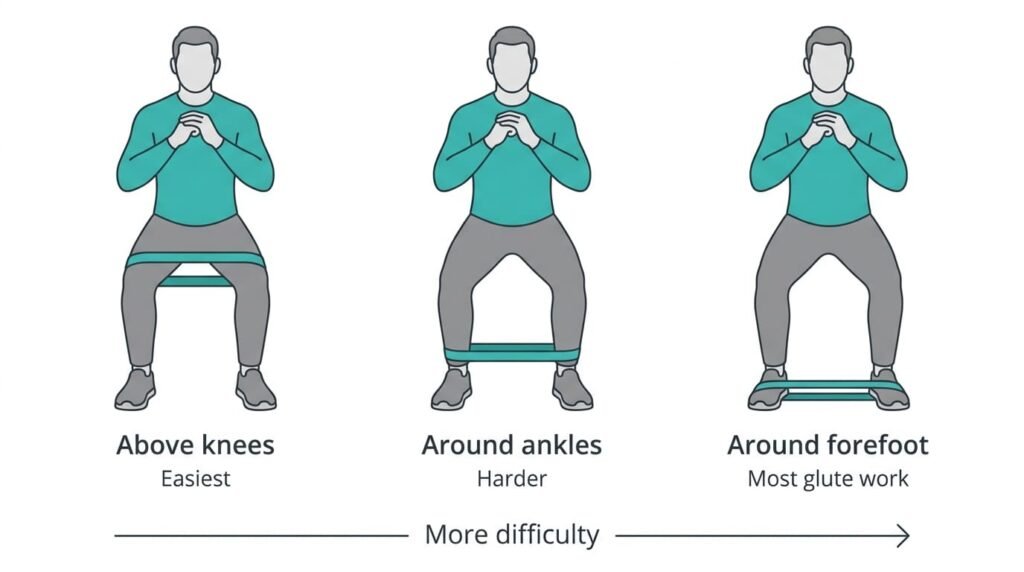
Band placement is the easiest way to make monster walks easier or harder.
| Band position | Difficulty | Best for |
|---|---|---|
| Above the knees | Easiest | Beginners, rehab, learning the movement |
| Around the ankles | Harder | Most people once the knee version is easy |
| Around the forefoot (balls of the feet) | Hardest for the glutes | Getting the most glute activation with less front-of-hip work |
If you are new to banded exercise, start with a light band above the knees. Move it to the ankles once you can do 15 controlled steps in each direction with good form. Try the forefoot position later. Our guide to the best resistance bands for beginners explains the different band types.
How to do monster walks
- Place a mini loop band just above your knees (or around your ankles if you are more experienced)
- Stand with your feet hip-width apart, so there is light tension in the band
- Sit your hips back into a quarter or half squat, chest up, and hands on your hips or in front of you
- Step forward and slightly out to the side with your right foot, about one foot’s length, keeping tension on the band
- Step forward and slightly out with your left foot
- Keep walking forward for 10 to 15 steps, staying low and keeping your knees pushed out
- Then walk backward the same way, stepping back and slightly out
Dose: 2 to 3 sets of 10 to 15 steps forward and 10 to 15 steps backward.
Form cues
| Do | Do not |
|---|---|
| Stay in a half squat the whole time | Stand up straight between steps |
| Keep knees pushed out over your toes | Let your knees cave inward |
| Take small, controlled steps | Take big, lunging steps |
| Keep tension on the band at all times | Let your feet come together |
| Keep your chest up and core braced | Rock your torso side to side |
| Move slowly | Rush through the reps |
How to do lateral band walks
Lateral band walks are the sideways version of the movement.
- Place the band above your knees or around your ankles
- Stand with your feet hip-width apart and sink into a quarter squat
- Step your right foot out to the side about 30 cm
- Follow with your left foot, stepping in only far enough to keep tension on the band
- Take 10 to 15 steps to the right, then 10 to 15 steps back to the left
Dose: 2 to 3 sets of 10 to 15 steps in each direction.
Keep your toes pointing forward and your hips level. If you feel it mostly at the front of your hip, sit lower into the squat, point your toes slightly in or move the band down toward your feet.
8 monster walk variations
1. Banded side steps (easiest)
Standing more upright, with small side steps and the band above the knees. A gentle starting point for rehab or older adults.
2. Forward monster walks
The standard version above, stepping forward on a slight diagonal.
3. Backward monster walks
Walking backward targets the glutes slightly differently and challenges your balance.
4. Lateral band walks
The sideways version. Good for the gluteus medius.
5. Banded monster walk with a deeper squat
Sink into a deeper squat, with thighs closer to parallel. This banded monster walk adds more quad and glute maximus work.
6. Diagonal (zigzag) monster walks
Step forward and out at a 45-degree angle, alternating sides, to trace a zigzag. This combines forward and lateral work.
7. Monster walks with a pause
Hold each step for two seconds before taking the next one. Slower steps mean more time under tension.
8. Double-band monster walks (advanced)
Place one band above your knees and another around your ankles or feet. This is very challenging, so keep the sets short.
| Variation | Difficulty | Main focus |
|---|---|---|
| Banded side steps | Easiest | Activation, rehab |
| Forward monster walks | Easy | Glutes and hip stability |
| Backward monster walks | Easy to moderate | Glutes, balance |
| Lateral band walks | Moderate | Gluteus medius |
| Banded monster walk with deeper squat | Moderate | Glutes and quads |
| Diagonal monster walks | Moderate | Combined directions |
| Monster walks with a pause | Moderate to hard | Time under tension |
| Double-band monster walks | Hard | Maximum hip work |
Monster walks vs other glute exercises
Monster walks are not the only way to train the side of your hips. This is how they compare with other popular moves.
| Exercise | Position | Main glute focus | Strengths | Limitations |
|---|---|---|---|---|
| Monster walks | Standing, moving | Gluteus medius and maximus | Trains the hips while standing and moving, close to real life | Band can roll or slip, needs some space |
| Lateral band walks | Standing, moving sideways | Gluteus medius | Simple, very targeted | Easy to cheat by standing up |
| Clamshells | Lying on your side | Gluteus medius and rotators | Easy to learn, great for beginners and rehab | Not weight-bearing |
| Side-lying leg raises | Lying on your side | Gluteus medius | No equipment needed | Not weight-bearing |
| Fire hydrants | On hands and knees | Gluteus medius and maximus | Good mind-muscle connection | Can strain wrists |
| Glute bridges | Lying on your back | Gluteus maximus | Builds hip extension strength | Less side-hip work |
| Single-leg squats and step-ups | Standing on one leg | All glutes plus quads | Very functional | Hard for beginners |
The best approach is to mix lying exercises such as clamshells, which are easy to learn, with standing exercises such as monster walks, which teach your hips to work while you are on your feet. That combination is why physiotherapists often start with clamshells and progress to lateral band walks.
A 15-minute glute and hip routine with monster walks
Do this two or three times a week, or use the first three exercises as a warm-up before a leg workout or a run.
| Exercise | Sets and reps |
|---|---|
| Clamshells | 2 x 15 each side |
| Glute bridges | 2 x 15 |
| Lateral band walks | 3 x 12 steps each direction |
| Monster walks forward and backward | 3 x 12 steps each direction |
| Fire hydrants | 2 x 12 each side |
| Side-lying leg raises | 2 x 15 each side |
Our guides to the clamshell exercise, fire hydrants and outer thigh exercises explain each move in detail, and the resistance band leg workout builds this into a full session.
Monster walks as a warm-up
Monster walks and lateral band walks make a great warm-up before squats, lunges, running or sports. One set of 10 steps in each direction wakes up the hips and reminds your knees where to go. Pair them with the other moves in our warm-up routine.
Who should do monster walks?
| Who | Why | Best version |
|---|---|---|
| Runners | Hip strength helps control knee and pelvis position with every stride | Lateral band walks, ankle band |
| People with knee pain | Hip strengthening is part of most programmes for pain around the kneecap | Banded side steps, knee band |
| Desk workers | Long hours sitting can leave the glutes underused | Forward monster walks |
| Lifters | Better knee control in squats and lunges | Banded monster walk with deeper squat |
| Older adults | Hip strength supports balance and walking | Banded side steps, holding a counter if needed |
| Team sport players | Cutting and landing need strong hips | Diagonal and lateral versions |
If knee pain is your main reason for doing them, our exercises for knee pain guide shows how monster walks fit into a complete plan. Runners will find more ideas in our guide on how to increase running endurance.
A 4-week hip strength plan with monster walks
If you want a clear structure, follow this simple plan three times a week. It takes 10 to 15 minutes and fits well before a run or at the start of a lower body workout.
| Week | Band position | Exercises | Sets and steps |
|---|---|---|---|
| Week 1 | Above the knees, light band | Banded side steps, forward monster walks, clamshells | 2 sets of 10 steps or reps each way |
| Week 2 | Above the knees, light band | Lateral band walks, forward and backward monster walks, glute bridges | 3 sets of 12 |
| Week 3 | Around the ankles, light band | Lateral band walks, diagonal monster walks, fire hydrants | 3 sets of 12 |
| Week 4 | Around the ankles, medium band | Lateral band walks with a pause, banded monster walk with deeper squat, single-leg glute bridges | 3 sets of 10 to 15 |
At the end of the four weeks, film yourself doing a few bodyweight squats from the front. Most people see their knees tracking more steadily over their toes. That is the payoff of stronger hips.
Choosing the right mini band
- Fabric bands are wider and grip the legs without rolling up. They are comfortable above the knees and usually a little stronger
- Latex mini loops are thinner, cheaper and come in more resistance levels. They suit ankle and foot placement well but can roll on bare skin
- Start light. If you cannot keep your knees out for 10 controlled steps, the band is too strong
- Buy a set. Having three or four resistance levels lets you progress without guessing
How to progress monster walks
- Start with a light band above the knees
- Increase to 15 steps in each direction
- Move the band down to the ankles
- Use a stronger band
- Sink into a deeper squat
- Add a pause on each step
- Move the band to the forefoot, or use two bands
Change one thing at a time, and only progress when you can keep your knees out and your torso steady for every step.
Common mistakes
- Standing up too tall, which shifts work to the front of the hip
- Letting the knees cave in as the band pulls them together
- Taking huge steps and losing control
- Rocking the upper body from side to side to move the legs
- Letting the feet come together so the band goes slack
- Using a band that is too strong too early
- Feeling it only at the front of the hip. Sit lower, slow down and move the band toward your feet
Safety
Monster walks are low-impact and suitable for most people. Stop and get advice if you feel sharp pain in your hip, groin, knee or lower back. If you have had hip or knee surgery, follow your physiotherapist’s guidance on when to start banded exercises. Check bands for small tears before each use, because a snapping band can sting.
This article is general information, not medical advice. See our medical disclaimer.
The bottom line
Monster walks and lateral band walks are simple, cheap and highly effective for strengthening the side of your hips. Loop a band around your legs, sit into a half squat, keep your knees pushed out and take small, controlled steps forward, backward and sideways. Start with the band above your knees and move it lower as you get stronger.
They might make you feel like a cartoon character, but the payoff is real: steadier knees, stronger glutes and better control when you walk, run and lift. Three short sessions a week was all it took to settle my knee. Give them six weeks and see what they do for yours.
Need a band? My guide to the CanDo band exercise loop 3 piece set covers the 10, 15 and 30 inch loops and the color levels.
Frequently asked questions
What do monster walks work?
Monster walks mainly work the gluteus medius and gluteus maximus, with help from the gluteus minimus, the hip muscles at the front of the hip, the quads and the core. They build hip stability and knee control.
What is the difference between monster walks and lateral band walks?
Monster walks move forward and backward, often on a slight diagonal, while lateral band walks move directly sideways. Both use a mini band and a half squat posture to work the side of the hips.
Where should the band go for monster walks?
Beginners should place the band just above the knees. Moving it to the ankles makes the exercise harder, and placing it around the forefoot increases glute activity the most while keeping the front of the hip less involved.
How many monster walks should I do?
Two to three sets of 10 to 15 steps in each direction, two or three times a week, is a good starting point. Use one set as a quick warm-up before leg workouts or runs.
Are monster walks good for knee pain?
Hip strengthening is part of most exercise programmes for pain around the kneecap, and monster walks are a common choice. Start with a light band above the knees and keep the movement pain-free. See a professional if knee pain is severe or follows an injury.
Why do I feel monster walks in the front of my hip?
You are probably standing too upright or letting your toes turn out. Sit lower into a half squat, keep your toes pointing forward, slow down and try moving the band toward your ankles or feet.
Can I do monster walks every day?
A short set as a warm-up every day is fine for most people. For strength, two or three harder sessions a week with rest days in between work better.
What band should I use for a monster walk exercise?
A light or medium fabric or latex mini loop band is ideal. Fabric bands roll up less and are comfortable around the thighs. Increase the resistance only when 15 controlled steps in each direction feel easy.
Is the monster walk exercise good for beginners?
Yes. It is low-impact and easy to scale. Start with a light band above the knees, a shallow quarter squat and small steps. Banded side steps are the gentlest version if you are very new to exercise or returning from an injury.
Do monster walks make your butt bigger?
They help strengthen the side of the glutes, which can improve shape a little, but they are mainly a stability and activation exercise. For more glute size, combine them with heavier moves such as hip thrusts, squats and lunges, plus enough protein.
What’s next?
Reading is the easy part. Pick one of these and do it today.