Treadmill Workouts for Beginners: 7 Easy Sessions, Speeds, Incline and a 6-Week Plan
Treadmill workouts were how I got fit through my first proper winter of exercising. It was dark when I left for work and dark when I came home, and the pavements were icy for weeks. A second-hand treadmill in the spare room became my best friend. The first time I stepped on, though, I had no idea what to do. I set it to 8 km/h because that sounded reasonable, lasted three minutes, and hit the stop button feeling like I had sprinted for a bus.
The machine was never the problem. I just needed a plan. Once I started with brisk walking, added incline, and only then mixed in short jogs, treadmill workouts became the most reliable part of my week. I could do them in any weather, at any time, while listening to a podcast.
This guide gives you seven simple treadmill workouts for beginners, the speeds and inclines to use, a six-week plan, a treadmill incline workout for weight loss, and practical tips for using a treadmill at home safely.
At a glance
- Start with walking. Most beginners do best at 4.5 to 6 km/h (about 3 to 3.7 mph) with little or no incline
- Set the incline to 1 percent to make running feel closer to running outdoors
- Incline walking is one of the best low-impact treadmill workouts for burning calories
- Three to five sessions a week of 20 to 40 minutes is plenty for beginners
- Clip the safety key to your clothing, start slowly and never jump off a moving belt
- Build up time first, then incline, then speed
- Combine treadmill workouts with strength training and a sensible diet for weight loss
Why treadmill workouts are great for beginners
| Benefit | What it means for you |
|---|---|
| Any weather, any time | No excuses on rainy, icy or dark days |
| Precise control | You choose the exact speed, incline and time |
| Easy to track progress | The display shows time, distance and pace |
| Softer surface | Most belts have some cushioning compared with pavement |
| Safe and private | Good for beginners who feel self-conscious outdoors |
| Handrails and stop button | Extra security when you are just starting |
What the research says
- The 1 percent rule. A study comparing treadmill and outdoor running found that setting the treadmill to a 1 percent grade most accurately reflected the energy cost of running outdoors on level ground, because there is no air resistance indoors
- Treadmill running is similar to running outside. A systematic review and meta-analysis of 33 crossover studies found that most measures of running mechanics, muscle activity and forces were largely comparable between motorised treadmill and overground running, with some small differences in how the foot meets the ground
- How much to do. The World Health Organization recommends 150 to 300 minutes of moderate aerobic activity, such as brisk walking, each week for adults, plus muscle strengthening on two or more days
Treadmill basics: speed, incline and safety
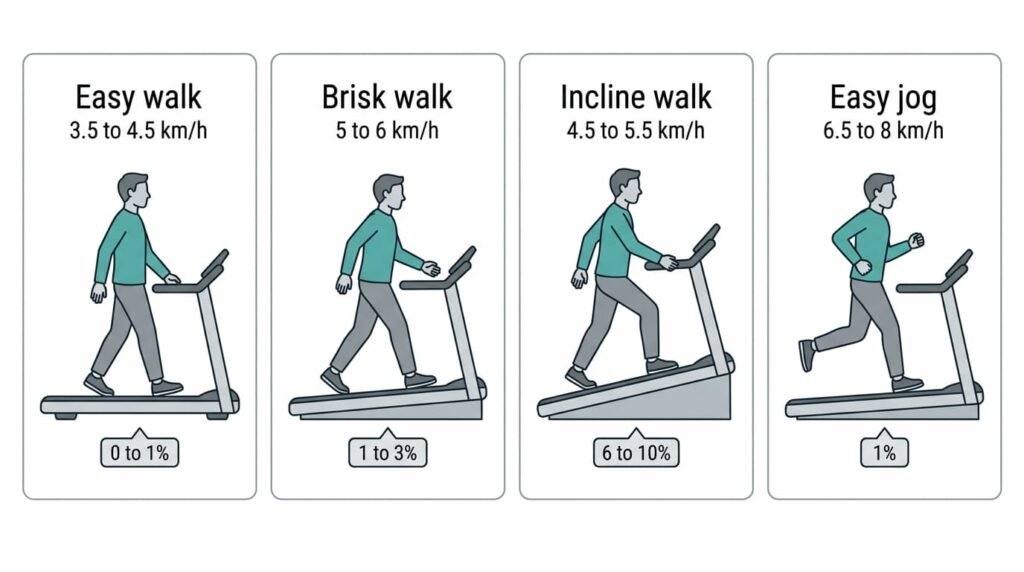
Beginner speed guide
Every treadmill and every body is different, so use these as starting points and adjust to how you feel.
| Activity | Speed (km/h) | Speed (mph) | How it should feel |
|---|---|---|---|
| Warm-up or easy walk | 3.5 to 4.5 | 2.2 to 2.8 | Easy, could chat all day |
| Brisk walk | 5 to 6 | 3.1 to 3.7 | Purposeful, slightly breathy, can still talk |
| Power walk | 6 to 6.5 | 3.7 to 4 | Hard to walk any faster |
| Easy jog | 6.5 to 8 | 4 to 5 | Light running, can talk in short sentences |
| Steady run | 8 to 10 | 5 to 6.2 | Comfortably hard |
| Fast run | 10 and above | 6.2 and above | Hard, short efforts only |
If you are not sure what speed to choose, start at the bottom and go up in small steps until you reach the feeling in the right-hand column. Our pace calculator converts treadmill speeds into minutes per mile or kilometre.
Using the incline
| Incline | What it does | Good for |
|---|---|---|
| 0 to 1 percent | Feels like flat ground. 1 percent mimics outdoor running | Running and easy walking |
| 2 to 5 percent | Gentle hill. Raises heart rate without speeding up | Building fitness, warm-ups |
| 6 to 10 percent | Steep hill. Big jump in effort | Incline walking workouts |
| 11 to 15 percent | Very steep | Short incline intervals for fitter walkers |
When you walk uphill, walk tall and let go of the handrails. Holding on tightly takes weight off your legs and reduces the work you do.
Safety first
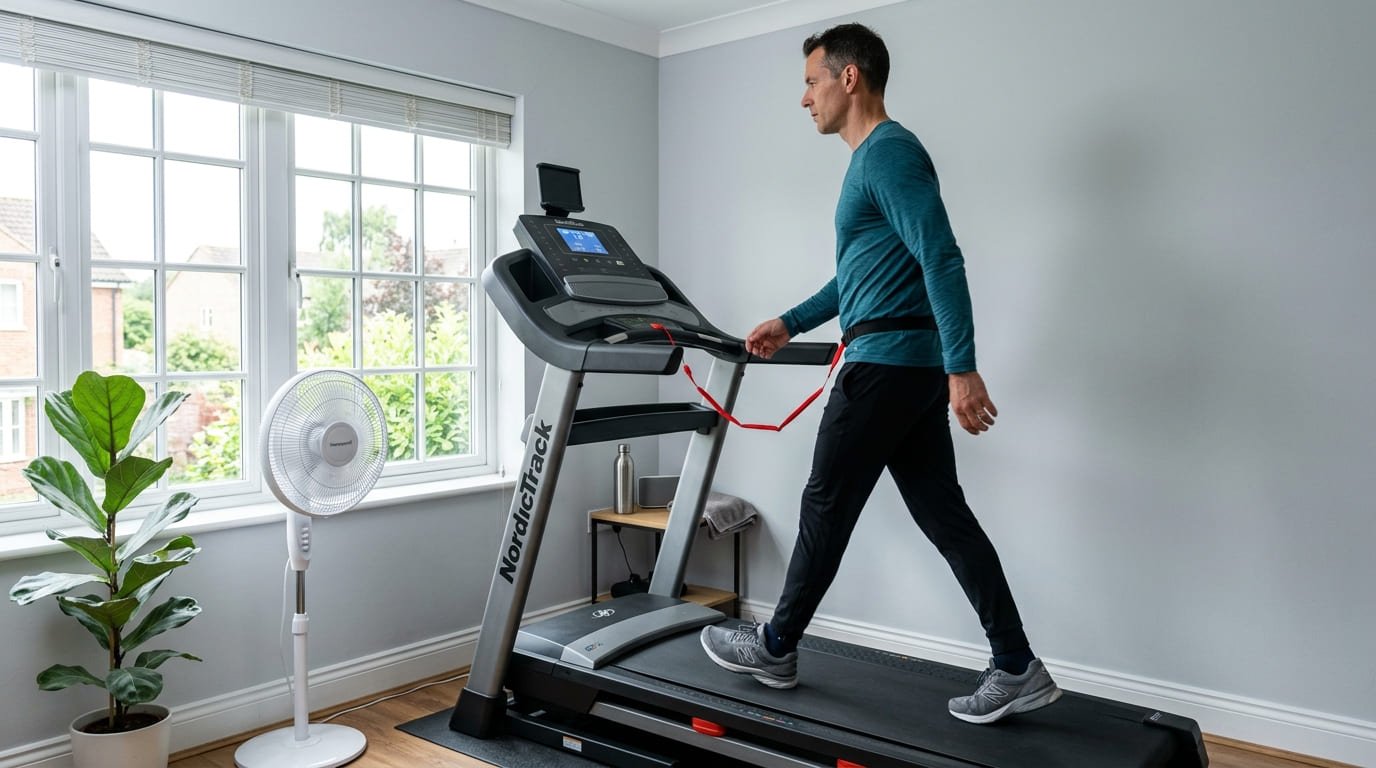
- Clip the safety key to your clothing. If you slip, the belt stops
- Start the belt at a slow speed while standing on the side rails, then step on
- Look ahead, not down at your feet
- Walk or run in the middle of the belt, not near the front or back
- Slow down gradually before you stop. Never jump off a moving belt
- Keep children and pets away from home treadmills, and unplug or remove the key when not in use
7 treadmill workouts for beginners
Every session starts with a 5-minute warm-up at an easy walking pace and ends with a 5-minute cool-down. Adjust the speeds to your own fitness using the guide above.
1. The 5-20-5 walk (25 to 30 minutes)
| Time | Speed | Incline |
|---|---|---|
| 0 to 5 minutes | Easy walk | 0 to 1 percent |
| 5 to 25 minutes | Brisk walk | 1 percent |
| 25 to 30 minutes | Easy walk | 0 percent |
The perfect first workout. If 20 minutes of brisk walking is too much, start with 10 and add a few minutes each session.
2. Walking intervals (25 minutes)
After your warm-up, alternate 2 minutes of brisk walking with 1 minute of easy walking, six times. Then cool down. Intervals make the time fly and gently push your fitness.
3. Rolling hills walk (30 minutes)
| Time | Incline | Speed |
|---|---|---|
| 0 to 5 minutes | 1 percent | Easy |
| 5 to 8 minutes | 3 percent | Brisk |
| 8 to 11 minutes | 1 percent | Brisk |
| 11 to 14 minutes | 5 percent | Brisk |
| 14 to 17 minutes | 1 percent | Brisk |
| 17 to 20 minutes | 6 percent | Brisk |
| 20 to 25 minutes | 1 percent | Brisk |
| 25 to 30 minutes | 0 percent | Easy |
A great introduction to incline and a nice change from flat walking.
4. Treadmill incline workout (30 minutes)
This treadmill incline workout builds up to a steady climb. After your warm-up, raise the incline by 1 percent every 2 minutes until you reach 8 percent, keeping a steady walking speed of about 4.5 to 5.5 km/h. Hold it for 5 minutes, then lower the incline 2 percent every minute back down. Cool down.
| Stage | Incline | Time |
|---|---|---|
| Climb | 1 to 8 percent in 1 percent steps | 16 minutes |
| Hold | 8 percent | 5 minutes |
| Descend | 6, 4, 2, 0 percent | 4 minutes |
Once this feels easy, try the 12-3-30 workout, the popular 12 percent incline, 3 mph, 30-minute walk.
5. First run-walk (25 minutes)
After your warm-up, jog easily for 1 minute, then walk briskly for 2 minutes. Repeat 5 times. Cool down. Each week, lengthen the jogs and shorten the walks. Our guide on how to increase running endurance has a full 8-week run-walk plan.
6. Pyramid walk-jog (30 minutes)
After your warm-up, jog for 1 minute, walk 1. Jog 2, walk 1. Jog 3, walk 1. Jog 2, walk 1. Jog 1, walk 1. Repeat once if you feel good, then cool down.
7. Steady state session (30 to 45 minutes)
Pick a speed and incline where you can talk in full sentences, whether that is a brisk walk on a 4 percent incline or an easy jog on 1 percent, and hold it. Steady sessions like this build your aerobic base. Our guide to steady state cardio explains why they matter.
| Workout | Length | Type | Best for |
|---|---|---|---|
| 5-20-5 walk | 25 to 30 minutes | Walking | Complete beginners |
| Walking intervals | 25 minutes | Walking | Building fitness and pace |
| Rolling hills walk | 30 minutes | Incline walking | Variety and leg strength |
| Treadmill incline workout | 30 minutes | Incline walking | Calorie burn, low impact |
| First run-walk | 25 minutes | Walk and jog | Starting to run |
| Pyramid walk-jog | 30 minutes | Walk and jog | Progressing your running |
| Steady state session | 30 to 45 minutes | Walk or jog | Aerobic base, recovery days |
When you are ready for harder treadmill workouts, our HIIT treadmill workout guide has three beginner-friendly interval sessions.
A 6-week treadmill workouts plan
Do three or four sessions a week, with at least one rest or strength day between the harder ones.
| Week | Session 1 | Session 2 | Session 3 | Optional session 4 |
|---|---|---|---|---|
| Week 1 | 5-20-5 walk (10 minutes brisk) | Walking intervals | 5-20-5 walk (15 minutes brisk) | Easy 20-minute walk |
| Week 2 | 5-20-5 walk (20 minutes brisk) | Walking intervals | Rolling hills walk | Steady state walk |
| Week 3 | Treadmill incline workout (up to 6 percent) | Walking intervals | Rolling hills walk | Steady state walk |
| Week 4 | Treadmill incline workout (up to 8 percent) | First run-walk or walking intervals | Rolling hills walk | Steady state walk |
| Week 5 | Treadmill incline workout | First run-walk or power walk intervals | Steady state session, 35 minutes | Rolling hills walk |
| Week 6 | Treadmill incline workout | Pyramid walk-jog or power walk intervals | Steady state session, 40 minutes | Rolling hills walk |
If you do not want to run, simply swap the run-walk sessions for power walking intervals: 2 minutes at your fastest walking pace, 1 minute easy, repeated six times.
Treadmill workout for weight loss
There is no magic treadmill workout for weight loss. What works is a combination of regular movement, a modest calorie deficit and strength training to protect your muscle. That said, these choices give you the most from your time on the belt:
- Incline walking burns noticeably more calories than flat walking at the same speed, with less impact than running
- Longer, steady sessions of 30 to 60 minutes burn more total calories than short, hard ones for most beginners
- One or two interval sessions a week add variety and fitness
- Consistency beats intensity. Four moderate sessions every week will do more than one brutal session you dread
| Session | Approximate calories, 70 kg person, 30 minutes |
|---|---|
| Easy walk, 4.5 km/h, flat | About 100 to 120 |
| Brisk walk, 5.5 km/h, flat | About 130 to 150 |
| Brisk walk, 5 km/h, 8 to 10 percent incline | About 220 to 270 |
| Easy jog, 8 km/h, 1 percent | About 280 to 300 |
These are rough estimates. Your own numbers depend on your weight, fitness and exact speed. Our calories burned calculator gives you a personal estimate, and our guide on whether cardio helps you lose weight explains how exercise and diet work together.
Can a treadmill burn belly fat?
You cannot choose where you lose fat. Treadmill workouts help you burn calories, and when you are in an overall calorie deficit, your body draws on fat stores, including belly fat. Combine treadmill sessions with strength training and sensible eating, and be patient. Our walking for weight loss guide shows how to build a realistic plan.
Using a treadmill at home
Using a treadmill at home is one of the easiest ways to make exercise a habit, because the hardest part, getting out of the door, disappears. A few tips make it safer and more enjoyable.
Setting up
- Space: leave at least 2 metres behind the treadmill and about half a metre on each side
- Floor: place it on a level, solid surface. A treadmill mat protects your floor and reduces noise
- Power: plug it directly into the wall socket rather than an extension lead, if the manual says so
- Airflow: a fan makes a big difference. Indoor running gets hot quickly
- Entertainment: a tablet stand, podcast or playlist helps longer sessions pass quickly
Looking after your treadmill
- Wipe down the belt and handrails after each use
- Check the belt is centred and not slipping. Most manuals explain how to adjust it
- Lubricate the belt as the manufacturer recommends, often every few months
- Keep the area under and around the treadmill clear of dust and objects
Staying motivated indoors
- Schedule it like an appointment
- Save a favourite podcast or series for treadmill time only
- Track your progress. Write down your time, distance and incline after every session
- Change the workout every session using the seven options above
- Set small goals, such as walking 5 km in under an hour or reaching an 8 percent incline
How to progress your treadmill workouts
Once the six-week plan feels comfortable, keep improving by changing one thing at a time. I use this order, because it keeps the risk of aches and niggles low:
- Time first. Add 5 minutes to one or two sessions a week until your longest is 45 to 60 minutes
- Incline second. Raise the incline on your hill sessions by 1 percent every week or two
- Speed third. Increase your brisk walking or jogging speed by 0.2 to 0.5 km/h at a time
- Intervals last. Add one harder interval session a week once the rest feels easy
| Sign | What it means | What to do |
|---|---|---|
| Sessions feel easy and you finish fresh | You are ready to progress | Change one variable |
| You are tired but recover by the next day | About right | Stay where you are for another week |
| Legs feel heavy for days or joints ache | Too much, too soon | Drop back a week and add a rest day |
Treadmill or walking outside?
Both are excellent. Treadmill workouts give you control, comfort and safety, while walking or running outside adds fresh air, changing terrain and a natural mood boost. Many people find the best plan mixes both: treadmill sessions on dark, wet or busy days, and outdoor walks at the weekend. If you want to know how your treadmill pace translates to the real world, our guide on how long it takes to walk a mile has simple time charts.
Common mistakes
- Holding the handrails during incline walking, which makes the workout much easier than the display suggests
- Starting too fast, like I did, and stopping after three minutes
- Doing the same workout every time, which leads to boredom and a plateau
- Looking down at your feet or phone, which strains your neck and affects balance
- Overstriding. Take shorter, quicker steps, especially when running
- Jumping off a moving belt
- Ignoring strength training. Two short sessions a week make you stronger and less injury-prone
Treadmill workouts for different people
| Who | Best workouts | Tips |
|---|---|---|
| Complete beginners | 5-20-5 walk, walking intervals | Start with 10 to 15 minutes and build up |
| Heavier beginners | Flat and incline walking | Low impact, steady progress |
| Older adults | 5-20-5 walk, rolling hills walk | Use the handrails lightly for balance only if needed |
| Future runners | Run-walk, pyramid | Build the jogging time gradually |
| Busy people | Walking intervals, treadmill incline workout | 25 to 30 minutes is enough |
| Returning after injury | Easy walking, gentle incline | Follow your physiotherapist’s advice |
When to check with your doctor
Treadmill workouts are safe for most people. Check with your doctor first if you have heart disease, high blood pressure, diabetes, balance problems, a joint condition, are pregnant, or have been inactive for a long time.
This article is general information, not medical advice. Stop and seek urgent help if you have chest pain, severe breathlessness, dizziness or fainting during exercise. See our medical disclaimer.
The bottom line
The best treadmill workouts for beginners start with walking, add incline, and only then introduce running. Begin with the 5-20-5 walk, try walking intervals and a rolling hills session, then build up to the treadmill incline workout and a first run-walk. Follow the six-week plan, keep the safety key clipped on, and let go of the handrails.
My second-hand treadmill carried me through that dark, icy winter and into spring fitter than I had been in years. With a simple plan, yours can do the same.
If you get breathless quickly on the treadmill, my guide to breathing while running shows how to slow down, relax and find a rhythm.
Frequently asked questions
What is a good treadmill workout for beginners?
A 5-20-5 walk is ideal: 5 minutes of easy walking, 20 minutes of brisk walking at about 5 to 6 km/h with a 1 percent incline, and 5 minutes of easy walking. Add incline or intervals once it feels easy.
What speed should a beginner walk on a treadmill?
Most beginners walk comfortably at 4.5 to 6 km/h, which is about 3 to 3.7 mph. Start slower if you are new to exercise and increase gradually until you are slightly breathy but can still talk.
How long should a beginner be on a treadmill?
Start with 15 to 30 minutes, three or four times a week. Build up to 30 to 45 minutes as your fitness improves.
What is the best treadmill workout for weight loss?
Incline walking and steady sessions of 30 to 60 minutes burn the most calories for most beginners, with one or two interval sessions a week for variety. Combine them with strength training and a modest calorie deficit.
Is a treadmill incline workout better than running?
For many beginners, yes. Incline walking burns a lot of calories with much less impact than running, which makes it easier to do often. Running builds more speed and endurance. Both are good choices.
Should I set my treadmill to 1 percent incline?
For running, a 1 percent incline makes the effort closer to running outdoors on flat ground. For walking, 0 to 1 percent is fine, and higher inclines turn it into a harder workout.
Is using a treadmill at home worth it?
For many people, yes. It removes weather and travel as excuses, which makes exercise easier to fit in. Make sure you have enough space, a solid level floor and a safe place away from children and pets.
Should I hold the handrails on a treadmill?
Only lightly for balance if you need it. Gripping the handrails, especially on an incline, takes weight off your legs and reduces the workout. Slow down instead of holding on.
What’s next?
Reading is the easy part. Pick one of these and do it today.