Swimming Workouts for Beginners: 6 Sessions and an 8-Week Plan
Swimming is the one form of exercise where being a beginner feels most obvious. You get in the pool, push off the wall with good intentions, and by the far end you are gasping. Meanwhile somebody twice your age glides past without apparent effort.
That was my experience the first time I tried to swim for fitness. I could run for thirty minutes, and I could not swim four lengths without stopping. It is not a fitness problem. Swimming is a skill, and until your breathing and body position settle, the water punishes every wasted movement.
The good news is that beginners improve quickly, and you do not need to swim non-stop to get a good workout. This guide explains how a swim session is structured, how to read a swim workout, and gives you six sessions and an eight-week plan that start from one length at a time.
At a glance
- A beginner swim workout lasts 20 to 30 minutes and covers about 300 to 800 metres
- Swim short distances with rests in between. Nobody starts by swimming continuously
- Every session has a warm-up, a main set and a cool-down
- Swim two or three times a week, with a day between sessions
- Relaxed breathing matters more than strength. Breathe out underwater, in above it
- A kickboard and a pair of goggles are the only extras you need
- Swimming is low impact and works the whole body, which makes it kind to joints
Why swimming is a good choice for beginners
- It is low impact. The water supports most of your body weight, so there is very little load on your knees, hips and back. That makes it a good option if you are heavier, have sore joints, or are returning from an injury
- It works the whole body. Your shoulders, back, core and legs all contribute to every stroke
- It builds heart and lung fitness. A review that pooled swim-training studies in non-elite swimmers found improvements in cardiorespiratory fitness and other health markers compared with not training
- You do not overheat. The water carries heat away, which many people find more comfortable than running
- It is a skill for life, and one you can keep doing into old age
There are two limits worth knowing. Swimming does little for bone density, because your skeleton is not bearing weight, and it is not a replacement for strength training. Pair it with a couple of sessions on land each week, such as our full-body workout for beginners.
Before your first session
Can you swim at all? This guide assumes you can cover one length of a pool in some fashion, even slowly and with a rest at the end. If you cannot yet, book adult lessons first. Most public pools run them, and a few sessions with a teacher will save you months of struggle.
What to bring:
| Item | Why | Essential? |
|---|---|---|
| Swimwear that stays in place | So you can concentrate on swimming | Yes |
| Goggles | To see where you are going and keep your face in the water comfortably | Yes |
| Swim cap | Keeps hair out of your face and is required at some pools | Depends on the pool |
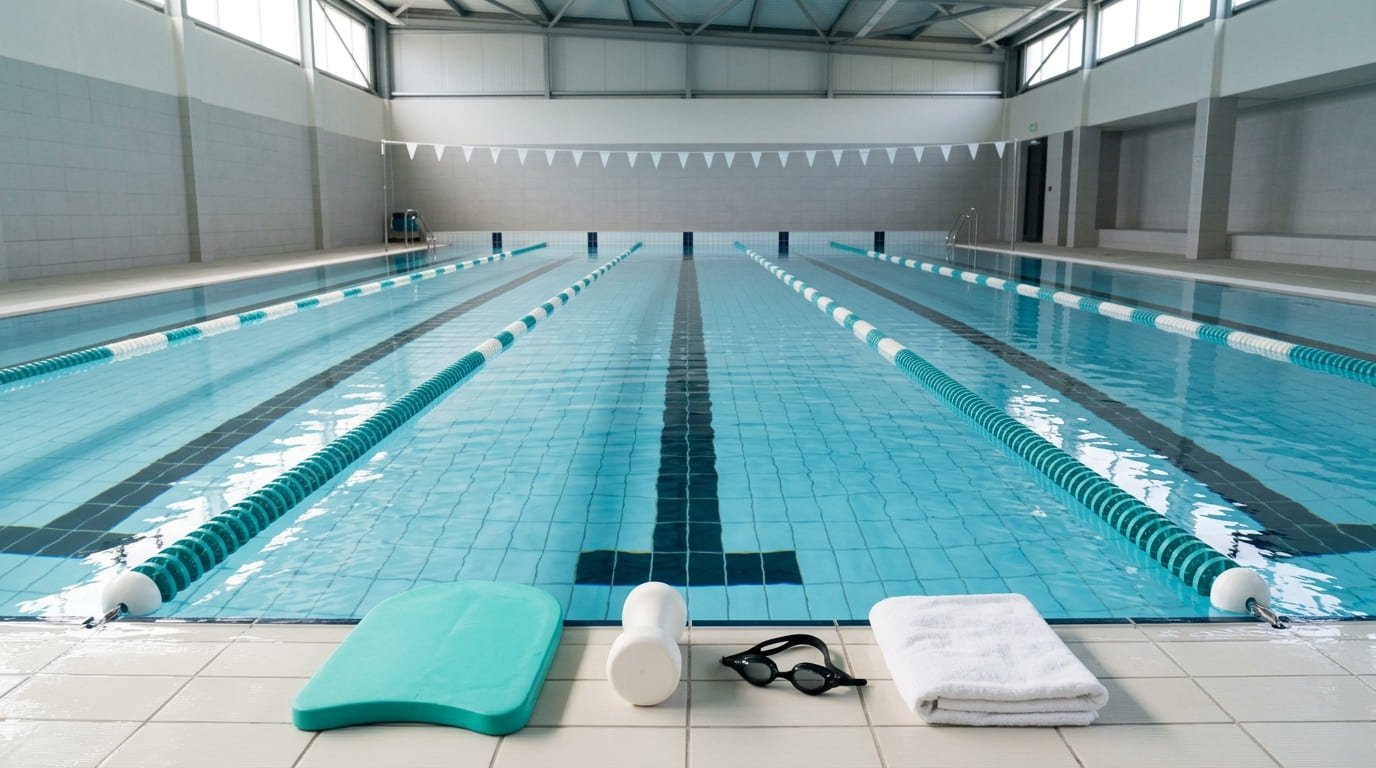
| Kickboard | For kicking drills and for a breather during a set | Very useful. Most pools lend them |
| Pull buoy | A float held between your thighs so you can focus on your arms | Optional |
| Water bottle | You sweat in the pool even though you do not feel it | Yes |
| Flip-flops and a towel | For the poolside and changing room | Yes |
Pool etiquette in two minutes:
- Choose the lane that matches your speed. Most pools label them slow, medium and fast
- Swim in the direction shown on the lane sign, usually a loop, staying to one side
- Rest in the corner of the lane, not the middle of the wall
- If someone taps your foot, let them pass at the next wall
- Push off a few seconds behind the person in front
How to read a swim workout
Swim workouts are written in a kind of shorthand. Once you know it, every plan makes sense.
| Term | What it means |
|---|---|
| Length | One trip from one end of the pool to the other. In most public pools that is 25 metres |
| Lap | Often used to mean the same as a length. Some people use it for there and back. This guide uses lengths |
| 4 x 50 | Swim 50 metres, four times, with a rest between each |
| Rest 30 seconds | Stop at the wall for 30 seconds before the next swim |
| Set | A group of swims done together, such as 4 x 50 |
| Easy | A pace where you could keep going and are not out of breath |
| Steady | A moderate effort. Breathing is deeper but controlled |
| Strong | Hard, but not all-out. You are glad to reach the wall |
| Kick | Legs only, usually holding a kickboard |
| Pull | Arms only, usually with a pull buoy between your thighs |
| Drill | A simplified exercise that practises one part of the stroke |
| Choice | Any stroke you like |
Distances in this guide are in metres and assume a 25-metre pool. If your pool is 25 yards, use the same numbers. The difference is under ten percent. In a 50-metre pool, one length counts as two.
How a swim session is structured
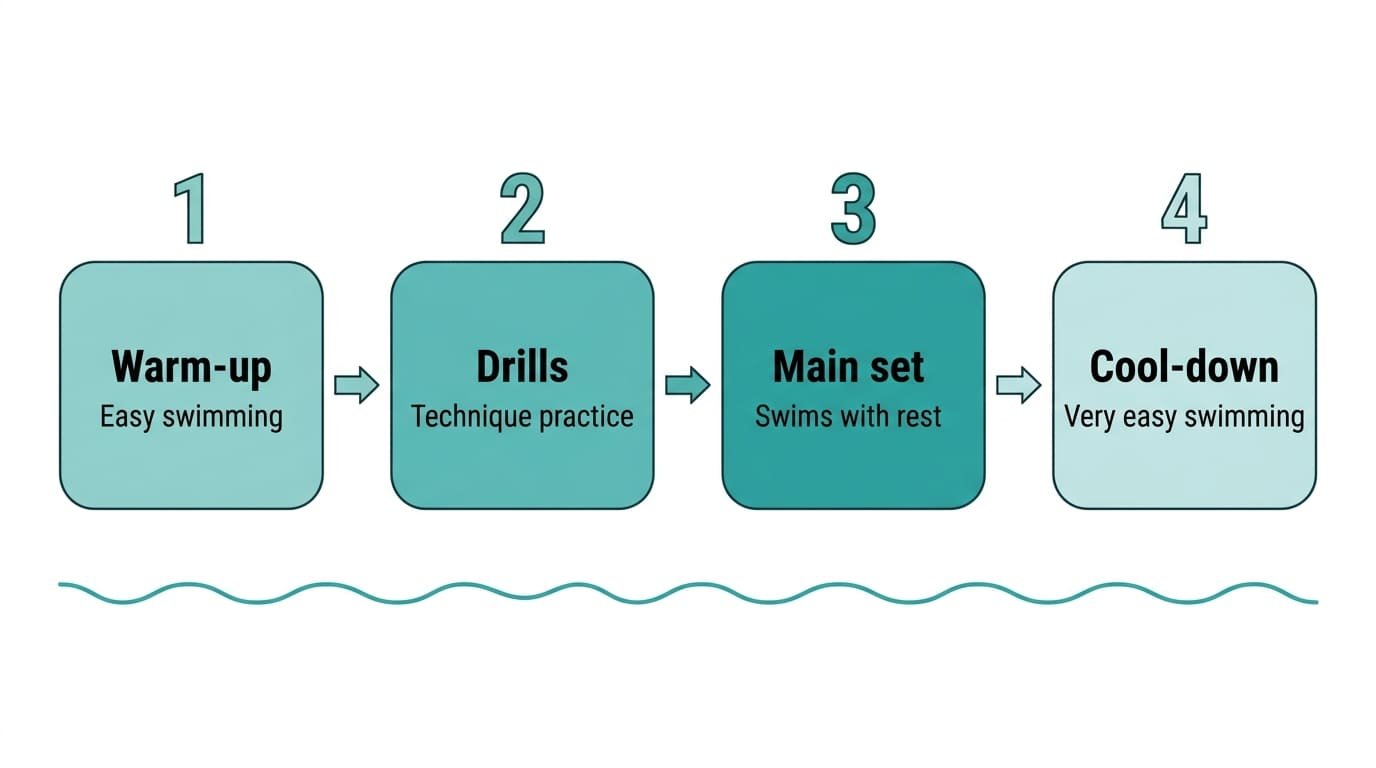
Every session has the same four parts.
| Part | Purpose | Typical beginner amount |
|---|---|---|
| Warm-up | Loosen up and get used to the water | 100 to 200 metres, easy |
| Drills or kick | Practise technique while you are fresh | 100 to 200 metres |
| Main set | The work: repeated swims with rest | 100 to 500 metres |
| Cool-down | Bring your breathing down | 50 to 100 metres, very easy |
Rest is part of the workout. Stopping at the wall for 20 to 40 seconds between swims is not failing. It is how swimmers of every level train. Short swims with rest let you hold good technique, and good technique is what makes swimming feel easier.
Five technique basics that make everything easier
You do not need perfect form. These five things remove most of the struggle from front crawl, also called freestyle.
- Breathe out underwater. This is the big one. Blow a steady stream of bubbles through your nose or mouth while your face is in the water, so that when you turn to breathe you only need to inhale. Holding your breath is what leaves beginners gasping
- Look down, not forward. Keep your eyes on the bottom of the pool and the back of your neck long. When your head lifts, your hips and legs sink and you drag them through the water
- Turn your head to breathe, do not lift it. Roll your head to the side with your body, keeping one goggle in the water
- Kick from the hips with fairly straight legs. Small, quick kicks with loose ankles. Bending the knees a lot creates drag
- Reach long and take your time. Stretch your arm forward before you pull. Fewer, longer strokes are easier than many short ones
If front crawl is too hard at first, swim breaststroke or backstroke. A workout done in a stroke you can manage is far better than one you abandon. Mix strokes freely.
Three useful drills
- Bubble bobs. Stand in the shallow end, take a breath, sink under and breathe out fully, then stand and breathe in. Repeat ten times. It teaches relaxed exhaling
- Kick with a board. Hold the board at arm’s length, face in the water, and kick. Turn your head to breathe every few seconds
- Side kick. Kick on your side with your lower arm stretched ahead and your top arm resting on your hip, face down, rolling to breathe. It teaches the body position for breathing
Six swimming workouts for beginners
They run from easiest to hardest. Use any stroke unless one is named.
Workout 1: first session (300 metres, about 20 minutes)
| Part | What to do | Rest |
|---|---|---|
| Warm-up | 4 x 25 easy, any stroke | 30 to 45 seconds after each |
| Kick | 2 x 25 with a kickboard | 30 seconds after each |
| Main set | 4 x 25, steady | 30 to 45 seconds after each |
| Cool-down | 2 x 25 very easy, backstroke or breaststroke | As needed |
Workout 2: building up (400 metres, about 20 minutes)
| Part | What to do | Rest |
|---|---|---|
| Warm-up | 4 x 25 easy | 30 seconds after each |
| Kick | 4 x 25 with a kickboard | 30 seconds after each |
| Main set | 6 x 25 steady | 30 seconds after each |
| Cool-down | 2 x 25 very easy | As needed |
Workout 3: first 50s (500 metres, about 25 minutes)
| Part | What to do | Rest |
|---|---|---|
| Warm-up | 100 easy, stopping at each wall if you need to | 1 minute after |
| Kick | 4 x 25 with a kickboard | 30 seconds after each |
| Main set | 4 x 50 steady | 45 seconds after each |
| Cool-down | 100 very easy, any stroke | As needed |
Workout 4: mixed set (600 metres, about 25 minutes)
| Part | What to do | Rest |
|---|---|---|
| Warm-up | 100 easy | 1 minute after |
| Drill | 4 x 25, alternating side kick and normal swimming | 30 seconds after each |
| Main set | 2 x 50 steady, then 4 x 25 strong, then 2 x 50 steady | 30 to 45 seconds after each |
| Cool-down | 100 very easy | As needed |
Workout 5: longer swims (800 metres, about 30 minutes)
| Part | What to do | Rest |
|---|---|---|
| Warm-up | 150 easy | 1 minute after |
| Kick | 4 x 25 with a kickboard | 20 to 30 seconds after each |
| Main set | 3 x 100 steady | 1 minute after each |
| Then | 4 x 50, the second half of each slightly faster than the first | 30 seconds after each |
| Cool-down | 50 very easy | As needed |
Workout 6: first continuous swim (1,000 metres, about 35 minutes)
| Part | What to do | Rest |
|---|---|---|
| Warm-up | 200 easy | 1 minute after |
| Drill | 4 x 25, any drill | 20 seconds after each |
| Main set | 400 continuous at an easy, relaxed pace | 2 minutes after |
| Then | 4 x 50 strong | 40 seconds after each |
| Cool-down | 100 very easy | As needed |
Swimming 400 metres without stopping is a real milestone. Go slower than you think you need to. If you have to stop, take ten seconds at the wall and carry on.
The 8-week beginner swim plan
Swim two or three times a week. Repeat a week if it felt hard, and move on when the last session felt comfortable.
| Week | Session A | Session B | Session C (optional) | Weekly total |
|---|---|---|---|---|
| 1 | Workout 1 | Workout 1 | Workout 1 | 600 to 900 m |
| 2 | Workout 1 | Workout 2 | Workout 2 | 700 to 1,100 m |
| 3 | Workout 2 | Workout 3 | Workout 2 | 900 to 1,300 m |
| 4 | Workout 3 | Workout 3 | Workout 4 | 1,000 to 1,600 m |
| 5 | Workout 3 | Workout 4 | Workout 4 | 1,100 to 1,700 m |
| 6 | Workout 4 | Workout 5 | Workout 4 | 1,400 to 2,000 m |
| 7 | Workout 5 | Workout 5 | Workout 4 | 1,600 to 2,200 m |
| 8 | Workout 5 | Workout 6 | Workout 5 | 1,800 to 2,600 m |
How to progress beyond the plan: change one thing at a time.
- Shorten the rests by five to ten seconds
- Lengthen the swims, for example from 50s to 100s
- Add one or two repeats to the main set
- Swim some repeats faster
- Increase total distance by no more than about ten percent a week
Which stroke should you use?
| Stroke | Difficulty to learn | Breathing | Muscles emphasised | Good for |
|---|---|---|---|---|
| Front crawl (freestyle) | Moderate | To the side, timing takes practice | Shoulders, back, core | Fitness swimming, the most efficient stroke |
| Breaststroke | Easy to start | Face comes up every stroke | Chest, inner thighs, glutes | Beginners, relaxed swimming |
| Backstroke | Easy to moderate | Face stays out of the water | Back, shoulders | Recovery lengths, people who dislike face-down swimming |
| Butterfly | Hard | Forward, every one or two strokes | Whole body | Leave it for later |
Most fitness swimmers use front crawl for main sets and breaststroke or backstroke to recover. If breaststroke bothers your knees, kick more gently or use a front crawl kick instead.
Swimming workouts for weight loss
Swimming burns a useful amount of energy, and because it is easy on the joints, heavier people can often do more of it than they could running.
| Activity, 30 minutes | Approximate calories, 60 kg person | 70 kg person | 85 kg person |
|---|---|---|---|
| Easy swimming, any stroke | 180 | 210 | 255 |
| Steady front crawl | 250 | 290 | 350 |
| Hard front crawl or intervals | 300 | 350 | 425 |
| Breaststroke, moderate | 160 | 185 | 225 |
| Water walking or aqua jogging | 140 | 160 | 200 |
These are estimates. Your actual figure depends on your technique, speed and how much of the session you spend resting at the wall.
Three honest points about swimming and fat loss:
- Swimming makes many people hungry. Cool water seems to sharpen appetite after a session. Have a planned snack with protein ready, so the swim is not cancelled out on the way home
- Rest time is not burning much. A 30-minute session with long rests might include 12 minutes of actual swimming. As your fitness improves, shorter rests raise the total
- Food still decides the result. No amount of swimming outpaces eating more than you burn
A simple fat-loss week: three swims of 25 to 35 minutes, two short strength sessions, a daily walk and a modest calorie deficit. Our guides on whether cardio helps you lose weight and home workouts for weight loss cover the eating side, and the calories burned calculator gives a personal estimate.
What to do when you run out of breath
Almost every beginner hits this, usually in the second length.
- Slow down. You are probably swimming much faster than you can sustain
- Breathe out the whole time your face is in the water
- Breathe every two strokes, always to the same side, until it feels easy. There is no need to breathe every three
- Swap strokes. A length of backstroke lets you breathe freely while still moving
- Take the rest. Start the next swim when your breathing has settled, not on a strict clock
Within three or four weeks, most people find the breathlessness fades sharply as their rhythm settles.
Common beginner mistakes
- Trying to swim non-stop from day one
- Holding your breath underwater
- Lifting your head to breathe or to look forward
- Kicking hard from the knees, which tires you and slows you down
- Sprinting every length. Most of your swimming should feel easy to steady
- Skipping the warm-up and cool-down
- Only ever doing the same session. Change the distances and the efforts
- Doing too much too soon. Shoulders need time to adapt to thousands of strokes
Looking after your shoulders
Shoulder soreness is the most common complaint among regular swimmers, and it is largely preventable.
- Build your weekly distance gradually
- Enter the water with your hand in line with your shoulder, not across the centre of your body
- Roll your body to breathe instead of reaching with your neck
- Strengthen your upper back on land with rows and band pull-aparts
- Stop if you feel a sharp pain at the front or top of the shoulder, and rest it for a few days
Our posture exercises guide has upper-back work that suits swimmers.
Swimming alongside other training
| Your goal | How to fit swimming in |
|---|---|
| General fitness | Two swims and two strength sessions a week |
| Fat loss | Three swims, two strength sessions, daily walking |
| Building muscle | Strength training three or four days, one or two easy swims on other days |
| Active recovery | One very easy swim of 15 to 20 minutes on a rest day |
| Sore joints or returning from injury | Swim in place of running or jumping, as your doctor or physiotherapist advises |
On days when you do both, lift first and swim afterward, or separate them by several hours. Our cardio exercises for beginners and low-impact workout for beginners guides have options for the days you cannot get to a pool.
Safety
- Swim in supervised pools while you are learning
- Stay in water you can stand up in until you are confident
- Do not swim alone in open water
- Get out if you feel dizzy, very cold or unusually short of breath
- Drink water. You lose fluid in the pool
- Speak to your doctor before starting if you have a heart or lung condition, epilepsy, or an ear, skin or eye problem that water could affect
The bottom line
Swimming rewards patience more than effort. The people gliding past you are not fitter than you. They have simply learned to breathe out underwater, keep their head down and take their time.
Start with one length at a time and rest at the wall. Follow the first workout two or three times a week, then move through the plan as each session starts to feel comfortable. In eight weeks, most beginners can go from struggling with four lengths to swimming 400 metres without stopping.
Keep most of your swimming easy, look after your shoulders, and add some strength work on land.
Frequently asked questions
What is a good swimming workout for a beginner?
A 20-minute session of about 300 metres: four easy lengths to warm up, two lengths of kicking with a board, four steady lengths as the main set, and two very easy lengths to finish. Rest 30 to 45 seconds at the wall after each length.
How many laps should a beginner swim?
Aim for 12 to 16 lengths of a 25-metre pool in your first sessions, which is 300 to 400 metres, taken one length at a time with rests. Build up over eight weeks to 30 to 40 lengths, or 800 to 1,000 metres.
How often should beginners swim?
Two or three times a week, with at least a day between sessions. That is enough to improve technique and fitness while giving your shoulders time to adapt. Two sessions maintain progress, and three bring faster improvement.
Is swimming good for losing weight?
Yes. Thirty minutes of steady swimming burns roughly 250 to 350 calories for most adults, and it is easy on the joints. It works best alongside a modest calorie deficit, because swimming often increases appetite. Plan a protein-rich snack for afterward.
Why do I get so out of breath when swimming?
Usually because you are holding your breath underwater and swimming too fast. Breathe out steadily while your face is in the water, slow your pace, and breathe every two strokes. Most beginners find breathlessness improves greatly within three to four weeks.
Is 30 minutes of swimming a good workout?
Yes. Thirty minutes including warm-up, a main set with rests and a cool-down is a complete session for a beginner. It trains your heart, lungs and most major muscles with very little stress on your joints.
What is the easiest swimming stroke for beginners?
Breaststroke is usually the easiest to start with, because your face comes out of the water on every stroke. Backstroke is also beginner-friendly, since you can breathe freely. Front crawl takes more practice but becomes the most efficient stroke for fitness.
Do I need lessons before starting swimming workouts?
If you cannot yet swim one length of the pool, yes. A few adult lessons will teach you breathing and body position far faster than struggling alone. If you can already swim a length, lessons are still helpful but not essential.
What’s next?
Reading is the easy part. Pick one of these and do it today.