

Jump Lunges: How to Do Them Safely, Muscles Worked and a 5-Step Progression
Jump lunges are one of those exercises that look easy in a workout video and feel brutal the first time you try them. I added them to a home circuit after a few months of regular training, confident that my legs were strong enough. After eight reps my thighs were on fire, I was out of breath, and my landings had turned into thuds that rattled the pictures on the wall.
The problem was not my fitness. It was that I had skipped the steps that come before jump lunges. Once I learned to control a deep split squat, practised small hops, and focused on landing quietly, jump lunges became one of my favourite moves. They build leg power, burn plenty of energy and need no equipment at all.
This guide explains how to do jump lunges safely, the muscles worked, a five-step progression from basic split squats to full plyometric lunges, three workouts, and the mistakes that cause sore knees.
At a glance
- Jump lunges are an explosive version of the lunge, where you jump and switch legs in the air
- They work the quads, glutes, hamstrings and calves, and challenge balance and coordination
- Master split squats and reverse lunges before you start jumping
- Land softly, with your front foot flat and your knee in line with your toes
- Start with 2 or 3 sets of 6 to 10 total reps and full rest between sets
- Do them once or twice a week, not every day
- Skip them if you have knee, hip or ankle pain, and choose a low-impact alternative
What are jump lunges?
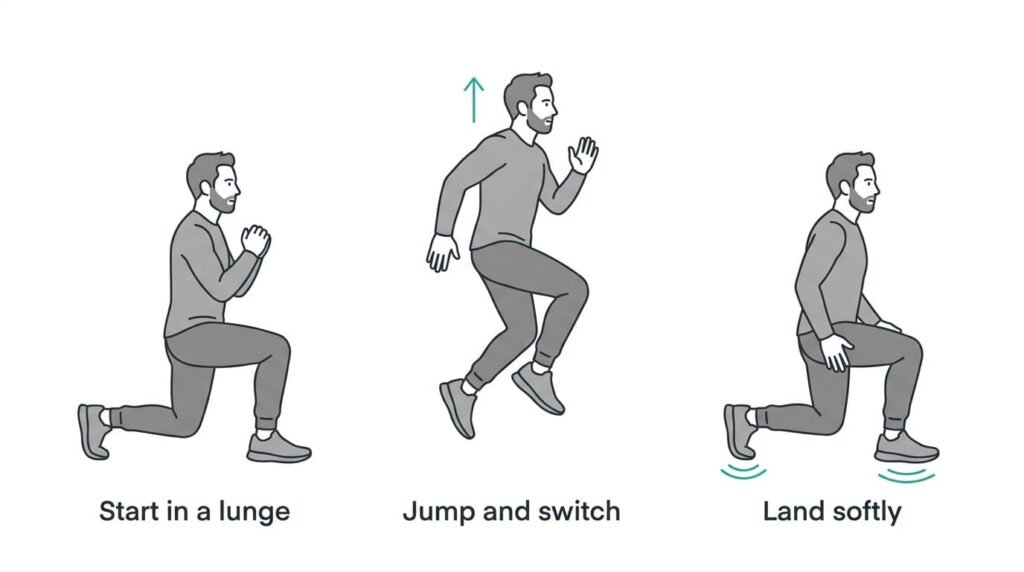
A jump lunge, also called a lunge jump, split jump or jumping lunge, starts in a lunge position with one foot forward and both knees bent. You jump straight up, switch your legs in the air, and land softly in a lunge with the other foot forward. Then you repeat, alternating sides.
Because the jump adds speed and impact, jump lunges are a plyometric exercise. Plyometrics train your muscles to produce force quickly, which builds power. They also raise your heart rate fast, which is why jump lunges appear in so many HIIT workouts.
Muscles worked by jump lunges
| Muscle | Role in the jump lunge |
|---|---|
| Quadriceps | Straighten the knee to drive you up, then absorb the landing |
| Glutes | Extend the hip for power and keep the pelvis steady |
| Hamstrings | Assist hip extension and help control the landing |
| Calves | Push off the floor and cushion the landing |
| Hip adductors and abductors | Keep the legs and knees aligned |
| Core | Keeps the torso upright and stable in the air |
What the research says
- Plyometric training builds jump power. A meta-analysis of 26 studies found that plyometric training improved vertical jump height by about 5 to 9 percent, depending on the type of jump tested
- Lunge depth matters. A study of muscle activity during forward lunges found that a longer step produced generally greater activity in the quadriceps, hamstrings, calves, adductors and gluteus maximus than a short step. That is why a decent lunge length in jump lunges works the legs so well
Benefits of jump lunges
- Leg power. Explosive single-leg work carries over to sprinting, jumping and sports
- Cardio in little time. A set of 10 to 20 lunge jumps raises your heart rate quickly
- Single-leg strength and balance. Each landing trains one leg at a time to absorb force
- No equipment. All you need is a little floor space and supportive shoes
- Coordination. Switching legs in the air takes timing and body control
How to do jump lunges
- Stand tall with your feet hip-width apart and your core gently braced
- Step one foot forward into a lunge, with both knees bent to about 90 degrees. Your front knee should be over your ankle, and your back knee just above the floor
- Swing your arms and push explosively through both feet to jump straight up
- In the air, quickly switch legs, bringing the back leg forward and the front leg back
- Land softly in a lunge with the opposite leg forward, bending your knees to absorb the landing
- Pause for a moment to check your balance, then jump again
Dose: start with 2 or 3 sets of 6 to 10 total reps (3 to 5 per leg), resting 60 to 90 seconds between sets.
Form cues
| Do | Do not |
|---|---|
| Land quietly, with soft knees | Land with straight legs or a loud thud |
| Keep your front knee over your ankle, pointing over your toes | Let your knee cave inward |
| Keep your torso tall | Lean forward over your front leg |
| Jump straight up | Lunge forward across the room |
| Use your arms for rhythm and height | Keep your arms stiff |
| Pause between reps when you are learning | Rush into fast, sloppy reps |
The front foot should land flat, or roll from the middle of the foot to the heel. The back foot lands on the ball of the foot. If you can hear yourself landing, slow down and absorb more with your knees and hips.
How to land jump lunges softly
The landing is where most knee and ankle aches come from, so it deserves its own section. A good landing spreads the force across your ankles, knees and hips, and lets your muscles act like springs instead of letting the joints take the jolt.
- Land with both knees already bending. Think of sinking into the lunge rather than stopping on top of it
- Land on the middle of the front foot, letting the heel come down, while the back foot lands on its ball
- Keep the front knee tracking over the second toe. If it dives inward, your hips are tired or the stance is too narrow
- Keep your chest up and your weight centred between both feet
- Listen. Quiet landings are controlled landings
Surface and shoes
| Surface | Verdict |
|---|---|
| Gym rubber flooring or an exercise mat on a firm floor | Best |
| Wooden floor | Good, with supportive trainers |
| Grass or artificial turf | Good outdoors, if level |
| Carpet | Okay, but can grip shoes and twist the knee |
| Concrete or tiles | Avoid. Very hard on the joints |
Wear supportive trainers with some cushioning. Bare feet and thin slippers make soft landings much harder.
A 5-step progression to jump lunges
Most of the problems people have with jump lunges come from skipping straight to the hardest version. Work through these steps. Move on when you can do the current step with good control for the reps shown.
Step 1: Split squats
Stand in a split stance with one foot forward. Lower your back knee toward the floor, then push back up. Keep your feet in place.
Goal: 3 x 10 on each leg with good balance.
Step 2: Reverse lunges
Step back into a lunge, then return to standing. Reverse lunges are easier on the knees than forward lunges and teach control. Our lunge alternatives guide covers more variations.
Goal: 3 x 10 on each leg.
Step 3: Split squat pulses and calf hops
Hold the bottom of a split squat and do small pulses up and down for 10 to 15 seconds. Then practise small calf hops on the spot to get used to landing softly.
Goal: 3 x 15 seconds of pulses each side and 3 x 15 hops.
Step 4: Split squat jumps (no switch)
Start in a split squat, jump straight up, and land in the same position without switching legs. Do all your reps on one side, then the other. This teaches the jump and landing without the switch.
Goal: 3 x 6 on each side with quiet landings.
Step 5: Full jump lunges
Now add the switch. Start slowly, pausing after each landing. As your control improves, link reps together in a smooth rhythm.
Goal: 3 x 10 total reps with good form.
| Step | Exercise | Impact | Goal before moving on |
|---|---|---|---|
| 1 | Split squats | None | 3 x 10 each leg |
| 2 | Reverse lunges | None | 3 x 10 each leg |
| 3 | Split squat pulses and calf hops | Low | 3 x 15 seconds and 15 hops |
| 4 | Split squat jumps (no switch) | Moderate | 3 x 6 each side, quiet landings |
| 5 | Full jump lunges | High | 3 x 10 total, smooth and controlled |
Jump lunges exercise variations
Low-impact option: alternating reverse lunges at speed
Step back quickly into a lunge and return, alternating legs, at a brisk pace. You get much of the cardio without the jump.
Half jump lunges
Jump only a few centimetres and switch your legs with smaller, quicker movements. Good for building rhythm.
Jump lunges with a pause
Land, hold the lunge for two seconds, then jump. This builds landing control and strength.
Double pulse jump lunges
Land, pulse down once, then jump. A great way to add burn without adding more jumps.
Weighted plyometric lunges (advanced)
Hold light dumbbells by your sides. Only try this once you can do 3 x 12 smooth bodyweight jump lunges, and keep the weight light.
Skater jumps
Leap sideways from one leg to the other. Not a lunge, but a great partner for jump lunges because it trains side-to-side power.
Jump lunges vs other leg exercises
| Exercise | Impact | Main benefit | Best for |
|---|---|---|---|
| Split squats | None | Single-leg strength and control | Beginners, building a base |
| Reverse lunges | None | Strength with less knee stress | Most people |
| Walking lunges | Low | Strength, balance and coordination | Leg day circuits |
| Jump lunges | High | Power, cardio and single-leg control | Fitter beginners and athletes |
| Jump squats | High | Two-leg power | Plyometric workouts |
| Step-ups | Low | Functional strength | Stairs, hiking, older adults |
The jump lunges exercise sits at the top of the lunge family. It does not replace strength exercises like split squats. Instead, it builds on them. The stronger your split squat, the better and safer your jump lunges will be.
Jump lunges for runners and sports
Runners, footballers, basketball players and tennis players all push off one leg at a time. Plyometric lunges train exactly that pattern: producing force quickly from a split stance and absorbing it safely on landing. Add a few sets once a week during the off-season or early in a training block, and keep them away from your hardest running sessions. Our guides on how to increase running endurance and speed and agility exercises show how power work fits alongside running.
A 6-week plan to master jump lunges
Do this twice a week, on non-consecutive days, alongside your normal training.
| Week | Main exercise | Sets and reps |
|---|---|---|
| Week 1 | Split squats and reverse lunges | 3 x 10 each leg |
| Week 2 | Reverse lunges, split squat pulses, calf hops | 3 x 10 each leg, 3 x 15 seconds, 3 x 15 hops |
| Week 3 | Split squat jumps (no switch) | 3 x 5 each side |
| Week 4 | Split squat jumps (no switch), first jump lunges with a pause | 3 x 6 each side, 2 x 6 total |
| Week 5 | Jump lunges with a pause | 3 x 8 total |
| Week 6 | Jump lunges in a smooth rhythm | 3 x 10 total |
If your knees, ankles or shins feel sore the next day, repeat the previous week. There is no rush. A jump lunges exercise done well six weeks from now is worth far more than a sloppy one today.
3 workouts with jump lunges
Warm up for 5 to 10 minutes first with brisk walking or marching, leg swings, bodyweight squats and a few reverse lunges.
Workout 1: Lower body power (15 minutes)
| Exercise | Sets and reps | Rest |
|---|---|---|
| Jump lunges | 3 x 8 total | 60 to 90 seconds |
| Jump squats | 3 x 8 | 60 to 90 seconds |
| Single-leg glute bridges | 3 x 10 each leg | 45 seconds |
| Calf raises | 3 x 15 | 45 seconds |
Our guide to jump squats explains the second exercise.
Workout 2: HIIT finisher (8 minutes)
Do 20 seconds of work, 40 seconds of rest, for 8 rounds, alternating between lunge jumps and mountain climbers. Add this to the end of a strength session once or twice a week. For more ideas, see our HIIT workout for beginners.
Workout 3: Leg day circuit (20 minutes)
| Exercise | Reps |
|---|---|
| Bodyweight squats | 15 |
| Reverse lunges | 10 each leg |
| Jump lunges | 10 total |
| Glute bridges | 15 |
| Wall sit | 30 seconds |
Rest 1 minute and repeat 3 times. Our beginner leg workout at home is a gentler place to start if this feels too hard.
Breathing and pacing
Jump lunges get tiring fast, and holding your breath makes them harder. Breathe out as you jump and in as you land, or simply keep breathing in a steady rhythm. In the first few weeks, treat every rep as a separate jump: land, reset your balance, take a breath, then go again. Linking reps together in a fast rhythm comes later, once your landings are quiet and steady.
When the set starts to fall apart, stop. Two or three good reps are better than ten wobbly ones. I still end most sets a rep or two before I need to, and my knees have thanked me for it.
Warm-up before jump lunges
Never start jump lunges cold. A good warm-up takes 5 to 10 minutes:
| Warm-up move | Time or reps |
|---|---|
| Brisk walking or marching on the spot | 2 to 3 minutes |
| Leg swings front to back and side to side | 10 each leg |
| Bodyweight squats | 10 |
| Reverse lunges | 5 each leg |
| Calf hops | 15 |
By the end of it, you should feel warm and slightly out of breath, with your hips and ankles moving freely.
How often should you do jump lunges?
Plyometric lunges are high-impact and demanding on the muscles, tendons and joints. Most people do best with one or two sessions a week, with at least 48 hours between them. Keep the total number of jumps per session modest, around 20 to 40 jump lunges spread across sets, especially when you are new to them.
| Level | Sessions per week | Total jump lunges per session |
|---|---|---|
| Beginner | 1 | 12 to 20 |
| Intermediate | 1 to 2 | 20 to 40 |
| Advanced | 2 | 30 to 60 |
Quality matters more than quantity. Stop the set when your landings get noisy or your knees start to wobble.
Common mistakes
- Skipping the progression and starting with full jump lunges
- Landing on a straight leg, which sends a jolt through the knee
- Letting the front knee cave inward on the landing
- Leaning forward over the front leg
- Too short a stance, which crowds the front knee
- Going too fast and losing control
- Doing them on a hard floor in thin shoes or bare feet
- Doing too many, too often
Who should be careful
Jump lunges are not for everyone. Choose a lower-impact option such as split squats or fast reverse lunges if you:
- Have current knee, hip, ankle or back pain
- Are new to exercise or returning after a long break
- Are pregnant or have pelvic floor symptoms such as leaking when you jump
- Have osteoporosis or a history of stress fractures
- Have balance problems
If sore knees are your concern, our exercises for knee pain are a gentler way to build leg strength first, and the plyometric workout for beginners introduces jumping gradually.
This article is general information, not medical advice. Stop if you feel sharp pain, and see a professional if pain continues. See our medical disclaimer.
The bottom line
Jump lunges are a powerful, equipment-free exercise for leg strength, power and fitness. Start with split squats and reverse lunges, add small hops and split squat jumps, and only then move to full jump lunges. Land quietly with soft knees, keep your torso tall and your front knee in line with your toes, and keep the total number of jumps modest.
I learned the hard way that jump lunges reward patience. Once I went back and built up step by step, they went from rattling the pictures on my wall to being one of the most satisfying moves in my training. Take the steps, and they will do the same for you.
Frequently asked questions
What muscles do jump lunges work?
Jump lunges work the quadriceps, glutes, hamstrings and calves, with the hip muscles and core keeping you stable. The jump adds power training and raises your heart rate quickly.
Are jump lunges good for beginners?
Not straight away. Beginners should first master split squats and reverse lunges, then practise small hops and split squat jumps. Most people are ready for full jump lunges after a few weeks of this progression.
How many jump lunges should I do?
Start with 2 or 3 sets of 6 to 10 total reps, with 60 to 90 seconds of rest. Keep the total to around 12 to 20 jumps per session at first, and build up gradually.
Are jump lunges bad for your knees?
Done with good form and a sensible amount, jump lunges are safe for most people with healthy knees. Land softly, keep your front knee in line with your toes and avoid them if you already have knee pain.
Are lunge jumps cardio or strength?
Both. Lunge jumps build leg strength and power, and because they are fast and demanding, they raise your heart rate quickly, so they also work as cardio in HIIT workouts.
What is a good alternative to jump lunges?
Fast alternating reverse lunges, split squats, step-ups and skater hops on a soft surface are good alternatives. For a no-impact option, try split squat pulses or a wall sit.
Do jump lunges burn fat?
They burn plenty of calories for the time spent and build muscle, which helps with fat loss. But you cannot burn fat from specific areas, and diet plays the biggest role.
How often should I do plyometric lunges?
Once or twice a week is plenty for most people, with at least 48 hours between sessions. Plyometric lunges are demanding on your muscles, tendons and joints, so quality matters more than quantity.
Why do I lose my balance on jump lunges?
Usually because your stance is too narrow, like walking on a tightrope. Keep your feet hip-width apart from side to side as well as front to back. Slowing down, pausing after each landing and building split squat strength also help.
Should my back knee touch the floor in jump lunges?
No. Aim to lower the back knee to just above the floor, or as low as you can control. Banging the knee on the floor is a sign the landing is too heavy.
What’s next?
Reading is the easy part. Pick one of these and do it today.