Partner Workouts: 16 Two-Person Exercises and 3 Full Routines
Training with another person changes the workout in ways that go well beyond having company. You get accountability, which is the single most reliable predictor of whether someone still trains in three months. You get exercises that are impossible alone, because resistance can come from a person instead of a dumbbell. And you get an honest reason to show up on the days you would otherwise talk yourself out of it.
What you also get, and what almost no partner workout article addresses, is a logistics problem. Two people are rarely the same size, strength or fitness level. Most partner exercise lists assume you are evenly matched, and then quietly fall apart when one of you can do twenty push-ups and the other can do four. This guide handles that directly, along with the warm-up, rest periods and progression that competing articles leave out.
At a glance
- Sixteen exercises, grouped by whether they need matched strength or not
- Three complete routines: 20-minute bodyweight, 30-minute strength, and a 15-minute game-based session
- A full section on training together when you are at very different fitness levels
- Safety notes for the exercises where you are genuinely supporting another person’s weight
- Two to three sessions a week works well, with clear progression for each routine
- No equipment needed for most of it, though a medicine ball and a band add options
Why partner workouts work
The benefits are not just motivational fluff, and they are worth understanding because they tell you what to prioritise.
- Accountability is the strongest effect. Cancelling on yourself costs nothing. Cancelling on someone who is already waiting costs something, and that small difference drives consistency more than any programme design
- Built-in rest timing. In an alternating format, your partner’s set is your rest period, which keeps sessions tight without a timer
- Exercises that need a second person. Assisted work, manual resistance, throws and holds are not available to a solo trainer
- Form feedback in real time. Another set of eyes catches a rounded back or a collapsing knee that you cannot see yourself
- Friendly competition raises effort. Most people push slightly harder when someone is watching, which is useful as long as it does not override technique
- It makes training social rather than a chore, which matters most for people who have never enjoyed exercise
If you are looking to train with a larger group rather than one other person, the format and exercise selection change considerably. Our guide to group exercises at home covers that situation.
The mismatch problem, and how to solve it
This is the section every competing article skips, and it is the reason most partner training attempts fail within a month. If one of you is considerably stronger, heavier or fitter, a shared workout can quickly become too easy for one person and demoralising for the other.
There are four reliable ways around it.
| Strategy | How it works | Best for |
|---|---|---|
| Same exercise, different version | One does full push-ups, the other does incline push-ups on a chair | Almost every bodyweight movement |
| Same exercise, different numbers | Both do a set until the harder-working partner finishes, each at their own rep count | Circuits and timed intervals |
| Time-based instead of rep-based | Both work for 40 seconds, each doing what they can in that window | Conditioning and circuits |
| Handicap the stronger partner | Slower tempo, a pause at the bottom, or a heavier load | Strength work |
The time-based approach is the most useful of the four, and it is dramatically underused. If you both work for 40 seconds, one person might complete 18 squats and the other 11. Both worked hard for the same duration. Nobody waited, nobody felt behind, and the session stays on schedule.
Avoid exercises where one person physically supports the other’s full body weight when there is a large weight difference between you. Wheelbarrow walks and partner-carried movements sound fun, but they are the most common source of injury in partner training. The exercise list below flags which movements require reasonably matched body weight.
A 5-minute warm-up you can do together
Not one of the six partner workout guides I read includes a warm-up, which is a genuine oversight given that several of the exercises involve catching, throwing and supporting another person.
- March on the spot together: 60 seconds
- Arm circles: 20 seconds forwards, 20 seconds backwards
- Bodyweight squats: 10 slow reps, facing each other and matching tempo
- Hip circles: 8 each direction on each leg
- Walking lunge with a reach: 6 each leg
- Partner high-five planks: 30 seconds, which warms the core and shoulders
Facing each other and matching tempo on the squats is a small thing that helps more than it sounds. It sets a shared rhythm for the session, which makes the rest of the workout easier to coordinate.
16 partner exercises
Grouped by body area, with a note on each about whether matched body weight matters.
Lower body
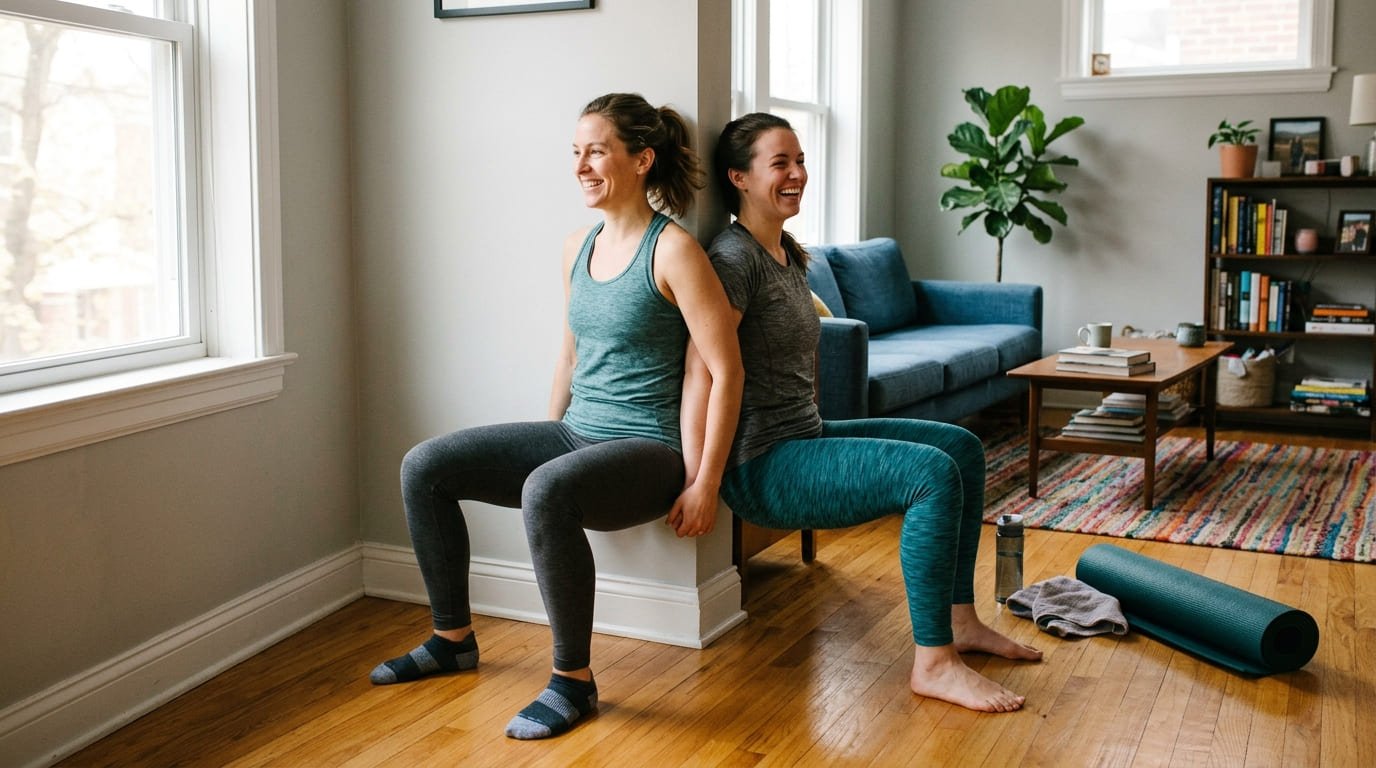
1. Back-to-back wall sit
Stand back to back, press against each other and walk your feet forward until you are both in a squat position, thighs roughly parallel to the floor. Hold. The pressure between your backs is what supports you.
- Time: 3 holds of 30 to 60 seconds
- Matched weight needed: helpful but not essential
- Tip: talk to each other about when to come out, so you stand up together
2. Partner-assisted pistol squat
Face each other, hold hands or wrists, and both lower into a single-leg squat at the same time, using the shared grip for balance. This makes a very hard exercise accessible to beginners.
- Reps: 3 sets of 5 to 8 each leg
- Matched weight needed: no, since you are balancing rather than lifting
3. Hand-hold squat
Face each other, hold both hands, lean back slightly so you are counterbalancing, and squat at the same time. The counterbalance lets both of you sit deeper than you could alone.
- Reps: 3 sets of 12 to 15
- Matched weight needed: yes, roughly
4. Partner hamstring curl
Kneel on a mat while your partner holds your ankles firmly. Keeping your body straight from knees to head, lower yourself forward under control as slowly as possible, catching yourself with your hands. This is one of the hardest hamstring exercises there is.
- Reps: 3 sets of 3 to 6
- Matched weight needed: no, the holder just needs a stable position
- Warning: this causes serious soreness the first few times. Start with 3 reps
5. Partner lunge pass
Stand a couple of metres apart facing each other. Both lunge forward, and at the bottom of the lunge pass a ball or a water bottle between you. Alternate legs.
- Reps: 3 sets of 10 each leg
Upper body
6. Resisted push-up
One partner performs a push-up while the other applies light downward pressure between their shoulder blades. The pressure should be gentle and consistent, never sudden.
- Reps: 3 sets of 6 to 12
- Matched weight needed: no, the resistance is adjustable by hand
- Key point: the person pushing should ease off immediately if form breaks down
7. High-five push-up
Face each other in a push-up position, roughly an arm’s length apart. Both lower into a push-up, and at the top reach across to high-five with alternating hands.
- Reps: 3 sets of 8 to 16 total
- Scaling: the weaker partner does theirs from the knees or with hands on a step
8. Manual resistance row
One partner holds a towel at both ends and pulls, while the other holds the middle and resists. The resistance is completely adjustable, which makes this the single best solution to strength mismatch in the whole list.
- Reps: 3 sets of 10 to 12 each
- Matched weight needed: no
9. Partner-assisted chin-up
If you have a bar, one partner holds the other’s feet or hips to remove some body weight. It is the most effective way for a beginner to build toward their first unassisted chin-up.
- Reps: 3 sets of 4 to 8
10. Wheelbarrow walk
One partner walks on their hands while the other holds their ankles. Excellent for the shoulders and core.
- Distance: 3 walks of 10 to 15 metres, then swap
- Matched weight needed: yes, this is the exercise where mismatch causes problems
- Safety: the holder should hold at the ankles rather than the feet, keep the hips level and walk at the other person’s pace, not their own
Core
11. Plank high-five
Face each other in a forearm plank and alternate high-fives. Lifting one hand forces the core to resist rotation, which is exactly what it is for.
- Time: 3 sets of 30 to 45 seconds
12. Partner leg throwdown
One partner lies on their back holding the other’s ankles. The standing partner pushes their legs down, and the lying partner resists and controls the legs back up without letting them touch the floor.
- Reps: 3 sets of 10 to 15
- Safety: push down to the centre, not to the side, and never push hard enough to slam the legs onto the floor
13. Back-to-back seated twist
Sit back to back with knees bent, and pass a ball around your bodies in one direction, then the other. The rotation trains the obliques and the shared pace keeps both of you honest.
- Reps: 3 sets of 10 passes each direction
14. Partner sit-up with a pass
Lie down facing each other with the soles of your feet touching, knees bent. Sit up at the same time and pass a ball at the top.
- Reps: 3 sets of 12 to 20
Conditioning
15. Medicine ball chest pass
Stand three metres apart and throw a medicine ball back and forth explosively from the chest. Bend your knees on the catch and drive back out.
- Reps: 3 sets of 15 passes
- Tip: start closer together than feels necessary, then step back as you warm up
If you want more options with this equipment, our medicine ball workout guide covers throws, slams and carries in more detail.
16. Rotational ball throw
Stand side on, a couple of metres apart. Rotate through the hips and throw the ball to your partner, who catches and rotates back. This trains the rotational power that almost no home workout touches.
- Reps: 3 sets of 10 each side
Routine 1: the 20-minute bodyweight session
No equipment at all. Three rounds, and you alternate so one person’s work is the other’s rest where the exercise allows it.
| Exercise | Work | Rest | Notes |
|---|---|---|---|
| Hand-hold squat | 40 sec | 20 sec | Both work at the same time |
| High-five push-up | 40 sec | 20 sec | Scale by hand height |
| Back-to-back wall sit | 45 sec | 20 sec | Both at the same time |
| Plank high-five | 40 sec | 20 sec | Both at the same time |
| Partner leg throwdown | 40 sec each | Swap | One works, one resists |
| Partner-assisted pistol squat | 40 sec | 20 sec | Both at the same time |
Rest 90 seconds between rounds. Time-based intervals are deliberate here, because they solve the mismatch problem automatically. Each of you does as many reps as you can in 40 seconds.
Routine 2: the 30-minute strength session
This is the one to use if you both want to get stronger rather than just sweat. Alternate sets: one person works while the other rests, which means no wasted time.
| Exercise | Sets | Reps | Format |
|---|---|---|---|
| Manual resistance row | 4 | 10 to 12 | Alternate, one resists |
| Resisted push-up | 4 | 6 to 12 | Alternate, one applies pressure |
| Partner hamstring curl | 3 | 3 to 6 | Alternate, one holds |
| Partner-assisted chin-up | 3 | 4 to 8 | Alternate, one assists |
| Back-to-back wall sit | 3 | 45 to 60 sec | Together |
| Partner leg throwdown | 3 | 12 to 15 | Alternate |
The manual resistance exercises are the centrepiece of this session and they deserve a specific instruction: the person providing resistance should aim for a load where their partner completes the set with two reps left in them, and should ease off the moment technique starts to break. Done well, this is genuinely comparable to working with adjustable weights.
Routine 3: the 15-minute game session
For days when neither of you wants a structured workout. Competitive, short, and it works.
- Rock paper scissors plank: best of seven. The loser of each round holds a plank for 20 seconds while the winner rests
- Rep ladder: alternate sets of squats, going 1, 2, 3, 4 and upwards. First person to fail a round loses
- Ball pass countdown: 30 chest passes, then 25 rotational throws, then 20 sit-up passes, as fast as you can manage together
- Wall sit standoff: both hold a back-to-back wall sit. Last one up wins
- Leapfrog lengths: alternate vaulting over a crouching partner for two minutes
Keep the competitive element on the exercises where losing form is not dangerous. Racing on squats and planks is fine. Racing on anything where you are supporting another person’s weight is not.
Safety: the part that matters in partner training
Partner exercises carry risks that solo exercises do not, because another person’s judgement is now part of your safety.
- Agree on a stop word before you start. A single clear word that means release immediately, no discussion. This matters most on assisted and supported movements
- The person providing resistance is responsible for the other person’s form. If their back rounds or a knee collapses, ease off rather than pushing through
- Never apply resistance suddenly. Load should be smooth and constant. Jerking is what causes strains
- Match body weight on supported exercises. Wheelbarrow walks, leapfrog and partner carries need roughly similar body weights
- Hold at joints, not extremities. Ankles rather than feet, hips rather than the waistband
- Keep the floor clear and give yourselves more space than you think you need
- Communicate through every rep of anything assisted. Counting out loud together is the simplest way to stay coordinated
How often should you train together?
| Your situation | Partner sessions per week | How to structure it |
|---|---|---|
| This is your only training | 3 | Routine 1 and Routine 2 alternating, plus a game session |
| You both train separately too | 1 to 2 | Use Routine 2 as an upper body day, or Routine 3 as a fun extra |
| Very different fitness levels | 2 | Time-based formats only, from Routine 1 |
| You are just starting out | 2 | Routine 1, building from two rounds to three |
| One of you is returning from a break | 2 | Routine 1, with the returning partner scaling every exercise |
Leave at least 48 hours between hard sessions, particularly if you include partner hamstring curls. That exercise produces some of the worst delayed soreness of any bodyweight movement, and it catches people out.
How to progress over 8 weeks
None of the competing articles explain how to make partner training harder over time, which means most people do the same session indefinitely. Here is the plan.
| Weeks | Routine 1 intervals | Routine 2 strength work |
|---|---|---|
| Weeks 1 to 2 | 2 rounds, 30 sec work and 30 sec rest | 3 sets, easier variations |
| Weeks 3 to 4 | 3 rounds, 35 sec work and 25 sec rest | 3 sets, more manual resistance |
| Weeks 5 to 6 | 3 rounds, 40 sec work and 20 sec rest | 4 sets, harder push-up variations |
| Weeks 7 to 8 | 4 rounds, 40 sec work and 20 sec rest | 4 sets, slower tempo and pauses |
The two levers that matter most are the work-to-rest ratio in the circuits and the amount of manual resistance in the strength work. Both are free, and both can be adjusted independently for each of you.
Seven common partner workout mistakes
- Assuming you need to match each other. Time-based work and adjustable manual resistance solve this completely
- Letting competition override form. Racing is fine on squats, not on anything involving support or resistance
- Applying resistance too aggressively. If your partner’s technique changes, you are pushing too hard
- Skipping the warm-up before exercises that involve catching and supporting
- Doing only fun exercises. Wheelbarrow races and leapfrog are enjoyable but they are not a training programme. Include the manual resistance work
- Never progressing. The same circuit for six months stops producing results around week five
- Not agreeing on the plan first. Decide the routine, the rounds and the stop word before you start, not halfway through
If you are training as a couple
A few things specific to training with a partner you live with, which is the most common version of this.
- Agree on shared goals rather than assuming them. One of you wanting to build strength and the other wanting to lose weight is fine, but only if you have said it out loud
- Do not coach unless you have been asked to. Unsolicited form corrections land differently from a partner than from a trainer
- Keep a fixed time. Couples who train at a set time stick with it far more often than couples who train when they both happen to be free
- Let each of you have separate training too. Partner sessions do not have to be your only workouts, and it removes pressure if one of you cannot make a session
- Accept that progress will differ. Different starting points, body sizes and recovery rates mean different rates of change. That is normal and not a sign anything is wrong
If one of you is completely new to exercise, it is worth running through our home workouts for beginners guide first so that the fundamentals are in place before you add another person to the equation.
The bottom line
Partner workouts work because of accountability first and exercise selection second. The exercises are genuinely useful, particularly manual resistance rows, resisted push-ups and partner hamstring curls, which have no good solo equivalent without equipment.
Use time-based intervals rather than rep counts if you are at different fitness levels, because that single change removes the main reason partner training falls apart. Agree on a stop word. Warm up before anything where you are supporting each other. Then progress the work-to-rest ratio every couple of weeks, and treat the game sessions as the reward rather than the programme.
Frequently asked questions
What are the best partner workouts for beginners?
Start with time-based bodyweight exercises: hand-hold squats, back-to-back wall sits, plank high-fives and high-five push-ups scaled to each person’s ability. These need no equipment, are hard to perform dangerously, and work at any strength level because each person completes their own number of reps within a shared time window.
How do you work out with a partner who is much stronger than you?
Use time-based intervals rather than matching rep counts, so you each do what you can in 40 seconds. Use different versions of the same exercise, such as incline push-ups against full push-ups. For strength work, manual resistance exercises like towel rows let the stronger partner apply exactly the load the other person needs.
How often should couples work out together?
Two to three sessions a week works well for most couples, leaving at least 48 hours between hard sessions. Keeping the sessions at a fixed time improves consistency considerably. It also helps if you each train separately as well, since it removes the pressure when one of you cannot make a session.
Do partner workouts actually build muscle?
Yes, particularly manual resistance exercises, partner hamstring curls and assisted chin-ups, all of which load the muscles heavily. The limitation is that partner resistance is harder to measure than a dumbbell, so you need to progress deliberately through tempo, pauses and work-to-rest ratios rather than assuming the sessions get harder on their own.
What equipment do you need for a two-person workout?
None for most of it. A medicine ball adds throws and passes, a resistance band adds pulling variations, and a pull-up bar allows assisted chin-ups. A towel is enough for manual resistance rows, which are arguably the most valuable partner exercise there is.
Are partner workouts safe?
They are safe with a few specific precautions. Agree on a stop word before you start, apply resistance smoothly rather than suddenly, hold at joints rather than extremities, and only do supported exercises like wheelbarrow walks if your body weights are reasonably similar. The person providing resistance is responsible for watching the other person’s form.
How long should a partner workout be?
Between 15 and 35 minutes. An alternating format is naturally time-efficient because your partner’s set is your rest period, so a 30-minute partner session often contains as much work as a 45-minute solo one. The game-based sessions work well at 15 minutes.
What is the hardest partner exercise?
The partner hamstring curl, also called the Nordic curl, where one person holds your ankles while you lower yourself forward under control. Most beginners manage only three reps, and it produces some of the most intense delayed soreness of any bodyweight exercise. Start with three reps and build slowly.