Shoulder and Bicep Workout: 3 Routines and Why It Works
Shoulders and biceps is one of the cleaner ways to pair muscle groups, and the reason is simple: they barely interfere with each other. Pressing overhead uses your deltoids and triceps. Curling uses your biceps and forearms. Neither one leaves the other pre-fatigued, so you can train both properly in the same session rather than watching the second one suffer.
That is more than can be said for some popular pairings. Chest and triceps, or back and biceps, both involve the smaller muscle assisting the larger one, which means the small muscle is already tired before you get to it. Shoulders and biceps avoids that problem almost entirely.
This guide covers the anatomy that decides exercise selection, three complete routines for different equipment, the correct exercise order, and the parts most articles on this topic skip: a rotator cuff warm-up, an eight-week progression plan, weekly volume numbers, and what to do if your shoulder hurts.
At a glance
- Shoulders and biceps pair well because neither fatigues the other
- Your shoulder has three heads, and the side delt is the one most people undertrain
- Train the pairing 2 times a week, with 12 to 18 shoulder sets and 10 to 16 bicep sets weekly
- Press first, then side delts, then rear delts, then biceps
- Lateral raises need light weight and strict form, not heavy weight and momentum
- A 4-minute rotator cuff warm-up meaningfully reduces shoulder irritation
Why shoulders and biceps work together
| Pairing | Does the smaller muscle assist the larger one? | Result |
|---|---|---|
| Shoulders and biceps | No | Both can be trained hard in one session |
| Chest and triceps | Yes, triceps assist every press | Triceps are pre-fatigued |
| Back and biceps | Yes, biceps assist every row and pull | Biceps are pre-fatigued |
| Shoulders and triceps | Yes, triceps assist overhead pressing | Triceps are pre-fatigued |
There are three practical advantages beyond the lack of interference.
- Both are relatively small muscle groups, so a complete session takes 35 to 45 minutes rather than an hour
- The equipment overlaps. A pair of dumbbells covers almost every exercise in this article
- It fits neatly into a weekly split. Shoulders and biceps as one upper body day, chest and back as another, legs as a third
One honest caveat: the biceps do get some indirect work from rows and pulls if you also train back during the week, so count that volume rather than ignoring it. Sixteen dedicated bicep sets on top of a heavy back day is usually more than you need.
The anatomy that decides your exercise selection
The shoulder
The deltoid has three heads, and they need different exercises. This is the single most useful thing to understand about shoulder training.
| Head | Where it sits | What it does | Best trained by |
|---|---|---|---|
| Anterior (front) delt | Front of the shoulder | Raises the arm forward | Overhead press, front raise |
| Lateral (side) delt | Outside of the shoulder | Raises the arm out to the side | Lateral raise, upright row |
| Posterior (rear) delt | Back of the shoulder | Pulls the arm backwards | Reverse fly, face pull, rear delt row |
Two points worth being blunt about.
The front delt is almost always overtrained, because it works during every pressing movement, including bench press and push-ups. Most people do not need much dedicated front raise work.
The side and rear delts are almost always undertrained, and they are the two that actually change how your shoulders look. Side delts create width. Rear delts create the rounded look from behind and help balance out all the pressing you do. If your shoulder training is mostly overhead pressing, this is what is missing.
The biceps
| Muscle | Where it sits | What it does | Best trained by |
|---|---|---|---|
| Biceps brachii, long head | Outer upper arm, crosses the shoulder | Flexes the elbow, assists in raising the arm | Incline curl, behind-the-body curl |
| Biceps brachii, short head | Inner upper arm | Flexes the elbow, turns the palm up | Preacher curl, concentration curl |
| Brachialis | Underneath the biceps | Flexes the elbow regardless of grip | Hammer curl, reverse curl |
| Brachioradialis | Top of the forearm | Flexes the elbow in a neutral grip | Hammer curl, reverse curl |
The brachialis is the one worth paying attention to. It sits under the biceps, and developing it pushes the biceps up, making the arm look thicker from the side. Hammer curls and reverse curls are the exercises that get it, and they are frequently left out of bicep routines.
A 4-minute shoulder warm-up
The shoulder is the most mobile joint in the body, which is another way of saying it is the least inherently stable. Overhead pressing on a cold shoulder is one of the more reliable ways to develop a nagging ache. None of the shoulder and bicep articles I read included a proper warm-up.
- Arm circles: 20 seconds forwards, 20 seconds backwards
- Band or towel pull-aparts: 15 reps, squeezing the shoulder blades
- Shoulder dislocates with a towel or light band: 10 slow reps
- External rotations with a light band, elbow tucked at your side: 12 each arm
- Scapular push-ups: 10 reps, arms straight, moving only the shoulder blades
- Wall slides: 10 reps, back and arms against a wall, sliding the arms overhead
- One light set of overhead press, roughly half your working weight
The external rotations are the one people skip and the one that matters most. They target the rotator cuff muscles directly, which are the small stabilisers that keep the shoulder joint tracking correctly under load.
Exercise order: press, side, rear, then biceps
Order matters more in this session than in most, and it follows a clear logic.
- Overhead press first. It is the heaviest, most technical movement and needs you fresh
- Side delts second. Lateral raises need control, not maximum strength, so they come after the press but before you are fully fatigued
- Rear delts third. Small muscle, light weight, high reps, so fatigue matters least
- Biceps last. Curling does not interfere with anything that came before it, and your grip is still fresh enough to hold the dumbbells properly
The one mistake to avoid is curling first. It feels good and the pump is immediate, but your grip and elbow flexors then have to stabilise heavy dumbbells overhead while already tired, which makes the press both harder and less safe.
Routine 1: dumbbells at home
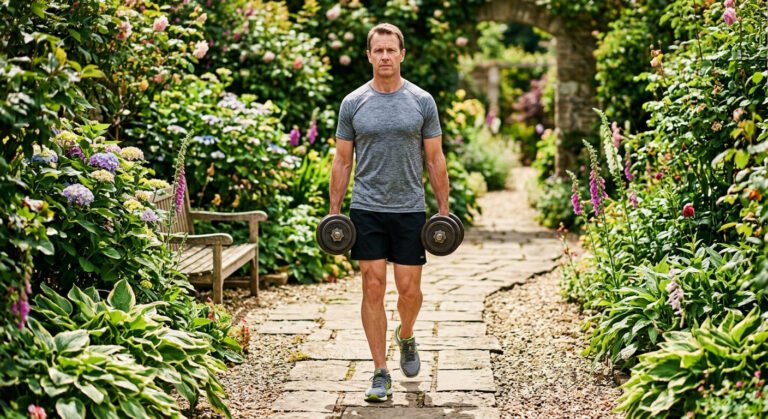
You need one pair of dumbbells, ideally two pairs if you have them, since lateral raises need much lighter weight than pressing. Roughly 40 minutes.
| Exercise | Sets | Reps | Rest |
|---|---|---|---|
| Standing dumbbell overhead press | 4 | 8 to 12 | 90 sec |
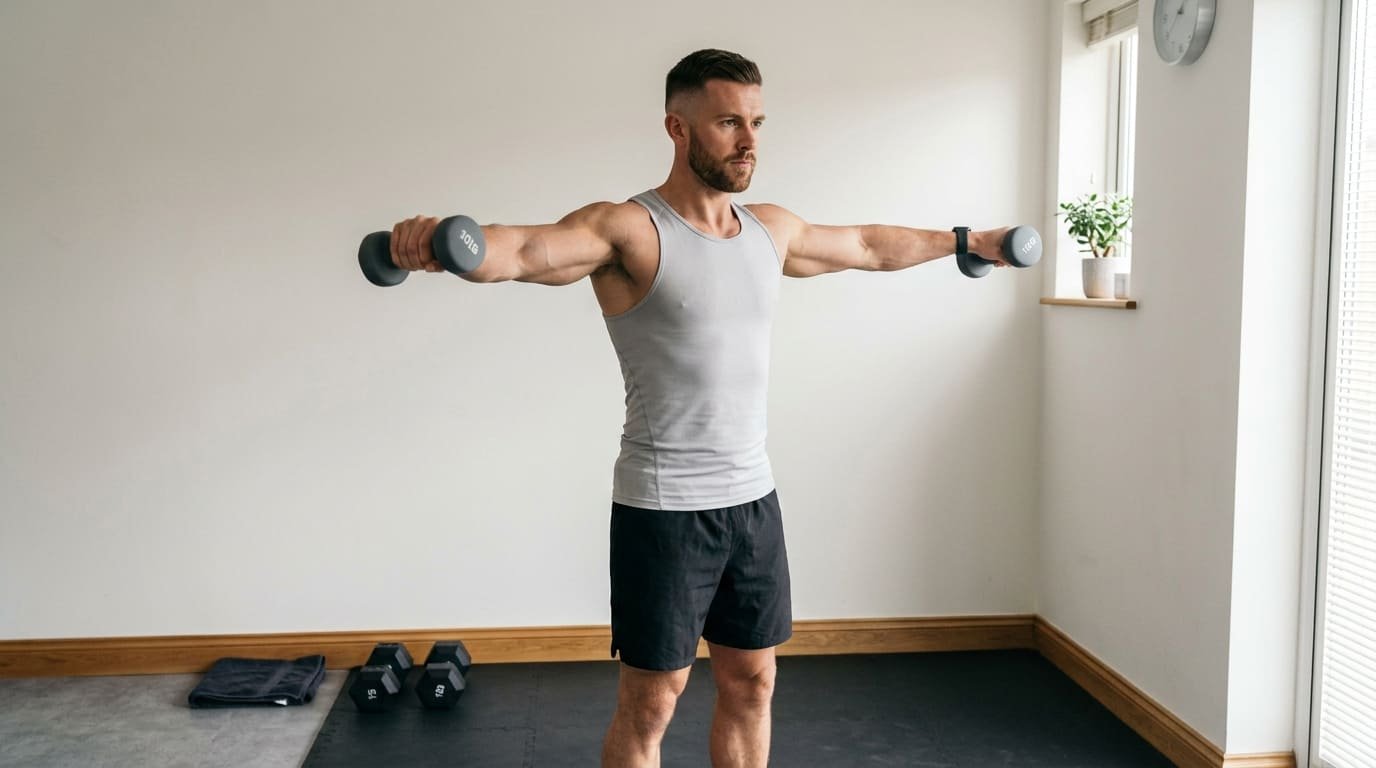
| Dumbbell lateral raise | 4 | 12 to 20 | 60 sec |
| Bent-over reverse fly | 3 | 15 to 20 | 45 sec |
| Dumbbell curl | 3 | 10 to 12 | 60 sec |
| Hammer curl | 3 | 10 to 12 | 60 sec |
| Incline curl, chest on a sofa arm or bench | 2 | 12 to 15 | 45 sec |
If you only have one pair of dumbbells, and they are too heavy for lateral raises, do the lateral raises as a slow tempo set: four seconds up, four seconds down, for 8 reps. That produces enough tension without needing a lighter weight.
For more variations in this format, see our shoulder workout with dumbbells guide.
Routine 2: full gym
Cables change what is possible for side and rear delts, because they keep tension at the bottom of the movement where dumbbells go slack.
| Exercise | Sets | Reps | Rest |
|---|---|---|---|
| Barbell or dumbbell overhead press | 4 | 6 to 10 | 2 to 3 min |
| Cable lateral raise, one arm | 3 | 12 to 15 each | 60 sec |
| Machine or dumbbell lateral raise | 3 | 15 to 20 | 60 sec |
| Cable face pull | 3 | 15 to 20 | 45 sec |
| Barbell or EZ-bar curl | 3 | 8 to 12 | 75 sec |
| Incline dumbbell curl | 3 | 10 to 12 | 60 sec |
| Cable hammer curl or rope curl | 3 | 12 to 15 | 45 sec |
Note the two-to-three minute rest on the overhead press. That is deliberate. Pressing is a strength movement, and cutting rest to 60 seconds means your third and fourth sets happen at a noticeably lower weight.
Routine 3: no equipment
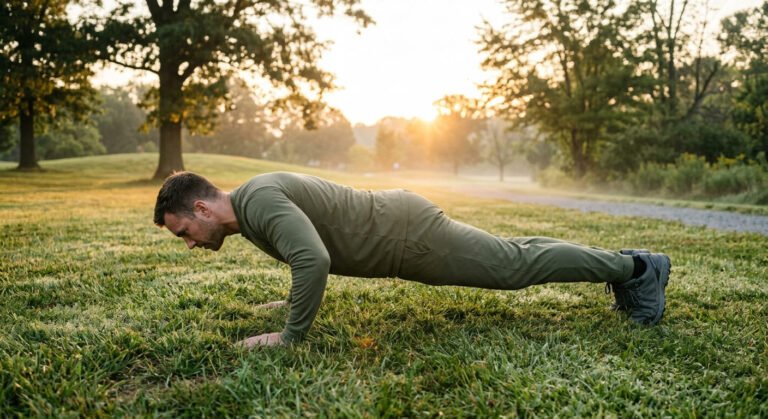
Shoulders respond reasonably well to bodyweight work. Biceps are genuinely harder without equipment, since nothing loads elbow flexion well without something to pull against. A towel and a door frame solve most of it.
| Exercise | Sets | Reps or time | Rest |
|---|---|---|---|
| Pike push-up | 4 | 6 to 12 | 75 sec |
| Wall walk or wall handstand hold | 3 | 20 to 40 sec | 60 sec |
| Prone Y raise on the floor | 3 | 15 to 20 | 45 sec |
| Prone T raise on the floor | 3 | 15 to 20 | 45 sec |
| Towel curl, self-resisted | 3 | 12 to 15 each arm | 45 sec |
| Door frame isometric curl | 3 | 20 sec each arm | 45 sec |
| Inverted row under a table, underhand grip | 3 | 8 to 12 | 60 sec |
The inverted row with an underhand grip is the best bodyweight bicep exercise available, because the biceps work hard as the elbow flexes under real body weight load. Our bicep workout without weights guide has more options in this category.
Lateral raises: the exercise most people do wrong
This deserves its own section, because side delts are the main determinant of shoulder width and lateral raises are the main exercise for them.
- Go lighter than you think. The side delt is small. If you need to swing the weight up, it is too heavy, and most of the work has shifted to your traps
- Lead with the elbows, not the hands. Think about lifting your elbows out to the side
- Stop at shoulder height. Above that, the traps take over
- Keep a slight forward lean of five to ten degrees, which puts the side delt in a better line of pull
- Control the lowering phase. Two to three seconds down. This is where much of the growth stimulus sits
- Higher reps work better here. Twelve to twenty is more productive than six to eight
A good test: if you can feel the exercise in the top of your shoulders and neck rather than the outside of your shoulders, the weight is too heavy or you are lifting too high. Our full lateral raises guide covers the form details.
Sets, reps and weekly volume
| Goal | Shoulder sets per week | Shoulder reps | Bicep sets per week | Bicep reps |
|---|---|---|---|---|
| Build strength | 10 to 14 | 5 to 8 on presses | 8 to 12 | 6 to 10 |
| Build muscle size | 14 to 18 | 8 to 20 depending on head | 12 to 16 | 8 to 15 |
| General fitness | 8 to 12 | 10 to 15 | 6 to 10 | 10 to 15 |
How to distribute the shoulder volume, which matters more than the total:
- Front delts: 0 to 4 dedicated sets. They already get worked by all your pressing
- Side delts: 6 to 10 sets. This is where most of your dedicated shoulder volume should go
- Rear delts: 4 to 8 sets. Light weight, high reps, and more often than you think
For biceps, remember to count the indirect work. If you do a heavy back day with rows and pull-ups, that is several effective bicep sets already. Twelve dedicated sets on top of that is usually plenty.
How often to train shoulders and biceps
| Your training week | Shoulder and bicep sessions | Structure |
|---|---|---|
| 2 sessions a week total | Both sessions | Full body, with shoulders and biceps included in each |
| 3 sessions a week | 2 | Upper A, lower, upper B |
| 4 sessions a week | 2 | Shoulders and biceps, legs, chest and back, legs |
| 5 or more | 2 to 3 | Push, pull, legs, with extra side delt work added |
| Shoulders are a priority | 2 full sessions plus 1 short | Add 4 to 6 sets of lateral raises on another day |
Side delts recover quickly and tolerate high frequency well, which is why adding a few sets of lateral raises on an otherwise unrelated day is one of the more reliable ways to make progress if shoulder width is your goal.
Leave at least 48 hours between heavy overhead pressing sessions. Biceps recover faster and can handle a third exposure, particularly through indirect work on a back day. If you would rather pair biceps with pulling instead, our back and biceps workout covers that structure.
An 8-week progression plan
Use double progression: add reps until you reach the top of the range, then add weight and start again at the bottom.
| Weeks | Overhead press | Lateral raises | Rear delts | Curls |
|---|---|---|---|---|
| Weeks 1 to 2 | 3 sets of 8, moderate | 3 sets of 12, light | 3 sets of 15 | 3 sets of 10 |
| Weeks 3 to 4 | 3 sets of 10 to 12 | 3 sets of 15 to 18 | 3 sets of 20 | 3 sets of 12 |
| Weeks 5 to 6 | Add weight, 4 sets of 8 | Add weight, 4 sets of 12 | 3 sets of 20 with a 1-sec hold | Add weight, 3 sets of 10 |
| Weeks 7 to 8 | 4 sets of 10 to 12 | 4 sets of 15, 3-sec lowering | 4 sets of 20 | 4 sets of 12, 2-sec squeeze |
Write it down. Shoulder and bicep progress happens in very small increments, often 1 kilogram at a time on lateral raises, and without a log you will not know whether you have actually moved.
Eight mistakes that stall progress
- Too much front delt work. Front raises on top of overhead pressing, bench pressing and push-ups is usually redundant volume
- Neglecting rear delts entirely. They are the most commonly skipped part of the shoulder and they balance out all your pressing
- Going too heavy on lateral raises. Momentum and shrugging mean your traps are doing the work
- Swinging the curls. If your torso rocks backwards, the weight is too heavy and your lower back is taking load it should not
- Only doing supinated curls. Palms-up curls miss the brachialis. Include hammer or reverse curls
- Curling before pressing. Your elbow flexors and grip need to be fresh to stabilise a press overhead
- Skipping the rotator cuff warm-up. This is the cheapest insurance in the whole session
- Training through shoulder pain. Muscle soreness is fine. Joint pain during the movement is a signal to change something
If your shoulder hurts
Shoulder discomfort is common with overhead pressing, and it usually responds to a few specific changes before it needs anything more.
- Switch from barbell to dumbbells. Dumbbells let your shoulders find their natural path rather than locking them into a fixed one
- Try a neutral grip, palms facing each other, which many people find far more comfortable overhead
- Reduce the range. Stop the press slightly short of full lockout, and do not lower the weight below chin height
- Add rear delt and rotator cuff volume. Pressing-dominant training pulls the shoulder forward over time, and strengthening the back of the shoulder often settles the front
- Check your setup. Ribs down rather than lower back arched, and elbows slightly in front of the body rather than flared straight out to the sides
- Swap overhead pressing for landmine or incline pressing temporarily if overhead is the only position that hurts
Sharp pain, pain that wakes you at night, clicking with pain, or weakness and loss of range deserves an assessment from a physiotherapist or doctor rather than a guess from an article.
The bottom line
Shoulders and biceps is a genuinely efficient pairing because neither muscle group pre-fatigues the other, and one pair of dumbbells covers almost the whole session.
Press first, then side delts, then rear delts, then biceps. Put most of your dedicated shoulder volume into side and rear delts rather than front raises, because that is what changes how your shoulders look and what balances out all your pressing. Go light on lateral raises and control them. Include one neutral-grip curl for the brachialis. Warm the rotator cuff up first, every time. Then add a rep or a kilogram every couple of weeks and write it down.
Frequently asked questions
Is it good to train shoulders and biceps together?
Yes. Neither muscle group assists the other, so unlike chest and triceps or back and biceps, the smaller muscle is not already fatigued when you get to it. Both are relatively small muscle groups, so a complete session takes 35 to 45 minutes and needs little more than a pair of dumbbells.
Should I do shoulders or biceps first?
Shoulders first, specifically overhead pressing. It is the heaviest and most technically demanding movement, so it needs you fresh. Curling first tires your grip and elbow flexors, which then have to stabilise dumbbells overhead, making the press both harder and less safe.
How many sets of shoulders and biceps per week?
For muscle growth, 14 to 18 shoulder sets and 12 to 16 bicep sets per week, split across two sessions. Distribute the shoulder volume carefully: roughly 6 to 10 sets for side delts, 4 to 8 for rear delts and 0 to 4 for front delts, since front delts already work during all your pressing.
Why are my side delts not growing?
Usually because lateral raises are too heavy. If you swing the weight or shrug your shoulders, your traps take over and the side delt does little. Use a much lighter weight, lead with the elbows, stop at shoulder height, control the lowering for two to three seconds, and work in the 12 to 20 rep range.
Can you do a shoulder and bicep workout at home?
Yes, and one pair of dumbbells covers most of it: overhead press, lateral raise, reverse fly, standard curl and hammer curl. Without any equipment, pike push-ups and prone Y and T raises train the shoulders well, while underhand inverted rows under a sturdy table are the best bodyweight bicep option.
How often should I train shoulders and biceps?
Twice a week for most people, leaving at least 48 hours between heavy overhead pressing sessions. Side delts recover quickly and tolerate a third weekly exposure, so adding four to six sets of lateral raises on another day is an effective way to build shoulder width without adding a full session.
What is the best bicep exercise for thickness?
Hammer curls and reverse curls, because they train the brachialis, the muscle sitting underneath the biceps. Developing the brachialis pushes the biceps up and makes the arm look thicker from the side. Most bicep routines use only palms-up curls and miss it entirely.
Does overhead pressing work the biceps?
Barely. Overhead pressing is driven by the front delts and triceps, with the biceps acting only as a minor stabiliser. That is exactly why this pairing works: you can press hard and then curl hard in the same session, because the pressing left your biceps essentially fresh.