Farmer’s Carry: How to Do It, Benefits and a Beginner Workout
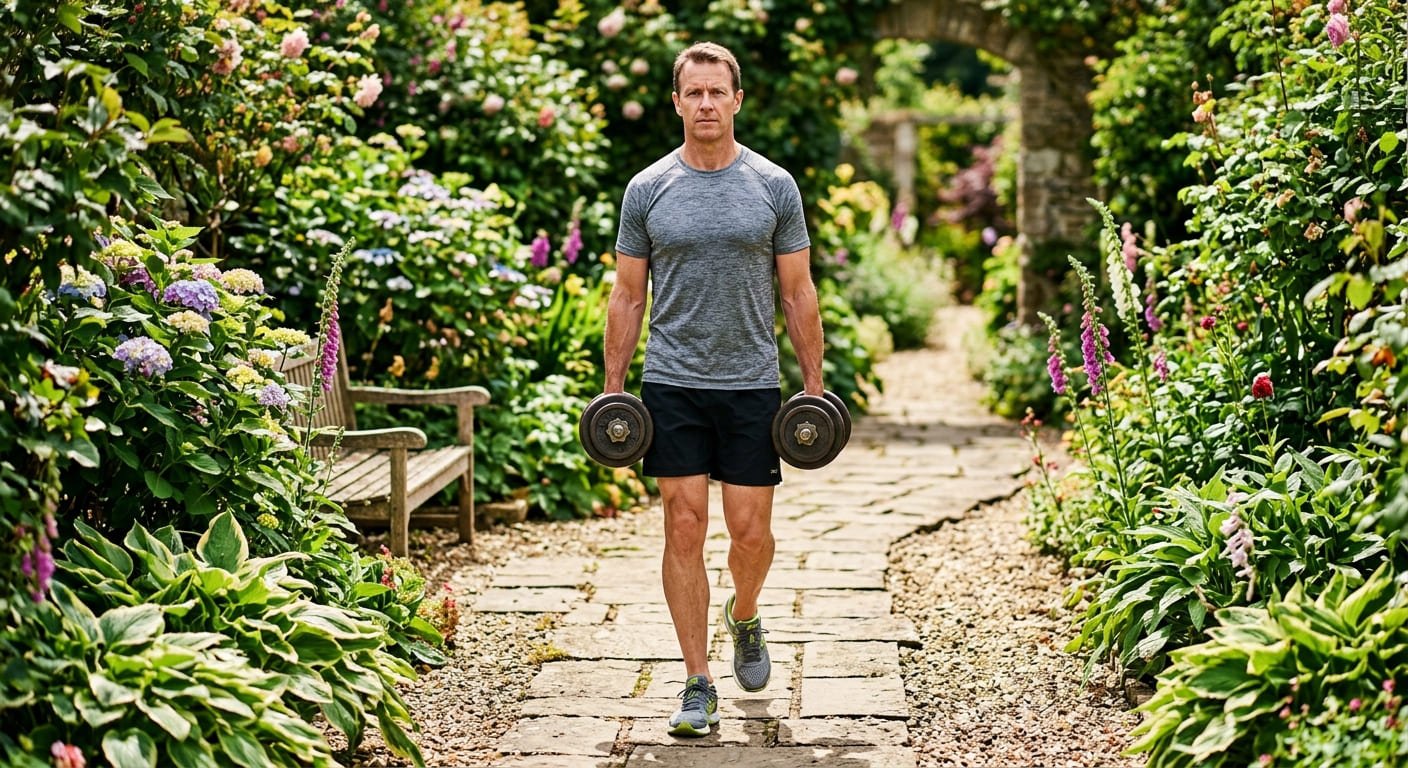
A farmer’s carry is exactly what it sounds like: you pick up a heavy weight in each hand, stand tall, and walk. It strengthens your grip, shoulders, upper back, core and legs all at once, and it trains the kind of strength you use every time you carry shopping bags, luggage or a toddler. For beginners, a pair of dumbbells and a hallway or garden is all you need.
It’s honestly one of the most underrated exercises I know. For a long time I thought it looked too simple to be useful. Then I tried carrying a pair of heavy dumbbells up and down my garden for 30 seconds and discovered muscles in my forearms, shoulders and stomach I didn’t know I had. It’s also the exercise that made carrying the weekly food shop from the car feel noticeably easier within a month, which is the sort of result I actually care about.
This guide covers how to do a farmer’s carry properly, what muscles it works, how heavy and how far to go, variations, a beginner workout and the mistakes to avoid.
At a glance
- What it is: walking while holding heavy weights at your sides
- Muscles worked: grip, forearms, traps, upper back, core, glutes and legs
- Equipment: dumbbells, kettlebells or even filled bags
- Beginner distance: 20 to 30 metres, or 20 to 30 seconds
- Beginner sets: 3 to 4
- How often: 2 to 3 times a week
- Key cue: walk tall, shoulders down, don’t lean
What is a farmer’s carry?
The farmer’s carry, also called the farmer’s walk, is a loaded carry exercise. You hold a weight in each hand with your arms by your sides, then walk a set distance or for a set time while keeping your posture tall and steady.
It became popular through strongman competitions, where athletes carry huge weights over a course. But the basic idea is far older than any sport. Carrying heavy things is one of the most natural human movements there is, and training it makes everyday life easier.
The beauty of the exercise is how simple it is to learn. There’s very little technique to master, and yet it challenges a surprising amount of your body.
Farmer’s carry muscles worked
| Muscle group | What it does |
|---|---|
| Forearms and grip | Hold the weights without them slipping |
| Trapezius (upper traps) | Keep your shoulders from being pulled down |
| Upper back and rhomboids | Keep your shoulders back and your chest up |
| Core and obliques | Keep your torso upright and stable with every step |
| Glutes and hips | Stabilise your pelvis while you walk |
| Quads, hamstrings and calves | Carry you forwards under load |
That long list is why the farmer’s carry feels so tiring. Almost every muscle between your fingers and your feet has a job to do.
Benefits of the farmer’s carry
- Grip strength. Stronger hands help with almost every other exercise, from rows to deadlifts, and grip strength is also linked with healthy ageing.
- Core stability. Your core works hard to keep you upright, which carries over to protecting your back in daily life.
- Better posture. Holding weight while standing tall trains your upper back and shoulders.
- Real-world strength. Carrying shopping, luggage, children and moving furniture all get easier.
- Conditioning. Heavy carries raise your heart rate quickly.
- Low skill, low risk. When done with sensible weights, it’s one of the safest strength exercises for beginners.
How to do a farmer’s carry
- Set up. Place a dumbbell or kettlebell on the floor beside each foot.
- Pick them up safely. Bend your hips and knees, keep your back straight, grip the handles firmly and stand up by driving through your legs, the same way you’d deadlift.
- Stand tall. Chest up, shoulders pulled slightly back and down, arms straight by your sides.
- Brace. Tighten your stomach gently, as if you’re about to be poked.
- Walk. Take short, controlled steps at a steady pace. Look straight ahead, not at the floor.
- Turn carefully. If you need to turn around, take small steps rather than twisting suddenly.
- Put them down safely. Stop, bend your hips and knees, and lower the weights to the floor with a straight back.
Breathe steadily throughout. Holding your breath for the whole walk is a common mistake that makes you tire much faster.
Picking the weights up and putting them down is actually the riskiest part of the farmer’s carry, not the walk itself. Treat both like a deadlift: bend your knees and hips, keep your back straight, and never bend over with rounded shoulders to grab heavy weights.
How heavy should you go?
For beginners, start with a weight that feels challenging but lets you walk with perfect posture for the whole distance. As a very rough guide:
| Level | Total weight (both hands combined) | Distance or time |
|---|---|---|
| Complete beginner | Around 25 to 35 percent of body weight | 20 to 30 metres, or 20 to 30 seconds |
| A few weeks in | Around 40 to 60 percent of body weight | 30 to 40 metres, or 30 to 40 seconds |
| Experienced | Around 75 to 100 percent of body weight | 40 metres or more |
| Advanced | Body weight or more | Variable |
So a 70 kg beginner might start with around 10 to 12 kg in each hand. If you don’t own dumbbells that heavy, carry what you have for longer, or use the single-arm suitcase carry, which feels much harder with the same weight.
If you’re choosing dumbbells, adjustable ones are ideal because your carry weight will increase quickly. My guide to the best adjustable dumbbells for home covers what to look for.
Doing farmer’s carries at home
You don’t need a long gym floor. Farmer’s carries work perfectly well at home:
- Hallway laps: walk to the end, turn carefully with small steps, and walk back
- Garden or driveway: great if you have a straight stretch
- Time-based sets: walk in a small circle or back and forth for 30 seconds
- Carry and march: if space is really limited, march on the spot while holding the weights
No dumbbells? Filled shopping bags, a bag of sand in a backpack held by the handles, or large water bottles all work in a pinch. The grip won’t be as comfortable, but the exercise still does its job.
Clear the floor first. You don’t want to trip over a toy or the edge of a rug while holding heavy weights.
Farmer’s carry variations
Suitcase carry (one hand)
Hold a weight in just one hand, like carrying a suitcase. Your core has to work very hard to stop you leaning towards the weight. It’s one of the best core exercises there is, and it uses half the equipment. Carry for the set distance, then switch hands.
Front rack carry
Hold two dumbbells or kettlebells at shoulder height, with your elbows tucked in. This shifts more of the work to your upper back and core, and it’s a great challenge for staying upright.
Overhead carry
Hold one or two lighter weights straight overhead and walk. This trains shoulder stability and core strength. Only try it once you can press the weight overhead comfortably, and use much lighter weights than your regular carry.
Mixed carry
Hold one weight at your side and another at shoulder height or overhead. The uneven load challenges your stability in a different way.
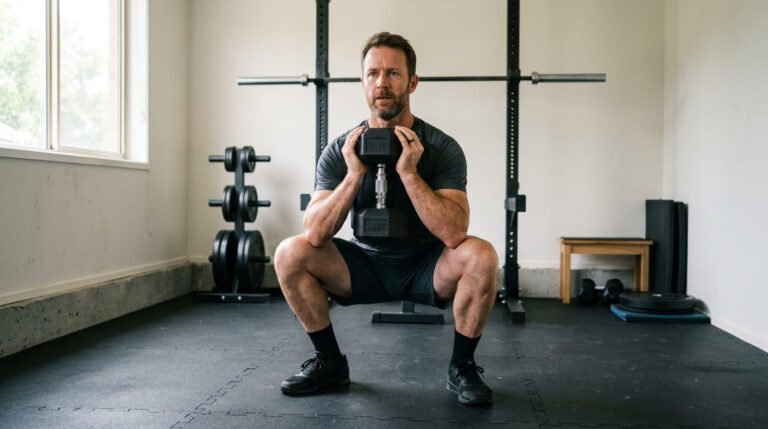
Goblet carry
Hold a single dumbbell or kettlebell vertically at your chest with both hands, then walk. It’s a good beginner variation if your grip gives out before the rest of your body.
| Variation | Main challenge | Difficulty |
|---|---|---|
| Goblet carry | Upper back, core | Easy |
| Farmer’s carry | Grip, traps, whole body | Easy to moderate |
| Suitcase carry | Obliques and core stability | Moderate |
| Front rack carry | Upper back, core, breathing | Moderate |
| Overhead carry | Shoulder stability, core | Moderate to hard |
A beginner farmer’s carry workout
Option 1: Carry finisher (10 minutes)
Add this to the end of any strength workout.
| Exercise | Sets | Distance or time | Rest |
|---|---|---|---|
| Farmer’s carry | 3 | 30 metres or 30 seconds | 60 seconds |
| Suitcase carry | 2 per side | 20 metres or 20 seconds | 60 seconds |
Option 2: Full body dumbbell circuit (25 minutes)
| Exercise | Reps or time |
|---|---|
| Goblet squat | 12 |
| Farmer’s carry | 30 metres or 30 seconds |
| Dumbbell floor press | 10 |
| Suitcase carry | 20 metres per side |
| Bent-over row | 10 |
| Rest | 90 seconds |
Complete 3 rounds. The dumbbell exercises in this circuit are explained in my dumbbell workout plan for beginners.
Option 3: Grip and core session (15 minutes)
| Exercise | Sets | Work | Rest |
|---|---|---|---|
| Farmer’s carry | 3 | 40 seconds | 45 seconds |
| Suitcase carry | 2 per side | 30 seconds | 45 seconds |
| Dead hang or plank | 3 | 20 to 30 seconds | 45 seconds |
| Goblet carry | 2 | 40 seconds | 60 seconds |
How to progress
Progress one variable at a time:
- Increase distance or time, by around 5 to 10 metres or 5 to 10 seconds
- Add sets, up to 4 or 5
- Increase the weight once you can complete all sets with perfect posture
- Try harder variations, like suitcase or front rack carries
- Reduce rest, if you’re using carries for conditioning
Your grip will probably be the first thing to give out. That’s normal, and it improves quickly with regular practice.
Building grip strength for carries
If your grip fails long before your legs or core, these simple habits help:
- Squeeze the handles hard throughout the carry, rather than letting your fingers relax
- Use chalk or a towel to dry your hands if the handles get slippery
- Add dead hangs from a pull-up bar, starting with 10 to 20 seconds
- Do slow, heavy holds: simply stand holding heavy dumbbells for 20 to 30 seconds
- Train carries two or three times a week, as grip adapts quickly
Where the farmer’s carry fits in your training
The farmer’s carry works well in a few different places:
- At the end of a strength workout as a finisher, which is how most people use it
- In circuits for conditioning
- On back and core days, because it trains both hard
- As part of military-style fitness training, which often includes carrying heavy loads. My military calisthenics workout plan pairs well with carries
It’s also considered a compound exercise, because it uses many muscles at once. If you like this style of training, my guide to compound exercises for beginners has more ideas. For the upper back specifically, the rows in my back workout with dumbbells complement carries really well.
Carrying strength in everyday life
The farmer’s carry is one of the few exercises that looks almost exactly like something you do in daily life. That’s a big part of its value.
Think about how often you carry things: shopping bags from the car, luggage through a station, a laundry basket up the stairs, a bag of compost across the garden, a sleepy child to bed. Every one of those tasks asks your grip, shoulders, core and legs to work together while you walk, often with uneven loads.
When you practise carries in a controlled way, those everyday jobs start to feel lighter and more stable. You’re less likely to hunch over, lean awkwardly or strain your back, because your body is used to holding weight while staying upright. It’s not glamorous, but it’s the kind of strength you notice every single week.
Carries as you get older
Carrying exercises become even more valuable with age. Grip strength tends to decline as we get older, and it’s closely linked to how easily people manage daily tasks and stay independent. Balance and core stability also matter more, especially for reducing the risk of falls.
The good news is that carries are easy to adapt:
- Start very light, even with small water bottles or light shopping bags
- Walk near a wall or rail for the first few sessions if balance is a concern
- Use the goblet carry, holding one weight at the chest, if grip or balance is limited
- Take short, steady steps on a clear, even surface
- Rest fully between sets
If you have heart problems, high blood pressure, osteoporosis or balance issues, check with your doctor first. Done sensibly, carries can be one of the most practical strength exercises for staying capable in daily life.
A sample week that includes carries
Here’s how carries can fit into a normal training week without taking over:
| Day | Training | Carries |
|---|---|---|
| Monday | Full body dumbbell workout | 3 sets of farmer’s carries at the end |
| Tuesday | Walk or easy cardio | None |
| Wednesday | Upper body and core | 2 sets per side of suitcase carries |
| Thursday | Rest or mobility | None |
| Friday | Full body dumbbell circuit | Carries built into the circuit |
| Weekend | Active rest | Optional light carries in the garden |
That gives you two or three short carry sessions a week, which is plenty to build grip, core and posture without overloading your back or forearms.
Common farmer’s carry mistakes
- Picking up weights with a rounded back. The most common cause of back strain with this exercise.
- Shrugging your shoulders up towards your ears.
- Leaning to one side, especially with uneven or single-arm carries.
- Looking down at your feet instead of straight ahead.
- Taking huge steps, which makes the weights swing.
- Walking too fast or turning sharply with heavy weights.
- Holding your breath for the whole walk.
- Going too heavy too soon, so your posture collapses.
Safety tips
- Start light and focus on posture before adding weight
- Clear your walking route of trip hazards
- Wear shoes with good grip, not socks on a smooth floor
- Don’t drop heavy weights near your feet
- Stop if you feel sharp pain in your back, shoulders or wrists
- If you have back problems, high blood pressure or heart issues, get medical advice before carrying heavy loads
Why carries are brilliant for your core
Most people think of core training as crunches and planks. Carries train your core in a more practical way, by making it resist bending, leaning and twisting while you move. That’s exactly what your core does when you carry a heavy bag up the stairs or lift a box.
The suitcase carry in particular is one of the best oblique exercises you can do, because your core has to fight constantly to stop you leaning towards the weight. If you want to build on that, my guides to the beginner core workout and oblique exercises both pair well with carries.
Dumbbells or kettlebells for carries?
Both work well, and the right choice is mostly whatever you already own.
| Dumbbells | Kettlebells | |
|---|---|---|
| Grip | Straight handle, easy to hold | Thicker handle, slightly harder on grip |
| Swing while walking | Very little | A little more, since the weight hangs lower |
| Front rack carries | Awkward | Comfortable, rests on the forearm |
| Adjustability | Adjustable sets make progressing easy | Usually need several separate bells |
| Best for beginners | Yes, simple and stable | Yes, especially for front rack variations |
If you’re starting from scratch, a pair of adjustable dumbbells is the more flexible option, because you can use them for carries and almost every other strength exercise too. If you already have kettlebells, they’re brilliant for suitcase and front rack carries.
The bottom line
The farmer’s carry is simple, effective and genuinely useful in everyday life. Pick up a pair of dumbbells, stand tall, brace your core and walk. Start with around 20 to 30 metres or seconds, focus on perfect posture, and gradually increase the distance and weight.
You don’t need a gym, a coach or any special skill to get good at this. A hallway, a pair of dumbbells and a few minutes at the end of a workout are enough. It’s one of those rare exercises that is just as useful for a complete beginner as it is for a competitive strongman, which says a lot about how fundamental carrying really is.
Add it to the end of your strength workouts two or three times a week, try the suitcase carry for an extra core challenge, and within a few weeks you’ll notice stronger hands, a steadier core and daily lifting and carrying tasks that feel far easier.
Carries are only part of the picture for your traps. My trap workout with dumbbells covers the upper, middle and lower traps with eight exercises and two routines.
If you want to build the grip that carries depend on, our guide to a forearm workout at home covers twelve exercises and a six-week progression plan.
Frequently asked questions
What does the farmer’s carry work?
The farmer’s carry works your grip, forearms, trapezius, upper back, core, glutes and legs. It’s a full body exercise that trains strength and stability at the same time.
How heavy should a farmer’s carry be for beginners?
Beginners can start with a total weight of around 25 to 35 percent of their body weight, split between both hands, and walk 20 to 30 metres. Choose a weight that lets you keep perfect posture for the whole distance.
How long should you do farmer’s carries for?
Beginners usually do 3 to 4 sets of 20 to 30 metres, or 20 to 30 seconds per set. As you get stronger, increase the distance to 40 metres or more, or the time to 40 to 60 seconds.
Can I do farmer’s carries at home?
Yes. Use dumbbells, kettlebells or filled bags, and walk up and down a hallway, garden or driveway. If space is limited, walk in a small circle or march on the spot while holding the weights.
Is the farmer’s carry good for your core?
Yes. Your core works hard to keep your torso upright and stable while you walk under load. The single-arm suitcase carry is especially effective for the obliques because it forces your core to resist leaning.
How often should I do farmer’s carries?
Two to three times a week works well for most people, usually at the end of a strength workout or as part of a circuit. Leave at least a day between heavy carry sessions.
What is the difference between a farmer’s carry and a suitcase carry?
A farmer’s carry uses a weight in both hands, while a suitcase carry uses a weight in only one hand. The suitcase carry challenges your core more because your body has to resist leaning towards the weight.
Does the farmer’s carry build muscle?
It can build muscle in your traps, forearms, upper back and core, especially for beginners, and it strengthens your grip. For bigger muscle gains, combine carries with exercises like rows, squats and presses.
Source: NHS, Physical activity guidelines for adults aged 19 to 64