Forearm Workout at Home: 12 Exercises and a 6-Week Plan
Your forearms are the reason your grip gives out before your back does on a row, the reason a heavy shopping bag feels like a challenge, and the reason a jar lid wins sometimes. They are also one of the easiest muscle groups to train at home, because the movements need almost nothing: a pair of dumbbells, a towel, a backpack, or in several cases just your hands and a wall.
I want to be honest about something first. Most forearm guides online hand you a list of wrist curls and stop there. They rarely tell you how heavy to go, how often, how to warm up a joint that is genuinely easy to irritate, or what to do when your wrists start to ache. This guide covers the exercises, but it also covers the parts that actually decide whether you get stronger over the next few months.
At a glance
- Your forearms contain roughly 20 muscles that control your wrist, fingers and forearm rotation
- Train them 2 to 3 times a week, either after your main workout or on their own
- Most forearm work responds best to higher reps, around 12 to 20, plus timed holds
- A 4-minute warm-up before loaded wrist work protects the tendons at your elbow
- Grip strength is a strong, well-studied marker of general health, not just gym performance
- You can build real forearm strength at home with dumbbells, a towel and a backpack
What your forearms actually do
The forearm is not one muscle. It is a dense bundle of around 20 small muscles running from your elbow to your fingers, and they fall into three functional groups. Understanding which group does what makes exercise selection obvious rather than random.
| Muscle group | Where it sits | What it does | Trained by |
|---|---|---|---|
| Flexors | Palm side of the forearm | Curls the wrist, closes the fingers, grips | Wrist curls, dead hangs, carries, towel wringing |
| Extensors | Back of the forearm | Straightens the wrist and fingers, stabilises during gripping | Reverse wrist curls, reverse curls, finger extensions |
| Rotators (supinator, pronator teres) | Deep, running across the forearm | Turns the palm up and down | Pronation and supination work, hammer curls, wrist rotations |
Two more terms are worth knowing, because they explain why different exercises feel so different.
- Crush grip is squeezing something between your fingers and palm, like a handshake or a gripper
- Support grip is holding something for time, like a carry or a dead hang
- Pinch grip is holding something between thumb and fingers, like a plate or a book
- Wrist strength is your ability to resist the wrist bending under load, which is separate from grip
Most people only ever train support grip by accident, through rows and deadlifts. Training all four deliberately is what makes a forearm routine feel worth doing.
Why forearm training is worth your time
There is a reason grip strength keeps appearing in medical research rather than only in gym articles. It is cheap to measure, hard to fake, and it tracks closely with overall muscular strength.
- Better lifts: your grip is the link between you and any weight you hold, so a stronger grip means your rows, carries and pull-ups end when your back is tired, not when your hands fail
- Fewer wrist and elbow niggles: balanced flexor and extensor strength reduces the strain that causes the nagging elbow pain often called tennis or golfer’s elbow
- Daily life gets easier: carrying shopping, opening jars, holding a toddler, moving furniture
- A visible difference: forearms are on show more than almost any other muscle, and they respond well to direct work
- A useful health marker: grip strength is widely used in research as an indicator of general physical function, particularly as people age
Source: Leong et al., Prognostic value of grip strength, The Lancet (2015)
What you need at home
Nothing on this list is essential, which is the point. Start with what you have.
| Equipment | Cost | What it unlocks |
|---|---|---|
| Nothing at all | Free | Finger extensions, wall wrist stretches, isometric holds, plank work |
| A towel | Free | Towel wringing, towel hangs, thick-grip pulling |
| A backpack with books | Free | Loaded carries, wrist curls, reverse curls |
| One or two dumbbells | Low | The full list: wrist curls, reverse curls, hammer curls, carries |
| A pull-up bar | Low | Dead hangs, the single best support grip builder |
| A resistance band | Low | Finger extensions, wrist rotations, pain-free light work |
| Grippers or grip trainers | Low | Crush grip specifically, useful but not necessary |
The honest answer is that a pair of dumbbells and a towel cover about 90 percent of what you need. Everything else is optional refinement.
A 4-minute wrist and forearm warm-up
Not one of the top-ranking forearm guides I read includes a warm-up. That is a strange gap, because wrists and elbows are among the easiest joints to irritate with sudden loading, and the tendons around them take longer to adapt than muscle does.
- Wrist circles: 10 slow circles each direction, hands clasped
- Open and close the fist: 20 fast reps, spreading the fingers wide at the top
- Wall wrist stretch, fingers down: palms on a wall with fingertips pointing at the floor, 20 seconds
- Wall wrist stretch, fingers up: the reverse position, 20 seconds
- Prayer stretch: palms together at the chest, lower the hands until you feel a gentle stretch, 20 seconds
- One light set of your first exercise, at roughly half your working weight
The last step matters more than the rest. Warming the exact movement pattern you are about to load is what stops your first working set from arriving as a shock to a cold tendon.
12 forearm exercises you can do at home
I have grouped these by what they train, so you can build a balanced session rather than doing five versions of the same thing.
Flexor exercises (palm side)
1. Seated dumbbell wrist curl
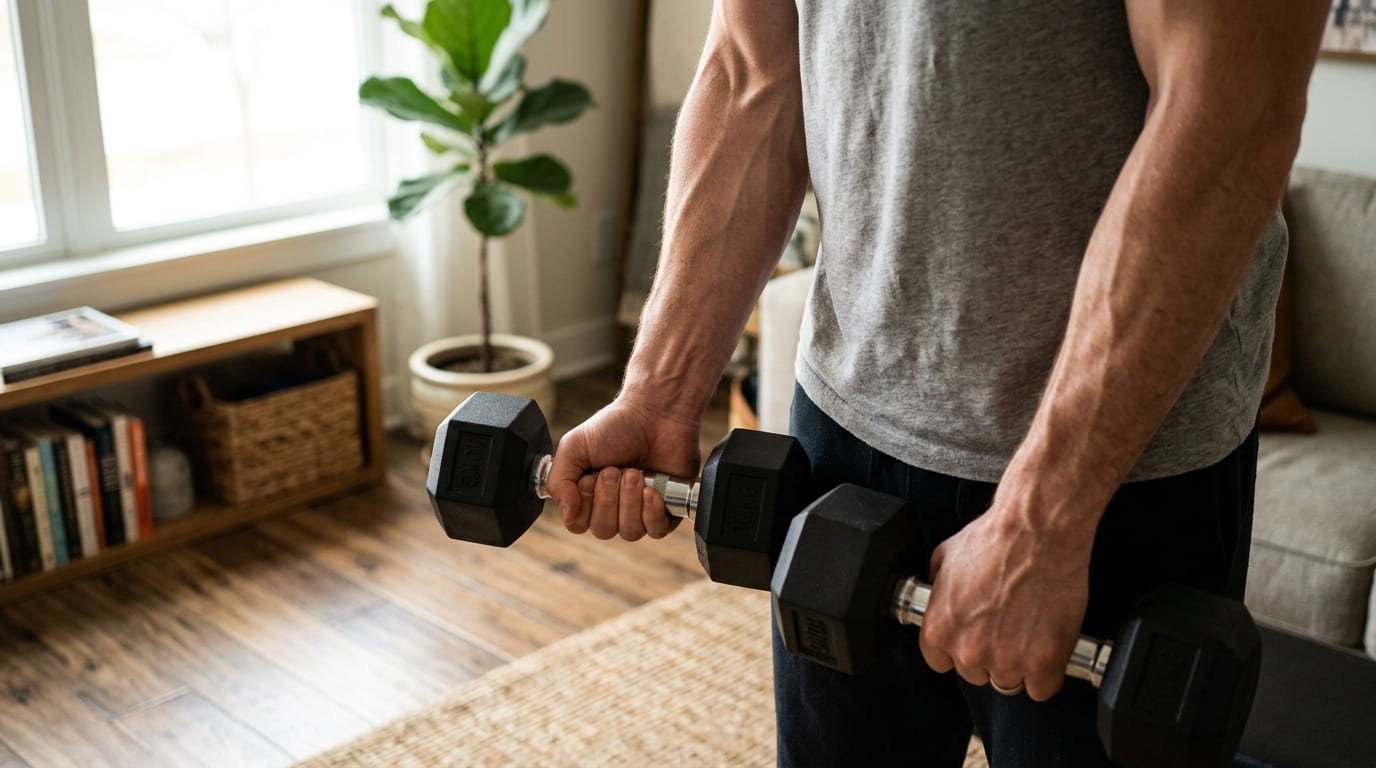
Sit with your forearms resting along your thighs, palms facing up, wrists hanging just past your knees. Let the dumbbells roll down to your fingertips, then curl them back up and squeeze. Full range matters here: rolling to the fingertips is what makes the exercise worth doing.
- Sets and reps: 3 sets of 15 to 20
- Common mistake: moving the elbows, which turns it into a weak curl
- No dumbbells: use a filled water bottle or a backpack handle
2. Behind-the-back barbell or dumbbell wrist curl
Stand holding the weight behind your back with palms facing away from you. Curl the wrists up. This version removes any temptation to cheat with your arms and gives a slightly different feel in the flexors.
- Sets and reps: 3 sets of 12 to 15
- Tip: start lighter than you expect, the leverage is different
3. Towel wring
Take a hand towel, soak it if you want extra resistance, and wring it in both directions as hard as you can for 30 seconds. This trains crush grip and rotation at the same time, and it is genuinely humbling the first time.
- Sets and time: 3 rounds of 30 seconds, alternating direction
- Why it works: it loads the rotators, which almost no standard exercise targets directly
4. Dead hang
Hang from a pull-up bar with a full grip, shoulders active rather than completely slack, and hold. If you have no bar, hang a thick towel over a sturdy door frame and hold both ends.
- Sets and time: 3 holds, working toward 45 to 60 seconds each
- Progression: add a towel for thicker grip, then one-arm hangs with the other hand lightly assisting
Extensor exercises (back of the forearm)
5. Reverse wrist curl
Same position as the wrist curl, but with palms facing down. The weight will be much lighter, often less than half, and that is completely normal. Extensors are smaller and rarely trained.
- Sets and reps: 3 sets of 15 to 20
- Key cue: slow on the way down, this is where the strength is built
6. Reverse curl
Hold dumbbells with an overhand grip and curl them as you would a normal curl. This trains the brachioradialis, the thick muscle that gives the forearm its shape near the elbow.
- Sets and reps: 3 sets of 10 to 15
- Tip: keep the wrists straight rather than letting them flop back
7. Finger extensions with a band
Loop a light resistance band around all five fingertips and spread your fingers open against it. If you do not have a band, a thick elastic band from a bunch of broccoli works, and so does pressing your fingers open against a mound of rice.
- Sets and reps: 3 sets of 20
- Why it matters: this is the single most useful exercise for balancing out heavy gripping and settling elbow pain
8. Reverse plank finger press
In a plank on your hands, shift your weight slightly forward and press through your fingertips rather than your palms. Hold for 20 to 30 seconds. It loads the fingers and wrists in a way nothing else on this list does.
Rotation, carries and grip
9. Hammer curl
Curl with palms facing each other. The neutral grip shifts load onto the brachioradialis and the forearm flexors, which is why this is a forearm exercise as much as a biceps one.
- Sets and reps: 3 sets of 10 to 12
10. Farmer’s carry
Pick up the heaviest pair of weights you have and walk. If your dumbbells are light, use a loaded backpack in one hand and a dumbbell in the other, or carry shopping bags. Keep your shoulders down and back and walk normally.
- Sets and time: 3 to 4 carries of 30 to 45 seconds
- Why it works: it trains support grip under real load, which is the most transferable grip quality there is
If you want a fuller breakdown of this movement, the farmer’s carry guide covers loading, distances and common form errors in detail.
11. Wrist rotations with a weight
Hold one end of a dumbbell so the other end hangs out, forearm resting on your thigh. Slowly rotate the palm up and then down through a full range. This directly trains pronation and supination, and it is brutally hard with even a light weight.
- Sets and reps: 3 sets of 10 each direction
12. Plate or book pinch
Pinch a hardback book or two plates together between your thumb and fingers and hold. Pinch grip is the weakest link for most people, and it improves quickly.
- Sets and time: 3 holds of 20 to 30 seconds each hand
Three forearm routines to follow
Pick the one that fits your week. All three assume you have done the warm-up.
Routine A: the 10-minute add-on
Do this at the end of an upper body session, twice a week.
| Exercise | Sets | Reps or time | Rest |
|---|---|---|---|
| Seated wrist curl | 3 | 15 to 20 | 45 sec |
| Reverse wrist curl | 3 | 15 to 20 | 45 sec |
| Dead hang | 3 | 30 to 45 sec | 60 sec |
| Band finger extension | 2 | 20 | 30 sec |
Routine B: the full forearm session
A standalone session, once or twice a week, roughly 25 minutes.
| Exercise | Sets | Reps or time | Rest |
|---|---|---|---|
| Farmer’s carry | 4 | 40 sec walk | 75 sec |
| Hammer curl | 3 | 10 to 12 | 60 sec |
| Seated wrist curl | 3 | 15 to 20 | 45 sec |
| Reverse wrist curl | 3 | 15 to 20 | 45 sec |
| Wrist rotations | 3 | 10 each way | 45 sec |
| Towel wring | 3 | 30 sec | 45 sec |
| Band finger extension | 3 | 20 | 30 sec |
Routine C: no equipment at all
Everything here uses your body, a wall and a towel.
| Exercise | Sets | Reps or time | Rest |
|---|---|---|---|
| Towel hang over a door frame | 3 | 20 to 40 sec | 60 sec |
| Towel wring | 3 | 30 sec each way | 45 sec |
| Reverse plank finger press | 3 | 20 to 30 sec | 60 sec |
| Fingertip push-ups on knees | 3 | 8 to 12 | 60 sec |
| Rice bucket or band finger extension | 3 | 20 | 30 sec |
| Isometric wall wrist press | 3 | 20 sec each direction | 30 sec |
A 6-week progression plan
This is the part almost every competing article skips. Listing exercises is easy. Getting stronger at them requires a plan.
Use double progression: keep adding reps until you reach the top of the range, then add weight and drop back to the bottom of the range.
| Week | Wrist curls and reverse curls | Carries and hangs | Finger extensions |
|---|---|---|---|
| Week 1 | 3 sets of 12, light | 3 rounds of 25 sec | 2 sets of 15 |
| Week 2 | 3 sets of 15 | 3 rounds of 30 sec | 2 sets of 20 |
| Week 3 | 3 sets of 18 | 3 rounds of 35 sec | 3 sets of 20 |
| Week 4 | Add weight, back to 3 sets of 12 | 4 rounds of 35 sec | 3 sets of 20 |
| Week 5 | 3 sets of 15 at the new weight | 4 rounds of 40 sec, heavier | 3 sets of 25 |
| Week 6 | 3 sets of 18, 1-second squeeze at the top | 4 rounds of 45 sec | 3 sets of 25 |
Write down what you lift. Forearm progress is measured in small increments, often 1 or 2 kilograms at a time, and without a log you will genuinely forget where you were three weeks ago.
If you also train back, biceps or deadlifts, your forearms already get indirect work. Do dedicated forearm training after those sessions, never before, or your grip will fail during the lifts that matter more.
How to test your grip strength at home
You cannot see forearm progress in the mirror week to week, but you can measure it. These three tests take five minutes and give you honest numbers.
| Test | How to do it | Beginner | Solid | Strong |
|---|---|---|---|---|
| Dead hang | Hang from a bar with two hands, no straps | 20 to 30 sec | 45 to 60 sec | 90 sec or more |
| Farmer’s carry | Walk with your heaviest pair of weights | 30 sec | 60 sec | 90 sec or more |
| Book pinch | Pinch a hardback between thumb and fingers | 15 sec | 30 sec | 45 sec or more |
Test on the same day of the week, at a similar time, before any other training. Retest every four to six weeks. If two of the three have improved, your programme is working.
Wrist and elbow pain: what to do
This section exists because forearm training is where a lot of people first meet elbow pain, and none of the top articles on this topic explain what to do about it.
Pain on the outside of the elbow is often linked to the extensor tendons, commonly called tennis elbow. It typically shows up in people who grip a lot and never train extension.
Pain on the inside of the elbow involves the flexor tendons, commonly called golfer’s elbow, and often appears after a jump in gripping or wrist curl volume.
What usually helps:
- Reduce the load, do not stop entirely. Tendons respond well to light, controlled work and badly to complete rest followed by a sudden return
- Emphasise slow eccentrics. Take 3 to 4 seconds on the lowering phase of wrist curls with a very light weight
- Add finger extension work. Most people grip far more than they extend, and the imbalance is often part of the problem
- Check your grip width and wrist position on rows, presses and curls, since a bent wrist under load is a common culprit
- Give it time. Tendon adaptation takes longer than muscle adaptation, often 8 to 12 weeks
Sharp, sudden or persistent pain, numbness, tingling or weakness in the hand deserves a proper assessment rather than a guess from an article. See a physiotherapist or doctor if symptoms last more than a few weeks or interfere with daily life.
Seven mistakes that stall forearm progress
- Only training flexors. Wrist curls with no reverse work builds imbalance, and imbalance is where elbow pain starts
- Going too heavy. The forearm muscles are small. Weight that forces your elbows to swing is weight that is training your shoulders instead
- Cutting the range short. Not letting the dumbbell roll to your fingertips removes most of the benefit of a wrist curl
- Training them before your main lifts. Pre-fatigued grip ruins rows, pull-ups and deadlifts
- Using straps for everything. Straps are useful on your heaviest pulls, but if you wear them for every set your grip never gets a reason to adapt
- Ignoring carries. Loaded carries are the most transferable grip exercise there is, and they are the one most often left out of home routines
- Expecting fast visible change. Strength moves quickly, size moves slowly, and forearm size is influenced heavily by genetics and body fat
How often should you train forearms?
Two to three sessions a week is the sweet spot for most people. Forearm muscles are small, recover reasonably fast, and are used constantly in daily life, so they tolerate more frequency than, say, hamstrings.
| Your situation | Frequency | Where to put it |
|---|---|---|
| You lift 2 to 3 times a week | 2 sessions | At the end of upper body days |
| You lift 4 or more times a week | 2 to 3 sessions | After pull days, plus one short standalone session |
| You only train at home with no weights | 3 sessions | Standalone, using Routine C |
| You have elbow pain | 2 short, very light sessions | Separate from everything else, focused on extensions |
Leave at least 48 hours between heavy grip sessions. If your hands still feel stiff or weak from the last session, that is a signal to go lighter rather than push through.
How long until you see results
Honest timelines, for someone training consistently twice a week and eating enough.
| Timeframe | What usually changes |
|---|---|
| Weeks 1 to 2 | Better wrist control, less discomfort during rows and curls |
| Weeks 3 to 6 | Clear strength gains: longer hangs, heavier carries, more reps |
| Weeks 6 to 12 | Grip stops being the limiting factor in your other lifts |
| 3 to 6 months | Visible thickness, particularly near the elbow |
| Beyond 6 months | Steady progress tied to overall training, food and body composition |
Two things speed this up: progressive overload and eating enough protein. Two things slow it down: doing only wrist curls forever, and going so heavy that your technique falls apart.
Fitting forearms into your week
Forearm work pairs naturally with pulling. Here is one simple way to slot it into a typical home training week.
| Day | Main session | Forearm work |
|---|---|---|
| Monday | Upper body push, like a push day workout | None |
| Tuesday | Lower body | None |
| Wednesday | Upper body pull, rows and curls | Routine A at the end |
| Thursday | Rest or walking | None |
| Friday | Full body | None |
| Saturday | Optional arms session | Routine B |
| Sunday | Rest | None |
If you would rather train arms together, a forearm block sits comfortably at the end of a back and biceps workout, since your grip is already warm and you have no heavy pulling left to protect.
The bottom line
Forearm training at home is not complicated, but it is easy to do badly. The formula that works is boringly consistent: train both sides of the forearm, include a carry or a hang every session, keep the reps relatively high, warm the wrists up first, and add a little weight or time every couple of weeks.
Do that twice a week for six weeks and you will notice it somewhere obvious, usually the first time you pick up something heavy and your hands simply do not complain.
Frequently asked questions
How long does it take to build forearm strength at home?
Most beginners notice clear strength improvements within 3 to 6 weeks of training twice a week, measured by longer dead hangs and heavier carries. Visible size changes take longer, typically 3 to 6 months of consistent training combined with adequate protein and overall muscle gain.
Can you train forearms every day?
You can do light grip work daily, such as band finger extensions or short holds, but heavy wrist curls and carries need 48 hours between sessions. Forearm tendons adapt more slowly than muscle, and daily heavy loading is one of the most common causes of elbow pain in people who train grip.
Do push-ups work your forearms?
Push-ups work the forearms isometrically, meaning the muscles contract to stabilise the wrist without changing length. That builds some wrist stability but very little grip strength or forearm size. Fingertip push-ups load the forearms far more directly if your wrists tolerate them.
Why are my forearms not growing?
The three usual reasons are training only the flexors with wrist curls, never adding weight or time from week to week, and not being in a position to build muscle overall because of insufficient food or sleep. Forearm size is also strongly influenced by genetics and body fat percentage.
What is the best forearm exercise without equipment?
The towel hang over a sturdy door frame, because it trains support grip under bodyweight load with a thick grip. Pair it with towel wringing for crush grip and rotation, and band or rice-bucket finger extensions to balance the extensors.
Should I train forearms before or after my main workout?
Always after. Forearm training fatigues your grip, and grip is what holds the bar during rows, pull-ups, deadlifts and carries. Training forearms first means your most important lifts end early because your hands gave out rather than your target muscles.
How heavy should I go on wrist curls?
Light enough that you can complete 15 to 20 controlled reps with your elbows completely still and the weight rolling to your fingertips at the bottom. For most beginners that means 2 to 5 kilograms per hand, and reverse wrist curls will be roughly half of that.
Do grip trainers actually work?
Spring grippers build crush grip specifically, which does transfer to handshakes and holding thick objects. They do not train support grip, pinch grip or wrist strength, so they are a useful addition rather than a replacement for carries, hangs and wrist curls.