Weighted Vest Training: 12 Exercises and What the Evidence Says
A weighted vest is a simple idea that works well: you add load to your body instead of to a bar, so every bodyweight exercise, every walk and every hill gets harder without changing anything else about how you train.
It has also become one of the most hyped pieces of equipment in fitness, largely on the back of the rucking trend, and the claims have run well ahead of the evidence. Bone density, posture correction, effortless fat loss. Some of that holds up, some is genuinely unsupported, and the difference matters if you are deciding whether to spend the money.
This guide covers how much weight to start with, twelve exercises that suit a vest, the specific exercises you should never wear one for, and an honest read of what the research does and does not show.
At a glance
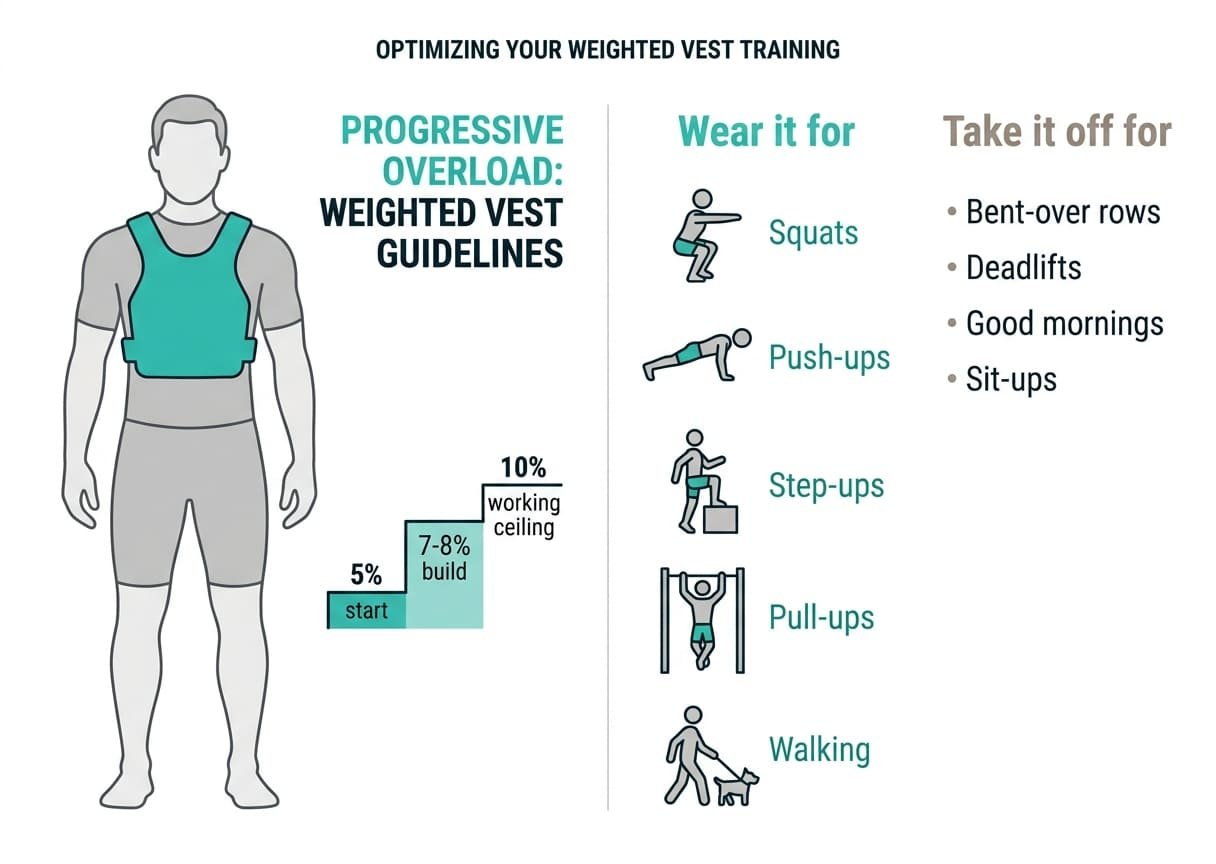
- Start at 5 percent of body weight, and treat 10 percent as the working ceiling
- Vests suit movements where you carry your body through space: walking, squats, push-ups, step-ups
- Never wear one for bent-over rows, deadlifts or anything with a horizontal torso
- The strongest case is progressive overload for bodyweight exercises and loaded walking
- Bone density claims are weaker than commonly stated, and posture claims are unsupported
- Build volume before adding weight, not the other way round
What a weighted vest is actually good for
The mechanism is not complicated. Adding mass to your torso increases the force your muscles must produce to move you, which raises the demand on every movement where you carry your own body weight.
The genuinely strong use cases:
- Progressive overload for bodyweight exercises. This is the best reason to own one. Once you can do 20 push-ups or 12 pull-ups, a vest lets you keep progressing without buying a rack of dumbbells
- Loaded walking and hiking. Adding 10 percent of your body weight to a walk raises the effort meaningfully while staying low impact
- Step-ups and stair climbing, where the load goes through the working leg
- Adding difficulty to circuits without changing exercises or equipment
- Sport-specific work, where brief loaded sprints or jumps can build power
What makes a vest better than dumbbells for these: your hands stay free, the load sits close to your centre of mass, and it does not change your technique the way holding weights does. A vested pull-up is still a pull-up. A pull-up holding a dumbbell between your feet is a slightly different exercise.
What the research actually supports
This is where the honest reading matters, because medical sources and fitness sources say noticeably different things.
| Claim | Evidence | Verdict |
|---|---|---|
| Increases the difficulty of bodyweight exercise | Straightforward mechanics | Well supported |
| Raises calorie burn during activity | Studies show increased energy cost when carrying 10 percent of body weight | Supported, but the effect is modest |
| Improves sprint and jump performance | Some evidence in athletes with brief loaded work | Reasonable, mainly in trained athletes |
| Builds strength | Only when used as progressive resistance training | Supported with caveats |
| Improves bone density | Mixed. A recent trial found vests alone did not reduce bone loss in older adults | Weaker than commonly claimed |
| Causes weight loss | Mixed results, no clear effect independent of diet | Not supported |
| Improves posture | No research supports this | Not supported |
| Replaces resistance training | No | Not supported |
The bone density claim deserves particular scrutiny, because it is the one most often repeated. The theory is reasonable: loading the skeleton stimulates bone. But the human evidence for wearing a vest specifically is weaker than the confident marketing suggests, and at least one recent trial found that vests alone did not prevent bone loss in older adults. Resistance training and impact activity have considerably better support for bone health.
The honest position: a weighted vest is a good tool for making bodyweight training progressive and for adding load to walking. It is not a metabolic shortcut, a posture device or a substitute for lifting weights.
How much weight to use
Getting this wrong is the main way people hurt themselves, so it deserves clear numbers.
| Your situation | Vest weight | As a share of body weight |
|---|---|---|
| Complete beginner | Start here | 5 percent |
| Comfortable after 3 to 4 weeks | Progress to | 7 to 8 percent |
| Experienced, good form | Working range | 10 percent |
| Loaded walking or rucking | Can go higher over time | 10 to 20 percent |
| Running with a vest | Keep it light | 5 percent maximum |
| Plyometrics and jumping | Very light | 5 percent maximum |
Worked examples:
| Body weight | 5 percent starting load | 10 percent working load |
|---|---|---|
| 60 kg | 3 kg | 6 kg |
| 70 kg | 3.5 kg | 7 kg |
| 80 kg | 4 kg | 8 kg |
| 90 kg | 4.5 kg | 9 kg |
| 100 kg | 5 kg | 10 kg |
Two rules that prevent most problems:
- Add volume before weight. If you are doing 3 sets of 10 vested push-ups, progress to 3 sets of 15 before adding a kilogram. This is the single most useful progression rule for vest training
- The vest should not change your technique. If your squat depth drops, your push-up sags or your walking gait changes, the load is too high
Buy an adjustable vest with removable weights rather than a fixed one. A fixed 10 kg vest is too heavy on day one and too light within a few months, which makes it the worst of both.
12 weighted vest exercises
Lower body
1. Bodyweight squat
The load sits on your torso, so it functions like a light back squat without needing a bar.
- Sets and reps: 3 to 4 sets of 12 to 20
2. Step-up
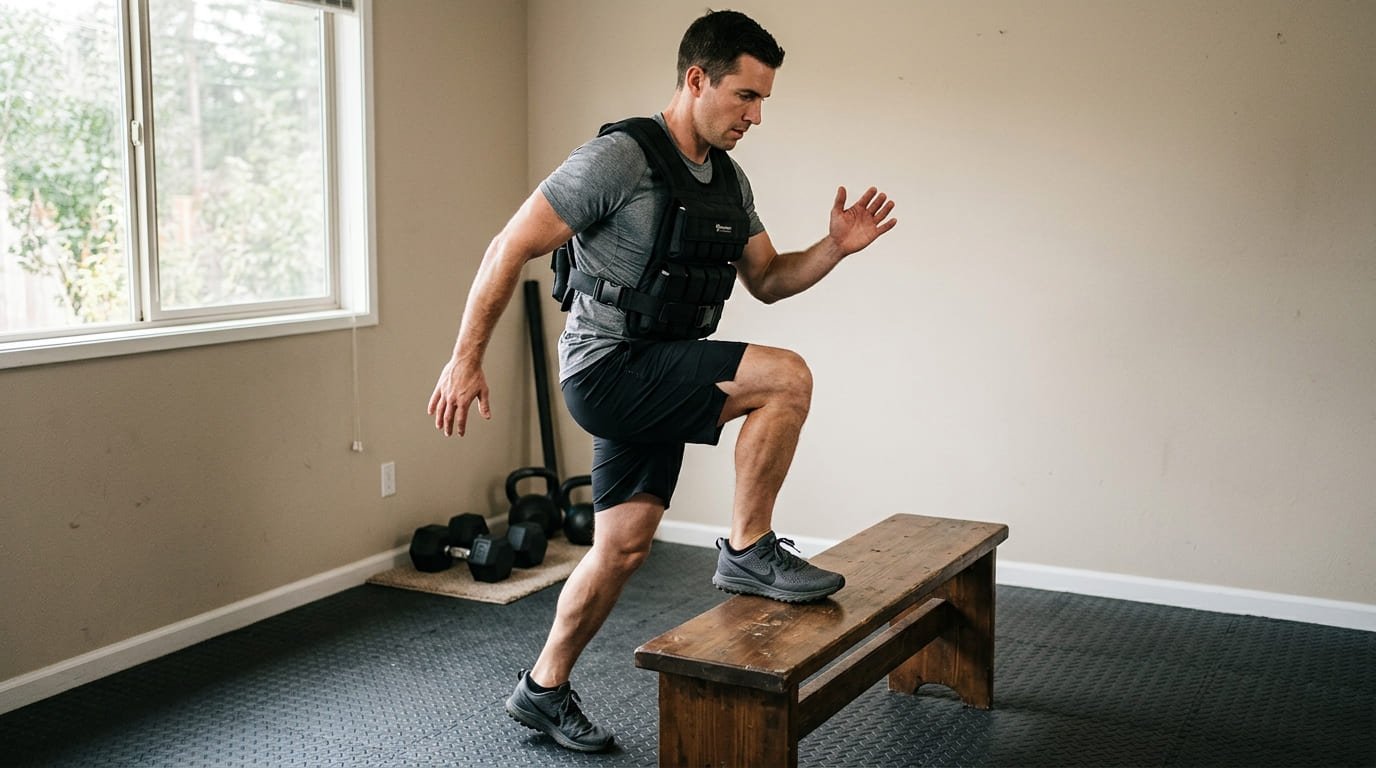
Onto a bench, a sturdy box or the bottom of a staircase. One of the best uses of a vest, because the load goes straight through the working leg.
- Sets and reps: 3 sets of 10 to 12 each leg
3. Split squat and lunge
Single-leg work with a vest is efficient, since your hands stay free for balance.
- Sets and reps: 3 sets of 8 to 12 each leg
4. Calf raise
With the heels dropped below a step, a vest adds load without needing dumbbells you would otherwise have to grip.
- Sets and reps: 3 sets of 15 to 20
- Our calf workout at home guide covers the range of motion that makes this work
5. Glute bridge and hip thrust
The vest sits across the torso and hips, which is exactly where you want the load.
- Sets and reps: 3 sets of 12 to 15
Upper body
6. Push-up
One of the best applications. A vest turns a plateaued push-up back into a strength exercise.
- Sets and reps: 3 to 4 sets of 8 to 15
7. Pull-up and chin-up
Cleaner than hanging a dumbbell between your feet, and the load stays closer to your centre of mass.
- Sets and reps: 3 to 4 sets of 4 to 8
- Only once you can do 10 or more unweighted. Our pull up alternatives guide covers getting there
8. Dip
Same principle as pull-ups, and the vest is more comfortable than a dipping belt for moderate loads.
- Sets and reps: 3 sets of 6 to 10
- Our dip exercise guide covers the form and the progression
9. Plank
The vest adds direct downward load on the core, which is difficult to achieve otherwise.
- Time: 3 holds of 20 to 45 seconds
Carrying and conditioning
10. Loaded walking
The most accessible use. Add the vest to a normal walk and the effort rises considerably at the same pace.
- Duration: 20 to 45 minutes, starting shorter
- Start with 10 to 15 minutes in your first week regardless of how easy it feels
11. Hill or stair walking
Combining incline with load is one of the most effective low-impact conditioning options available.
- Duration: 15 to 30 minutes
12. Step-up intervals
Step-ups performed continuously for intervals, which works well when space is limited.
- Format: 6 rounds of 45 seconds work, 60 seconds rest
Exercises to never wear a vest for
This list matters more than the previous one, and most articles either skip it or bury it.
| Avoid | Why |
|---|---|
| Bent-over row | The vest hangs away from your spine, multiplying the load on your lower back |
| Deadlift | You already have a loaded spine. Adding torso weight is unnecessary and risky |
| Good morning | Same problem, with worse leverage |
| Romanian deadlift | The hanging vest increases spinal load in the hinged position |
| Sit-ups and crunches | Adds compressive and shearing load to the lumbar spine during repeated flexion |
| Barbell back squat | Redundant, and the vest interferes with bar position |
| Running on roads, early on | Impact forces rise with added mass, and the joints need time to adapt |
| Any overhead pressing | The vest does nothing useful and encourages lower back arching |
The principle behind the list: a vest is useful when the load sits over your base of support, as in standing, squatting or a push-up. It becomes a problem when your torso is horizontal or hinged, because then the weight acts on a long lever arm through your lower back.
An 8-week starting plan
| Week | Vest weight | Sessions | Content |
|---|---|---|---|
| Weeks 1 to 2 | 5 percent | 2 | 15-minute loaded walk only |
| Weeks 3 to 4 | 5 percent | 2 to 3 | Walk plus vested squats and push-ups |
| Weeks 5 to 6 | 7 percent | 3 | Full routine below, shorter sets |
| Weeks 7 to 8 | 8 to 10 percent | 3 | Full routine, add reps before weight |
The full routine, roughly 30 minutes:
| Exercise | Sets | Reps | Rest |
|---|---|---|---|
| Vested squat | 3 | 15 | 60 sec |
| Vested push-up | 3 | 10 to 15 | 60 sec |
| Step-up | 3 | 10 each leg | 60 sec |
| Vested pull-up or inverted row | 3 | 5 to 8 | 90 sec |
| Split squat | 3 | 10 each leg | 60 sec |
| Plank | 3 | 30 sec | 45 sec |
| Loaded walk | 1 | 15 to 20 min | Finish |
Two or three sessions a week is plenty. The vest adds load to everything you do in it, so the total stress accumulates faster than the session length suggests.
Rucking and loaded walking
Loaded walking deserves its own section, since it is the use case that brought vests back into fashion.
What it does well:
- Raises the energy cost of walking substantially at the same pace
- Stays low impact, which suits joints that do not tolerate running
- Builds trunk and postural endurance over long durations
- Fits into time you already spend walking
How to start:
| Week | Load | Duration |
|---|---|---|
| Weeks 1 to 2 | 5 percent of body weight | 15 to 20 min |
| Weeks 3 to 4 | 7 percent | 25 to 30 min |
| Weeks 5 to 8 | 10 percent | 30 to 45 min |
| Beyond 2 months | 10 to 20 percent | 45 to 60 min |
A backpack works nearly as well for walking specifically, provided the load sits high and close to your back rather than sagging at the base. For exercise, a vest is better because it does not shift.
Our walking for weight loss guide covers how walking volume contributes overall.
Choosing a vest
Vests vary more than they look, and a poorly chosen one ends up unused in a cupboard.
| Feature | What to look for | Why it matters |
|---|---|---|
| Adjustability | Removable weight packets | The single most important feature, since you outgrow a fixed load |
| Weight range | Ideally 2 kg up to 15 to 20 kg | Covers 5 percent to 10 percent as you progress |
| Fit | Snug across the chest and waist | A vest that bounces changes your gait and rubs |
| Profile | Slim, close to the body | Bulky vests interfere with push-ups and pull-ups |
| Straps | Adjustable at both shoulders and waist | Stops it riding up during movement |
| Weight distribution | Even front and back | Front-loaded vests pull you forward |
| Material | Breathable, washable | You will sweat into it heavily |
| Shoulder padding | Present and thick enough | Thin straps dig in during loaded walking |
Two style choices:
- Short, plate-carrier style vests sit high and close, which suits push-ups, pull-ups and dips. These are the better all-round choice for exercise
- Long vests with many small packets distribute weight over more area, which is more comfortable for long walks but gets in the way on the floor
What to check before your first session: put the vest on and do ten push-ups and ten squats. If it slides up toward your neck, rides forward, or stops you reaching the floor, adjust the straps before you train in it properly.
What to expect in the first fortnight
The most common experience with a new vest is being considerably more sore than expected, because the load applies to everything at once rather than to one muscle group.
| Timeframe | What usually happens |
|---|---|
| First session | Feels easier than expected during, noticeably harder afterwards |
| 24 to 48 hours after | Widespread soreness, often in the calves, quads and shoulders |
| Week 1 | Shoulders and traps sore from the straps, which settles |
| Weeks 2 to 3 | Soreness drops sharply as the body adapts |
| Week 4 onward | The same load feels routine, which is the signal to add volume |
Shoulder and trap soreness in the first week is normal and comes from carrying the straps rather than from the exercises. It settles within two or three sessions.
What is not normal: knee, hip or lower back pain, or any joint that aches rather than the muscle around it. That means the load is too high for your current tolerance, and the answer is to remove weight rather than push through.
Who should be cautious
Speak to a doctor before using a weighted vest if you have:
- Neck, shoulder or back pain, or a history of disc problems
- Knee, hip or ankle joint problems, since the added load increases joint forces
- Heart or lung conditions, because the cardiovascular demand rises
- Balance problems, as a vest shifts your centre of mass
- Osteoporosis, where loading needs individual guidance rather than assumptions
- Pregnancy
- Recent surgery or injury
Children should not use weighted vests for training, and older adults should start at the very bottom of the range with supervision available.
Seven common mistakes
- Starting at 10 percent rather than 5, which is where most soreness and joint complaints come from
- Wearing it for hinged exercises, particularly rows and deadlifts
- Wearing it all day. Prolonged wear loads the spine and shoulders without a training benefit, and the research does not support the practice
- Buying a fixed-weight vest rather than an adjustable one
- Adding weight before adding volume
- Running on hard surfaces immediately, before the joints have adapted
- Expecting it to replace strength training, which it does not
The bottom line
A weighted vest is a genuinely useful tool with a narrow, well-defined purpose: making bodyweight exercises progressive again, and adding load to walking. For both of those it works well, and it is one of the better value purchases in home fitness.
Start at 5 percent of your body weight, treat 10 percent as your working ceiling, and add reps before you add kilograms. Wear it for squats, push-ups, step-ups, pull-ups and walking. Take it off for anything where your torso hinges forward, because that is where the lever arm through your lower back becomes the problem.
And treat the bigger claims carefully. It will not fix your posture, it will not drive fat loss on its own, and the bone density evidence is thinner than the marketing suggests.
A loaded pack works the same way on the trail. See our guide to strength training for hiking.
Frequently asked questions
How much weight should I use in a weighted vest?
Start at 5 percent of your body weight and build toward 10 percent over several weeks. For a 70 kg person that means starting around 3.5 kg and working up to 7 kg. Keep it at 5 percent maximum for running and jumping, where impact forces rise sharply with added load.
What exercises are best with a weighted vest?
Movements where you carry your body through space: squats, push-ups, step-ups, split squats, pull-ups, dips, planks and walking. The vest adds load without changing your technique, which makes it particularly good for progressing bodyweight exercises you have plateaued on.
What exercises should you avoid with a weighted vest?
Anything where your torso is hinged or horizontal, including bent-over rows, deadlifts, good mornings and Romanian deadlifts, since the vest acts on a long lever arm through your lower back. Also avoid it for sit-ups and crunches, and skip it for barbell back squats where it interferes with bar position.
Do weighted vests help with bone density?
The evidence is weaker than commonly claimed. The theory is reasonable, since loading stimulates bone, but human trials have been mixed and at least one recent study found vests alone did not reduce bone loss in older adults. Resistance training and impact activity have considerably better support for bone health.
Can a weighted vest help you lose weight?
It increases the calorie cost of activity modestly, but studies show mixed results and no clear effect independent of diet. Fat loss is driven by overall energy balance, so a vest is best viewed as a way to make your training harder rather than as a weight loss tool in itself.
Is it bad to wear a weighted vest all day?
It is not recommended. Prolonged wear loads the spine and shoulders for hours without providing a meaningful training stimulus, and the research does not support the practice. Use a vest for defined training sessions of 20 to 60 minutes and take it off afterwards.
Should I run with a weighted vest?
Cautiously, and not at first. Impact forces rise with added mass, so the knees, hips and ankles need time to adapt. Start with loaded walking for several weeks, keep the load at 5 percent of body weight maximum for running, and begin on soft surfaces rather than roads.
Is a weighted vest better than a backpack?
For exercise, yes, because the load sits close to your centre of mass and does not shift during movement. For loaded walking specifically, a well-packed backpack with the weight sitting high and close to your back works nearly as well and costs nothing if you already own one.
What’s next?
Reading is the easy part. Pick one of these and do it today.