Rib Flare Exercises: How to Stack Your Ribs Over Your Pelvis
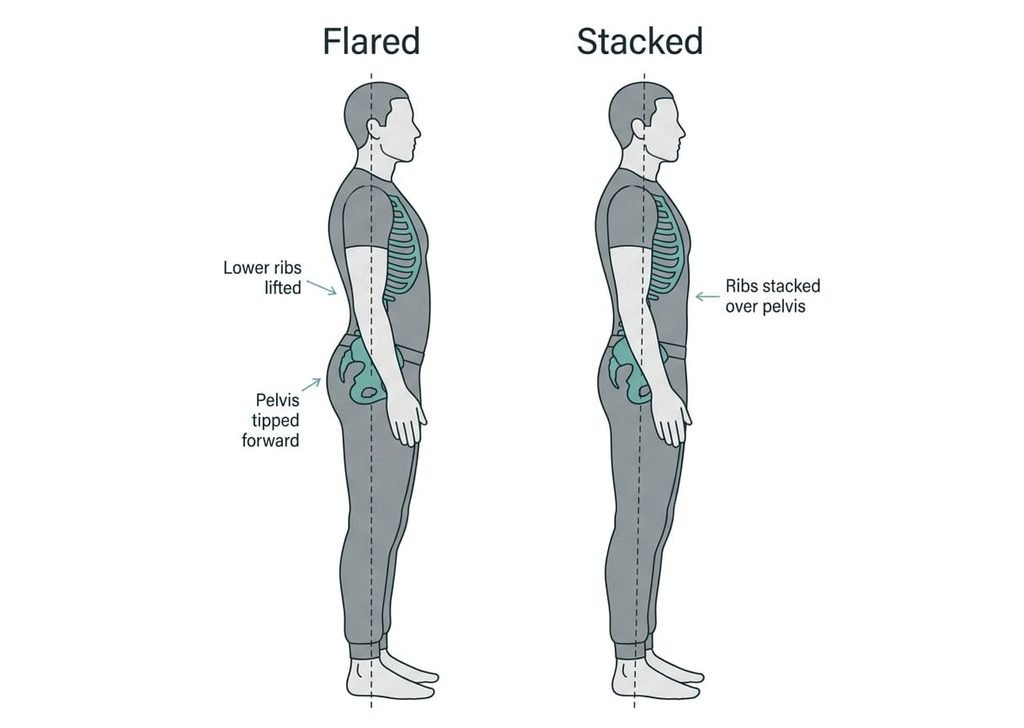
Rib flare describes the lower front ribs sitting angled up and forward rather than lying flat against the torso. You notice it lying on your back, where the bottom of the ribcage sticks up, or standing side-on, where the chest lifts and the lower back arches to match.
Before going any further, one thing needs saying that almost no article on this topic says: a visible rib edge is not automatically a problem. Lean people see their ribs more. Some people have a naturally wider infrasternal angle, meaning the ribs simply sit at a broader angle where they meet the breastbone. Children commonly show rib flare and grow out of it. If you have no pain, no breathing difficulty and no performance issue, you may be looking at your own anatomy rather than a fault.
What this guide covers is the version worth addressing: ribs that flare because the diaphragm and abdominals are not working together, which shows up as a chest-dominant breathing pattern, an arched lower back, and a core that struggles to brace properly.
At a glance
- Rib flare means the lower ribs tip up and forward instead of stacking over the pelvis
- It is often a breathing pattern issue rather than a structural fault
- A visible rib edge in a lean person is frequently normal anatomy
- The fix is exhaling fully, not sucking your stomach in
- Two self-tests below tell you which one you are dealing with
- Expect 6 to 12 weeks for a positional change, since this is a habit not a stretch
What rib flare actually is
Your ribcage and pelvis are meant to sit roughly stacked, one above the other, like two bowls facing each other. In that position, the diaphragm above and the pelvic floor below sit parallel, and the abdominals can hold the two together.
In rib flare, the ribcage tips backwards at the top and the front edge lifts. The pelvis usually tips forward to match, the lower back arches, and the stack is lost.
| Structure | Stacked position | Flared position |
|---|---|---|
| Lower ribs | Lying flat against the torso | Tipped up and forward, edge visible |
| Pelvis | Neutral | Tipped forward, increased lower back arch |
| Diaphragm | Domed, parallel to the pelvic floor | Tipped, less efficient |
| Abdominals | Able to hold the ribs down | Lengthened at the front, less effective |
| Breathing | Lower ribs expand sideways and backwards | Chest lifts, expansion goes forward |
The diaphragm is the key. It attaches around the inside of your lower ribs. When the ribcage tips up, the diaphragm is pulled into a flatter, less efficient position, so breathing shifts to the neck and chest muscles. That in turn keeps the ribs lifted, and the pattern reinforces itself.
Why ribs flare
| Cause | How it happens | How common |
|---|---|---|
| Breathing pattern | Chest-dominant breathing keeps the ribs elevated | Very common |
| Weak or lengthened abdominals | Nothing holds the front of the ribcage down | Very common |
| Excessive lower back arch | The pelvis tips forward and the ribs follow | Common |
| Prolonged sitting | The position is rehearsed for hours daily | Common |
| Postpartum changes | The abdominal wall stretched and has not regained tension | Common |
| Overhead sports and gymnastics | Repeated overhead reaching trains rib elevation | Situational |
| Natural anatomy | A naturally wide infrasternal angle | Not a fault at all |
| Structural conditions | Scoliosis, pectus deformities | Uncommon, needs assessment |
Notice that the top four are all trainable. That is the good news, and it is why the approach below focuses on breathing and abdominal control rather than stretching anything.
Two self-tests
Test 1: the supine rib check
Lie on your back with your knees bent and feet flat, and relax completely for thirty seconds.
Now run your fingers along the bottom edge of your ribcage at the front.
- Ribs feel flat and level with your abdomen: stacked position, nothing to fix
- Ribs stick up noticeably, with a clear gap under the edge: flare present
- Ribs stick up but flatten when you exhale fully and hold: a positional issue that responds well to training
- Ribs stay lifted even after a complete exhale: more likely structural, worth an assessment
That third check is the most useful one in this entire article. If a full exhale flattens your ribs, you have the muscular control available and you simply are not using it at rest. That is the version training fixes reliably.
Test 2: the wall breathing check
Stand with your back against a wall, heels a few centimetres out, and press your lower back toward the wall so the gap closes.
Now breathe in normally. Watch what moves.
- Your lower ribs widen sideways and your back presses into the wall: good mechanics
- Your chest lifts and your shoulders rise: chest-dominant breathing
- Your lower back arches away from the wall as you inhale: the ribs are driving into extension
Take a photo of yourself standing side-on, relaxed, and repeat it every four weeks. Rib position changes slowly and is almost impossible to judge day to day.
The breathing protocol
This is the centre of the whole approach, and the part most exercise lists get wrong.
The mistake almost everyone makes: trying to fix rib flare by sucking the stomach in or forcing the ribs down with tension. That creates a rigid, braced torso that returns to the old position the moment you stop thinking about it.
What works instead: a full exhale. Breathing all the way out brings the ribs down naturally through the abdominal wall, and it is the position you then learn to maintain.
The 90-90 breathing drill
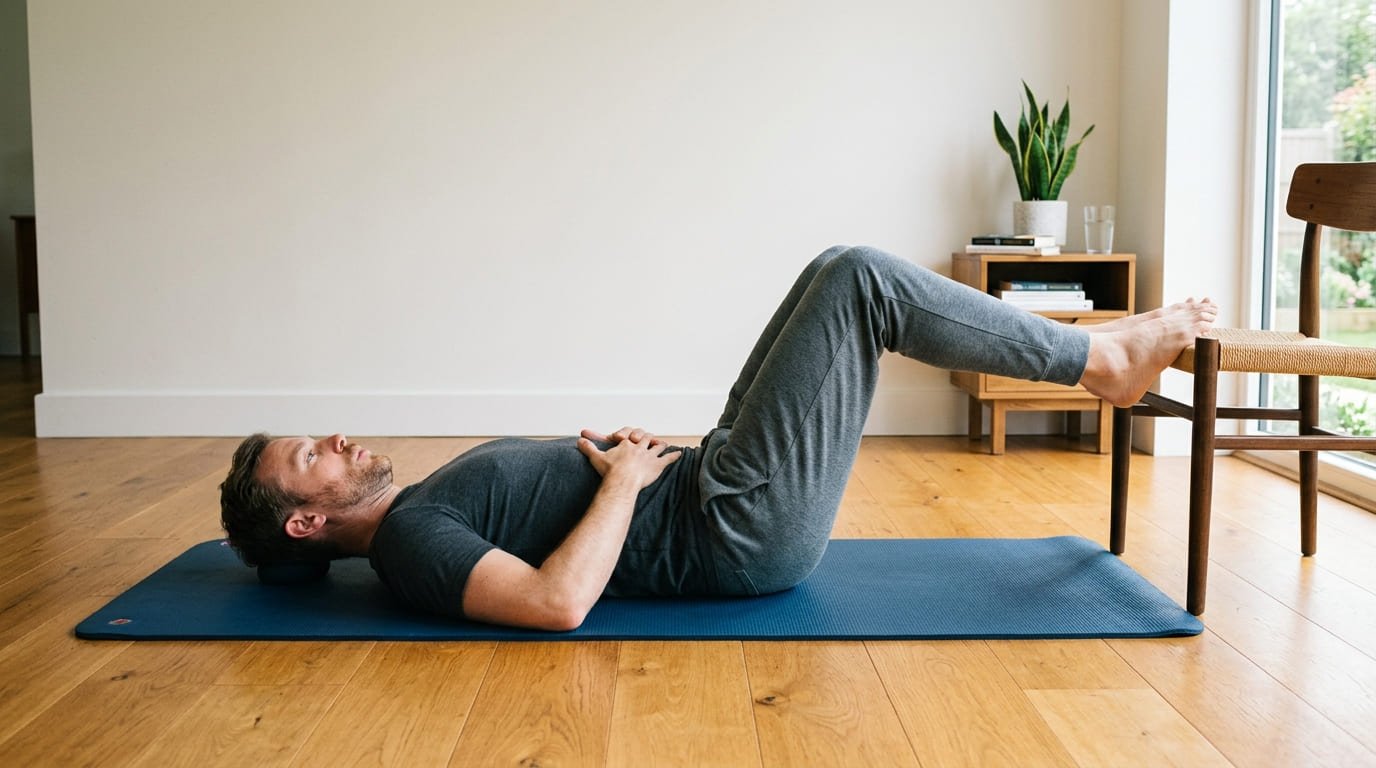
- Lie on your back with your feet flat on a wall or a chair, hips and knees both bent to roughly 90 degrees
- Gently tuck your pelvis so your lower back flattens toward the floor. You should feel your lower abdominals engage
- Breathe in through your nose for 4 seconds, feeling your lower ribs widen sideways and into the floor rather than your chest lifting
- Breathe out through pursed lips for 6 to 8 seconds, all the way to the end, until you feel your ribs settle down and your abs tighten
- Pause for 2 to 3 seconds at the bottom of the exhale, holding that rib position
- Breathe in again without letting the ribs lift back up
- Reps: 5 breaths, 2 to 3 sets
- Frequency: twice a day
- The pause at the end of the exhale is the active ingredient. That is where you learn what a stacked ribcage feels like
Most people find this surprisingly hard, and many feel their abdominals working for the first time in a way no crunch has produced. That sensation is the point.
10 rib flare exercises
Three stages. Each one builds on the breathing pattern rather than replacing it.
Stage 1: finding the position
1. 90-90 breathing
As described above.
- Reps: 5 breaths, 2 to 3 sets, twice daily
2. Supine rib grab
Lying on your back, place your hands on your lower ribs. Exhale fully and gently guide the ribs down and in with your hands, then inhale without letting them lift.
- Reps: 8 breaths
- The hands are feedback, not force. Guide, do not press hard
3. Dead bug with a full exhale
On your back, arms up and knees over hips. Exhale fully as you lower one arm and the opposite leg, and stop the moment your lower back lifts.
- Reps: 3 sets of 8 each side
- Match the exhale to the movement, since the exhale is what keeps the ribs down
4. Wall press breathing
Stand with your back against a wall, press your lower back toward it, and breathe with the ribs staying down.
- Reps: 8 breaths
Stage 2: holding it under load
5. Deep core march
From the 90-90 position, lower one foot toward the floor and back while the pelvis and ribs stay completely still.
- Reps: 3 sets of 10 each side
6. Modified side plank
On your side from the knees, propped on a forearm. Breathe normally and keep the ribs down rather than letting the lower ribs flare toward the ceiling.
- Time: 3 holds of 20 to 30 seconds each side
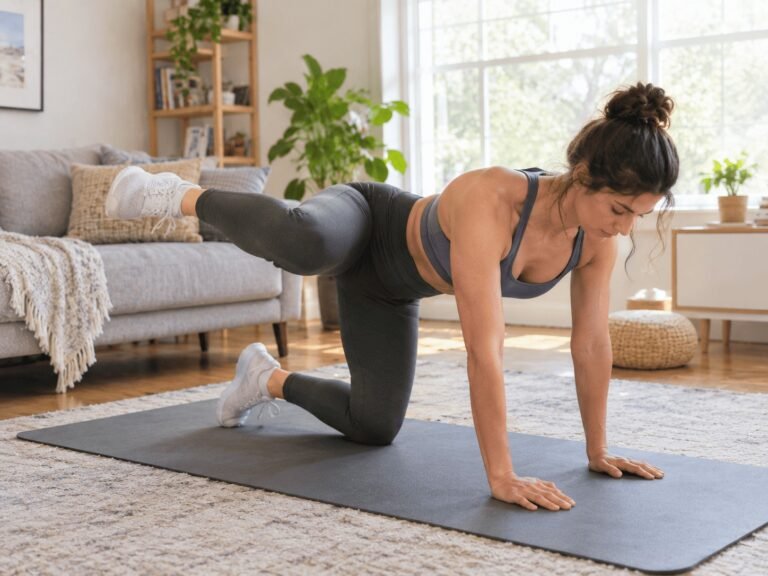
7. Bear hold
Hands and knees with the toes tucked, knees hovering 2 cm off the floor, back flat, breathing throughout.
- Time: 3 holds of 20 to 30 seconds
8. Glute bridge with a posterior tilt
Lift your hips, tuck the pelvis by squeezing the glutes, and hold while exhaling fully. Glute engagement is a direct counter to the forward pelvic tilt that accompanies rib flare.
- Reps: 3 sets of 12, holding 3 seconds each
Stage 3: overhead and upright
9. Supine overhead reach
Lying on your back with the lower back flat, reach both arms overhead toward the floor. Stop at the point your ribs start to lift, which is your current honest range.
- Reps: 3 sets of 10
- Why this matters: reaching overhead is where rib flare shows itself most, so this is the transfer exercise
10. Standing overhead press with ribs down
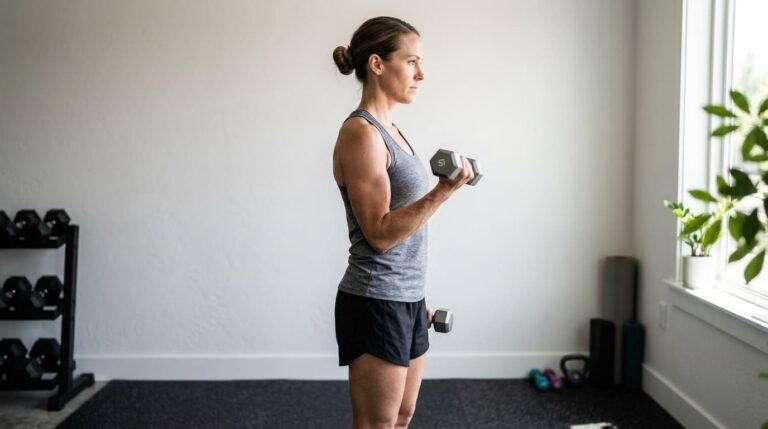
Press a light weight overhead while consciously keeping the lower ribs down and the lower back flat. Most people have to reduce the weight considerably to do this honestly.
- Reps: 3 sets of 10, light
- If your ribs flare to complete the press, your shoulders lack the overhead range and your lower back is compensating
A daily routine and a 12-week plan
The 10-minute daily routine:
| Exercise | Reps or time |
|---|---|
| 90-90 breathing | 5 breaths x 3 |
| Supine rib grab | 8 breaths |
| Dead bug with exhale | 2 x 8 each side |
| Glute bridge with tilt | 2 x 12 |
| Bear hold | 2 x 25 sec |
| Supine overhead reach | 2 x 10 |
The 12-week progression:
| Weeks | Focus | What changes |
|---|---|---|
| Weeks 1 to 3 | Learning the exhale | Stage 1 only, twice daily, no loading |
| Weeks 4 to 6 | Holding it | Add stage 2, once daily plus breathing twice |
| Weeks 7 to 9 | Overhead | Add stage 3, keep breathing daily |
| Weeks 10 to 12 | Carrying it over | Apply the rib position to your normal training |
Expect 6 to 12 weeks for a visible change at rest. This is a motor pattern rather than a stretch, so it changes at the speed habits change rather than the speed muscles do.
Applying it to your normal training
The routine above is only half the job. If you spend ten minutes a day stacking your ribs and then flare them through every set of overhead presses, the pattern wins.
- Overhead pressing: reduce the weight until you can press without the lower back arching. This is the single most common place rib flare is rehearsed
- Pull-ups and hanging: keep the ribs down rather than letting the body arch into a banana shape
- Squats and deadlifts: exhale at the top rather than holding a permanently inflated chest
- Planks: tuck the pelvis slightly and breathe. A plank with a sagging back and flared ribs reinforces the problem
- Running: nasal breathing at easy paces encourages a fuller exhale
- Sitting at a desk: a chair that lets your pelvis roll back into a slump puts the ribs into flare for hours. Sitting with your feet flat and your weight through your sit bones keeps the stack closer to neutral
Our transverse abdominis exercises guide covers the deep core layer that holds this position, and the posture exercises guide covers the upper back side of the same picture.
When rib flare is not a problem
Worth its own section, because the internet has turned a normal anatomical variation into a condition.
Rib flare is likely not a problem if:
- You are lean and simply see your rib edges more than someone with more body fat
- Your ribs flatten completely when you exhale fully
- You have no pain, no breathing difficulty and no performance limitation
- It has been there your whole life and nothing has changed
- You are a teenager or a child, since it commonly resolves with growth
The infrasternal angle is worth knowing about. This is the angle where your lower ribs meet at the breastbone, and it varies naturally between people. A naturally wide angle looks like flare and is not a fault. No amount of breathing work narrows a bone structure.
See a professional if:
- You have pain in the ribs, chest or mid-back
- Breathing feels genuinely restricted rather than just inefficient
- One side flares noticeably more than the other, which can relate to scoliosis
- The chest appears sunken or protruding, which may indicate a pectus deformity
- You are postpartum with significant abdominal separation
- It appeared suddenly rather than gradually
Rib flare after pregnancy
This version deserves its own treatment, because it is common and the general advice does not fully fit.
During pregnancy the ribcage widens to make room, the abdominal wall stretches considerably, and the diaphragm is displaced upward. After birth, the ribs often stay flared because the abdominal wall has lost the tension that previously held them down, and the breathing pattern adapted over months does not reset on its own.
What tends to help:
- Start with breathing, not exercises. The 90-90 drill is the appropriate first step and can begin gently very early
- Connect the exhale to the pelvic floor. A full exhale naturally engages both the deep abdominals and the pelvic floor together, which is the coordination you are rebuilding
- Progress on control, not on a calendar. The measure is whether you can hold the rib position, not how many weeks have passed
- Watch for doming. If your abdomen pushes into a visible ridge down the midline during an exercise, that exercise is currently too advanced
- Avoid crunches and full planks early, in favour of dead bugs, bear holds and breathing work
See a pelvic health physiotherapist if you have significant abdominal separation, any leaking, pelvic heaviness or ongoing pain. This is the one area where individual assessment genuinely outperforms any general routine, and it is worth the appointment.
Seven common mistakes
- Sucking the stomach in instead of exhaling fully, which creates tension rather than position
- Forcing the ribs down with constant muscular effort, which cannot be maintained
- Stretching the abdominals, which are usually already lengthened at the front
- Holding the breath during the exercises, when breathing is the exercise
- Doing the routine but flaring through every overhead press in your normal training
- Expecting change in two weeks. This is a habit and takes 6 to 12 weeks
- Treating a normal rib edge as a defect that needs correcting
How to know it is working
Rib position changes slowly, so track things you can actually measure rather than judging by appearance alone.
| Marker | How to check it | What improvement looks like |
|---|---|---|
| Exhale length | Time a comfortable full exhale | From 4 seconds toward 8 to 10 |
| Rib position at rest | The supine rib check | Less gap under the rib edge when relaxed |
| Overhead reach | Supine reach with a flat lower back | Arms get closer to the floor before the ribs lift |
| Wall test | Inhale with your back against a wall | Lower ribs widen sideways rather than the chest lifting |
| Side photo | Standing relaxed, every four weeks | Ribs and pelvis visibly closer to stacked |
| Overhead press | Weight you can press with ribs down | The honest weight climbs back toward your old numbers |
The overhead reach is the most sensitive marker. Most people gain range there within three to four weeks, well before anything changes in a photograph, because it reflects control rather than structure.
The bottom line
Rib flare usually reflects how you breathe rather than how your skeleton is built. When the ribcage tips up, the diaphragm loses its efficient position, breathing shifts to the chest, and the pattern holds itself in place.
So the fix is not tension. It is a full exhale, held for a moment at the bottom, until your body learns where a stacked ribcage sits. Do the 90-90 breathing twice a day, add the loaded work once you can find the position reliably, and then carry that rib position into your overhead pressing rather than abandoning it the moment you pick up a weight.
Give it 6 to 12 weeks. And if your ribs flatten fully when you exhale, and nothing hurts, there is a reasonable chance you never had a problem to fix.
Frequently asked questions
What causes rib flare?
Most commonly a chest-dominant breathing pattern combined with abdominals that are lengthened at the front and cannot hold the ribcage down. An excessive lower back arch, prolonged sitting and postpartum changes all contribute. Some rib flare is simply natural anatomy, particularly a naturally wide angle where the ribs meet the breastbone.
How do you fix rib flare?
Through full exhalation rather than tension. Practise 90-90 breathing twice daily, exhaling completely and pausing at the bottom to feel the ribs settle, then progress to holding that position during dead bugs, bear holds and overhead reaching. Expect 6 to 12 weeks, since this is a motor pattern rather than a stretch.
Is rib flare normal?
Often, yes. Lean people see their rib edges more, children commonly show rib flare and grow out of it, and a naturally wide infrasternal angle looks like flare without being a fault. If your ribs flatten fully when you exhale completely, and you have no pain or breathing difficulty, it is unlikely to be a problem.
Can you fix rib flare with exercise alone?
If the cause is a breathing pattern and abdominal control, yes, exercise and breathing work are the appropriate treatment. If it relates to scoliosis, a pectus deformity or significant postpartum abdominal separation, you need proper assessment first, since exercise alone will not address a structural cause.
How long does it take to fix rib flare?
Most people notice their breathing changes within two to three weeks and see a positional change at rest between six and twelve weeks. Progress depends more on daily consistency than on session length, since you are replacing a pattern you repeat thousands of times a day.
Does rib flare cause back pain?
It can contribute, since the position usually comes with an increased lower back arch that concentrates load on the lumbar spine. The link is not automatic though, and plenty of people with visible rib flare have no pain at all. If you have persistent back pain, get it assessed rather than assuming your ribs are the cause.
Should I suck my stomach in to fix rib flare?
No. Sucking the stomach in creates a braced, rigid torso that reverts as soon as you stop thinking about it, and it can push pressure downward onto the pelvic floor. A full exhale brings the ribs down naturally through the abdominal wall, and that position is the one you are trying to learn.
Do planks help rib flare?
Only if you perform them with the pelvis slightly tucked and breathing normally. A plank with a sagging lower back and ribs flaring toward the floor rehearses exactly the pattern you are trying to change. Bear holds and modified side planks with active breathing are generally better starting points.
What’s next?
Reading is the easy part. Pick one of these and do it today.