Ankle Dorsiflexion Exercises: Test Your Range and Improve It
If your heels lift when you squat, if your knees cave inward on the way down, or if you feel a block at the front of your ankle when you lunge, the cause is often the same: your shin cannot travel far enough forward over your foot. That movement is ankle dorsiflexion, and it is one of the most commonly limited ranges in the body.
It matters more than its size suggests. Every step, every stair, every squat and every landing needs the shin to tilt forward over a planted foot. When the ankle cannot provide that range, the movement has to come from somewhere else, and the knee, hip and lower back end up compensating.
The good news is that you can measure it in two minutes with a wall and a tape measure, and for most people it responds to training. The part most guides skip is working out why your ankle is limited, because a tight calf and a stiff joint feel different and need different fixes. This guide covers the test, how to tell the two apart, eleven exercises and an eight-week plan.
At a glance
- Dorsiflexion is the shin moving forward over the foot, the opposite of pointing your toes
- The knee-to-wall test measures it at home in two minutes
- Roughly 10 cm or more from toe to wall is a commonly used benchmark for adequate range
- A stretch at the back of the lower leg suggests tight calves, a pinch at the front suggests a joint restriction
- Stretching alone is not enough. You also need strength in the new range
- Most people see measurable change within four to eight weeks of consistent work
What ankle dorsiflexion is
Your ankle moves in two main directions. Plantarflexion points the foot down, as when you stand on tiptoe. Dorsiflexion does the opposite, bringing the top of the foot and the shin closer together.
There are two ways to produce it, and the second is the one that matters for training:
- Open chain: the foot is in the air and you pull your toes up toward your shin
- Closed chain: the foot is planted and the shin travels forward over it, as in a squat, lunge or walking down stairs
| Structure | Role in dorsiflexion |
|---|---|
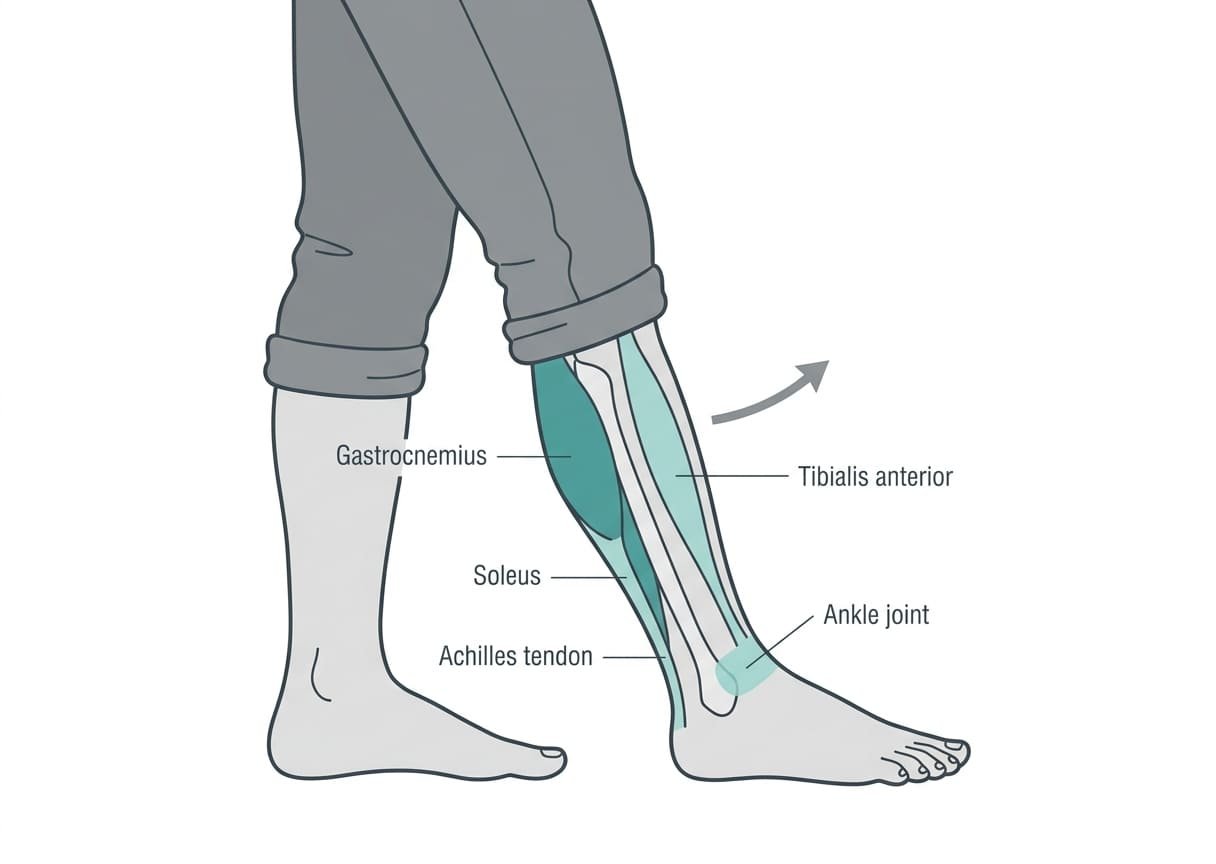
| Gastrocnemius | The larger calf muscle, crosses the knee and ankle, limits range when the knee is straight |
| Soleus | The deeper calf muscle, crosses only the ankle, limits range when the knee is bent |
| Achilles tendon | Connects both calf muscles to the heel, must lengthen to allow the shin forward |
| Talus | The ankle bone that must glide backward as the shin moves forward |
| Tibialis anterior | The shin muscle that actively pulls the foot up |
| Joint capsule and ligaments | Can stiffen after sprains or long periods of limited use |
That fourth row is the one people overlook. Dorsiflexion is not only a matter of calf length. The talus has to slide backward in its socket, and if it does not, no amount of calf stretching will give you the range.
Why limited dorsiflexion matters
When the ankle runs out of range, the body borrows movement from elsewhere. These are the usual compensations.
| Activity | What you see when dorsiflexion is limited |
|---|---|
| Squatting | Heels lift, torso tips far forward, or knees collapse inward |
| Lunging | Front heel lifts or the knee cannot travel over the toes |
| Walking down stairs | Foot turns out, or you descend stiffly |
| Running | Foot turns out and the arch collapses to find extra range |
| Landing from a jump | Stiff landing with less knee bend, so more force goes through the joints |
| Walking | Early heel lift and a shorter stride |
Research on landing mechanics has linked greater dorsiflexion range with more knee bend and lower ground reaction forces on landing, which is one reason ankle mobility gets attention in injury prevention programmes for jumping sports.
A realistic caveat. Limited dorsiflexion is common and plenty of people function well with it. It is worth working on if it restricts something you want to do, such as squatting to depth, or if you notice the compensations above. It is not something to fix simply because a number is below a benchmark.
The knee-to-wall test
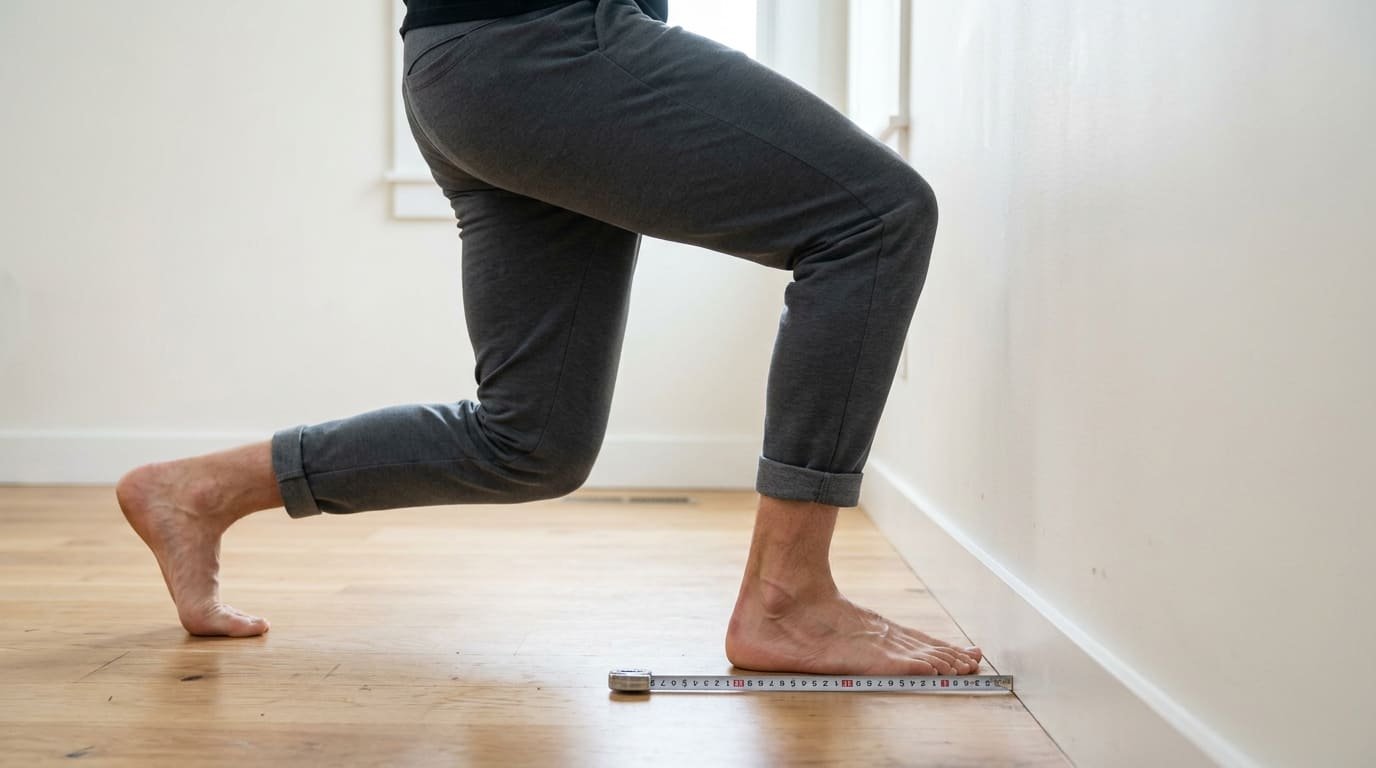
This is the standard way to measure closed chain dorsiflexion, and it needs only a wall and a tape measure.
- Stand facing a wall, barefoot, with one foot forward and its big toe about 5 cm from the wall
- Keep that heel flat on the floor. This is the rule that makes the test valid
- Bend the front knee and try to touch it to the wall, keeping the knee tracking over your second toe rather than drifting inward
- If the knee touches with the heel down, move the foot back 1 cm and try again
- Keep going until you find the furthest distance at which the knee touches and the heel stays flat
- Measure from the tip of the big toe to the wall, then repeat on the other side
| Toe-to-wall distance | What it suggests |
|---|---|
| Under 5 cm | Clearly restricted |
| 5 to 9 cm | Limited, likely to affect squat depth |
| 10 to 12 cm | Adequate for most activities |
| Over 12 cm | Good range |
These bands are approximate guides rather than clinical cut-offs, and they vary with foot length and build. A widely quoted rule of thumb is that each centimetre equals roughly 3.6 degrees of dorsiflexion.
Two things to record: the distance on each side, and the difference between them. A gap of more than about 2 cm between your left and right is worth addressing in its own right, particularly if the stiffer side is one you have sprained before.
Test before you warm up, at the same time of day, and barefoot. Ankles are looser after exercise and later in the day, so inconsistent testing will give you numbers that mean nothing.
Tight calf or stiff joint? How to tell
This is the most useful thing in the article, and it determines which exercises will actually work for you. Do the knee-to-wall test again and notice where you feel the limit.
| What you feel at end range | Likely restriction | What helps most |
|---|---|---|
| A stretch in the calf or Achilles, at the back | Soft tissue: gastrocnemius, soleus or Achilles | Calf stretching and eccentric calf work |
| A pinch or block at the front of the ankle | Joint: the talus is not gliding back | Banded mobilisation, loaded ankle rocks |
| A stretch at the back and a block at the front | Both | A mix of the two approaches |
| Nothing in particular, it just stops | Often joint or long-standing stiffness | Loaded mobility and patience |
A second check separates the two calf muscles. Stretch your calf with the knee straight, then with the knee bent. If the straight-knee version feels much tighter, the gastrocnemius is the limit. If the bent-knee version is the tight one, it is the soleus, and that is the one that matters for squatting because your knee is bent in a squat.
A front-of-ankle pinch that does not improve after a few weeks of mobilisation work, or one that started after a sprain, is worth showing to a physiotherapist. Some restrictions involve bone or scar tissue that exercise will not change.
11 exercises to improve dorsiflexion
For tight calves
1. Straight-knee calf stretch
Stand facing a wall with one leg back, knee straight and heel down. Lean forward until you feel the stretch high in the calf.
- Time: 3 holds of 30 to 45 seconds per leg
- Targets: gastrocnemius
2. Bent-knee calf stretch
The same position, but bend the back knee while keeping the heel down. The stretch moves lower, toward the Achilles.
- Time: 3 holds of 30 to 45 seconds per leg
- Targets: soleus, the one that limits your squat
3. Eccentric calf lowering off a step
Stand with the balls of your feet on a step. Rise onto both feet, shift to one foot, and lower that heel slowly below the level of the step over four seconds.
- Reps: 3 sets of 8 to 10 per leg
- Why it works: it lengthens the calf under load, which improves range and builds strength in that range together
4. Calf foam rolling or ball release
Sit with your calf on a roller or ball and move slowly along it for a minute or two, pausing on tender spots.
- Time: 60 to 90 seconds per leg
- Use it as preparation, since the effect is short-lived on its own
For a stiff joint
5. Knee-to-wall ankle rocks
Set up as in the test, at a distance where the knee only just reaches the wall. Rock the knee forward to the wall and back, keeping the heel down.
- Reps: 3 sets of 15 per side
- The simplest and most effective drill, because it is the test practised as an exercise
6. Banded ankle mobilisation
Loop a heavy band low around the front of your ankle, just above the foot, and anchor it behind you. Step forward into a half-kneeling position so the band pulls backward, then drive your knee forward over your toes.
- Reps: 3 sets of 10 to 15 per side, holding 2 to 3 seconds at end range
- The band helps the talus glide back, which is what a front-of-ankle pinch needs
7. Half-kneeling loaded ankle rock
In half kneeling, rest a dumbbell or kettlebell on your front knee and gently press the knee forward over the toes, heel down. Our kneeling exercises guide covers the setup.
- Reps: 3 sets of 10 per side with a 3-second hold
8. Deep squat ankle shifts
Sit into a deep squat, holding a door frame or counter for support. Shift your weight onto one foot and push that knee forward over the toes, then switch.
- Reps: 2 sets of 8 shifts per side
For strength in the new range
9. Tibialis raise
Once your ankle moves better, our guide to tibialis anterior exercises builds strength in the muscle that lifts your foot.
Stand with your back against a wall, feet about 30 cm out. Keep your heels down and lift your toes toward your shins as high as you can.
- Reps: 3 sets of 15 to 20
- This trains the muscle that actively produces dorsiflexion
10. Heel-elevated to flat squat progression
Squat with your heels on a thin plate or book, working to full depth. Every two weeks, reduce the height until you are squatting flat.
- Reps: 3 sets of 10
- This lets you train depth now while your range catches up
11. Slow goblet squat with a pause
Hold a weight at your chest, squat as deep as your heels allow, and pause for three seconds at the bottom with your knees pushed forward.
- Reps: 3 sets of 8
- Loaded time at end range is what makes new mobility stick
An 8-week plan
A randomised trial of an eight-week programme combining soft tissue work, joint mobilisation, stretching and strengthening, performed three times a week, found a meaningful improvement in weight-bearing dorsiflexion compared with a control group. The plan below follows the same broad structure.
| Weeks | Focus | Daily mobility, 5 minutes | Strength, 3 times a week |
|---|---|---|---|
| Weeks 1 to 2 | Establish the habit | Calf stretches, knee-to-wall rocks | Tibialis raises, heel-elevated squats |
| Weeks 3 to 4 | Add load to the stretch | Add banded mobilisation | Add eccentric calf lowering |
| Weeks 5 to 6 | Build strength at end range | Add loaded half-kneeling rocks | Lower the heel lift, add paused goblet squats |
| Weeks 7 to 8 | Use the range | Maintain | Flat-footed squats, retest |
The 5-minute daily routine:
| Exercise | Dose |
|---|---|
| Calf foam roll | 60 sec per leg |
| Bent-knee calf stretch | 2 x 30 sec per leg |
| Knee-to-wall rocks | 15 per side |
| Banded mobilisation | 10 per side |
Retest every two weeks using the knee-to-wall test, cold and barefoot. A gain of 1 to 2 cm over a month is solid progress.
What to do about your squat in the meantime
You do not have to wait for your ankles before squatting well.
- Raise your heels. A thin plate, a wedge or weightlifting shoes give you the range artificially and let you train depth now
- Widen your stance and turn your toes out slightly, which reduces the dorsiflexion a squat needs
- Use a goblet squat. Holding a weight in front shifts your balance and makes depth easier
- Try a box squat, sitting back to a box, which keeps the shins more upright
None of these are cheating. They let you keep building leg strength while the ankle work catches up. Our what muscles do squats work guide covers the squat variations in more detail, and the single leg squat progression is a good test of ankle range once it improves.
Shoes, heels and daily habits
What you do for the other twenty-three hours matters as much as the drills.
- Raised heels shorten the calf over time. Many everyday shoes, including most running shoes, lift the heel by 8 to 12 mm. Spending all day in them means your ankle rarely visits its full range
- Time barefoot at home helps, because the ankle and foot move through more of their range on a flat surface
- Walk on varied ground when you can. Slopes and uneven paths take the ankle through angles that flat pavements never do
- Sit in a deep squat for short periods, holding a door frame for balance. Thirty seconds a few times a day is a gentle, effective habit
- Do not switch to flat shoes overnight. Moving abruptly from a raised heel to a flat shoe loads the Achilles more than it is used to. Change over weeks, not days
| Habit | Effect on dorsiflexion | How to apply it |
|---|---|---|
| Barefoot time at home | Helpful | Build up gradually from a few minutes |
| Deep squat sits | Helpful | 3 x 30 seconds daily, with support |
| Calf stretch after long sitting | Helpful | 30 seconds per leg |
| All-day raised heels | Unhelpful | Vary your footwear through the week |
| Abrupt change to flat shoes | Risky for the Achilles | Transition over 4 to 8 weeks |
Seven common mistakes
- Only stretching the straight-leg calf. The soleus, stretched with a bent knee, is the one that limits a squat
- Stretching a joint restriction. If you feel a pinch at the front, more calf stretching will not help
- Letting the heel lift during drills, which removes the stretch entirely
- Letting the knee collapse inward and the arch flatten to fake extra range
- Never loading the new range. Mobility you do not strengthen fades within weeks
- Testing warm, in shoes, at different times of day, then wondering why the numbers jump around
- Expecting a result in a week. Tendons and joint capsules adapt slowly
When to see a professional
- A hard, bony block at the front of the ankle that does not change at all
- Pain rather than tightness during the knee-to-wall test
- A large side-to-side difference after an ankle sprain or fracture
- Swelling, locking or a feeling of the ankle giving way
- No change after eight weeks of consistent work
- Pain in the Achilles that worsens with stretching
Related foot and lower leg work is covered in our calf workout at home and flat feet exercises guides, since the calf, arch and ankle influence one another.
The bottom line
Ankle dorsiflexion is the shin moving forward over a planted foot, and when it is limited, your squat, lunge and landing mechanics all have to work around it.
Measure it first with the knee-to-wall test, then notice where you feel the limit. A stretch at the back means calf work. A pinch at the front means joint mobilisation. Many people need some of both.
Do five minutes of mobility daily, three short strength sessions a week, and retest every fortnight. Use a heel lift so you can keep squatting properly while the range improves. Above all, load the new range with tibialis raises and paused squats, because mobility you never use does not stay.
Tight calves are one of the most common limits on ankle range. My guide to calf stretches shows how to stretch both calf muscles properly, with a straight and a bent knee.
Frequently asked questions
What is ankle dorsiflexion?
The movement that brings the top of your foot and your shin closer together. With the foot planted, it means the shin travelling forward over the foot, as in squatting, lunging or walking down stairs. It is the opposite of plantarflexion, which is pointing the foot downward.
How do I test my ankle dorsiflexion?
Use the knee-to-wall test. Stand barefoot facing a wall, keep your heel flat, and find the furthest distance from the wall at which your knee can still touch it. Measure from your big toe to the wall. Around 10 cm or more is a commonly used benchmark for adequate range.
How long does it take to improve ankle dorsiflexion?
Most people see a measurable change in four to eight weeks of consistent work, typically a gain of 1 to 2 cm on the knee-to-wall test in the first month. Joint restrictions and long-standing stiffness after a sprain can take longer, since tendons and joint capsules adapt slowly.
What causes limited ankle dorsiflexion?
Tight calf muscles, a stiff ankle joint in which the talus does not glide backward properly, scar tissue or stiffness after a sprain, long periods in shoes with raised heels, and individual bone structure. Feeling a stretch at the back suggests a calf restriction, while a pinch at the front suggests the joint.
Does limited ankle mobility affect squats?
Yes. Without enough dorsiflexion the shins cannot travel forward, so the heels lift, the torso tips forward or the knees collapse inward. Raising your heels on a thin plate, widening your stance or using a goblet squat lets you train depth while you work on the ankle range.
Should I stretch or mobilise my ankles?
It depends on where you feel the restriction. Calf stretching helps when the limit is a stretch at the back of the lower leg. Banded mobilisation and knee-to-wall rocks help when you feel a block or pinch at the front of the ankle. Many people benefit from doing both.
Why do I feel a pinch at the front of my ankle?
It usually means the talus, the ankle bone, is not gliding backward as the shin moves forward, so the joint closes at the front. A banded mobilisation, with the band pulling backward across the front of the ankle, often relieves it. A pinch that persists should be assessed by a physiotherapist.
Are calf raises good for ankle dorsiflexion?
Slow eccentric calf lowering off a step is, because it lengthens the calf under load and builds strength in that lengthened position. Standard calf raises on flat ground do little for range. Pair eccentric lowering with tibialis raises, which strengthen the muscle that actively lifts the foot.
What’s next?
Reading is the easy part. Pick one of these and do it today.