
Vibration Plate Exercises: 12 Moves and What the Evidence Says
Vibration plates are marketed with some of the boldest claims in home fitness. Ten minutes replacing an hour in the gym. Cellulite reduction. Effortless fat loss. Almost none of that holds up.
What does hold up is more modest and more interesting. A vibrating platform makes your muscles contract reflexively many times per second as they respond to the movement underfoot. That produces a genuine training stimulus, and the research suggests it is most useful for specific groups: older adults building lower body strength, people with limited mobility who cannot do conventional exercise, and anyone who wants a low-impact way to add work to their week.
This guide gives you twelve exercises with actual settings and timings, a straight assessment of what the evidence supports, and a safety list that sellers rarely mention. If you own a plate or are considering one, this should tell you whether it earns its space.
At a glance
- The plate makes muscles contract reflexively as they respond to the movement
- Best supported for lower body strength in older adults, and for low-impact training
- Weak or unsupported: fat loss, cellulite, and replacing conventional exercise
- Hold each position 30 to 60 seconds rather than performing normal reps
- 15 minutes, three times a week, is the usual recommendation
- A real contraindication list exists, and it matters
How a vibration plate works
You stand on a platform that vibrates rapidly, typically somewhere between 20 and 50 times per second. Each small movement of the platform slightly changes the length of the muscles holding you up, and your body responds with a rapid reflexive contraction to stabilise.
The result is that a muscle contracts far more often during a 60-second hold than it would standing still on solid ground. That is the mechanism, and it is real.
Two types of plate exist, and they feel different:
| Type | How it moves | Typical frequency | Feels like | Notes |
|---|---|---|---|---|
| Oscillating (pivotal) | Tilts side to side like a seesaw | 5 to 30 Hz | A rocking motion | Gentler, less transmission to the head |
| Vertical (lineal) | The whole plate moves up and down | 20 to 50 Hz | A buzzing sensation | More intense, more vibration reaches the upper body |
| Dual motion | Both, switchable | Varies | Either | More expensive, more versatile |
For general home use, oscillating plates tend to be more comfortable and transmit less vibration to the head and spine. Vertical plates are more common in research settings.
What the research actually supports
This is the section that matters most, because the marketing and the evidence are far apart.
Reasonably supported:
- Lower body strength in older adults. This is the strongest finding. Reviews have repeatedly found improvements in leg strength, particularly knee extensor strength, in older populations
- Balance and gait in older adults, which follows from the strength improvements
- Flexibility, where there is moderate evidence for improvements in hamstring range
- Chronic low back pain, where reviews have found improvements in pain and function, though the studies are generally small
- As a supplement to normal training, where combining vibration with conventional exercise often produces better results than conventional exercise alone
Weak, mixed or unsupported:
- Fat loss. Some studies show modest results, usually alongside diet changes. The energy cost of standing on a plate is low, and no plausible mechanism makes it a significant fat loss tool on its own
- Bone density. Animal studies looked promising, but human trials have been considerably less convincing
- Cellulite. No good evidence
- Replacing exercise. The most thorough reviews conclude that vibration training is a potential supplement rather than a substitute for conventional training
The honest summary: a vibration plate is a legitimate piece of equipment with a modest, real effect, most useful for people who cannot easily do conventional resistance training. It is not a shortcut, and anyone selling it as one is overstating what it does.
Choosing your settings
Most plates have a speed or intensity dial, often numbered 1 to 30 or 1 to 99, which does not map neatly onto frequency. Use this as a practical guide.
| Purpose | Intensity | Time per position | Total session |
|---|---|---|---|
| Warm-up and circulation | Low, around 20 to 30 percent | 30 to 60 sec | 5 min |
| Balance and stability | Low to moderate | 45 to 60 sec | 10 min |
| Strength and muscle | Moderate to high | 30 to 45 sec | 15 min |
| Flexibility and stretching | Low | 30 to 60 sec per stretch | 5 to 10 min |
| Recovery and massage | Low | 1 to 2 min per area | 5 to 10 min |
Start lower than you think. Five to ten minutes at a low setting for your first week is sensible. If your vision blurs, your teeth chatter or you feel anything in your head, the intensity is too high.
Keep your knees soft. Locked knees transmit vibration straight up through the skeleton to the spine and head. A slight bend lets the leg muscles absorb it, which is both safer and more effective.
12 vibration plate exercises
The key difference from normal training: you hold positions rather than performing reps. Time under vibration is what produces the stimulus.
Lower body
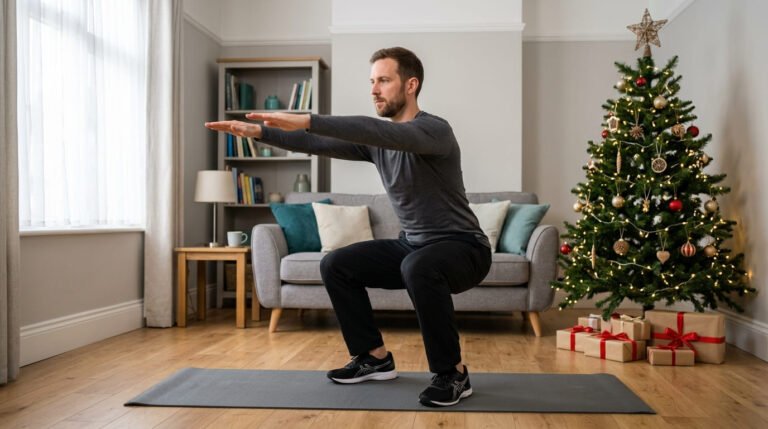
1. Static squat hold
Stand on the plate, feet hip width, and hold a quarter or half squat with knees soft and weight through the mid-foot.
- Time: 3 holds of 30 to 60 seconds
- The foundational exercise, and the one most of the research uses
2. Slow squat
The same, but moving slowly through the range rather than holding.
- Reps: 3 sets of 10, taking 3 seconds down and 3 up
3. Split squat hold
One foot on the plate, the other behind you on the floor, holding a lunge position.
- Time: 3 holds of 30 seconds each leg
4. Calf raise hold
Rise onto the balls of your feet on the plate and hold, then lower slowly.
- Time: 3 holds of 30 seconds, or 3 sets of 12 slow reps
5. Single-leg balance
Stand on one leg on the plate with a soft knee, holding a rail or wall for support.
- Time: 3 holds of 20 to 30 seconds each leg
- Start with support every time
6. Glute bridge
Lie on the floor with your feet on the plate and lift your hips into a bridge, holding at the top.
- Time: 3 holds of 30 to 45 seconds
Upper body and core
7. Push-up hold
Hands on the plate, body in a push-up position, either from the knees or the feet, holding at the top or halfway down.
- Time: 3 holds of 20 to 40 seconds
8. Plank
Forearms on the plate, holding a plank.
- Time: 3 holds of 20 to 45 seconds
9. Triceps dip position
Sitting with your hands behind you on the plate, holding your body weight with arms slightly bent.
- Time: 3 holds of 20 to 30 seconds
10. Seated position
Sit on the floor with your feet or hands on the plate. This is the gentlest option and useful if standing is difficult.
- Time: 2 to 3 minutes
Stretching and recovery
11. Hamstring stretch
Place one heel on the plate with a straight leg and hinge forward gently from the hips.
- Time: 30 to 60 seconds each leg, low intensity
12. Calf and foot rolling
Sit with your calf resting on the plate, or stand with just the arches of your feet on it, at a low setting.
- Time: 1 to 2 minutes per area
A 15-minute session and a starting plan
| Exercise | Time | Intensity |
|---|---|---|
| Standing warm-up, soft knees | 2 min | Low |
| Static squat hold | 3 x 45 sec | Moderate |
| Split squat hold | 2 x 30 sec each leg | Moderate |
| Calf raise hold | 3 x 30 sec | Moderate |
| Plank on forearms | 3 x 30 sec | Moderate |
| Glute bridge | 2 x 40 sec | Moderate |
| Hamstring stretch | 60 sec each leg | Low |
A four-week starting plan:
| Week | Sessions | Duration | Intensity |
|---|---|---|---|
| Week 1 | 2 | 5 to 8 min | Low, standing and squat holds only |
| Week 2 | 3 | 10 min | Low to moderate, add split squats and calf raises |
| Week 3 | 3 | 12 to 15 min | Moderate, add upper body holds |
| Week 4 | 3 | 15 min | Moderate, full routine above |
Fifteen minutes three times a week is the commonly cited protocol and a sensible ceiling for home use. More is not better here, and very long sessions raise the total vibration exposure without a clear benefit.
Who should not use a vibration plate
This list is genuinely important and sellers rarely present it clearly. Avoid vibration plates, or speak to your doctor first, if any of the following apply.
- Pregnancy
- A pacemaker or other implanted medical device
- Recent surgery, fracture or acute injury
- Deep vein thrombosis or a blood clotting disorder
- Severe osteoporosis
- Epilepsy
- Retinal conditions or recent eye surgery
- Severe cardiovascular disease, or poorly controlled blood pressure
- Recent joint replacement
- Hernia
- Gallstones or kidney stones
- Migraine or vertigo, which vibration can trigger in some people
- Children, since effects on growing skeletons are not well established
Stop immediately if you experience dizziness, nausea, headache, blurred vision, numbness or any pain.
This is not a complete list, and it is not medical advice. If you have any ongoing health condition or take regular medication, check with your doctor before starting. Vibration is a physical stimulus that travels through the whole body, which makes the contraindications broader than for most exercise equipment.
Who a vibration plate genuinely suits
| Group | Likely benefit | Notes |
|---|---|---|
| Older adults | Good, best-supported use | Lower body strength and balance |
| People with limited mobility | Good | Provides a training stimulus when conventional exercise is hard |
| People with joint pain | Moderate | Low impact, though check contraindications |
| Anyone short on time | Moderate | A supplement, not a replacement |
| People wanting to lose fat | Low | Diet and general activity matter far more |
| Healthy, active people | Low to moderate | Adds a little, but conventional training matters more |
| Anyone looking to build serious muscle | Low | Progressive loading with weights is far more effective |
The clearest case for buying one: you are older, or have a condition that makes conventional resistance training difficult, and you want a low-impact way to build leg strength and balance at home.
The weakest case: you are healthy and active, and you want it to replace strength training or produce fat loss. It will do neither, and a set of dumbbells would serve you far better for the same money. Our guide to the best home gym equipment for beginners covers where the money goes furthest.
How to fit it into a week
A vibration plate works best alongside conventional training rather than instead of it.
| Day | Main activity | Plate use |
|---|---|---|
| Monday | Strength session | 5 min warm-up and stretching after |
| Tuesday | Walk | 15 min full plate session |
| Wednesday | Rest | 5 min stretching and recovery |
| Thursday | Strength session | 5 min warm-up |
| Friday | Walk | 15 min full plate session |
| Weekend | Activity you enjoy | Optional recovery session |
If the plate is your only training, three 15-minute sessions a week is a reasonable programme, and adding walking will do more for your general health than adding plate time. Our walking for weight loss guide covers how much that contributes.
What to look for if you are buying one
Plates range from about £100 to well over £2,000, and the differences are worth understanding before you spend.
| Feature | What to look for | Why it matters |
|---|---|---|
| Motion type | Oscillating for comfort, vertical for intensity | Oscillating transmits less vibration to the head |
| Frequency range | A usable low end, ideally from around 5 Hz | Cheap plates often start too intense |
| Weight capacity | Comfortably above your body weight | Affects motor life and stability |
| Amplitude | Adjustable if possible | More control over intensity than speed alone |
| Platform size | Wide enough to stand comfortably | Small plates limit which exercises you can do |
| Support handle or rail | Useful for balance work and older users | A genuine safety feature, not a gimmick |
| Noise | Check reviews | Some cheaper motors are very loud on hard floors |
| Build weight | Heavier units are usually more stable | Very light plates can move on the floor |
Two warnings about the cheap end. Many budget plates vibrate at a fixed high frequency with no genuine low setting, which makes the gentle protocols in this article impossible. And some very cheap units produce vibration levels that are uncomfortable and poorly controlled, which is the opposite of what you want from a piece of equipment whose whole premise is a controlled stimulus.
One thing not to pay for: preset programmes. They are marketing. Holding a squat for 45 seconds at a moderate setting is the exercise, and no programme improves on that.
Seven common mistakes
- Locking your knees, which sends vibration straight up the skeleton
- Starting at high intensity rather than building up over a fortnight
- Expecting it to replace exercise, which the evidence does not support
- Very long sessions. More vibration exposure is not better
- Ignoring the contraindication list because the marketing makes it sound entirely benign
- Performing fast reps rather than holding positions, which misses the point of the stimulus
- Buying one for fat loss, where the money would go considerably further elsewhere
What to realistically expect
| Timeframe | What usually changes |
|---|---|
| Weeks 1 to 2 | The sensation stops feeling strange, holds become easier |
| Weeks 3 to 6 | Noticeably steadier on one leg, legs tire less during holds |
| Weeks 6 to 12 | Measurable leg strength gains, particularly if you were previously inactive |
| 3 months and beyond | Progress slows unless you add conventional resistance training |
How to track it honestly. Time how long you can hold a static squat at a fixed intensity, and test a single-leg stand off the plate. Both should improve over six to eight weeks. Do not track progress by how the vibration feels, since you adapt to the sensation long before the strength changes.
The plateau is real and worth planning for. A vibration plate has a fixed ceiling: you cannot progressively load it the way you can add weight to a dumbbell. Once holds become comfortable at your highest tolerable setting, further progress needs something else, whether that is adding resistance while you stand on the plate, or moving on to conventional strength work.
That is not a criticism of the equipment so much as a description of what it is. A plate gets a sedentary person moving and builds a base. Building substantial strength from there needs progressive loading.
One simple way to extend its useful life: hold a pair of light dumbbells during your squat and split squat holds, or wear a loaded backpack. That reintroduces progression without changing anything else about how you use the plate, and it is the cheapest upgrade available.
The bottom line
A vibration plate does something real. The platform movement triggers rapid reflexive muscle contractions, and that produces a modest but genuine training effect. The research is most convincing for lower body strength and balance in older adults, and for people who cannot easily do conventional resistance training.
It does not replace exercise, it does not remove fat in any meaningful way, and the cellulite claims have nothing behind them.
If you own one, use it properly: soft knees, hold positions for 30 to 60 seconds rather than doing fast reps, build up from five minutes to fifteen over a month, and treat it as an addition to walking and strength work rather than a substitute. Read the contraindication list before your first session, because vibration reaches the whole body and the cautions are broader than for most equipment.
Frequently asked questions
Do vibration plates actually work?
They produce a real but modest effect. The evidence is reasonably good for improving lower body strength and balance in older adults, for flexibility, and for chronic low back pain. It is weak or absent for fat loss, cellulite and bone density in humans. Reviews generally conclude vibration is a supplement to exercise rather than a replacement.
How long should you use a vibration plate?
Fifteen minutes, three times a week, is the commonly recommended protocol. Start with five to eight minutes at a low intensity for the first week and build up over a month. Longer sessions increase total vibration exposure without clear additional benefit.
Can you lose weight with a vibration plate?
Not to any meaningful degree on its own. The energy cost of standing on a plate is low, and studies showing weight loss generally involve dietary changes alongside. Fat loss is driven by overall energy balance, so diet, daily movement and conventional exercise matter far more than plate time.
What exercises can you do on a vibration plate?
Squat holds, split squats, calf raises, glute bridges, single-leg balances, planks, push-up holds and stretches. The key difference from normal training is that you hold positions for 30 to 60 seconds rather than performing fast repetitions, since time under vibration is what creates the stimulus.
Who should not use a vibration plate?
Anyone pregnant, with a pacemaker or implanted device, recent surgery or fracture, blood clots or clotting disorders, severe osteoporosis, epilepsy, retinal conditions, severe cardiovascular disease, recent joint replacement, hernia, gallstones or kidney stones. Children should not use them, and anyone with an ongoing health condition should check with a doctor first.
Are vibration plates good for older adults?
This is their best-supported use. Reviews have found improvements in lower body strength, particularly knee extensor strength, along with better balance and gait. They are low impact, which suits people who find conventional resistance training difficult. Use a support rail and start at a low intensity.
Should you bend your knees on a vibration plate?
Yes, always keep a slight bend. Locked knees transmit vibration directly up through the skeleton to the spine and head, which is both less comfortable and less effective. A soft knee lets the leg muscles absorb the movement, which is where the training stimulus comes from.
Is an oscillating or vertical vibration plate better?
Oscillating plates tilt like a seesaw and transmit less vibration to the head and spine, which makes them more comfortable for most home users. Vertical plates move the whole platform up and down at higher frequencies and are more common in research settings. For general home use, oscillating is usually the more comfortable choice.
What’s next?
Reading is the easy part. Pick one of these and do it today.