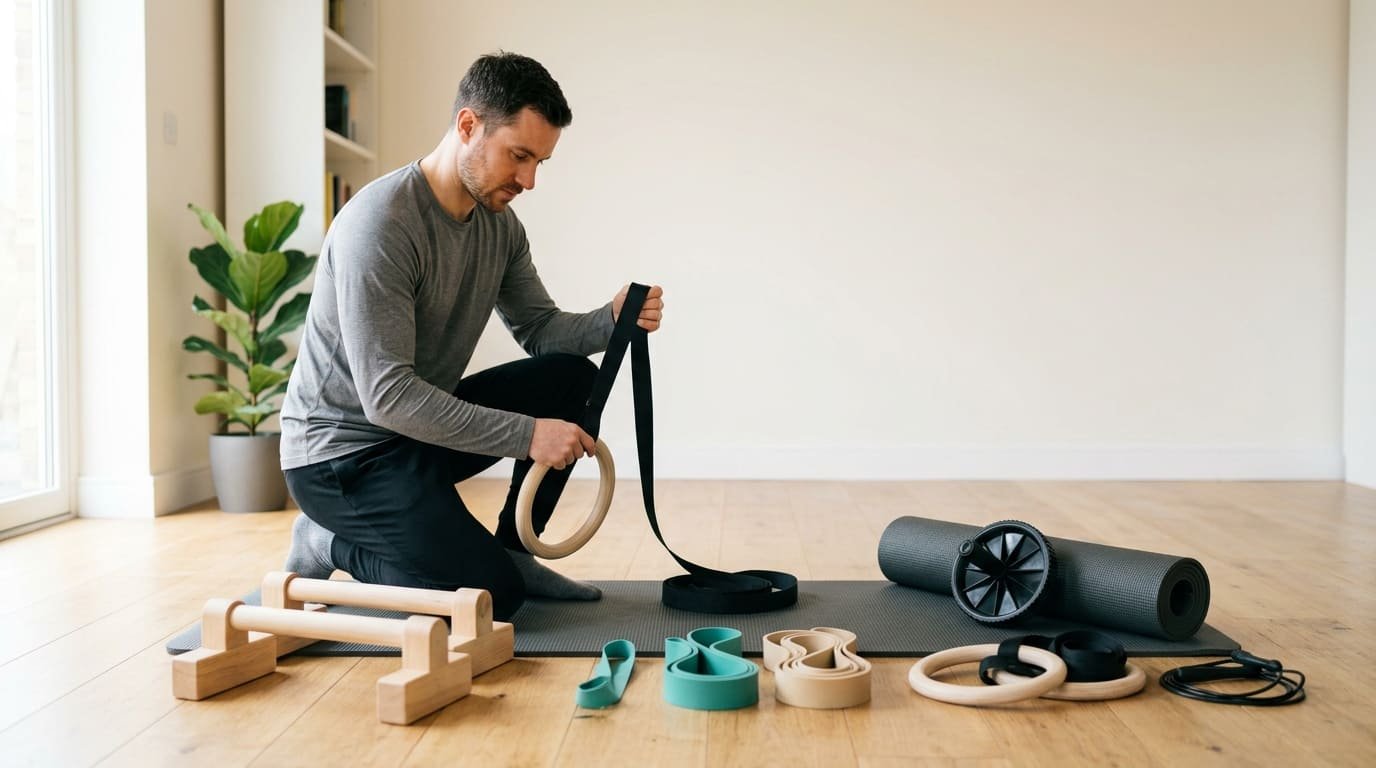
Bodyweight Exercise Equipment: What to Buy First and What to Skip
Bodyweight training is supposed to need nothing, and for the first few months that is true. Push-ups, squats, lunges and planks will take a beginner a long way with only a floor.
Then you run into the gap. There is no good way to train your back and biceps without something to pull on. I spent my first months doing push-ups and squats and wondering why my posture was getting worse instead of better. The answer was simple: I was pushing three times a week and pulling never.
That is what bodyweight exercise equipment is for. It does not replace your body as the resistance. It gives you something to hang from, lets you move through a longer range, and makes exercises easier or harder than the floor allows. This guide ranks the equipment by how much it adds, tells you what to buy first on any budget, and points out what you can safely skip.
At a glance
- You can start bodyweight training with no equipment at all
- The first thing worth buying is something to pull on: a pull-up bar, rings or a suspension trainer
- Resistance bands are the best-value second purchase, because they make hard exercises easier
- A complete home setup can cost less than two months of gym membership
- Check the weight rating and the fixing point of anything you hang from
- Skip gadgets that only do one exercise until you have the basics
Do you need equipment for bodyweight training?
Not to begin. Our no equipment home workout and calisthenics workout plan for beginners both work with nothing but floor space.
Equipment earns its place by solving four specific problems.
| Problem with floor-only training | What solves it | Example |
|---|---|---|
| No pulling exercises for the back and biceps | Something to hang from or pull against | Pull-up bar, rings, suspension trainer |
| Exercises are too hard to start | Assistance | A band under your knees or feet for pull-ups and dips |
| Exercises become too easy | Added load or a harder angle | Weighted vest, rings, parallettes |
| Limited range of motion and sore wrists | Raised or neutral-grip handles | Parallettes, push-up handles |
If a piece of equipment does not solve one of these, you probably do not need it yet.
It is also worth knowing that bodyweight training done progressively builds real muscle. In one study, a group doing progressively harder push-up variations for four weeks gained similar strength and muscle thickness to a group training the bench press.
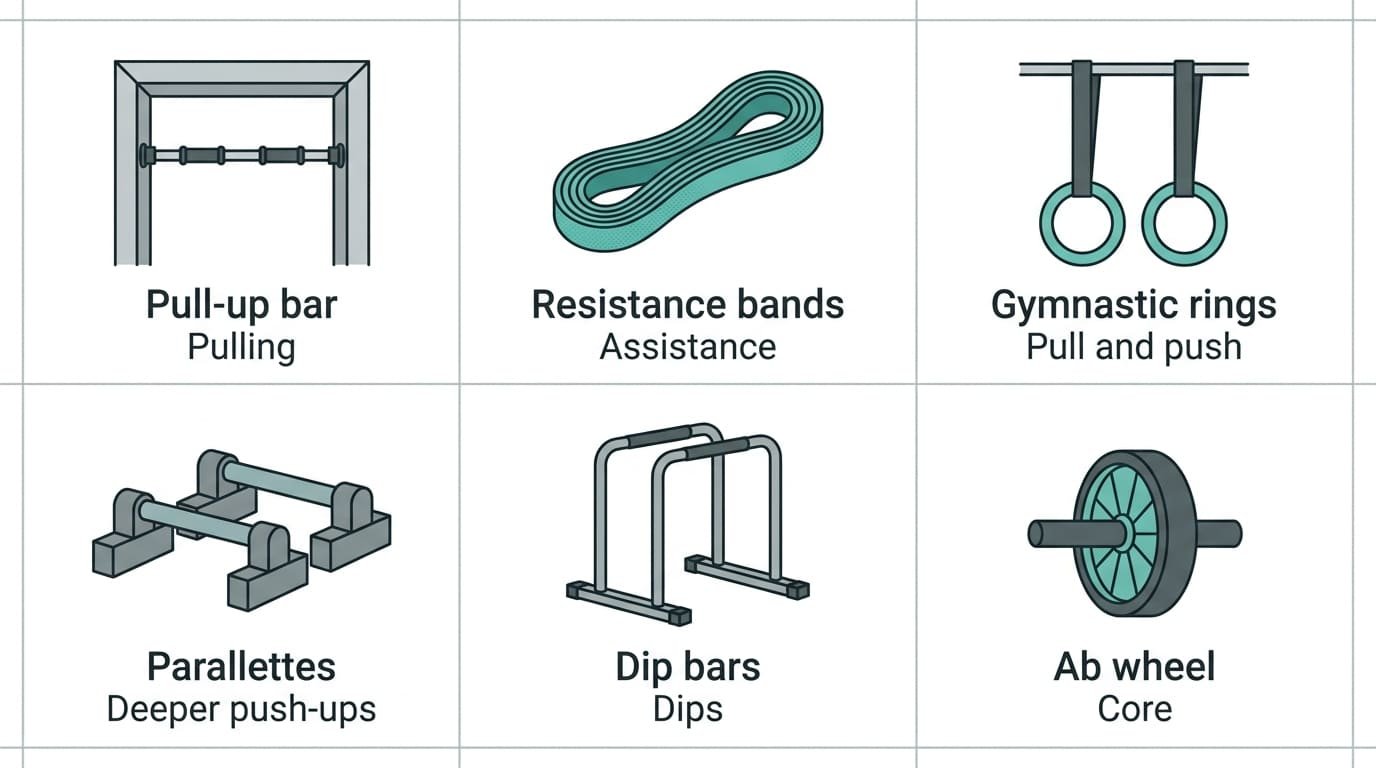
Bodyweight training equipment, ranked by usefulness
Prices are rough guides for mid-range products and vary by country and brand.
| Rank | Equipment | What it adds | Typical price (US dollars) | Space needed |
|---|---|---|---|---|
| 1 | Pull-up bar | Pulling: pull-ups, chin-ups, hangs, leg raises | 25 to 80 | A doorway or wall |
| 2 | Resistance bands | Assistance, added resistance, pulling without a bar | 15 to 50 | A drawer |
| 3 | Gymnastic rings | Pulling and pushing at any height, rows, dips, support work | 30 to 60 | Somewhere to hang them |
| 4 | Parallettes | Deeper push-ups, L-sits, wrist-friendly holds | 30 to 90 | A shelf |
| 5 | Dip bars or dip station | Dips, rows, leg raises | 60 to 150 | About one square metre |
| 6 | Exercise mat | Comfort for floor work | 15 to 40 | Rolls up |
| 7 | Ab wheel | Hard core training | 10 to 25 | A drawer |
| 8 | Weighted vest | Extra load on basics | 40 to 150 | A hook |
| 9 | Jump rope | Cardio and coordination | 8 to 25 | Ceiling height and a clear floor |
| 10 | Power tower | Pull-up bar and dip station in one frame | 120 to 300 | About 1.5 square metres and 2.2 metres of height |
1. Pull-up bar
If you buy one thing, buy this. It fills the biggest hole in floor-only training and opens up pull-ups, chin-ups, dead hangs and hanging knee raises.
| Type | How it fits | Good for | Watch out for |
|---|---|---|---|
| Doorway lever bar | Hooks over the door frame and braces against it, no screws | Renters, quick setup | Needs a sturdy frame with a proper trim, and can mark paintwork |
| Telescopic doorway bar | Twists to press against both sides of the frame | Very small spaces | Can slip unless you use the screw-in cups supplied |
| Wall or ceiling-mounted bar | Bolted into studs, joists or masonry | Homeowners, the most solid option | Requires drilling and correct fixings |
| Free-standing bar or tower | Stands on the floor | No suitable door or wall | Takes up floor space and can wobble |
What to look for: a stated weight limit comfortably above your own weight, a grip about as thick as a broom handle or slightly thicker, and enough room above the bar for your head.
If you cannot do a pull-up yet, the bar is still useful. Start with dead hangs, slow lowering from the top, and band-assisted reps. Our pull-up alternatives guide lays out the progression.
2. Resistance bands
Bands do three jobs in bodyweight training, which is why they rank so high.
- Assistance. Loop a long band over the bar and place a knee or foot in it. The band takes part of your weight, so you can practise full pull-ups and dips before you are strong enough to do them alone
- Resistance. Rows, pull-aparts, presses and leg work with no bar at all
- Warm-up and mobility. Shoulder and hip preparation before training
What to buy: a set of long loop bands in three or four thicknesses. The thicker the band, the more it helps in assisted exercises. Add a pack of mini loop bands for hip and glute work. Our guide to the best resistance bands for beginners compares the types.
3. Gymnastic rings
Rings are the most versatile piece of bodyweight equipment you can own. Because the straps adjust, the same pair does rows at chest height, dips at waist height and push-ups near the floor.
- Rows, from nearly upright to nearly horizontal
- Push-ups and dips with a deeper range
- Pull-ups and chin-ups, with handles that rotate freely, which many people find kinder to elbows and shoulders
- Core work, such as knee tucks and fallouts
- Support holds, which build shoulder stability
The catch: rings are unstable, so every exercise is harder than its fixed-bar version. That is a benefit later and a hurdle at first. Start with rows and supported holds.
What to look for: wooden rings for indoor grip, or plastic if they will live outdoors. Straps with numbered markings make it easy to set both sides level. You need a pull-up bar, a beam, a sturdy tree branch or ceiling anchors to hang them from.
Suspension trainers are a close relative: two handles on adjustable straps, often with a door anchor. They are easier to set up in a flat and excellent for rows and core work, but less suited to dips and pull-ups.
4. Parallettes
Parallettes are a pair of short bars a few centimetres to about 30 cm off the floor.
- Deeper push-ups, because your chest can travel below your hands
- A neutral wrist position, which helps if flat-palm push-ups make your wrists ache
- L-sits and tuck holds for the core
- Pike push-ups and, later, handstand work
What to look for: a wide, non-slip base, a grip around 3 to 4 cm thick, and a height that suits your goal. Low versions are steadier for push-ups. Taller versions give room for L-sits. Push-up handles are a cheaper alternative that covers the wrist and range benefits only.
5. Dip bars and dip stations
Dips are one of the best bodyweight exercises for the chest, shoulders and triceps, and they need two stable, parallel supports at about waist height.
A free-standing dip station also works for inverted rows underneath the bars, knee raises and support holds. Look for a wide base, a clear weight limit and bars spaced a little wider than your shoulders.
Dips are demanding on the shoulders, so learn them gradually. Our dip exercise guide covers form, bench dips and the band-assisted version.
6. Exercise mat
Not exciting, but you will use it every session. A mat protects your knees, elbows and tailbone during planks, bridges and core work, and keeps your hands from sliding on hard floors.
Choose one around 6 to 10 mm thick for general training. Very thick, soft mats feel comfortable but make balance exercises wobbly.
7. Ab wheel
A small wheel with a handle on each side. The rollout is one of the hardest core exercises there is, because your abs must stop your lower back from sagging as your arms travel forward.
Start on your knees and roll out only as far as you can control. If you feel it in your lower back rather than your stomach, shorten the range. A wider wheel is steadier for beginners.
8. Weighted vest
When push-ups, squats and pull-ups become easy, a vest lets you keep the same exercises and add load in small steps.
This is a later purchase. It makes sense once you can do around 15 good push-ups and 8 pull-ups. Look for a vest with removable weights so you can increase gradually, and a snug fit that does not bounce. Our weighted vest training guide explains how heavy to go.
9. Jump rope
Bodyweight strength work does little for your heart and lungs unless you arrange it as a circuit. A rope is the cheapest piece of cardio equipment available and takes up no space.
A basic beaded or PVC rope is ideal for learning. To size it, stand on the middle with one foot: the handles should reach roughly to your armpits.
10. Power tower
A power tower combines a pull-up bar, dip handles and usually a padded station for knee raises in one free-standing frame.
Good if you have a garage or spare room, cannot fix anything to walls or door frames, and want everything in one place.
Less good if space is tight or your ceiling is low. Cheaper models can rock during pull-ups, so check the weight rating and the width of the base. A doorway bar plus a pair of rings does most of the same jobs for a fraction of the price and floor space.
Small extras that are worth having
| Item | What it is for | Do you need it? |
|---|---|---|
| Chalk or liquid chalk | Grip on bars and rings when hands sweat | Useful once you are hanging regularly |
| Sliders | Core and hamstring exercises on smooth floors | Nice to have. Towels on a hard floor work too |
| Dip belt | Hanging weight for pull-ups and dips | Only for advanced trainees |
| Wrist wraps | Support during long holds on the hands | Only if your wrists need it |
| Sturdy step or box | Step-ups, raised push-ups, Bulgarian split squats | Useful. A stair or solid chair also works |
| Door anchor | Fixing bands or a suspension trainer to a door | Often included with tube band sets |
Three starter kits by budget
| Budget | What to buy | What it lets you train |
|---|---|---|
| About 50 dollars | Doorway pull-up bar, set of long loop bands | Pull-ups with band assistance, hangs, rows, plus all floor exercises |
| About 120 dollars | The above, plus gymnastic rings and an exercise mat | Rows at any angle, ring push-ups and dips, core work |
| About 250 dollars | The above, plus parallettes, an ab wheel, a jump rope and mini bands | A complete bodyweight gym, including holds and cardio |
Buy in this order rather than all at once. Each piece should be bought because your training needs it, not because it came in a bundle.
What to buy for your goal
| Your goal | First purchase | Second purchase |
|---|---|---|
| General fitness as a beginner | Resistance bands | Pull-up bar |
| A stronger back and better posture | Pull-up bar or rings | Long loop bands |
| Your first pull-up | Pull-up bar | Long loop bands for assistance |
| Bigger chest and arms | Rings or dip bars | Parallettes |
| Core strength | Exercise mat | Ab wheel |
| Fat loss and conditioning | Jump rope | Resistance bands |
| Training in a very small flat | Bands with a door anchor | Doorway pull-up bar |
| Travel | Bands | Suspension trainer or rings |
Safety checks before you hang from anything
Equipment that fails does so suddenly, and usually when you are upside down or at the top of a rep. These checks take a minute.
- Read the weight limit and make sure it is well above your body weight, plus any vest you might add later
- Inspect the door frame. Doorway bars need a solid frame with intact trim. Do not use them on glass doors, damaged frames or thin partition walls
- Test with your feet on the floor first. Pull down hard and bounce gently before you take your full weight
- Fix wall and ceiling bars into structure, meaning studs, joists or solid masonry, with the correct bolts. Plasterboard alone will not hold. If you are unsure, ask someone qualified
- Check straps and buckles on rings and suspension trainers for fraying and slipping
- Inspect bands for nicks and cracks before each session
- Clear the space around and below you
- Set parallettes and dip bars on a level, non-slip surface
If you rent your home, check your tenancy agreement before drilling. Doorway lever bars, rings on a doorway bar, and bands with a door anchor all work without leaving a mark.
Free substitutes you already own
You can test whether you will use something before paying for it.
| Instead of | Use | How |
|---|---|---|
| Pull-up bar, for rows | A sturdy table | Lie underneath, grip the edge and pull your chest up to it |
| Dip bars | Two solid, heavy chairs, or a kitchen worktop corner | Check they cannot slide or tip |
| Parallettes | Two thick books or a pair of dumbbells | Hands on top for a neutral grip |
| Sliders | Two small towels on a hard floor | Under the feet or hands |
| Weighted vest | A backpack loaded with books | Wear it snugly, high on the back |
| Step or box | The bottom stair | For step-ups and raised push-ups |
These are fine for trying an exercise. For regular training, purpose-made equipment is safer and more comfortable.
What to skip, at least for now
- Single-exercise gadgets, such as sit-up frames and twisting boards. A mat does the same job
- Very cheap power towers with narrow bases and no stated weight limit
- Sauna belts and waist trimmers. They do not burn fat
- Electrical muscle stimulators sold as a replacement for exercise
- A weighted vest in your first few months. Master the movements first
- Several versions of the same thing. A bar and rings cover pulling. You do not also need a tower
If you are setting up a wider home gym with weights as well, our guide to the best home gym equipment for beginners covers dumbbells, benches and more, and do you need equipment to work out at home looks at the question from the start.
A first workout with the 50-dollar kit
Three times a week, with a rest day between sessions. Rest 60 to 90 seconds between sets.
| Exercise | Equipment | Sets | Reps |
|---|---|---|---|
| Band-assisted pull-up, or slow lowering from the top | Bar and long band | 3 | 3 to 6 |
| Push-up, or incline push-up | None | 3 | 6 to 12 |
| Bodyweight squat | None | 3 | 12 to 15 |
| Band row, band anchored around the bar upright or a post | Long band | 3 | 10 to 12 |
| Reverse lunge | None | 2 | 8 per leg |
| Hanging knee raise, or dead hang | Bar | 2 | 6 to 10, or 15 to 30 seconds |
| Plank | None | 2 | 30 to 45 seconds |
Add a rep to each set when you can. When you reach the top of the range, use a thinner band for the pull-ups or move to a harder push-up variation. Our sets and reps guide explains how to progress.
Looking after your equipment
- Bands: store them away from sunlight and radiators, keep them dry, and replace them at the first sign of cracking
- Wooden rings and parallettes: keep them dry and brush off chalk. Do not leave wood outdoors
- Straps: check stitching and buckles every few weeks
- Doorway bars: take them down between sessions if they mark the frame, and check the contact pads
- Bolted bars: retighten the fixings after the first few weeks of use, then every few months
- Mats: wipe them down with mild soapy water and let them dry flat
The bottom line
You do not need equipment to start bodyweight training, and you should not let a shopping list delay your first workout.
When you are ready to buy, begin with the gap that floor exercises cannot fill: pulling. A doorway pull-up bar and a set of long bands cost about as much as one month at a gym and turn a push-only routine into a balanced one. Rings are the best next step, followed by parallettes if your wrists or your push-ups need them.
Buy one piece at a time, check what you hang from, and add the next item only when your training asks for it.
For how to use the wheel safely, see our guide to ab wheel exercises.
Frequently asked questions
What equipment do I need for bodyweight exercises?
None to begin with. The most useful additions are a pull-up bar, which makes back and biceps training possible, and a set of resistance bands, which make hard exercises easier to learn. Rings, parallettes and a mat are good next steps.
What is the best piece of bodyweight training equipment?
For most people, a pull-up bar, because pulling is the one movement you cannot train well on the floor. Gymnastic rings are the most versatile single item if you have somewhere to hang them, since they cover rows, pull-ups, push-ups and dips.
Are doorway pull-up bars safe?
They are safe when used on a solid door frame with intact trim and within the stated weight limit. Test the bar with your feet on the floor before each session. Avoid damaged or very thin frames, and consider a wall-mounted or free-standing bar if your doorways are unsuitable.
Are gymnastic rings good for beginners?
Yes, if you start with the right exercises. Ring rows and supported holds are beginner-friendly and can be made as easy as you need by adjusting the strap height. Ring dips and ring pull-ups are much harder and can wait until you have built some strength.
How much does a home bodyweight gym cost?
A basic setup of a doorway pull-up bar and resistance bands costs around 50 dollars. Adding rings and a mat brings it to roughly 120 dollars, and a complete kit with parallettes, an ab wheel and a jump rope is about 250 dollars.
Is a power tower worth it?
It can be, if you have the floor space and ceiling height and cannot attach anything to a door or wall. For small homes, a doorway bar and a pair of rings do most of the same jobs for much less money and space.
Can you build muscle with bodyweight equipment?
Yes. Muscle grows when exercises are hard enough and get harder over time. Equipment such as rings, bands and a weighted vest lets you keep progressing bodyweight exercises. Research has found progressive push-up training can match bench press training for early strength and muscle gains.
What can I use instead of a pull-up bar?
For rows, a sturdy table, a pair of rings or a suspension trainer on a door anchor, or a long resistance band fixed to a post. These train the same back and biceps muscles while you build up to hanging exercises.
What’s next?
Reading is the easy part. Pick one of these and do it today.