Rowing Machine Workouts for Beginners: Technique and 6 Sessions
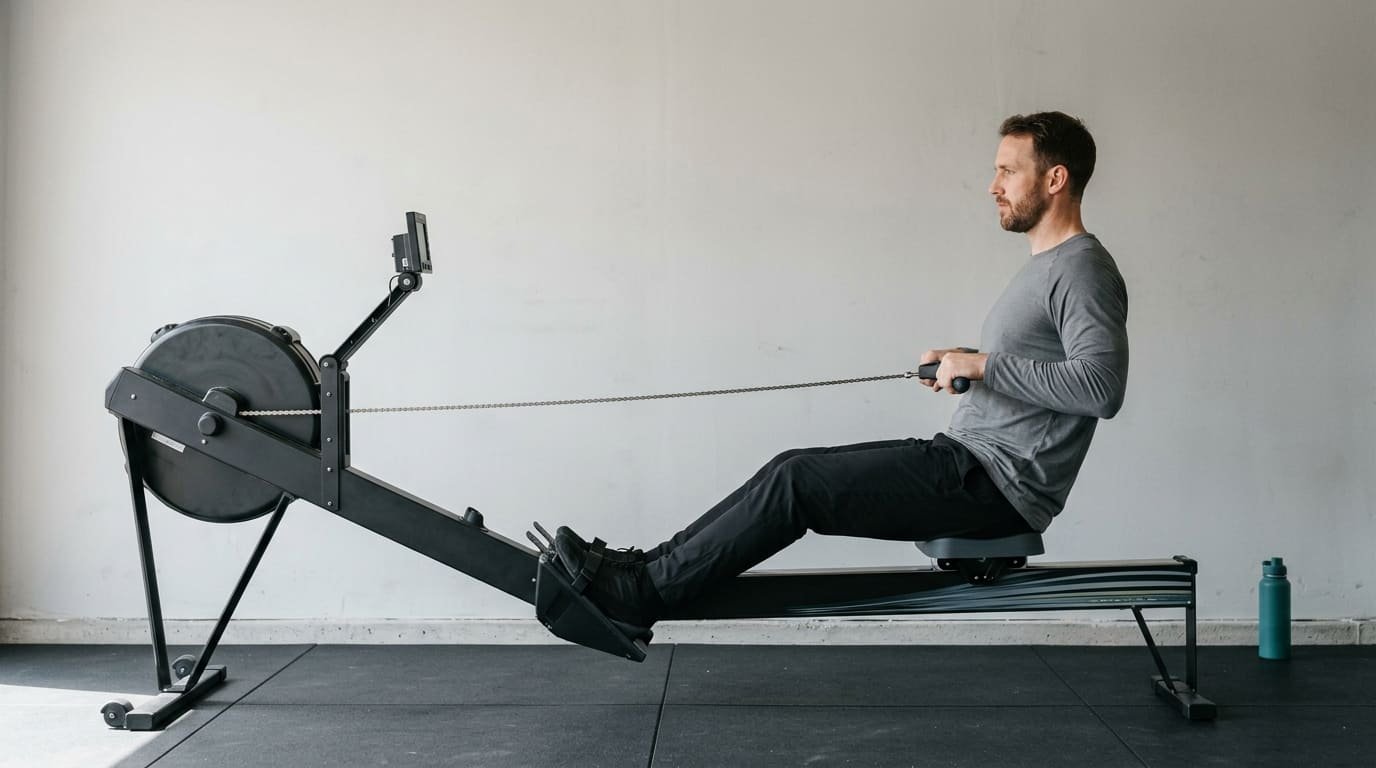
The rowing machine is usually the emptiest piece of cardio equipment in a gym, and it is one of the best. It works your legs, back and arms together, it is easy on your joints, and you can get a serious session done in twenty minutes.
It sits empty because most people have never been shown how to use it. I was one of them. I yanked the handle with my arms, slid up and down the rail as fast as I could, and wondered why my lower back ached and the numbers on the screen were so poor. A friend watched for ten seconds and said, legs first. That one instruction changed everything.
This guide teaches the stroke properly, explains the numbers on the monitor, and gives you six workouts and a six-week plan. You may also see the machine called an indoor rower, an ergometer or an erg, and the workout called erging. They all mean the same thing.
At a glance
- The rowing stroke is driven by the legs. Roughly 60 percent of the power comes from them
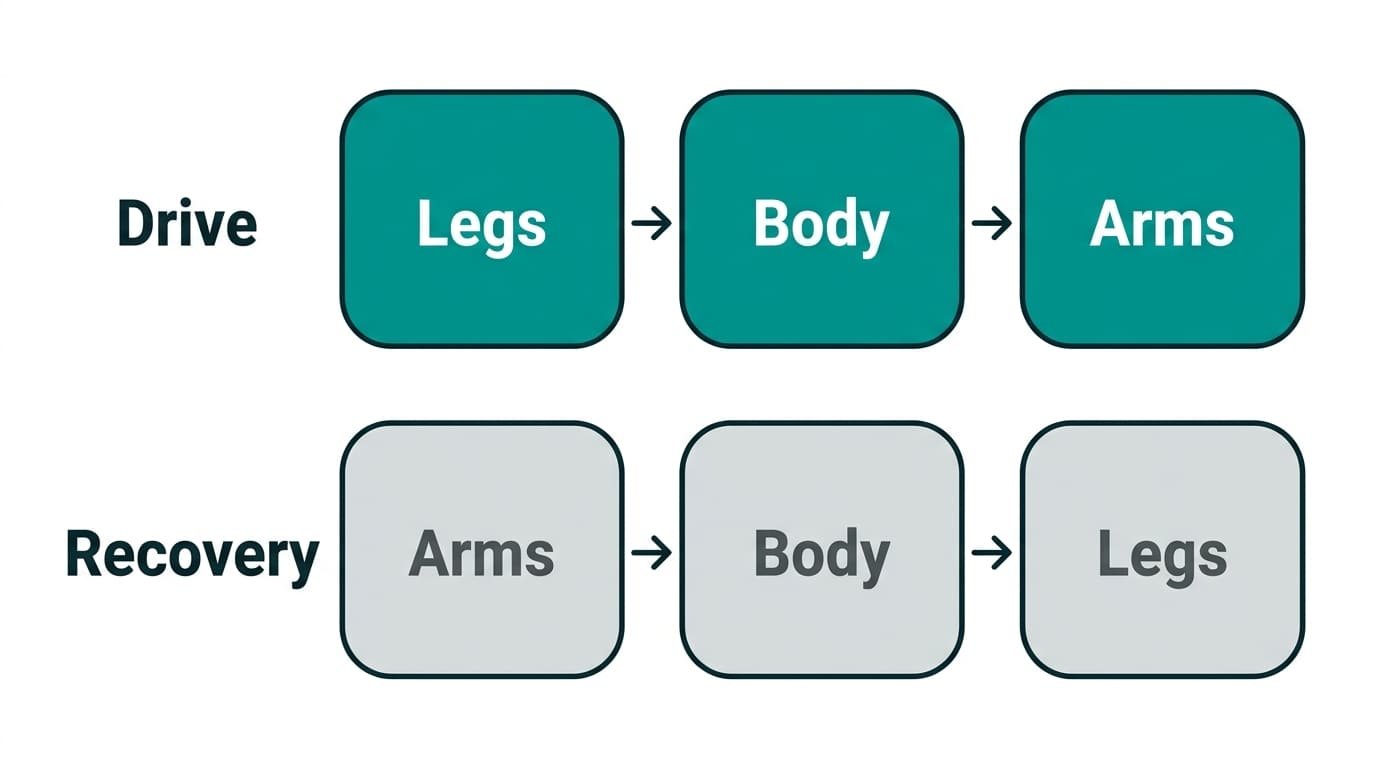
- The order is legs, body, arms on the way back, then arms, body, legs on the way forward
- Set the damper at 3 to 5. Higher is not harder in a useful way
- Beginners should row at 18 to 24 strokes per minute
- Your split, the time per 500 metres, is the best measure of effort
- Start with 10 to 15 minutes and build to 20 to 30
- Row two or three times a week, and keep your back straight throughout
Why use a rowing machine
- It uses most of your muscles at once. Legs, glutes, back, core and arms all contribute to every stroke
- It is low impact. You are seated and your feet stay fixed, so there is no pounding on knees, hips or ankles
- It trains both pushing and pulling. The leg drive is a push and the finish is a pull, which most cardio machines lack
- It builds heart and lung fitness quickly. A classic review of the physiology of rowing describes it as one of the most demanding endurance activities, because it involves such a large mass of working muscle
- It strengthens the back of the body, which helps counter hours of sitting
- It is easy to measure. The monitor shows exactly how far and how hard you have rowed, so progress is obvious
- It is time-efficient. Twenty minutes is a complete session
Source: Hagerman, Applied physiology of rowing, Sports Medicine (1984)
Muscles worked
| Phase of the stroke | Main muscles |
|---|---|
| Start of the drive | Quadriceps, glutes, calves |
| Middle of the drive | Hamstrings, glutes, lower back, abdominals |
| End of the drive | Lats, upper back, rear shoulders, biceps, forearms |
| Recovery | Triceps, abdominals, hip flexors, hamstrings |
Coaches commonly describe the power of the stroke as coming about 60 percent from the legs, 20 to 30 percent from the trunk and 10 to 20 percent from the arms. If your arms are tired before your legs, your order is wrong.
Setting up the machine
Foot straps
Adjust the footplate so the strap crosses the widest part of your foot, over the ball. Tighten it enough that your foot does not slide, but leave your heel free to lift a little as you come forward.
The damper
On an air rower, the lever on the side of the fan cage is the damper. It controls how much air enters the flywheel.
| Damper setting | What it feels like | Compare it to |
|---|---|---|
| 1 to 3 | Light and quick, like a sleek racing boat | A low gear on a bicycle |
| 3 to 5 | Balanced. Recommended for most people | A middle gear |
| 6 to 10 | Heavy and slow, like a rowing boat full of people | A high gear |
The damper is not a difficulty level. The harder you push, the more resistance the fan gives you at any setting. A high damper simply makes each stroke slower and heavier, which tires your back and wrecks your technique. Set it between 3 and 5 and leave it there.
Magnetic and water rowers work differently. On a magnetic machine, choose a low to middle resistance level to learn. A water rower has no setting to change: you create more resistance by pulling harder.
The monitor
| Number | What it means | Beginner guide |
|---|---|---|
| Split, shown as time per 500 m | How long it would take you to row 500 metres at your current effort. Lower is faster | About 2:30 to 3:00 for easy rowing |
| Stroke rate, in strokes per minute (spm) | How many strokes you take each minute | 18 to 24 |
| Distance, in metres | How far you have rowed | 1,500 to 4,000 a session |
| Time | How long you have been rowing | 10 to 30 minutes |
| Watts | The power you are producing | Varies widely |
| Calories | An estimate of energy used | Treat as a rough guide |
The two to watch are split and stroke rate. A good rower goes faster by pushing harder with the legs on each stroke, which lowers the split, not by rushing up and down the slide, which only raises the stroke rate.
The rowing stroke, step by step
The stroke has four positions. Learn them slowly.
1. The catch
The start, at the front of the machine.
- Shins vertical, knees over ankles
- Arms straight, shoulders relaxed and in front of your hips
- Back straight, leaning forward from the hips to about the one o’clock position
- Heels may lift slightly
2. The drive
The work phase. The order is legs, then body, then arms.
- Legs. Push the footplate away. Your arms stay straight and your trunk angle does not change
- Body. As your legs approach straight, swing your trunk back from the hips to about the eleven o’clock position
- Arms. Finally, pull the handle to your lower ribs
3. The finish
The end of the stroke.
- Legs straight but not locked
- Trunk leaning back slightly, core braced
- Handle touching your lower ribs, just below the chest
- Elbows drawn back past your sides, wrists flat, shoulders down
4. The recovery
The return. It is the drive in reverse: arms, then body, then legs.
- Arms. Push your hands away until your arms are straight
- Body. Hinge forward from the hips to the one o’clock position
- Legs. Only now bend your knees and slide forward to the catch
The handle must pass over your knees before they rise. If you have to lift the handle over your knees, you are bending your legs too early.
The rhythm
The drive is quick and powerful. The recovery is slow and relaxed, taking about twice as long. Count one on the drive and two, three on the way back. That ratio is what gives you a moment to breathe on every stroke.
Breathing: breathe out during the drive and in during the recovery.
Three drills to learn the order
Do these for two or three minutes at the start of your first few sessions.
- Arms only. Sit at the finish with legs straight and trunk leaning back slightly. Row using only your arms for ten strokes
- Arms and body. Add the hip swing. Arms straighten, trunk rocks forward, trunk rocks back, arms pull. Ten strokes
- Half slide, then full slide. Add a small leg bend for ten strokes, then the full stroke
Another useful drill is the pause. On every stroke, stop for one second with your arms straight and your trunk forward, before your knees bend. It builds the correct sequence into habit.
Common mistakes and how to fix them
| Mistake | What it looks like | Fix |
|---|---|---|
| Pulling with the arms first | Elbows bend at the start of the drive | Keep your arms straight like ropes until your legs are nearly flat |
| Bending the knees too early on the recovery | The handle has to climb over your knees | Arms away, body over, then knees |
| Shooting the slide | Your seat moves back but the handle does not | Brace your core so your legs and the handle move together |
| Rounding the back | A curved spine at the catch | Sit tall, hinge from the hips, and do not reach too far forward |
| Leaning back too far | Lying back beyond eleven o’clock | Stop the swing when your core starts to shake |
| Rushing the recovery | Racing forward into the next stroke | Slow the return to twice the length of the drive |
| Lifting the handle to the chin or dropping it to the lap | The chain moves up and down | Keep the chain level and pull to the lower ribs |
| Gripping hard | White knuckles, sore forearms | Hook the handle with your fingers and keep your thumbs relaxed |
| Damper on 10 | Slow, heavy strokes and a tired back | Set it to 3 to 5 |
| High stroke rate with a slow split | Lots of movement, little speed | Lower the rate to 20 and push harder with your legs |
How hard should it feel?
| Effort level | How it feels | Stroke rate | Typical use |
|---|---|---|---|
| Easy | You could hold a conversation | 18 to 22 | Warm-ups, long steady rows, recovery |
| Steady | You can speak in short sentences | 20 to 24 | Most beginner training |
| Hard | A few words at a time | 24 to 28 | Intervals of 1 to 4 minutes |
| Very hard | You cannot talk | 28 to 32 | Short intervals of 20 to 60 seconds |
Most of your rowing should be easy or steady. Our target heart rate calculator can put numbers on these zones, and steady-state cardio explains why the easy sessions matter.
Six rowing machine workouts
Begin every session with the warm-up: three minutes of very easy rowing, the three drills, then two minutes building to a steady pace. Finish with three minutes of easy rowing.
Workout 1: first row (10 minutes plus warm-up)
| Segment | What to do |
|---|---|
| 5 times | 1 minute of steady rowing at 20 strokes per minute, then 1 minute of very easy paddling |
Concentrate entirely on the order: legs, body, arms, then arms, body, legs.
Workout 2: steady 15
Row continuously for 15 minutes at an easy to steady effort, at 20 to 22 strokes per minute. Note your total distance, and try to beat it by a little next time.
Workout 3: rate ladder (16 minutes)
| Minutes | Stroke rate |
|---|---|
| 0 to 4 | 18 |
| 4 to 8 | 20 |
| 8 to 12 | 22 |
| 12 to 16 | 20 |
Keep the same strong leg push at every rate. This teaches you to control the stroke rate with the speed of your recovery, not by rushing.
Workout 4: 500-metre intervals
| Segment | What to do |
|---|---|
| 4 to 6 times | Row 500 metres at a hard effort, then rest or paddle very gently for 2 minutes |
Try to hold the same split on every interval. If the last one is much slower than the first, you started too fast.
Workout 5: one on, one off (20 minutes)
| Segment | What to do |
|---|---|
| 10 times | 1 minute hard at 24 to 26 strokes per minute, then 1 minute very easy |
Workout 6: the 5,000 metres
Row 5,000 metres at a steady effort. For most beginners this takes 25 to 32 minutes. Break it into five blocks of 1,000 metres in your head, and hold an even split.
A rowing and bodyweight circuit
Repeat three to four times, resting one minute between rounds.
| Station | Amount |
|---|---|
| Row | 500 metres, steady |
| Bodyweight squats | 15 |
| Push-ups, or incline push-ups | 10 |
| Plank | 30 seconds |
Our conditioning workouts for beginners has more sessions in this style.
A 6-week beginner rowing plan
| Week | Session 1 | Session 2 | Session 3 (optional) |
|---|---|---|---|
| 1 | Workout 1 | Workout 1 | Workout 1 |
| 2 | Workout 1 | Workout 2 | Workout 2 |
| 3 | Workout 2 | Workout 3 | Workout 2 |
| 4 | Workout 3 | Workout 5 | Steady 20 minutes |
| 5 | Workout 4 | Steady 20 minutes | Workout 5 |
| 6 | Workout 5 | Workout 6 | Workout 4 |
Leave a day between sessions. Move on only when your technique holds together to the end of the current week’s rows.
How to progress after the plan: add about ten percent to your weekly distance, lengthen a steady row by five minutes, or add one interval. Change one thing at a time.
How many calories does rowing burn?
Stationary rowing is rated at about 4.8 METs for moderate, general effort, 7 METs at a solid 100 watts and 8.5 METs at a vigorous 150 watts.
| Body weight | Easy to moderate, 30 minutes | Solid effort, 30 minutes | Vigorous, 30 minutes |
|---|---|---|---|
| 60 kg | About 150 calories | About 220 | About 270 |
| 70 kg | About 175 calories | About 255 | About 310 |
| 85 kg | About 215 calories | About 310 | About 380 |
| 100 kg | About 250 calories | About 370 | About 445 |
These are estimates, and the calorie figure on the monitor is also an estimate based on a standard body weight. Our calories burned calculator gives a personal figure.
Rowing supports fat loss well because it is sustainable: it is low impact, so you can do it often, and it uses enough muscle to burn a useful amount of energy. Food still decides the outcome. Our guide on whether cardio helps you lose weight explains how the two fit together.
Rowing compared with other cardio machines
| Machine | Muscles used | Impact | Skill needed | Best for |
|---|---|---|---|---|
| Rowing machine | Legs, back, core, arms | Low | Moderate | Full-body cardio and back endurance |
| Treadmill | Legs | Moderate to high | Low | Walking and running fitness |
| Exercise bike | Legs | Very low | Low | Sore joints, long easy sessions |
| Elliptical | Legs, some arms | Low | Low | Low-impact cardio standing up |
| Stair climber | Legs and glutes | Low to moderate | Low | Leg endurance |
Our guides to the exercise bike, the elliptical and the StairMaster cover the alternatives. Rowing is the only one of these that gives your upper back and arms meaningful work.
Is rowing bad for your back?
Rowing strengthens the muscles of the back and hips. It is also true that the lower back is the most commonly injured area in people who row a lot, as a review of rowing injuries describes. Both things can be true, and the difference is technique and volume.
Source: Hosea and Hannafin, Rowing injuries, Sports Health (2012)
To keep your back happy:
- Sit tall and hinge from the hips. Do not round your spine at the catch
- Drive with your legs first. Opening your back early puts the load on your spine instead of your legs
- Keep the damper low
- Do not lean back beyond eleven o’clock
- Build distance gradually, and stop a session when your posture starts to collapse
- Strengthen your core and hips off the machine. Our McGill Big 3 guide is a good place to start
If you have a current back injury, a disc problem or sciatica, get advice from a doctor or physiotherapist before you row.
Buying a rowing machine for home
| Type | How resistance works | Feel | Noise | Typical price |
|---|---|---|---|---|
| Air | A fan flywheel. The harder you pull, the more resistance | Smooth and responsive. The standard for training | Loud whoosh | Middle to high |
| Water | Paddles in a tank of water | Closest to real rowing, pleasant sound | Gentle swish | Middle to high |
| Magnetic | Magnets and a flywheel, set by a dial | Consistent, less dynamic | Very quiet | Low to middle |
| Hydraulic piston | Pistons on the arms | Least like rowing, short stroke | Quiet | Low |
Check the length of the rail if you are tall, the maximum user weight, whether it stands on end or folds for storage, and whether the monitor shows split and stroke rate.
The bottom line
The rowing machine trains your legs, back and arms together with almost no impact, and it tells you exactly how you are doing. The only barrier is learning the stroke, and that comes down to one sequence.
Legs, body, arms on the drive. Arms, body, legs on the recovery. Push hard, come back slowly. Keep the damper between 3 and 5, your stroke rate around 20, and your back straight.
Start with ten minutes of one minute on, one minute off. Within six weeks, a steady 5,000 metres will be within reach.
Frequently asked questions
What is a good rowing machine workout for beginners?
After a five-minute warm-up, row for one minute at a steady pace of 20 strokes per minute, then paddle gently for one minute, and repeat five times. Focus on the order of the stroke: legs, body, arms, then arms, body, legs.
How long should a beginner row for?
Start with 10 to 15 minutes, including short rests, two or three times a week. Build up to 20 to 30 minutes over about six weeks. Stop a session when your technique or posture starts to fall apart.
What damper setting should I use on a rowing machine?
Between 3 and 5 for most people. The damper works like bicycle gears, not like a difficulty level. A higher setting makes each stroke heavier and slower, which tires your back without making the workout more effective.
What is a good stroke rate for beginners?
18 to 24 strokes per minute. Lower rates give you time to practise the correct sequence. Go faster by pushing harder with your legs on each stroke, not by sliding back and forth more quickly.
What is a good 500m split for a beginner?
For easy to steady rowing, roughly 2:30 to 3:00 per 500 metres is typical for beginners, though it depends on your size, age and fitness. Use your own split as the benchmark and aim to improve it gradually.
Is 20 minutes of rowing a day enough?
Twenty minutes of steady rowing is a solid cardio session. Three or four days a week is enough for most beginners, with rest days between for your back and hands to adapt. Daily rowing is possible later, with a mix of easy and hard days.
Does rowing build muscle?
It builds muscular endurance in the legs, glutes, back and arms, and beginners may gain some muscle. It is mainly a cardio exercise. For significant muscle growth, add strength training two or three times a week.
Is rowing good for losing belly fat?
Rowing burns a good number of calories and works many muscles, which supports overall fat loss when combined with sensible eating. It does not target belly fat specifically. No exercise removes fat from one chosen area.
What’s next?
Reading is the easy part. Pick one of these and do it today.


