Elliptical Workout for Beginners: 5 Workouts and a 6-Week Plan
The elliptical is the most forgiving cardio machine in most gyms. Your feet never leave the pedals, so there is no impact through your knees, hips or ankles, and the motion is close enough to walking or running that it feels natural within a minute or two. That combination makes it genuinely ideal if you are starting out, carrying extra weight, coming back from an injury or simply do not enjoy running.
It is also the machine people are most likely to waste time on. Set the resistance to 2, hold the stationary handles, lean on them, and coast for 30 minutes while reading your phone. You will finish having barely raised your heart rate.
This guide gives you five specific workouts with actual resistance numbers rather than vague instructions to “increase intensity”, a six-week plan, fixes for the five common form errors, and a solution for the foot numbness that affects a surprising number of people.
At a glance
- Five workouts with exact resistance levels, durations and cadence targets
- A 6-week plan taking you from 15 minutes to 35 minutes and interval work
- The five most common form mistakes, and what each one costs you
- Foot numbness is common and usually fixable in three ways
- Aim for 55 to 70 strides per minute, not the 90 most beginners default to
- Using the moving handles properly turns it into a genuine full-body workout
Why the elliptical suits beginners
- It is low impact. Your feet stay in contact with the pedals, so there is no repeated landing force through your joints. This is the main reason it is recommended after injury and for anyone with knee, hip or ankle discomfort
- It is hard to do dangerously. Unlike a treadmill, you cannot fall off it, and you control the speed entirely
- It can be a full-body workout. The moving handles bring in the chest, back, shoulders and arms, which few other cardio machines do
- It is easy to learn. Most people have the motion within a minute
- It suits a wide range of fitness levels, because resistance and incline adjust across a large range
- You can go backwards, which shifts emphasis to the glutes and hamstrings and is a genuinely different stimulus
The honest limitation: because it is low impact and the machine supports part of the movement, the elliptical generally burns somewhat fewer calories at the same perceived effort than running does, and machine calorie readouts tend to overestimate. Treat those numbers as a rough guide rather than a measurement.
Setting up before your first session
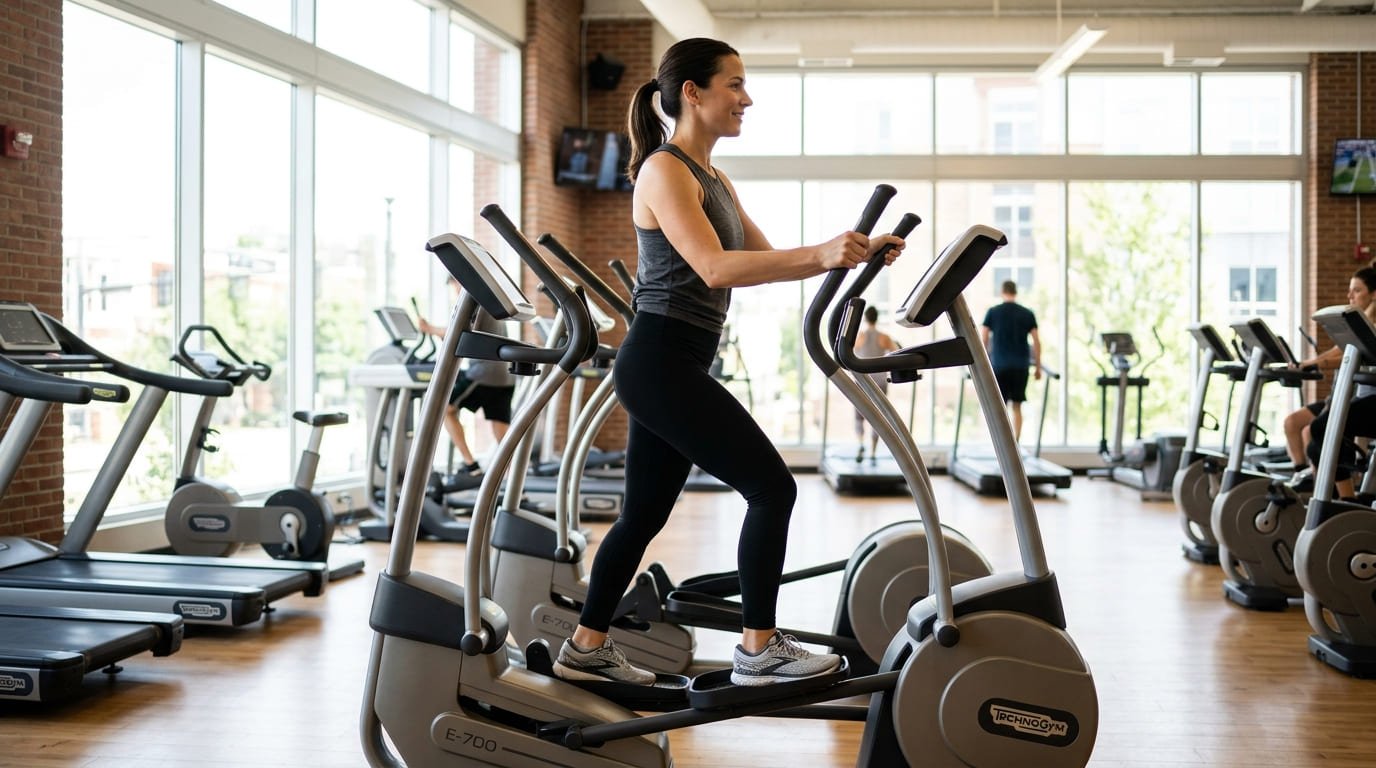
- Step on carefully, holding the fixed handles, one foot at a time, with the pedals roughly level
- Set resistance to zero or one and let your legs find the oval motion for 60 to 90 seconds before touching anything else
- Check your foot position. Your whole foot should be on the pedal with your heel down, not perched on the ball of your foot
- Stand tall. Shoulders back, chest open, eyes forward rather than down at your feet
- Set incline low, around 3 to 5 percent if your machine has one, for your first sessions
- Then add resistance one or two levels at a time until it feels like moderate work
About resistance numbers: machines vary, and level 6 on one brand is not level 6 on another. Use this guide instead.
| Effort level | How it should feel | Can you talk? | Typical resistance |
|---|---|---|---|
| Very easy, warm-up | Almost no effort | Easily, could sing | 1 to 3 |
| Easy | Comfortable, could continue an hour | Full sentences | 3 to 5 |
| Moderate | Working, breathing noticeably | Short sentences | 5 to 7 |
| Hard | Challenging, want it to end | A few words only | 8 to 11 |
| Very hard, intervals | Maximum sustainable effort | Barely a word | 12 and above |
Calibrate to how it feels, not the number on the display.
The five mistakes that ruin elliptical workouts
1. Leaning on the handles
The most common by a wide margin. Resting your body weight on the fixed handles offloads your legs, which drops the effort dramatically while the machine keeps reporting the same numbers.
Fix: hold the handles lightly, or let go entirely for 30 seconds to check. If the effort jumps noticeably when you release, you were leaning.
2. Spinning fast with no resistance
Beginners often default to 90 or more strides a minute at resistance 2, which feels busy but is barely training anything. Cardiovascular adaptation comes from meaningful resistance, not flailing speed.
Fix: aim for 55 to 70 strides per minute with enough resistance that you feel it in your legs. Slower and harder beats faster and easier.
3. Pushing through your toes only
Riding on the balls of your feet overworks your calves, is a leading cause of foot numbness, and takes your glutes largely out of the movement.
Fix: keep your heels down and press through the whole foot, driving through the heel on each push.
4. Looking down and hunching forward
Watching your feet rounds your upper back, restricts your breathing and puts strain on your neck over a 30-minute session.
Fix: eyes forward, chest open, ribs stacked over hips. If the machine has a screen you cannot avoid looking down at, raise it or look past it.
5. Ignoring the moving handles
The moving handles are what make this a full-body machine, and most people hold the fixed ones instead. Using them properly raises your heart rate at the same leg effort and brings in your back, chest and shoulders.
Fix: push and pull actively rather than letting your arms be carried along. Alternate: five minutes on the moving handles, then a few minutes hands-free to load the legs.
Five beginner elliptical workouts
Every one includes a warm-up and cool-down, and every one gives you actual numbers.
Workout 1: the first session, 15 minutes
For your very first time on the machine.
| Time | Resistance | Cadence | Effort |
|---|---|---|---|
| 0 to 3 min | 1 to 2 | 50 to 60 spm | Warm-up, get the rhythm |
| 3 to 12 min | 4 to 5 | 55 to 65 spm | Easy, conversational |
| 12 to 15 min | 1 to 2 | 50 spm | Cool-down |
Workout 2: steady state, 25 minutes
The workhorse session. Most of your elliptical time should look like this.
| Time | Resistance | Cadence | Effort |
|---|---|---|---|
| 0 to 5 min | 2 to 3 | 50 to 60 spm | Warm-up |
| 5 to 20 min | 5 to 7 | 55 to 70 spm | Moderate, short sentences only |
| 20 to 25 min | 2 | 50 spm | Cool-down |
Workout 3: beginner intervals, 22 minutes
Introduce this from week three, once steady state feels comfortable.
| Time | Resistance | Effort |
|---|---|---|
| 0 to 5 min | 3 | Warm-up |
| 5 to 6 min | 8 to 9 | Hard |
| 6 to 8 min | 4 to 5 | Recovery |
| Repeat that 3-minute block | Alternating | 5 rounds total |
| 20 to 22 min | 2 | Cool-down |
Note the recovery is twice as long as the work interval. That ratio is deliberate for beginners and is what makes intervals sustainable rather than miserable.
Workout 4: hill climb, 30 minutes
Builds leg strength and endurance using a resistance pyramid.
| Time | Resistance | Notes |
|---|---|---|
| 0 to 5 min | 3 | Warm-up |
| 5 to 9 min | 5 | Settle into rhythm |
| 9 to 13 min | 7 | Working |
| 13 to 17 min | 9 | Hard, slow the cadence to 50 to 55 |
| 17 to 21 min | 7 | Back down |
| 21 to 25 min | 5 | Easier |
| 25 to 30 min | 2 | Cool-down |
Workout 5: full body with direction changes, 30 minutes
The most complete session, and the one that uses everything the machine offers.
| Time | Resistance | Direction | Handles |
|---|---|---|---|
| 0 to 5 min | 2 to 3 | Forward | Light hold, warm-up |
| 5 to 10 min | 5 to 6 | Forward | Moving handles, push and pull actively |
| 10 to 14 min | 6 to 7 | Backward | Moving handles, feel it in the glutes |
| 14 to 19 min | 6 to 7 | Forward | Hands off, legs only |
| 19 to 23 min | 7 to 8 | Backward | Moving handles |
| 23 to 27 min | 5 to 6 | Forward | Moving handles |
| 27 to 30 min | 2 | Forward | Cool-down |
Going backwards feels strange for the first minute and shifts noticeable work into the glutes and hamstrings. Reduce your cadence slightly when you switch.
A 6-week beginner plan
| Week | Sessions | Workout | Duration |
|---|---|---|---|
| Week 1 | 3 | Workout 1 | 15 min |
| Week 2 | 3 | Workout 1, extended | 20 min |
| Week 3 | 3 to 4 | Workout 2 twice, Workout 3 once | 22 to 25 min |
| Week 4 | 4 | Workout 2 twice, Workout 3 once, Workout 4 once | 25 to 30 min |
| Week 5 | 4 | Workout 2, 3, 4 and 5 | 25 to 30 min |
| Week 6 | 4 to 5 | Rotate all five, add 5 min to steady state | 30 to 35 min |
The progression rule: increase either duration or intensity in a given week, never both. If you are adding five minutes, keep the resistance the same. If you are adding resistance, keep the duration the same.
How to know you are progressing: the same resistance level feels easier, your heart rate at a given effort is lower, and you recover faster between intervals. All three are better indicators than the calorie display.
Using heart rate, simply
You do not need a chest strap, but knowing roughly where you are helps.
A workable estimate of maximum heart rate is 220 minus your age. It is approximate and varies considerably between individuals, so treat it as a rough guide.
| Zone | Percentage of max | How it feels | Use it for |
|---|---|---|---|
| Warm-up | 50 to 60 percent | Very easy | Start and end of every session |
| Fat burning and endurance | 60 to 70 percent | Comfortable, can talk | Most of your steady-state work |
| Aerobic | 70 to 80 percent | Working, short sentences | Moderate sessions, hill climbs |
| Threshold | 80 to 90 percent | Hard, few words | Interval work intervals |
| Maximum | 90 percent and above | Unsustainable | Brief peaks only |
The talk test is genuinely as useful as the numbers for beginners. If you can speak in full sentences, you are in the easy to moderate range. If you can manage only a few words, you are working hard.
Foot numbness, and how to fix it
This affects a large number of elliptical users and almost no article addresses it properly.
The cause is usually a combination of sustained pressure on the same part of the foot, since your feet never lift off the pedals, and slight swelling as blood flow increases.
Three fixes, in order of effectiveness:
- Shift your foot position periodically. Every few minutes, slide your feet slightly forward or back on the pedals, or lift your heels briefly. Changing the pressure point is the single most effective fix
- Loosen your laces, particularly across the middle of the foot. Many people tie trainers tighter than needed
- Keep your heels down rather than pressing through the toes, which concentrates pressure on the ball of the foot
If numbness persists despite all three, or comes with pain or tingling that continues after you stop, it is worth getting your feet looked at rather than working around it.
Which muscles the elliptical actually works
Worth knowing, because it determines how you should use the machine and what it will not do for you.
| Muscle group | How much it works | How to increase it |
|---|---|---|
| Quadriceps | Substantial, especially going forward | Higher resistance, more upright posture |
| Glutes | Moderate, more when going backward | Reverse direction, push through the heels, raise the incline |
| Hamstrings | Moderate | Backward motion, higher resistance |
| Calves | Moderate | Naturally involved, no need to chase it |
| Core | Light, as a stabiliser | Let go of the handles entirely |
| Back, chest and shoulders | Light to moderate | Use the moving handles actively rather than passively |
Two honest caveats. First, the elliptical is a cardiovascular machine, not a muscle-building one. The resistance is real but the load is far below what builds meaningful muscle, so it complements strength training rather than replacing it.
Second, the full-body claim is only true if you use the moving handles deliberately. Holding the fixed bars turns it into a legs-only machine, which is what most people end up doing without noticing.
About the calorie display
Machine calorie readouts are estimates, and generally optimistic ones. They typically use your weight, time and resistance, without knowing your body composition, fitness level or how much you are leaning on the handles.
Assume the true figure is meaningfully lower than displayed. That is not a reason to avoid the machine, just a reason not to plan your food intake around the number.
If you want a better estimate, our calories burned calculator gives figures based on activity and body weight.
Elliptical versus other cardio
| Machine | Impact | Full body? | Best for |
|---|---|---|---|
| Elliptical | Very low | Yes, with moving handles | Joint issues, beginners, injury return |
| Treadmill | High when running | No | Running-specific fitness, higher calorie burn |
| Exercise bike | Very low | No | Leg endurance, very low back strain |
| Rowing machine | Low | Yes | Full-body conditioning, but technique-dependent |
| StairMaster | Moderate | No | Glutes and legs, high intensity |
| Walking outdoors | Low | No | Accessibility, daily step count |
The elliptical’s genuine advantage is being both low impact and full body, which no other common machine manages. If you have joint pain that stops you running, this is usually the best substitute. Our guides to the exercise bike and the StairMaster cover the alternatives.
How often should beginners use it?
| Your goal | Sessions per week | Duration |
|---|---|---|
| General health | 3 | 20 to 30 min |
| Fat loss | 4 to 5 | 25 to 40 min, plus strength training |
| Building endurance | 3 to 4 | 30 to 45 min, mostly steady state |
| Recovering from injury | 3 to 5 | 15 to 30 min, easy effort |
| Cross-training alongside running | 2 | 30 min, easy or intervals |
Public health guidance suggests roughly 150 minutes of moderate activity a week, which four 35-minute sessions comfortably covers.
One important point for fat loss: cardio alone is less effective than cardio plus strength training plus a modest calorie deficit. The elliptical is a useful tool for the cardio component, not a complete solution. Our home workout for weight loss guide covers how the pieces fit together.
Staying interested past week three
The most common reason people stop using the elliptical is not difficulty, it is monotony. A few things that genuinely help.
- Vary the workout rather than the machine. Rotating between the five sessions above is far more effective than switching to a different machine every week and never progressing on any of them
- Change direction every few minutes. It breaks the session into segments and gives you something to think about
- Use the intervals as structure. A 22-minute interval session passes considerably faster than 22 minutes of steady state, because you are counting down to the next change
- Save something for the machine. A podcast or series you only watch while training is a surprisingly effective adherence tool
- Track one number each session, such as distance at a fixed resistance and time. Watching it improve gives a session a point beyond just finishing it
The bottom line
The elliptical is one of the easiest ways to build cardiovascular fitness without hammering your joints, and it is the best machine in most gyms for someone starting from scratch.
Do three things and it will work. Stop leaning on the handles, because that single habit undoes most of the session. Use enough resistance that 55 to 70 strides a minute feels like work, rather than spinning fast against nothing. And use the moving handles for part of each session so you get the full-body benefit the machine is designed for.
Start with 15 minutes three times a week. Add either time or intensity each week, never both. Within six weeks you will be handling 30 to 35 minutes and interval work, and the change in how easily you handle stairs and hills will be obvious well before the machine’s calorie display tells you anything useful.
Frequently asked questions
How long should a beginner use an elliptical?
Start with 15 minutes three times a week, then add about five minutes per week. By week six most beginners handle 30 to 35 minutes comfortably. Duration matters less than consistency and resistance: 20 focused minutes at a moderate resistance beats 45 minutes of coasting at level 2.
What resistance should a beginner use on an elliptical?
Levels 4 to 6 for steady-state work, with 1 to 3 for warm-up and cool-down and 8 to 9 for interval efforts. Machines vary between brands, so calibrate by feel: at the right resistance you should be able to speak in short sentences but not hold a full conversation.
Is the elliptical good for losing belly fat?
It helps with overall fat loss by contributing to your weekly energy expenditure, but no exercise removes fat from one specific area. Fat is lost across the whole body in a pattern set by genetics. Combining elliptical sessions with strength training and a modest calorie deficit is far more effective than cardio alone.
Why do my feet go numb on the elliptical?
Because your feet never leave the pedals, pressure stays concentrated on the same spot while blood flow increases. The most effective fix is shifting your foot position every few minutes or briefly lifting your heels. Loosening your laces and keeping your heels down rather than pressing through the toes also help.
Is 30 minutes on the elliptical enough?
Yes, for most goals. Four 30-minute sessions a week comfortably exceeds the general guidance of 150 minutes of moderate activity weekly. What matters more than the duration is whether you used meaningful resistance and avoided leaning on the handles, since both dramatically change the actual effort.
Should I use the moving handles or the fixed ones?
Use the moving handles for most of the session, pushing and pulling actively rather than letting your arms be carried. That brings in your back, chest and shoulders and raises your heart rate at the same leg effort. Periods with your hands off entirely are also useful for loading the legs more.
Is the elliptical better than the treadmill?
It depends on your goal. The elliptical is far better if you have joint pain, are returning from injury or want a full-body workout. The treadmill generally produces a higher calorie burn at the same perceived effort and builds running-specific fitness. For a beginner with any joint concerns, the elliptical is usually the better starting point.
Does going backwards on the elliptical do anything?
Yes. Reversing the direction shifts emphasis toward the glutes and hamstrings, whereas forward motion loads the quadriceps more. It also provides a different stimulus and breaks up longer sessions. Reduce your cadence slightly when you switch, since it takes a minute to feel coordinated.