Wall Angels Exercise: How to Do It Right, Easier Versions and Why It Feels So Hard
The wall angels exercise looks like the easiest move in the world. You stand with your back against a wall and slide your arms up and down, like making a snow angel standing up. The first time I tried it, I could not get my hands to touch the wall above my shoulders without my lower back arching off it. My arms simply would not go where I asked them to.
That was the moment I realised how stiff my upper back and shoulders had become after years at a laptop. The wall does not lie. It shows you exactly where you have lost movement. Over the next couple of months, with a few minutes a day, my hands crept higher up the wall, my shoulders felt looser, and the stiffness I used to feel after long work days faded.
This guide explains how to do the wall angels exercise properly, why it feels so hard, six variations from easy to hard, how it fits with other forward head posture exercises and a simple daily routine. If you are looking for an exercise for good posture that needs nothing but a wall, this is one of the best.
At a glance
- Wall angels train upper back mobility, shoulder mobility and the muscles that hold the shoulder blades in place
- Keep your head, upper back and bottom against the wall, with a small gap at the lower back
- Slide your arms up only as far as you can without arching or losing contact
- It feels hard because most people have stiff upper backs and tight chests from sitting
- Start with the floor or doorway version if the wall version is too difficult
- Do 2 sets of 8 to 10 slow reps once or twice a day
- Combine it with chin tucks, chest stretches and upper back strength work for the best posture results
What the wall angels exercise does
The wall angels exercise works three things at once:
| Area | What wall angels do | Why it matters |
|---|---|---|
| Upper back (thoracic spine) | Encourage it to straighten against the wall | A stiff, rounded upper back pulls the head and shoulders forward |
| Shoulders | Move the arms overhead in a controlled path | Shoulders lose overhead range when the upper back is stiff |
| Shoulder blade muscles | Train the lower and middle trapezius and serratus anterior | These muscles rotate and hold the shoulder blades as you lift your arms |
| Chest | Gently stretch the pecs as the arms open | Tight chest muscles pull the shoulders forward |
That combination is why physiotherapists and coaches use the wall angel exercise as both a test and a training tool. If you cannot get your arms flat to the wall, it tells you where you are stiff. Practising it slowly helps you get that movement back.
What the research says
There is little research on wall angels as a single exercise, but there is good evidence for the kinds of exercise it combines:
- Forward head posture. A systematic review of randomised trials found that therapeutic exercise produced large improvements in forward head posture and moderate improvements in neck pain
- Upper back rounding. A systematic review and meta-analysis of 24 studies found moderate certainty evidence that exercise improved kyphosis, an excessive forward rounding of the upper spine, in adults with age-related hyperkyphosis, and also improved back extensor strength
- Combined programmes. A randomised trial in office workers with forward head posture found that combining scapular stabilisation and thoracic extension exercises, without exercising the neck directly, improved head posture, breathing measures, neck pain and disability. That is exactly the mix the wall angels exercise offers
How to do the wall angels exercise
Setting up
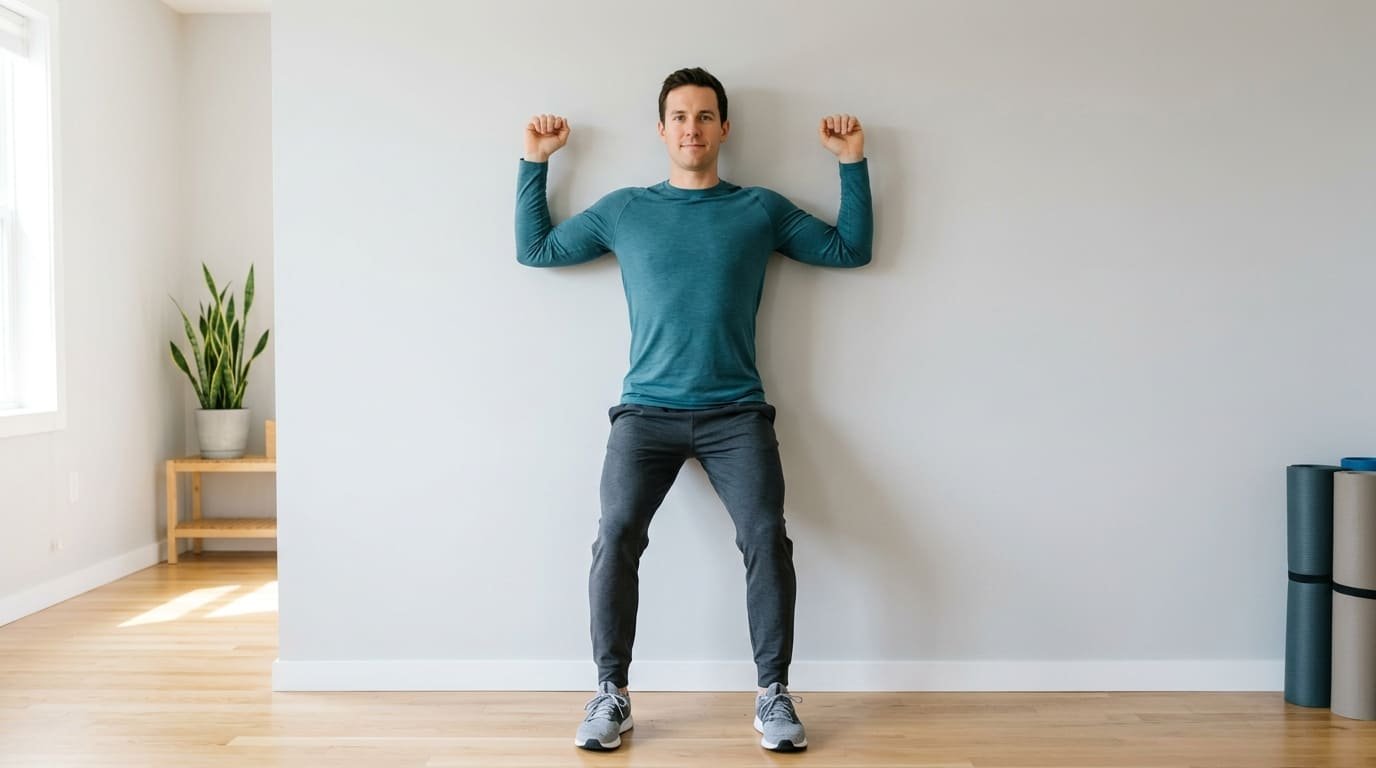
- Stand with your back against a wall, feet about 15 to 20 cm away from it and hip-width apart
- Bend your knees slightly
- Press your bottom, upper back and the back of your head gently against the wall
- Tuck your chin slightly so your eyes stay level. Do not tip your head back to reach the wall
- Let your lower back keep a small natural curve, about the thickness of your hand
The movement
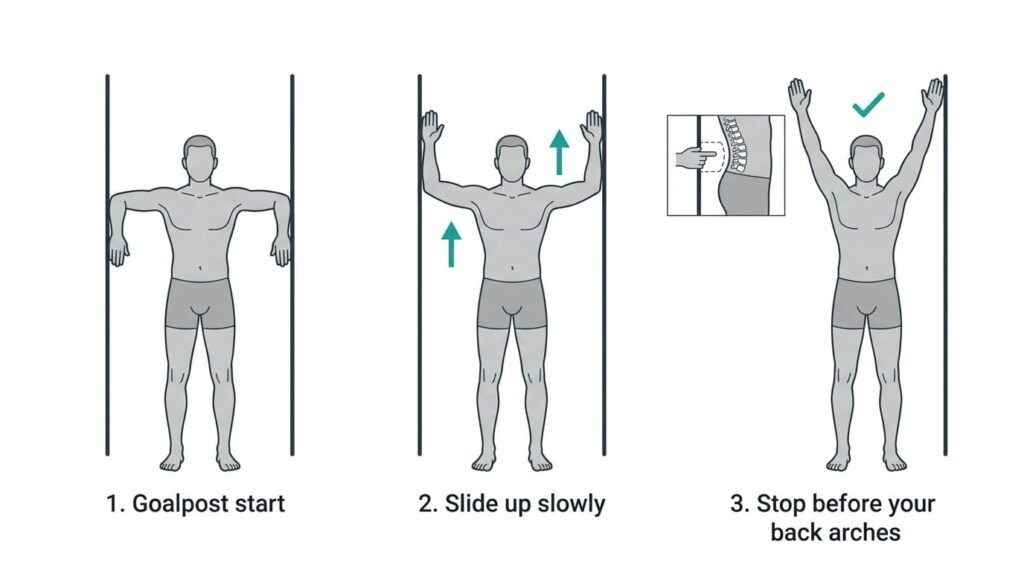
- Raise your arms into a goalpost position: upper arms out to the sides at shoulder height, elbows bent to 90 degrees, backs of the hands and forearms toward the wall
- Try to touch the wall with the backs of your wrists, forearms and elbows. Only go as far as you can while keeping your back in place
- Slowly slide your arms up the wall, straightening the elbows a little, as if making a snow angel
- Stop when you feel your lower back arch, your head lift off the wall or your arms leave the wall
- Slowly slide your arms back down to the goalpost position, drawing your shoulder blades gently down
- Breathe out as you slide up and in as you slide down
Dose: 2 sets of 8 to 10 slow reps. Take about three seconds up and three seconds down.
Cues that make it work
| Do | Do not |
|---|---|
| Keep the ribs down and the lower back’s small natural curve | Arch the lower back to get the arms higher |
| Keep the back of the head on the wall with the chin level | Tip the head back or poke the chin forward |
| Move slowly and smoothly | Rush or bounce the arms |
| Stop at the point where contact is lost | Force the arms flat to the wall |
| Draw the shoulder blades down as the arms come down | Shrug the shoulders toward the ears |
| Accept a small range at first | Compare your range to anyone else’s |
If your forearms or wrists will not touch the wall at all, that is fine. Keep them as close as you can and let the range improve over weeks. Pushing harder only moves the strain to your lower back.
Why the wall angel exercise feels so hard
It is common to feel surprised, even a little frustrated, the first time you try a wall angel exercise. There are three main reasons it is harder than it looks:
- A stiff upper back. Hours of sitting and looking at screens leave the upper back rounded. When it cannot straighten, the arms cannot reach the wall overhead without the lower back arching to compensate
- Tight chest and lat muscles. The pecs and lats both attach to the upper arm. When they are tight, they pull the arms forward and away from the wall
- Weak lower trapezius and serratus anterior. These muscles need to rotate the shoulder blades upward as the arms rise. If they are weak, the shoulders shrug instead
The good news is that all three respond well to practice. The wall angels exercise works on all of them at the same time, which is why it is such a useful exercise for good posture.
6 wall angels exercise variations
Start with the easiest version you can do with good form, then move on when 10 slow reps feel easy.
1. Floor angels (easiest)
- Lie on your back with your knees bent and feet flat
- Place your arms in the goalpost position on the floor
- Slide your arms up and down along the floor, keeping your lower back gently in contact
Dose: 2 sets of 10. The floor supports your spine, which makes this the best starting point for very stiff upper backs. Place a thin pillow under your head if your chin pokes up.
2. Seated wall angels
Sit on the floor or a low stool with your back against a wall and your knees bent. Perform the same arm movement. Sitting reduces the tendency to arch the lower back, because the hips are bent.
Dose: 2 sets of 8 to 10.
3. Standard standing wall angels
The version described in the how-to section above. Once you can do 10 slow reps with full contact through most of the range, move on.
4. Reverse wall angels (facing the wall)
- Stand facing a wall, with your forehead or nose a few centimetres away from it
- Place your arms in the goalpost position, with your little fingers lightly touching the wall
- Lift your hands a centimetre off the wall, then slide them up and down without touching it
Dose: 2 sets of 6 to 8. This is much harder for the shoulder blade muscles, because they have to hold the arms up without help from the wall.
5. Band wall angels
Stand with your back to the wall and a light resistance band looped around your wrists. Keep gentle tension in the band as you slide your arms up and down. The band makes the outward-rotating muscles of the shoulder work harder.
Dose: 2 sets of 8.
6. Prone angels
- Lie face down with your forehead on a folded towel and your arms in the goalpost position
- Lift your arms a few centimetres off the floor
- Slide them overhead and back down without touching the floor
Dose: 2 sets of 6 to 8. The hardest version, because you are lifting the arms against gravity the whole time.
| Variation | Difficulty | Best for |
|---|---|---|
| Floor angels | Easiest | Very stiff upper backs, older adults |
| Seated wall angels | Easy | People who arch a lot when standing |
| Standard standing wall angels | Moderate | Most people |
| Reverse wall angels | Hard | Strengthening the shoulder blade muscles |
| Band wall angels | Moderate to hard | Adding rotator cuff work |
| Prone angels | Hardest | Advanced upper back strength |
Warm up first for a better wall angels exercise
Wall angels feel much easier when the upper back and chest are already a little looser. Spend two minutes on these before your first set:
- Arm circles. Ten slow circles forward and ten backward, getting gradually bigger
- Doorway chest stretch. Forearms on the door frame at shoulder height, step gently through, hold for 30 seconds
- Seated thoracic extension. Sit on a chair, hands behind your head, and gently arch your upper back over the backrest five times
- Cat and cow. On hands and knees, round and then gently arch your back five times, moving slowly
On days you feel especially stiff, a warm shower before the routine helps too. You will often notice your hands sit a little higher on the wall straight away.
Use your breathing
Breathing makes a surprising difference to the wall angels exercise. When you breathe in deeply, your ribs lift and your lower back tends to arch. When you breathe out fully, your ribs drop and it becomes easier to keep the lower back in its small natural curve.
Try this: before each rep, take a normal breath in. Then breathe out slowly and fully as you slide your arms up the wall, letting your ribs sink down toward your hips. Breathe in again as the arms come down. It turns a fiddly shoulder movement into something calmer and more controlled, and it helps you stay against the wall.
How to track your progress
The wall angels exercise is easy to measure, which makes it motivating. Try one of these once a week:
- Height on the wall. Put a small piece of tape where your fingertips reach at the top of your best clean rep. Watch it move up over the weeks
- Contact points. Note which parts touch the wall in the goalpost position: elbows, forearms, wrists, backs of the hands. Most people gain one contact point over a month
- Side-on photo. Take a relaxed, side-on photo in the same spot every two weeks
When I started, my fingertips stopped well short of where my hands should have been. After six weeks of a few minutes most days, the tape had moved up by about the length of my hand. Small, steady changes like that are exactly what you are looking for.
Wall angels and forward head posture exercises
Forward head posture, where the head sits in front of the shoulders, usually comes with a rounded upper back and tight chest. That is why forward head posture exercises work best as a small routine rather than a single move. The wall angels exercise fits neatly into that routine because it works on the upper back and shoulders, while the chin tuck works on the neck.
| Exercise | What it does | Dose |
|---|---|---|
| Chin tuck | Retrains the deep neck muscles | 10 x 5-second holds |
| Wall angels | Upper back extension and shoulder blade control | 2 x 8 to 10 |
| Doorway chest stretch | Opens a tight chest | 30 seconds x 2 |
| Thoracic extension over a chair | Restores upper back movement | 10 reps |
| Band pull-apart | Strengthens the upper back | 2 x 15 |
Do this routine once or twice a day. It takes less than ten minutes. For more forward head posture exercises, see our guides to the chin tuck exercise, thoracic mobility exercises and posture exercises.
A daily exercise for good posture routine
If you only have five minutes, this is the exercise for good posture routine I use most days, usually after work.
| Step | Exercise | Time |
|---|---|---|
| 1 | Chin tucks against the wall | 1 minute |
| 2 | Wall angels, standard or floor version | 2 minutes |
| 3 | Doorway chest stretch | 1 minute |
| 4 | Band pull-aparts or shoulder blade squeezes | 1 minute |
Do it once a day for four weeks, then check your progress by taking a side-on photo, standing relaxed, and comparing it with a photo from the start. Many people also find their wall angels range improves noticeably within two to four weeks, which is a nice sign the upper back is loosening.
At the desk
Desk workers can add two quick changes. Stand up every 30 to 45 minutes and do five slow wall angels against the nearest wall or door. Raise your screen so the top is at eye level. Our desk exercises guide has more simple moves for long days at a computer.
Who wall angels help most
| Who | Why | Best version |
|---|---|---|
| Desk workers | Long hours with the arms forward | Standard wall angels, daily |
| People with a stiff upper back | Restores extension through the thoracic spine | Floor angels, then standing |
| Lifters who struggle overhead | Improves overhead shoulder range and control | Standard and band versions |
| Swimmers and climbers | Lots of overhead work | Reverse and prone angels |
| Older adults | Gentle way to maintain upright posture | Floor or seated version |
If you also have aches between the shoulder blades, our mid back exercises and scapular retraction exercises build strength in the same muscles.
Common mistakes
- Arching the lower back to get the arms higher, which defeats the purpose
- Tipping the head back to reach the wall instead of tucking the chin
- Forcing the wrists to touch when your shoulders do not yet have the range
- Shrugging as the arms go up
- Rushing. Slow, controlled reps work much better than fast ones
- Holding the breath. Breathe out on the way up
- Standing too close to the wall, which makes it harder to keep the hips and back in contact
When to be careful
The wall angels exercise is gentle and suitable for most people. Stop and see a doctor or physiotherapist if:
- You feel a sharp pinch in the shoulder, especially if you have shoulder impingement. Use a smaller range or the floor version
- You feel numbness, tingling or pain running down the arm
- You have had a recent shoulder dislocation or shoulder surgery
- You have osteoporosis with a known fracture of the spine and have not been given exercises by your care team
This article is general information, not medical advice. See our medical disclaimer.
The bottom line
The wall angels exercise is a simple way to train your upper back, shoulders and shoulder blade muscles at the same time. Stand with your head, upper back and bottom against the wall, keep a small curve in your lower back, and slide your arms up only as far as you can without losing contact. Start on the floor if the wall feels impossible.
It is hard at first for nearly everyone, because modern life leaves most of us with stiff upper backs and tight chests. That is exactly why it is worth doing. Pair it with chin tucks and chest stretches, practise a few minutes most days, and watch your hands creep higher up the wall. Mine did, and the stiffness that used to follow me home from work went with it.
Frequently asked questions
How do you do the wall angels exercise?
Stand with your back against a wall, feet slightly forward, and keep your head, upper back and bottom touching the wall. Raise your arms into a goalpost shape, then slowly slide them up and down the wall, only as far as you can without arching your lower back.
Why are wall angels so hard?
Most people have a stiff upper back, tight chest and weak lower trapezius muscles from sitting. These make it hard to lift the arms against the wall without the lower back arching. The range usually improves with regular practice.
What muscles do wall angels work?
Wall angels work the lower and middle trapezius, rhomboids, serratus anterior and rotator cuff, and stretch the chest and lats. They also encourage extension through the upper back.
How many wall angels should I do a day?
Two sets of 8 to 10 slow reps once or twice a day is a good starting point. Quality matters more than quantity.
Do wall angels help forward head posture?
They help as part of a routine of forward head posture exercises. Wall angels work on the upper back and shoulders, while chin tucks work on the neck. Research shows exercise programmes that combine these elements can improve posture.
Is it okay if my hands do not touch the wall?
Yes. Keep them as close as you can without arching your back or shrugging. Your range will usually improve over a few weeks. Forcing them to touch only moves the strain elsewhere.
What is the best exercise for good posture?
There is no single best exercise for good posture. A short routine of chin tucks, wall angels, chest stretches and upper back strengthening, done most days, works better than any one move.
Can I do wall angels on the floor?
Yes. Floor angels, done lying on your back with your knees bent, are an easier version. The floor supports your spine, which makes them ideal if the standing version is too hard.
What’s next?
Reading is the easy part. Pick one of these and do it today.