5-Day Workout Split: The Best Options and 2 Complete Routines
Five days a week is the point where training stops fitting around your life and starts being part of it. It is a real commitment, and for the right person it is a very satisfying one. Sessions are shorter and more focused than on three or four days, and there is room to give every muscle the attention it needs.
It is also the schedule people jump to too early. I did. After four months of training I decided that more days must mean more progress, copied a five-day routine from a bodybuilding site, and spent the next six weeks tired, sore and no stronger. The plan was not wrong. I simply had not earned it yet.
This guide explains who a five-day split suits, compares the four main ways to organise it, and gives you two complete routines: one for the gym and one for home.
At a glance
- A 5-day split spreads your training over five sessions a week, with two rest days
- It suits people with at least a year of consistent training who want more work per muscle
- The best all-round option combines upper, lower, push, pull and legs, so each muscle is trained twice a week
- The classic body-part split trains each muscle once a week, which is less efficient for most people
- Each session has 5 to 6 exercises and takes 45 to 60 minutes
- Aim for 10 to 20 hard sets per muscle group per week
- Beginners make faster progress on three or four days
What a 5-day workout split is
A split is how you divide your training through the week. On a five-day split you lift on five days and rest on two. Because the work is spread out, each session covers fewer muscles, which allows more exercises and sets for each.
| Days per week | Typical split | Time per session | Best for |
|---|---|---|---|
| 3 | Full body | 60 to 75 minutes | Beginners |
| 4 | Upper lower | 45 to 60 minutes | Most people past the beginner stage |
| 5 | Upper lower plus push pull legs, or body-part split | 45 to 60 minutes | Intermediates who want more volume and enjoy training often |
| 6 | Push pull legs twice | 45 to 60 minutes | Experienced lifters with good recovery |
Who should train five days a week?
| Your situation | Is a 5-day split right? | Better option if not |
|---|---|---|
| Training for under 6 months | No | Full body, three days |
| Training for 6 to 12 months | Probably not yet | Upper lower, four days |
| Training for over a year, progress slowing | Yes | |
| Sessions on four days are running past 75 minutes | Yes | |
| Sleep, food and stress are in good order | Yes | |
| Often miss sessions | No. A missed day unbalances the week | Four days, or full body |
| Enjoy shorter, more frequent sessions | Yes | |
| Main goal is general health or fat loss | Optional | Three or four days is plenty |
More days do not, by themselves, build more muscle. When researchers compared split routines with full-body routines at the same weekly amount of work, they found no significant difference in strength or muscle growth. The value of five days is practical: it lets you fit in more good-quality sets without marathon sessions.
If you are newer to training, start with our 3-day workout split or the upper lower split and come back to this later.
The four main 5-day splits
| Split | Layout | Times each muscle is trained weekly | Best for |
|---|---|---|---|
| Upper lower plus push pull legs | Upper, lower, rest, push, pull, legs, rest | 2 | Most people. Balanced, with twice-weekly frequency |
| Push pull legs rotation | Push, pull, legs, push, pull, then continue next week | About 1.7 | Those who like the PPL structure |
| Body-part split | Chest, back, legs, shoulders, arms | 1 | People who enjoy one focused area per day |
| Upper lower rotation | Upper, lower, upper, lower, upper, then swap next week | 2.5 | Those who like simple, repeating sessions |
Option 1: upper lower plus push pull legs
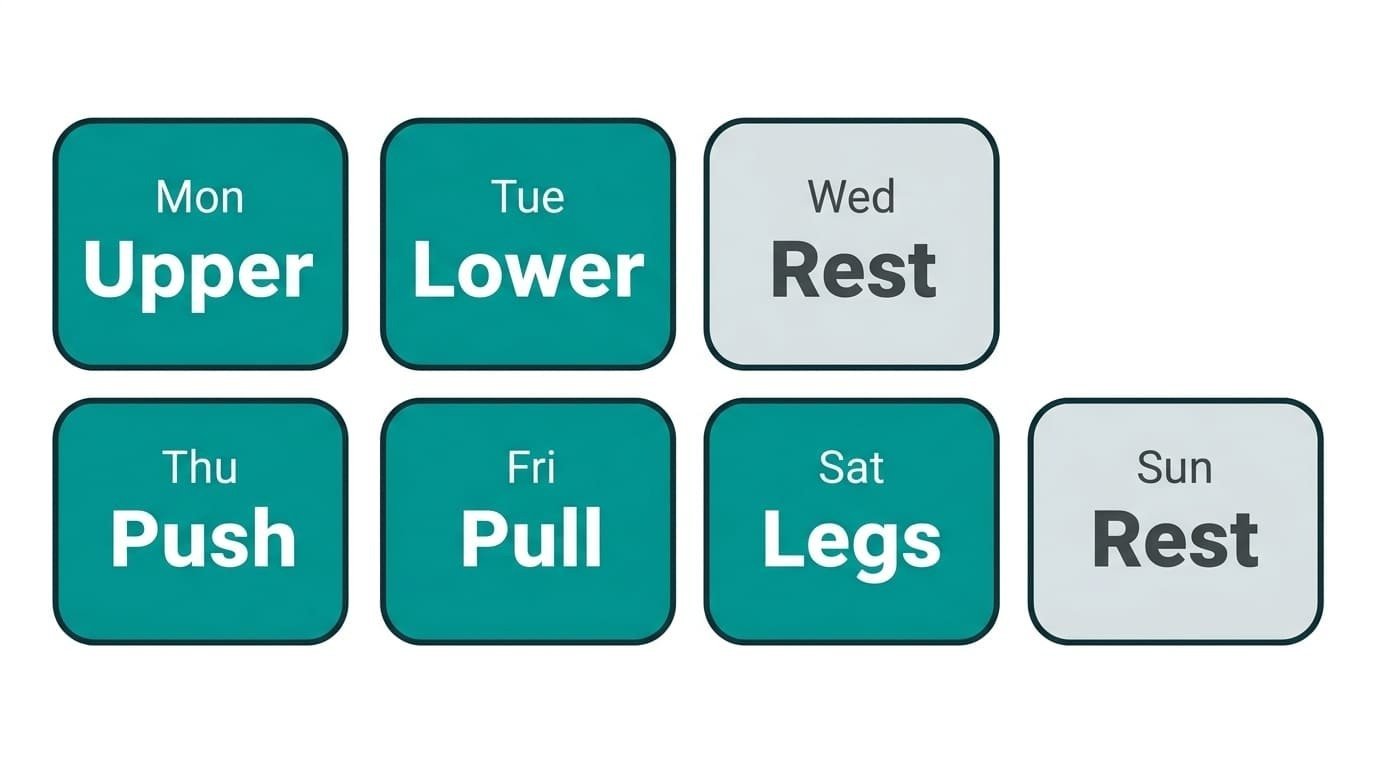
This is the one I recommend for most people, and the routines below use it. The first two days train the whole body across an upper and a lower session. After a rest day, three more focused sessions train it again as push, pull and legs. Every muscle is trained twice a week, with at least two days between.
Option 2: push pull legs rotation
You cycle push, pull, legs across five training days and carry on where you left off the following week. Over three weeks, everything is trained equally. Our push pull legs workout guide explains this in full.
Option 3: the body-part split
Often called the bro split. Each day is devoted to one or two muscle groups: chest, back, legs, shoulders, arms. It is the traditional bodybuilding layout, it is enjoyable, and it does work. Its weakness is that each muscle is trained only once a week.
A review of the research found that training each muscle group twice a week produced more growth than once a week when the total work was matched. That is the main reason to prefer the other options.
In practice the difference is smaller than it looks, because muscles overlap. Your triceps work on chest day and shoulder day, and your biceps on back day. If you love this style and it keeps you training, it is a perfectly reasonable choice.
Option 4: upper lower rotation
Three upper and two lower sessions one week, then two upper and three lower the next. Simple and effective, though some people find five sessions of two types repetitive.
How to schedule the five days
| Option | Mon | Tue | Wed | Thu | Fri | Sat | Sun |
|---|---|---|---|---|---|---|---|
| Classic | Upper | Lower | Rest | Push | Pull | Legs | Rest |
| Weekdays only | Upper | Lower | Push | Pull | Legs | Rest | Rest |
| Split rest days | Upper | Lower | Push | Rest | Pull | Legs | Rest |
The classic layout is the easiest to recover from, because the rest day falls in the middle. The weekdays-only version keeps your weekend free but means five days in a row, which only works well if your sessions are sensibly sized.
If you miss a day, do not double up. Slide the sessions along and use a rest day, or drop the least important session of the week.
The 5-day gym routine
Rest 2 to 3 minutes after sets of the first two exercises each day and 60 to 90 seconds after the others. Longer rests on the heavy lifts have been shown to produce better strength and muscle gains than short ones.
Day 1: Upper, strength focus
| Exercise | Sets | Reps |
|---|---|---|
| Bench press | 4 | 5 to 8 |
| Barbell row or chest-supported row | 4 | 6 to 8 |
| Overhead press | 3 | 6 to 8 |
| Pull-up or lat pulldown | 3 | 6 to 10 |
| Dumbbell curl | 2 | 8 to 10 |
| Triceps pushdown | 2 | 8 to 10 |
Day 2: Lower, strength focus
| Exercise | Sets | Reps |
|---|---|---|
| Back squat | 4 | 5 to 8 |
| Romanian deadlift | 3 | 6 to 8 |
| Leg press | 3 | 8 to 10 |
| Leg curl | 3 | 8 to 10 |
| Standing calf raise | 3 | 10 to 12 |
| Plank | 3 | 30 to 45 seconds |
Day 3: Push
| Exercise | Sets | Reps |
|---|---|---|
| Incline dumbbell press | 3 | 8 to 12 |
| Seated dumbbell shoulder press | 3 | 8 to 12 |
| Dips, or machine chest press | 3 | 8 to 12 |
| Lateral raise | 3 | 12 to 15 |
| Overhead triceps extension | 3 | 10 to 12 |
Day 4: Pull
| Exercise | Sets | Reps |
|---|---|---|
| Chin-up, or neutral-grip pulldown | 3 | 8 to 10 |
| Seated cable row | 3 | 10 to 12 |
| One-arm dumbbell row | 3 | 10 per side |
| Face pull or reverse fly | 3 | 12 to 15 |
| Incline dumbbell curl | 3 | 10 to 12 |
| Hammer curl | 2 | 10 to 12 |
Day 5: Legs
| Exercise | Sets | Reps |
|---|---|---|
| Deadlift, or trap bar deadlift | 3 | 5 to 6 |
| Bulgarian split squat | 3 | 8 to 10 per leg |
| Hip thrust | 3 | 10 to 12 |
| Leg extension | 3 | 12 to 15 |
| Seated calf raise | 3 | 12 to 15 |
| Hanging knee raise | 3 | 8 to 12 |
New to the big lifts? Our guide to barbell exercises for beginners has form steps for each.
The 5-day home dumbbell routine
You need a pair of dumbbells, ideally adjustable, a chair or sofa, and if possible a resistance band or doorway pull-up bar. Rest 60 to 90 seconds between sets.
Day 1: Upper
| Exercise | Sets | Reps |
|---|---|---|
| Push-up, or dumbbell floor press | 4 | 8 to 12 |
| One-arm dumbbell row | 4 | 8 to 10 per side |
| Dumbbell overhead press | 3 | 8 to 10 |
| Pull-up, band-assisted pull-up, or band pulldown | 3 | 6 to 10 |
| Dumbbell curl | 2 | 10 to 12 |
| Overhead dumbbell triceps extension | 2 | 10 to 12 |
Day 2: Lower
| Exercise | Sets | Reps |
|---|---|---|
| Goblet squat | 4 | 8 to 12 |
| Dumbbell Romanian deadlift | 3 | 8 to 12 |
| Reverse lunge | 3 | 8 to 10 per leg |
| Glute bridge, weighted | 3 | 12 to 15 |
| Single-leg calf raise | 3 | 12 to 15 |
| Dead bug | 3 | 8 per side |
Day 3: Push
| Exercise | Sets | Reps |
|---|---|---|
| Decline push-up, feet on a chair | 3 | 8 to 12 |
| Arnold press, or seated dumbbell press | 3 | 10 to 12 |
| Close-grip push-up | 3 | 8 to 12 |
| Lateral raise | 3 | 12 to 15 |
| Bench dip on a sturdy chair | 2 | 10 to 15 |
Day 4: Pull
| Exercise | Sets | Reps |
|---|---|---|
| Bent-over two-dumbbell row | 4 | 10 to 12 |
| Inverted row under a sturdy table, or band row | 3 | 8 to 12 |
| Dumbbell pullover | 3 | 10 to 12 |
| Reverse fly | 3 | 12 to 15 |
| Hammer curl | 3 | 10 to 12 |
Day 5: Legs
| Exercise | Sets | Reps |
|---|---|---|
| Bulgarian split squat, back foot on a chair | 4 | 8 to 10 per leg |
| Single-leg Romanian deadlift, hand on a wall | 3 | 8 per leg |
| Dumbbell hip thrust, back against a sofa | 3 | 12 to 15 |
| Step-up | 3 | 10 per leg |
| Calf raise on a step | 3 | 15 |
| Side plank | 2 | 20 to 30 seconds per side |
Our upper body dumbbell workout and dumbbell leg workout guides have more exercises to swap in.
Exercise swaps
Keep the movement and change the tool. Swap for comfort or equipment, not for novelty.
| If you cannot do | Use instead | Day |
|---|---|---|
| Bench press | Dumbbell press, push-up, machine chest press | Upper, push |
| Barbell row | One-arm dumbbell row, seated cable row, chest-supported row | Upper, pull |
| Overhead press | Seated dumbbell press, landmine press, pike push-up | Upper, push |
| Pull-up or chin-up | Lat pulldown, band-assisted pull-up, inverted row | Upper, pull |
| Dips | Close-grip push-up, bench dip, machine dip | Push |
| Back squat | Goblet squat, leg press, split squat | Lower |
| Deadlift | Romanian deadlift, trap bar deadlift, hip thrust | Legs |
| Leg curl | Stability ball or sliding hamstring curl | Lower |
| Leg extension | Step-down, slow split squat | Legs |
Sets, reps and weekly volume
| Variable | Target |
|---|---|
| Hard sets per muscle group per week | 10 to 20 |
| Reps on the main lifts | 5 to 10 |
| Reps on accessory lifts | 10 to 15 |
| Effort | End each set with one to three reps in reserve |
| Exercises per session | 5 to 6 |
| Session length | 45 to 60 minutes |
The routines above give about 14 to 18 weekly sets for the chest, back and legs, and 10 to 14 for the shoulders and arms once you count the work those muscles do in presses and rows. Research links around ten or more weekly sets per muscle with greater growth than fewer sets.
The trap with five days is doing too much. Five sessions of eight exercises each is forty exercises a week, most of them done tired. Keep each session to five or six exercises and make every set count.
How to move up from four days
Do not jump straight to the full routine. Add the fifth day in stages.
| Week | What to do |
|---|---|
| 1 | Run all five days with two sets per exercise |
| 2 | Three sets on the first three exercises each day, two on the rest |
| 3 | The full routine as written |
| 4 onward | Add reps and weight |
If after three weeks you feel worse instead of better, with sleep disrupted, joints aching or lifts going backward, go back to four days. That is not failure. It means four days is what you recover from at the moment.
How to progress
- Start each exercise at the bottom of its rep range with two reps in reserve
- Add a rep to one or more sets each session
- When every set reaches the top of the range, add the smallest weight available and return to the bottom
- Log every session. With five different workouts, you will not remember your numbers
| Week | Bench press, target 4 sets of 5 to 8 | Action |
|---|---|---|
| 1 | 60 kg: 6, 6, 5, 5 | Start |
| 2 | 60 kg: 7, 6, 6, 6 | Add reps |
| 3 | 60 kg: 8, 7, 7, 6 | Add reps |
| 4 | 60 kg: 8, 8, 8, 8 | Top of range |
| 5 | 62.5 kg: 6, 6, 5, 5 | Add weight |
Every six to eight weeks, take an easier week with about two thirds of your normal sets. Our sets and reps guide explains the reasoning.
Recovery on five days a week
- Sleep 7 to 9 hours. This matters more as training days increase
- Eat enough. Aim for roughly 1.6 to 2.2 grams of protein per kilogram of body weight a day. Our protein intake calculator gives your figure
- Keep cardio moderate. Daily walking and one or two easy sessions of 20 to 30 minutes are enough
- Use your rest days. At least one should be genuinely easy
- Watch for warning signs: lifts falling for two weeks, poor sleep, persistent soreness, sore joints or dreading the gym
Our guides to rest day activities and whether it is bad to work out every day cover this in more detail.
Where cardio fits
| Goal | How much cardio | When |
|---|---|---|
| Build muscle | 1 to 2 easy sessions of 20 minutes, plus walking | On rest days, or after lifting |
| General fitness | 2 sessions of 20 to 30 minutes | After upper-body days or on rest days |
| Fat loss | 2 to 3 sessions of 20 to 30 minutes, plus 8,000 to 10,000 steps a day | After lifting, or on rest days |
Avoid hard cardio the day before your leg sessions. Our guide on cardio before or after a workout explains the order.
5-day split compared with 3, 4 and 6 days
| Days | Weekly time | Frequency per muscle | Recovery demand | Verdict |
|---|---|---|---|---|
| 3, full body | 3 to 4 hours | 3 | Low | Best for beginners |
| 4, upper lower | 3 to 4 hours | 2 | Moderate | Best balance for most people |
| 5, hybrid | 4 to 5 hours | 2 | Moderate to high | Good for intermediates who want more volume |
| 6, push pull legs | 5 to 6 hours | 2 | High | For experienced lifters who recover well |
The step from four to five days adds about an hour a week and lets you spread the same work more thinly, or add a little more. It is a refinement, not a transformation.
Common mistakes
- Starting on five days as a beginner
- Too many exercises per session
- Pressing on three days in a row, such as chest, then shoulders, then triceps. The shared muscles never recover
- Skipping leg day, which is easier to do when it has its own slot
- Training to failure on every set
- No rest day in the middle of the week
- Not logging, so progress is guesswork
- Copying a professional bodybuilder’s volume
- Sticking with five days when life only allows three. A plan you complete beats a plan you keep missing
The bottom line
A five-day split gives you focused sessions of under an hour and enough room to train every muscle thoroughly. It suits people who have trained consistently for a year or more, recover well and enjoy being in the gym often.
The best layout for most is upper, lower, rest, push, pull, legs, rest. Each muscle is trained twice a week, no session drags, and there is a rest day when you need it. The body-part split works too, though it trains each muscle only once.
Keep each session to five or six exercises, build up to the full routine over three weeks, log everything, and take an easier week every couple of months. If four days is what your life and recovery allow, four days will build just as much.
Frequently asked questions
What is the best 5-day workout split?
For most people, upper, lower, rest, push, pull, legs, rest. It trains every muscle twice a week with sensible recovery. A push pull legs rotation and the classic body-part split also work. The best one is the one you can follow consistently.
Is a 5-day split good for building muscle?
Yes, for people past the beginner stage. Five sessions make it easy to reach 10 to 20 hard sets per muscle each week without long workouts. It is not better than four days for the same total work, but it is more comfortable to fit in.
Is a 5-day split too much for a beginner?
Usually. Beginners progress quickly on three full-body sessions a week and gain nothing extra from more days. Five days adds fatigue and complexity before it is needed. Move up after roughly a year of consistent training.
What muscle groups should I train on each day of a 5-day split?
Day 1 upper body, day 2 lower body, day 3 push muscles (chest, shoulders, triceps), day 4 pull muscles (back, biceps), day 5 legs. The traditional alternative is chest, back, legs, shoulders and arms on separate days.
Is the bro split effective?
It works, but each muscle is trained only once a week, and research suggests twice a week builds more muscle for the same total work. Overlap between muscles narrows the gap. If you enjoy it and stay consistent, it is a reasonable choice.
How long should a 5-day split workout be?
About 45 to 60 minutes, including warm-up sets. Each session should have five or six exercises. If you regularly pass 75 minutes, reduce the number of exercises, not the rest between heavy sets.
Should I train five days in a row?
You can, but a rest day after day two is easier to recover from. If you must train Monday to Friday, keep sessions to five exercises, order them so the same muscles are not worked on consecutive days, and rest fully at the weekend.
Can I do a 5-day split at home?
Yes. A pair of adjustable dumbbells and a chair cover push, lower-body and leg days. Pull day is better with a doorway pull-up bar or resistance bands, though rows, pullovers and curls with dumbbells are enough to start.
What’s next?
Reading is the easy part. Pick one of these and do it today.