Barbell Exercises for Beginners: 12 Lifts and 2 Full Workouts
The barbell is the most intimidating piece of equipment in most gyms. It lives in the corner where the confident people train, it weighs 20 kg before you put anything on it, and nobody explains how any of it works.
I avoided it for a long time for exactly those reasons. When I finally learned the basic lifts with an empty bar, I found the opposite of what I expected. The barbell is simple. A handful of movements train the whole body, and you always know precisely how much you lifted last time, so progress is easy to see.
This guide is for anyone who has never touched a barbell or has only tried it once or twice. It covers the equipment, how to start safely, twelve barbell exercises with clear steps, and two full-body workouts built from them.
At a glance
- Five lifts cover the whole body: squat, deadlift, bench press, overhead press and row
- A standard Olympic bar weighs 20 kg, and many gyms also have lighter 15 kg and 10 kg bars
- Learn every lift with an empty bar or a broomstick before adding plates
- Train three non-consecutive days a week, with 3 sets of 5 to 10 reps on most lifts
- Add the smallest plates available when every set feels solid
- Always use collars, set the safety bars, and never bench press heavy alone without them
Why train with a barbell?
You can build strength with dumbbells, bands or your own body weight, and most of this site is about exactly that. The barbell has a few advantages worth knowing.
- You can load it in small steps. Plates as light as 1.25 kg, or even 0.5 kg, let you add a little weight nearly every week for months
- Both hands share one bar, so you can lift more than with two separate dumbbells, and the big muscles of the legs and back get enough work
- A few exercises do almost everything. Five movements train every major muscle group
- Progress is obvious. The number on the bar goes up, or it does not
- It is a skill that lasts. Once you can squat, hinge, press and pull with a bar, every other form of training gets easier
Free weights and machines both work. A review that pooled studies comparing the two found no meaningful difference in muscle growth, and strength gains were largest in whichever method people actually trained with. So the barbell is not magic. It is simply a very efficient tool.
The equipment, explained
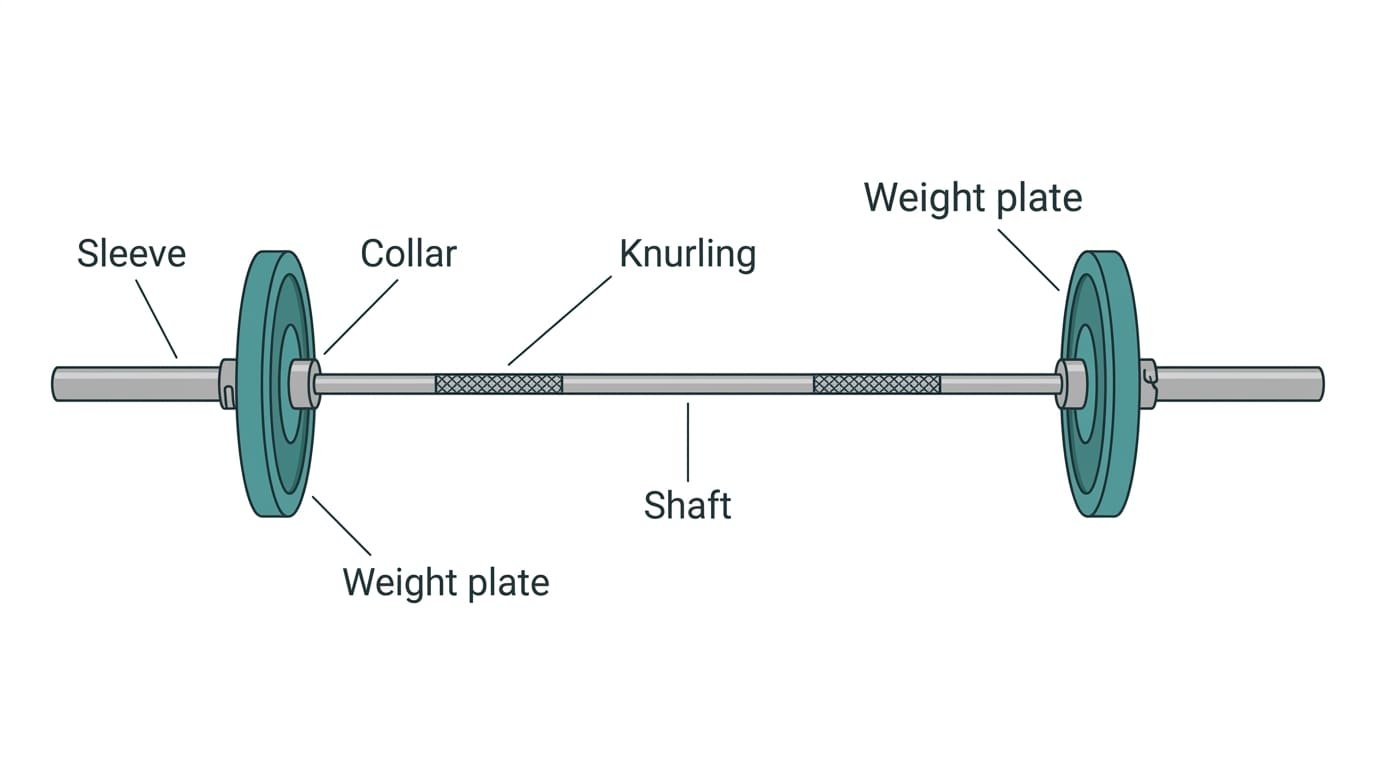
| Item | What it is | What to know |
|---|---|---|
| Olympic barbell | A 2.2 metre steel bar with rotating ends | Usually 20 kg. Lighter versions weigh 15 kg |
| Technique or training bar | A shorter or lighter bar | Often 10 kg or less. Ideal for learning |
| Sleeves | The thick rotating ends of the bar | Plates slide onto these |
| Knurling | The rough, cross-hatched grip sections | Helps your hands hold on. The smooth rings are guides for hand position |
| Weight plates | Discs from 1.25 kg to 25 kg | Full-size plates set the bar at the standard height for deadlifts |
| Collars or clips | Clamps that hold the plates on | Use them on every lift |
| Squat rack or power rack | A frame with hooks to hold the bar | Lets you start squats and presses from standing height |
| Safety bars or arms | Horizontal bars inside the rack | Catch the bar if you cannot finish a rep |
| Bench | A flat padded bench | For the bench press |
How to work out the weight on the bar: add up the plates on both sides and add the bar. Two 10 kg plates on a 20 kg bar is 40 kg. If you are not sure what a bar weighs, ask a member of staff. It is a normal question.
How to start safely
- Begin with the empty bar. If 20 kg is too heavy for a lift, use a lighter training bar, a pair of dumbbells or a broomstick until it is not. There is no minimum
- Set the rack before you lift. For squats and presses, the hooks should hold the bar at about the height of your upper chest, so you only need a slight knee bend to lift it out
- Set the safety bars just below the lowest point the bar reaches in your squat or bench press
- Put collars on, every time
- Load and unload evenly. Take plates off one side at a time in small amounts so the bar does not tip
- Warm up with lighter sets before your working weight
- Wear flat, firm shoes. Soft running shoes make you unstable under a bar
- Ask for a form check. One session with a qualified coach, or a video of your lifts from the side, is worth a great deal
Barbell training has a reputation for being dangerous that the numbers do not support. A review of injury studies across the weight-training sports found rates of roughly one to four injuries per thousand hours of training in powerlifting and weightlifting, which the authors noted is low compared with many team sports. Those figures are for competitive lifters handling maximal loads. Sensible beginner training carries less risk still.
Two skills every lift needs
Bracing. Before each rep, take a breath into your stomach and tighten your midsection as if someone were about to poke you in the side. Hold that tension through the hard part of the lift, then breathe out. A braced trunk keeps your spine steady under load.
A neutral spine. Your back should keep its natural, gentle curves throughout. It should not round forward or arch hard. If you cannot hold that position, the weight is too heavy or the range is too deep for now.
The 12 best barbell exercises for beginners
The first five are the foundation. The other seven are variations and additions.
1. Back squat
Trains the quadriceps, glutes, inner thighs and trunk.
- Set the bar in the rack at upper-chest height. Step under it and rest it across the muscles of your upper back, not on your neck
- Grip the bar a little wider than your shoulders and pull your elbows down
- Stand up to lift the bar out, take two steps back, and set your feet shoulder-width apart with toes turned out slightly
- Brace, then bend your hips and knees together and sit down between your heels
- Go down until your thighs are at least parallel to the floor, keeping your whole foot planted and your knees in line with your toes
- Drive up, keeping your chest and hips rising at the same speed
Form cue: if your heels lift or your back rounds at the bottom, reduce the depth slightly and work on ankle mobility. Our guide to ankle dorsiflexion exercises helps with this, and what muscles squats work explains the movement in more detail.
2. Deadlift
Trains the glutes, hamstrings, back and grip. It is the lift where you will handle the most weight.
- Stand with the bar over the middle of your feet, feet hip-width apart
- Bend down and grip the bar just outside your legs
- Bend your knees until your shins touch the bar. Do not let the bar roll forward
- Lift your chest and flatten your back. Your shoulders should be slightly in front of the bar
- Brace, then push the floor away and stand up, keeping the bar against your legs
- Finish standing tall, without leaning back
- Lower by pushing your hips back first, then bending your knees once the bar passes them
Form cue: with an empty bar or small plates, the bar sits lower than standard height. Rest it on blocks or stacked plates so it starts at mid-shin.
3. Bench press
Trains the chest, front of the shoulders and triceps.
- Lie on the bench with your eyes under the bar and your feet flat on the floor
- Squeeze your shoulder blades together and down, and keep them there
- Grip the bar slightly wider than your shoulders, thumbs wrapped around it
- Lift the bar out and bring it over your shoulders
- Lower it under control to the middle of your chest, elbows at about 45 to 70 degrees from your sides
- Press back up to the starting position
Safety: bench inside a rack with the safety bars set just above your chest, or with a spotter. Do not use collars if you are benching alone without safeties, so you can tip the plates off in an emergency. Better still, do not bench heavy alone.
4. Overhead press
Trains the shoulders, triceps, upper chest and trunk.
- Take the bar from the rack at upper-chest height, hands just outside your shoulders, forearms vertical
- Stand with feet hip-width apart, squeeze your glutes and brace
- Press the bar straight up, moving your head back slightly to let it pass
- Finish with the bar over the middle of your feet and your arms locked, head through
- Lower under control to your collarbones
Form cue: do not lean back to turn it into a standing bench press. If that happens, the weight is too heavy. Many beginners need a 15 kg or lighter bar for this lift at first.
5. Bent-over row
Trains the upper back, lats, rear shoulders and biceps.
- Stand with feet hip-width apart, holding the bar with hands just outside your knees
- Push your hips back and bend your knees slightly until your trunk is at about 45 degrees or lower, back flat
- Let the bar hang at arm’s length
- Pull it to your lower ribs, leading with your elbows
- Pause briefly, then lower under control
Form cue: your trunk should stay still. If you are heaving your chest up on each rep, take weight off.
6. Romanian deadlift
Trains the hamstrings and glutes through a long stretch, and teaches the hip hinge.
- Stand tall holding the bar at your thighs
- Soften your knees and keep them at that angle
- Push your hips straight back and slide the bar down your thighs, back flat
- Stop when you feel a strong stretch in your hamstrings, usually just below the knee
- Drive your hips forward to stand
7. Front squat
The bar rests across the front of your shoulders, which keeps your trunk more upright and shifts more work to the quadriceps. Use a crossed-arm grip if the standard grip strains your wrists. Start very light.
8. Barbell hip thrust
The best barbell exercise for the glutes. Sit with your upper back against a bench, roll a padded bar over your hips, and drive your hips up until your trunk and thighs form a straight line. Our hip thrusts at home guide covers the setup.
9. Barbell reverse lunge
With the bar on your upper back, step one foot back and lower until both knees are bent to about 90 degrees, then push through the front foot to stand. Learn it with bodyweight first. Balance is the limiting factor.
10. Incline bench press
A bench press on a bench set to about 30 degrees. It emphasises the upper chest and shoulders. Use the same setup rules as the flat bench.
11. Good morning
A hinge with the bar on your upper back. It strengthens the hamstrings and lower back and needs only a light load. Our good morning exercise guide explains the form.
12. Barbell curl
Stand holding the bar with palms forward, elbows by your sides, and curl it to your shoulders without swinging. A simple way to add biceps work at the end of a session.
Which lift trains what
| Lift | Movement pattern | Main muscles |
|---|---|---|
| Back squat | Squat | Quadriceps, glutes, inner thighs |
| Front squat | Squat | Quadriceps, upper back, trunk |
| Deadlift | Hinge | Glutes, hamstrings, back, grip |
| Romanian deadlift | Hinge | Hamstrings, glutes |
| Hip thrust | Hinge | Glutes |
| Bench press | Horizontal push | Chest, front shoulders, triceps |
| Incline bench press | Angled push | Upper chest, shoulders, triceps |
| Overhead press | Vertical push | Shoulders, triceps |
| Bent-over row | Horizontal pull | Upper back, lats, biceps |
| Reverse lunge | Single-leg | Quadriceps, glutes |
| Barbell curl | Isolation | Biceps |
The barbell is weakest for vertical pulling. Add pull-ups, lat pulldowns or one of our pull-up alternatives to complete the picture.
Two full-body barbell workouts
Alternate Workout A and Workout B on three non-consecutive days a week. Week one is A, B, A. Week two is B, A, B.
Workout A
| Exercise | Sets | Reps | Rest |
|---|---|---|---|
| Back squat | 3 | 5 to 8 | 2 minutes |
| Bench press | 3 | 5 to 8 | 2 minutes |
| Bent-over row | 3 | 8 to 10 | 90 seconds |
| Romanian deadlift | 2 | 8 to 10 | 90 seconds |
| Plank | 3 | 30 to 45 seconds | 60 seconds |
Workout B
| Exercise | Sets | Reps | Rest |
|---|---|---|---|
| Deadlift | 2 | 5 | 2 to 3 minutes |
| Overhead press | 3 | 5 to 8 | 2 minutes |
| Lat pulldown or assisted pull-up | 3 | 8 to 10 | 90 seconds |
| Reverse lunge, bodyweight or light bar | 2 | 8 per leg | 90 seconds |
| Barbell curl | 2 | 10 to 12 | 60 seconds |
Each session takes 45 to 60 minutes including the warm-up. Our 3-day workout split guide explains why full-body training suits beginners.
How to warm up
- Five minutes of easy cardio or brisk walking
- Ten bodyweight squats and ten hip hinges
- For your first lift, work up in steps
| Warm-up set | Weight | Reps |
|---|---|---|
| 1 | Empty bar | 10 |
| 2 | About 50 percent of your working weight | 5 |
| 3 | About 75 percent of your working weight | 3 |
| Working sets | 100 percent | As planned |
Later lifts in the session need only one or two lighter sets. Our workout warm-up guide has more.
How much weight should you start with?
Start with the empty bar on every lift and add a little each session until the last rep of each set is clearly harder than the first but your form looks the same. That is your starting weight. Finding it usually takes two or three sessions.
Typical starting points vary enormously with body size, age and history, so treat these only as a rough guide.
| Lift | A common first working weight |
|---|---|
| Back squat | Empty bar to 40 kg |
| Deadlift | 30 to 50 kg |
| Bench press | Empty bar to 30 kg |
| Overhead press | 10 kg bar to 25 kg |
| Bent-over row | Empty bar to 30 kg |
Starting too light costs you a week or two. Starting too heavy costs you your form. Err on the light side.
How to add weight
- When you complete every set at the top of the rep range with good form, add weight next session
- Add 2.5 kg in total for upper-body lifts and 2.5 to 5 kg for squats and deadlifts
- Drop back to the bottom of the rep range and build up again
- If you fail to hit the bottom of the range twice in a row, take 10 percent off and work back up
| Session | Back squat, target 3 sets of 5 to 8 | Action |
|---|---|---|
| 1 | 30 kg: 6, 6, 5 | Start |
| 2 | 30 kg: 7, 7, 6 | Add reps |
| 3 | 30 kg: 8, 8, 8 | Top of range |
| 4 | 32.5 kg: 6, 6, 5 | Add weight |
| 5 | 32.5 kg: 7, 7, 7 | Add reps |
| 6 | 32.5 kg: 8, 8, 8 | Top of range |
Our sets and reps guide explains the reasoning, and the strength calculator estimates your one-rep maximum without testing it.
Common beginner mistakes
- Adding weight before the movement is learned. Good form with a light bar beats poor form with a heavy one
- Rounding the back in deadlifts and rows. Flatten your back before the bar leaves the floor
- Cutting squats short as the weight goes up
- Bouncing the bar off the chest in the bench press
- Leaning back in the overhead press
- Skipping collars and safety bars
- Training the same lifts hard on consecutive days, which leaves no time to recover
- Comparing your numbers with people who have trained for years
Barbell or dumbbells?
| Barbell | Dumbbells | |
|---|---|---|
| Maximum load | High | Limited by what you can hold |
| Progression steps | Small, with fractional plates | Often 2 kg jumps or more per hand |
| Space and cost | Needs a bar, plates and a rack | A pair or adjustable set fits in a corner |
| Learning curve | Moderate | Lower |
| Left and right balance | The stronger side can compensate | Each side works alone |
| Best for | Heavy squats, deadlifts and presses | Home training, variety, single-arm work |
Neither is better. If you train at home with limited space, our dumbbell workout plan for beginners covers the same movement patterns, and home workout versus gym compares the two settings.
Who should get advice first
Barbell training suits most healthy adults, including older adults, when it starts light and progresses slowly. Speak to a doctor or physiotherapist first if you have:
- Uncontrolled high blood pressure or a heart condition
- A current back, shoulder, hip or knee injury
- A hernia, or recent surgery
- Osteoporosis. Loaded training is often recommended for bone health, but it should be supervised at first
- A pregnancy, if you were not lifting beforehand
Stop a lift that causes sharp pain, pain that travels down an arm or leg, or dizziness.
The bottom line
A barbell looks complicated and is not. Learn five movements: squat, deadlift, bench press, overhead press and row. Start with an empty bar, use collars and safety bars, and train three days a week.
Add a little weight whenever every set is solid, and write down what you lift. Within a few months you will be handling loads that seemed out of reach at the start, and the corner of the gym that looked intimidating will simply be where you train.
You do not need any accessories to begin. When you are curious, our guide to wrist wraps, elbow sleeves and lifting gloves explains who needs what.
Once you own a barbell, a corner of the room turns it into a landmine. Our landmine exercises guide shows how.
Frequently asked questions
What are the best barbell exercises for beginners?
The back squat, deadlift, bench press, overhead press and bent-over row. Together they train every major muscle group and teach the main movement patterns. Romanian deadlifts and hip thrusts are useful additions once those five feel comfortable.
How much does a barbell weigh?
A standard Olympic barbell weighs 20 kg, or about 44 pounds. Many gyms also have 15 kg bars and lighter training bars of around 10 kg. If you are unsure, ask a member of staff, as bars are not always labelled.
Can beginners use a barbell?
Yes. Beginners often progress fastest with a barbell because the weight can be increased in very small steps. Start with an empty or lighter bar, learn each movement properly, use the safety bars in the rack, and add weight gradually.
How many days a week should I do barbell workouts?
Three non-consecutive days a week is ideal for beginners, such as Monday, Wednesday and Friday. That gives each muscle group regular practice with a day of recovery between sessions. Two days a week also works if your schedule is tight.
How much weight should I lift on a barbell as a beginner?
Start with the empty bar and add weight over two or three sessions until the final reps of each set are challenging but your form stays the same. Starting points differ widely between people, so use your own form as the guide.
Are barbell exercises safe?
They are safe when you learn the technique with light weights, use collars and safety bars, and progress gradually. Studies of competitive lifters report injury rates lower than in many team sports. Most problems come from adding weight too quickly.
Can I build muscle with only a barbell?
Yes. Squats, deadlifts, presses and rows train nearly every muscle, and the barbell makes it easy to keep adding load, which is what drives muscle growth. Adding pull-ups or pulldowns fills the one gap, which is vertical pulling.
Do I need a spotter for barbell exercises?
Not for most lifts. Squatting and pressing inside a rack with the safety bars set correctly is safe alone. The bench press is the exception: use safety bars or a spotter whenever the weight is challenging.
What’s next?
Reading is the easy part. Pick one of these and do it today.