
Core Exercises for Runners: 12 Moves for a Stronger, Steadier Stride (Plus 3 Workouts)
Core exercises for runners were something I ignored for my first two years of running. I thought “core” meant crunches and six-packs, and I was not interested in either. Then, around mile 9 of my first half marathon, my form fell apart. My hips dropped, my shoulders hunched and my lower back ached for the last four miles. The legs still had something left. The middle of my body did not.
A physiotherapist who also coached runners explained it simply: “Your core is the link between your legs and your arms. When it tires, everything wobbles.” She gave me a short routine of planks, dead bugs, side planks and single-leg moves, two or three times a week, 15 minutes at a time. By my next half marathon, I held my form to the finish line and knocked six minutes off my time.
This guide explains what core strength means for runners, 12 of the most useful core exercises for runners, three core workouts for runners you can do at home, how to fit them into your week, and what the research says.
At a glance
- For runners, the core includes the abs, obliques, lower back, glutes and hips, not just the six-pack
- Its job is to keep your trunk and pelvis steady while your legs and arms move
- Anti-movement exercises like planks, side planks and dead bugs suit runners best
- Single-leg and hip exercises matter as much as classic ab moves
- In one trial, six weeks of core training improved 5,000 metre times in recreational runners
- Two or three short sessions a week, 10 to 20 minutes each, are enough
- Do core work after easy runs or on non-running days, not before hard sessions
What does core strength mean for runners?
Every running stride involves one leg pushing off, one swinging through, and your arms swinging the opposite way. Your core has to stop your trunk twisting, your pelvis dropping and your lower back arching too much, thousands of times per run.
| Core muscle group | Role in running | Example exercise |
|---|---|---|
| Deep abdominals (transverse abdominis) | Stiffen the trunk like a corset | Dead bug |
| Rectus abdominis and obliques | Control rotation and stop the ribs flaring | Plank, side plank |
| Lower back muscles | Hold your posture upright as you tire | Bird dog |
| Glutes | Drive you forward and keep the pelvis level | Glute bridge, single-leg bridge |
| Hip abductors | Stop the hip dropping on each stride | Side plank, monster walks |
| Hip flexors | Lift the knee and control the swing leg | Dead bug, mountain climbers |
That is why the best core exercises for runners look quite different from a classic ab workout. They train your body to resist unwanted movement and to stay stable on one leg.
What the research says
- Core training improved race times. A small randomised trial of recreational and competitive runners found that six weeks of core strength training led to faster 5,000 metre times compared with a control group. Interestingly, it did not measurably change ground forces or a balance test, so the exact reason for the improvement is not clear
- Strength training makes runners more efficient. A meta-analysis of trained middle- and long-distance runners found that two or three sessions a week of strength and plyometric training for 8 to 12 weeks had a large beneficial effect on running economy
- Strength work helps prevent injuries. A meta-analysis of 25 trials with more than 26,000 people found that strength training reduced sports injuries to less than a third, while stretching alone had no clear protective effect
12 core exercises for runners
These are grouped into four types. A good routine includes at least one from each group. Move slowly, breathe steadily and stop each set while your form is still good.
Anti-extension: stop the lower back arching
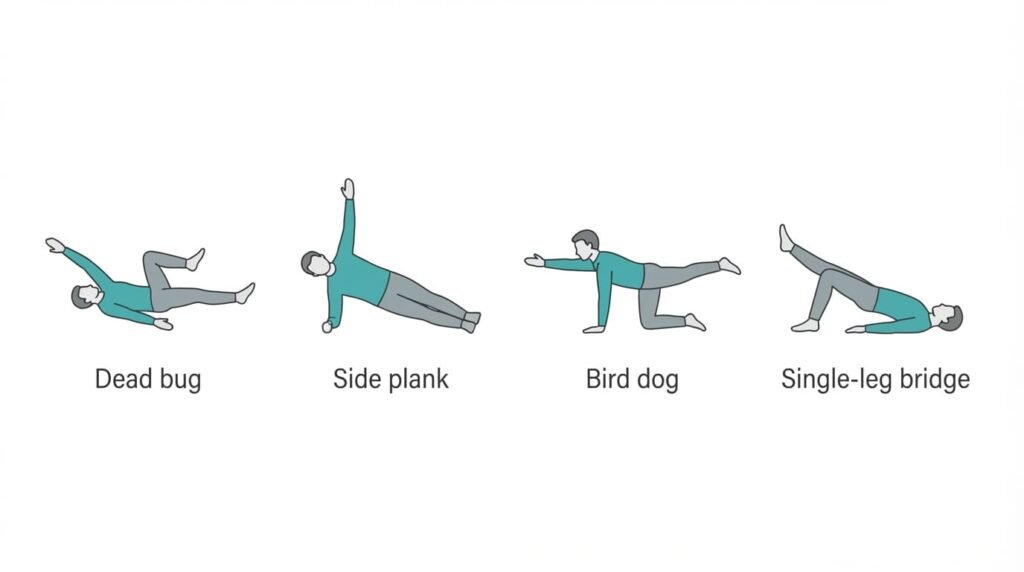
1. Dead bug
- Lie on your back, arms pointing at the ceiling, knees bent at 90 degrees above your hips
- Press your lower back gently into the floor
- Slowly lower your right arm overhead and straighten your left leg toward the floor, without letting your back arch
- Return and switch sides
Dose: 2 to 3 sets of 6 to 10 each side. The dead bug mimics the opposite arm and leg action of running, which makes it one of the most useful core exercises for runners.
2. Front plank
Hold your body in a straight line on your forearms and toes, ribs down and glutes gently squeezed.
Dose: 3 x 20 to 45 seconds. Better to hold three perfect 30-second planks than one shaky two-minute plank.
3. Plank with alternating leg lift
From a front plank, lift one foot a few centimetres off the floor for 2 seconds, then switch, without letting your hips twist.
Dose: 2 to 3 sets of 8 each side.
Anti-lateral flexion: keep the trunk upright
4. Side plank
- Lie on your side, elbow under your shoulder, legs stacked
- Lift your hips so your body forms a straight line
- Hold without letting your hips sag
Dose: 3 x 15 to 30 seconds each side. Side planks train the obliques and the hip muscles that stop your pelvis dropping as you run.
5. Side plank with top leg lift
From a side plank, lift your top leg toward the ceiling and lower it slowly.
Dose: 2 sets of 8 to 10 each side. Excellent for the gluteus medius.
6. Suitcase carry
Hold a heavy dumbbell or a loaded bag in one hand and walk 20 to 30 metres, standing tall without leaning. Switch hands. Our farmer’s carry guide covers this and other carries.
Dose: 3 rounds each side.
Anti-rotation: resist twisting
7. Bird dog
- Start on hands and knees, hands under shoulders and knees under hips
- Reach your right arm forward and left leg back, keeping your back flat and hips level
- Hold for 2 to 3 seconds, return and switch
Dose: 2 to 3 sets of 8 each side. Part of the McGill Big 3, a core routine many physiotherapists recommend.
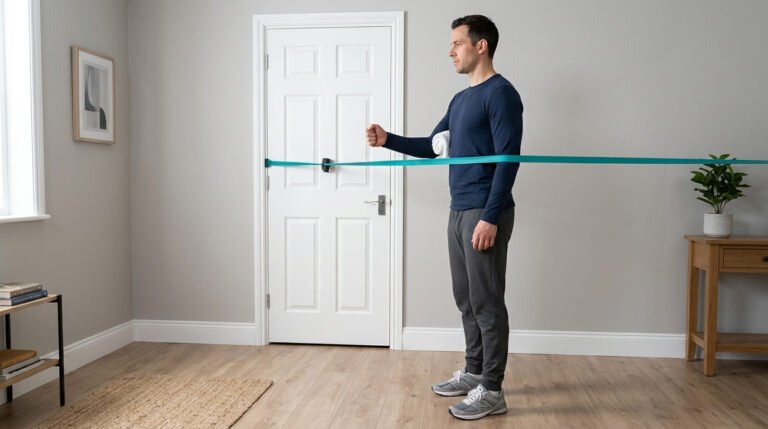
8. Pallof press
- Anchor a resistance band at chest height and stand side-on to it
- Hold the band at your chest with both hands
- Press your hands straight out in front of you, resisting the band’s pull to rotate you
- Hold for 2 seconds, then bring your hands back
Dose: 2 to 3 sets of 10 each side.
9. Plank shoulder taps
From a high plank with feet wide, tap each shoulder with the opposite hand while keeping your hips still. Our plank shoulder taps guide explains how to stop the hips rocking.
Dose: 2 to 3 sets of 10 to 20 taps.
Hips and single-leg stability
10. Single-leg glute bridge
- Lie on your back, knees bent, one foot on the floor and the other knee pulled gently toward your chest
- Drive through the heel on the floor to lift your hips
- Keep your pelvis level and lower slowly
Dose: 2 to 3 sets of 8 to 12 each side. Our glute bridge vs hip thrust guide shows progressions.
11. Monster walks or lateral band walks
With a loop band above the knees, sink into a quarter squat and step forward, back and sideways, keeping your knees pushed out. Our monster walks guide covers band placement.
Dose: 2 to 3 sets of 12 steps each direction.
12. Single-leg balance reach
- Stand on one leg with a soft knee
- Reach your other foot forward, then to the side, then behind you, touching the floor lightly each time
- Keep your hips level and your standing knee over your toes
Dose: 2 sets of 5 reaches in each direction, each leg. Running is a series of single-leg landings, and this trains exactly that.
| Exercise | Type | Equipment | Main benefit for runners |
|---|---|---|---|
| Dead bug | Anti-extension | None | Controls the lower back while arms and legs move |
| Front plank | Anti-extension | None | Stiff, upright trunk |
| Plank with leg lift | Anti-extension and anti-rotation | None | Stability as the legs move |
| Side plank | Anti-lateral flexion | None | Level pelvis and strong obliques |
| Side plank with leg lift | Anti-lateral flexion and hips | None | Gluteus medius strength |
| Suitcase carry | Anti-lateral flexion | Dumbbell or bag | Upright posture under load |
| Bird dog | Anti-rotation | None | Coordination of opposite arm and leg |
| Pallof press | Anti-rotation | Resistance band | Resisting trunk rotation |
| Plank shoulder taps | Anti-rotation | None | Stability when one limb lifts |
| Single-leg glute bridge | Hips | None | Powerful, stable push-off |
| Monster walks | Hips | Loop band | Knee and pelvis control |
| Single-leg balance reach | Single-leg stability | None | Steadier landings |
3 core workouts for runners
Do these core workouts for runners after an easy run or on a non-running day. Rest about 30 seconds between exercises.
Workout 1: Beginner (10 minutes)
| Exercise | Sets x reps or time |
|---|---|
| Dead bug | 2 x 6 each side |
| Front plank | 2 x 20 seconds |
| Side plank | 2 x 15 seconds each side |
| Bird dog | 2 x 6 each side |
| Glute bridge (two legs) | 2 x 12 |
Workout 2: Intermediate (15 minutes)
| Exercise | Sets x reps or time |
|---|---|
| Dead bug | 3 x 8 each side |
| Side plank with top leg lift | 2 x 8 each side |
| Pallof press | 3 x 10 each side |
| Single-leg glute bridge | 3 x 10 each side |
| Monster walks | 2 x 12 steps each direction |
| Front plank | 2 x 40 seconds |
Workout 3: Runner’s stability circuit (20 minutes)
Do 3 rounds:
| Exercise | Reps or time |
|---|---|
| Plank with alternating leg lift | 8 each side |
| Side plank | 30 seconds each side |
| Suitcase carry | 30 metres each side |
| Single-leg balance reach | 5 each direction, each leg |
| Plank shoulder taps | 20 taps |
| Single-leg glute bridge | 10 each side |
A 6-week progression for core exercises for runners
If you want a clear path, follow this progression twice a week. It starts gentle and builds toward the full runner’s stability circuit.
| Week | Workout | Focus |
|---|---|---|
| Weeks 1 to 2 | Workout 1, beginner | Learn the movements and control your breathing |
| Weeks 3 to 4 | Workout 2, intermediate | Add single-leg and anti-rotation work |
| Week 5 | Workout 2, with longer holds and 2 extra reps per set | Build endurance in the core |
| Week 6 | Workout 3, runner’s stability circuit | Put it all together under fatigue |
After six weeks, keep two sessions a week going year-round. Core exercises for runners work best as a habit, not a short project before race season.
How to brace and breathe
Many runners hold their breath during core exercises, which makes them feel harder and teaches the wrong habit. Try this before every exercise:
- Stand or lie in your starting position
- Take a normal breath in through your nose
- Gently tighten your midsection, as if preparing for someone to poke your stomach. Aim for about 20 to 30 percent effort, not a full squeeze
- Keep breathing steadily, in through the nose and out through the mouth, while you hold that light brace
This light, breathing brace is closer to what your core does while running than a maximal clench. Our guide to breathing while running explains belly breathing, which pairs well with this.
Core exercises for runners at every stage
| Runner | Best starting point | Tips |
|---|---|---|
| New runners | Workout 1 after easy runs | Start with short holds and focus on form |
| Half marathon and marathon runners | Workout 2 or 3, twice a week | Keep it going through the taper, but reduce the volume in race week |
| Older runners | Dead bugs, bird dogs, side planks from the knees | Add balance work, which protects against falls too |
| Runners with a history of back pain | Bird dog, dead bug and side plank, with guidance | The McGill Big 3 approach is a sensible start |
| Runners after pregnancy | See a pelvic health physiotherapist first | They can check for abdominal separation and pelvic floor needs |
Whatever your stage, choose core exercises for runners that you can do with good control. Easier versions done well beat harder versions done badly.
Fitting core work into your running week
| Day | Session |
|---|---|
| Monday | Rest |
| Tuesday | Easy run, then Workout 1 or 2 |
| Wednesday | Strength training or rest |
| Thursday | Interval or tempo run (no core work beforehand) |
| Friday | Core workout or rest |
| Saturday | Long run |
| Sunday | Easy run or rest |
Avoid tiring your core before hard runs or long runs, because a fatigued core is exactly what you are trying to prevent. Our guides to running for beginners and the 12 week half marathon training plan show how strength fits into a full plan.
Strength training for distance runners
Core work is one part of the bigger picture of strength training for distance runners. A complete routine also includes:
| Area | Exercises | Why |
|---|---|---|
| Legs | Squats, split squats, step-ups | Stronger push-off and better shock absorption |
| Calves | Calf raises, single-leg calf raises | Support the Achilles and absorb landing forces |
| Hamstrings | Single-leg Romanian deadlifts, bridges | Protect against hamstring strains |
| Power | Low hops, skips, jump squats once strong | Improve running economy |
Two sessions a week combining core work with these exercises is a solid plan for most runners. Our guide on how to increase running endurance explains how strength fits alongside easy running, and the single-leg squat guide is a great next step for leg strength.
Bodyweight exercises for runners: no equipment needed
Almost all of the core exercises above are bodyweight exercises for runners, so you can do them anywhere, including a hotel room the night before a race. If you only have five minutes, this no-equipment mini routine covers the essentials:
- Dead bug, 8 each side
- Side plank, 20 seconds each side
- Single-leg glute bridge, 8 each side
- Bird dog, 8 each side
- Front plank, 30 seconds
For more ideas, our calisthenics core workout and guide to transverse abdominis exercises cover additional moves.
How core strength shows up in your running
| Weak core sign | What a stronger core changes |
|---|---|
| Hips dropping to one side with each stride | Level pelvis and smoother stride |
| Upper body twisting or arms crossing the body | Arms swing forward and back with less rotation |
| Lower back ache late in long runs | Upright posture held to the finish |
| Form falling apart in the last mile | Steadier form when tired |
Our running form guide shows how to film yourself and spot these signs.
Common mistakes
- Doing only crunches and sit-ups, which train flexing the spine rather than stabilising it
- Holding planks for minutes with poor form instead of shorter, perfect holds
- Ignoring the hips and glutes, which are a huge part of a runner’s core
- Rushing the reps, especially dead bugs and bird dogs
- Doing core work right before hard runs
- Holding your breath during holds
- Training core once a month. Consistency matters more than intensity
Safety
Core exercises for runners are low-risk for most people. Stop any exercise that causes sharp pain in your back, hips or shoulders. If you have current back pain, a recent injury, are pregnant or have recently given birth, get advice from a physiotherapist on which exercises suit you.
This article is general information, not medical advice. See our medical disclaimer.
The bottom line
The best core exercises for runners train your trunk and hips to stay steady while your legs and arms move. Dead bugs, planks, side planks, bird dogs, Pallof presses, single-leg bridges, monster walks and single-leg balance work cover everything you need. Two or three short sessions a week, after easy runs or on rest days, are enough.
When I finally took core work seriously, my form held together to the end of my long runs and my lower back stopped aching. It was the cheapest performance boost I have ever found: 15 minutes, a few times a week, on the living room floor.
Frequently asked questions
What are the best core exercises for runners?
Dead bugs, front planks, side planks, bird dogs, Pallof presses, plank shoulder taps, single-leg glute bridges, monster walks and single-leg balance reaches are among the best core exercises for runners. They train stability rather than just crunching the abs.
How often should runners do core workouts?
Two or three times a week is ideal for most runners. Each session can be 10 to 20 minutes. Do them after easy runs or on non-running days.
Should I do core work before or after running?
After easy runs or on separate days is best. Tiring your core before a hard or long run can make your form worse during the run.
Does core strength make you a faster runner?
It can help. In one trial, six weeks of core training improved 5,000 metre times in recreational runners. Core work also helps you hold good form when you are tired.
Are planks enough for runners?
Planks are useful, but runners also need side planks, anti-rotation exercises and single-leg hip work, because running happens on one leg at a time and involves rotation.
What strength training should distance runners do?
Strength training for distance runners should include core stability work, leg strength such as squats and split squats, calf raises, hamstring exercises and, once strong, some low-level hopping. Two sessions a week is a good target.
Can I do core workouts for runners without equipment?
Yes. Most core workouts for runners need no equipment at all. Dead bugs, planks, side planks, bird dogs and single-leg bridges are all bodyweight exercises for runners.
How long until core training improves my running?
Many runners notice steadier form within four to six weeks of consistent core work, two or three times a week.
Do runners need ab exercises like crunches?
Not really. Crunches train flexing the spine, which is not what your core does while running. Runners get more benefit from stability exercises such as planks, side planks, dead bugs and bird dogs, plus single-leg hip work.
Can core exercises help with lower back pain from running?
They often help, especially exercises like bird dogs, dead bugs and side planks that build endurance in the trunk muscles. If you have ongoing or severe back pain, see a physiotherapist for a programme tailored to you.
What’s next?
Reading is the easy part. Pick one of these and do it today.