Kettlebell Leg Exercises: 12 Moves and 3 Leg Workouts for Beginners
Kettlebell leg exercises are a brilliant way to train your lower body at home. One kettlebell can cover squats, lunges, hinges, swings and step-ups, which means quads, glutes, hamstrings and calves all get worked without a rack or a barbell.
What I like most is how the shape of the kettlebell helps your form. Holding it at your chest for a goblet squat naturally keeps your torso upright, and the handle makes swings and deadlifts feel smooth. For a beginner, that is a big help.
This guide covers 12 kettlebell leg exercises, grouped into squats, lunges, hinges and power moves. You will also find advice on choosing a weight, three leg workouts, a 6-week plan and what the research says about kettlebell training for leg strength.
At a glance
- Kettlebell leg exercises train the quads, glutes, hamstrings, calves and core
- The goblet squat, kettlebell deadlift and reverse lunge are the best starting moves
- Kettlebell glute exercises such as swings, hip thrusts and single-leg deadlifts build strong hips
- In one study, 6 weeks of twice-weekly kettlebell swing training improved half squat strength by about 10 percent and jump height by about 20 percent
- Another study found heavy barbell lifting built squat strength faster than kettlebell training, so kettlebells are great but not magic
- Train legs with kettlebells two or three times a week
- Most beginners do well with an 8 to 16 kg kettlebell
Muscles worked by kettlebell leg exercises
| Muscle group | Best kettlebell exercises | What they do in daily life |
|---|---|---|
| Quadriceps | Goblet squat, step-up, reverse lunge | Standing up, climbing stairs |
| Glutes | Swing, hip thrust, single-leg deadlift | Walking uphill, lifting, balance |
| Hamstrings | Romanian deadlift, swing, good morning | Bending and lifting safely |
| Inner and outer thighs | Lateral lunge, sumo squat | Side-to-side movement and knee control |
| Calves | Calf raise holding a kettlebell | Walking, running, jumping |
| Core | Every exercise, especially carries and single-leg work | Keeping your spine steady |
Our guide to what muscles squats work explains the squat pattern in more detail.
Choosing your kettlebell weight
| Exercise type | Complete beginner | Some experience |
|---|---|---|
| Goblet squats and lunges | 8 to 12 kg | 12 to 20 kg |
| Deadlifts and Romanian deadlifts | 12 to 16 kg | 16 to 24 kg |
| Swings | 8 to 12 kg | 12 to 20 kg |
| Single-leg exercises | 6 to 10 kg | 10 to 16 kg |
Legs are strong, so you will outgrow a light kettlebell faster than for upper body work. If you only own one bell, make exercises harder by slowing the lowering phase, adding a pause at the bottom or switching to single-leg versions. Our guide to the kettlebell workout for beginners covers buying your first bell.
How to do kettlebell leg exercises well
- Warm up first. 5 minutes of walking, bodyweight squats and leg swings
- Keep your heels down in squats and lunges
- Knees follow toes. Do not let them cave inward
- Hinge, do not round. In deadlifts and swings, push your hips back with a long, flat back
- Control the way down. Take 2 to 3 seconds to lower in squats, lunges and deadlifts
- Breathe and brace. Breathe in and tighten your stomach before each rep
A 5-minute kettlebell leg warm-up
A short warm-up makes the first sets of kettlebell leg exercises feel smoother and helps you find a good squat depth.
| Move | How to do it | Time or reps |
|---|---|---|
| Brisk marching or walking | On the spot or around the room | 1 minute |
| Bodyweight squats | Slow, to a comfortable depth | 10 reps |
| Leg swings | Forward and back, holding a wall | 10 per leg |
| Hip hinge practice | Hands on hips, push hips back and stand | 10 reps |
| Light goblet squat hold | Hold the bell at your chest at the bottom of a squat | 2 x 20 seconds |
Squat exercises
1. Goblet squat
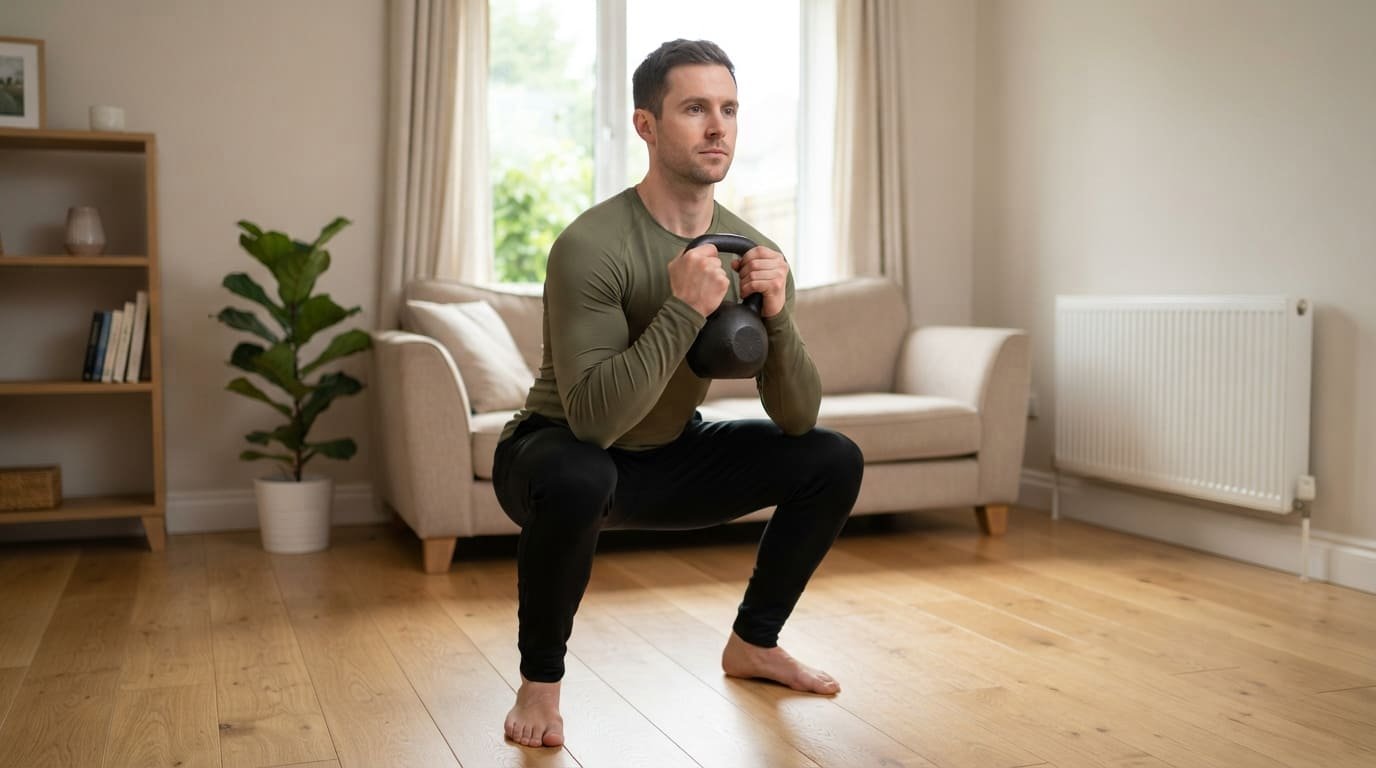
The goblet squat is the king of kettlebell leg exercises for beginners.
- Hold the kettlebell by the horns at your chest, elbows pointing down
- Stand with feet slightly wider than hip-width, toes turned out a little
- Sit down between your knees, keeping your chest tall and heels on the floor
- Go as low as you comfortably can, ideally until your elbows touch the insides of your knees
- Push through your whole foot to stand
Dose: 3 sets of 10 to 12.
2. Sumo squat
Stand with a wide stance and toes turned out. Hold the kettlebell by the handle with straight arms between your legs. Squat down, keeping your knees pushing out over your toes, then stand. This works the inner thighs and glutes a little more. 3 sets of 12.
3. Pause goblet squat
Do a goblet squat and hold the bottom position for 2 to 3 seconds before standing. The pause removes bounce and makes a light bell feel much heavier. 3 sets of 8.
Lunge and single-leg exercises
4. Reverse lunge
Hold the kettlebell at your chest or by your side. Step one foot back and lower your back knee toward the floor. Push through your front foot to return. Reverse lunges are kinder on the knees than forward lunges. 3 sets of 8 to 10 per leg.
5. Lateral lunge
Hold the bell at your chest. Take a big step to the side, bend that knee and sit your hips back, keeping the other leg straight. Push back to the start. 3 sets of 8 per side. Great for the inner thighs and hips. Our guide to inner thigh exercises has more ideas.
6. Kettlebell step-up
Hold the kettlebell at your chest or by your side and step up onto a sturdy step or low bench. Drive through the front heel to stand tall, then step down slowly. 3 sets of 8 to 10 per leg. Start with a low step, about knee height or lower.
7. Split squat
Stand in a long split stance holding the bell at your chest. Lower your back knee straight down toward the floor, then press up. Keep your front heel down. 3 sets of 8 to 10 per leg. Our guide to the single leg squat shows how to progress further.
Hinge exercises for glutes and hamstrings
These are the kettlebell glute exercises and kettlebell hamstring exercises that balance out all the squatting.
8. Kettlebell deadlift
Stand over the kettlebell with feet hip-width apart. Hinge at your hips, bend your knees slightly and grip the handle. Brace and stand up by driving your hips forward. 3 sets of 10 to 12. This is the base for every hinge in this guide.
9. Kettlebell Romanian deadlift
Start standing with the kettlebell in both hands. Keep a soft bend in your knees and push your hips back, sliding the bell down your thighs until you feel a strong stretch in your hamstrings. Stand back up by squeezing your glutes. 3 sets of 10. This is one of the most effective kettlebell hamstring exercises.
10. Single-leg Romanian deadlift
Hold the kettlebell in one hand and balance on the opposite leg. Hinge forward, reaching your free leg behind you, then stand up. 3 sets of 6 to 8 per side. Hold a wall at first. It trains glutes, hamstrings and balance together.
11. Kettlebell hip thrust
Sit with your upper back against a sofa or bench and a kettlebell resting on your hips, held with both hands. Drive your hips up until your body is level from shoulders to knees, squeeze your glutes, then lower. 3 sets of 12. If you prefer the floor version, our guide to the glute bridges exercise covers it, and hip thrusts at home covers the sofa setup.
Power move
12. Kettlebell swing
The swing is a fast, powerful hip hinge. You hike the bell back between your legs, then snap your hips forward to float it to chest height. It trains the glutes and hamstrings hard and raises your heart rate quickly.
A study had healthy young men do 12-minute swing sessions twice a week for 6 weeks. Their half squat strength improved by about 10 percent and their vertical jump by about 20 percent, similar to a group doing jump squat training.
Learn the deadlift first, then follow our step-by-step guide to the kettlebell swing. Dose: 5 sets of 10 to 15.
Kettlebells vs heavier lifting for leg strength
Kettlebells are excellent, but it is worth being realistic. One study compared 6 weeks of kettlebell training with traditional weightlifting and heavy barbell training. Both groups got stronger and more powerful, but the weightlifting group gained more back squat strength. There was no difference in vertical jump.
For most beginners training at home, that does not matter much. Kettlebell leg exercises build plenty of strength for the first year or two. If your goal is maximum leg strength later on, adding heavier loads, whether bigger kettlebells, double kettlebells or a barbell, will help.
3 kettlebell leg workouts
Workout A: beginner legs (20 minutes)
| Exercise | Sets and reps | Rest |
|---|---|---|
| Goblet squat | 3 x 10 | 60 seconds |
| Kettlebell deadlift | 3 x 10 | 60 seconds |
| Reverse lunge | 2 x 8 per leg | 60 seconds |
| Kettlebell hip thrust | 2 x 12 | 45 seconds |
| Calf raise holding the bell | 2 x 15 | 30 seconds |
Workout B: glutes and hamstrings (25 minutes)
| Exercise | Sets and reps | Rest |
|---|---|---|
| Kettlebell Romanian deadlift | 3 x 10 | 60 seconds |
| Single-leg Romanian deadlift | 3 x 8 per side | 60 seconds |
| Kettlebell hip thrust | 3 x 12 | 60 seconds |
| Kettlebell swing | 5 x 12 | 45 seconds |
| Sumo squat | 2 x 12 | 45 seconds |
Workout C: 15-minute lower body kettlebell circuit
Do each exercise for 40 seconds, rest 20 seconds, and complete 3 rounds:
- Goblet squat
- Kettlebell swing
- Reverse lunge, alternating legs
- Kettlebell Romanian deadlift
- Step-up, alternating legs
This circuit is a good option on busy days and a fun way to combine strength with some cardio. Our beginner leg workout at home is a bodyweight alternative for days without the bell.
A 6-week plan for kettlebell leg exercises
| Week | Workouts | Progression |
|---|---|---|
| 1 | Workout A twice | Learn the squat, deadlift and lunge |
| 2 | Workout A twice | Add 2 reps per set |
| 3 | Workout A plus Workout C | Introduce swings in the circuit |
| 4 | Workout A plus Workout B | Add single-leg hinges and hip thrusts |
| 5 | Workout B plus Workout C | Slow the lowering phase to 3 seconds |
| 6 | Workout A and Workout B, heavier bell if available | Increase the load |
Rest at least one day between leg sessions. Track your reps and weights with our strength calculator, and use the next-step resistance calculator to decide when to move up a bell.
Lower body kettlebell exercises for older adults and complete beginners
Kettlebells are not just for athletes. Lower body kettlebell exercises can be adapted for people who are older, heavier or brand new to strength training.
- Use a box or chair. Do goblet squats down to a sturdy chair and stand up again. This sets a safe depth and builds confidence
- Start light. A 4 to 8 kg bell is plenty for the first weeks
- Hold on for balance. Do lunges and single-leg deadlifts next to a wall or kitchen counter
- Skip swings at first. Deadlifts, squats and step-ups give most of the benefit with less coordination required
- Go slowly. Controlled reps are safer and work the muscles just as well
These lower body kettlebell exercises build the leg strength that makes stairs, getting up from the floor and carrying shopping easier. Our guide to leg exercises for seniors has more gentle options.
Fitting kettlebell leg workouts into your week
| Your schedule | Suggested plan |
|---|---|
| 2 days a week | Workout A on day 1, Workout B on day 2 |
| 3 days a week | Workout A, Workout C, Workout B, with rest days between |
| Full-body training | One squat or lunge plus one hinge in every session |
| Runners and walkers | Workout A or C on easy days, never the day before a long run |
| Busy weeks | Workout C twice |
Whatever your schedule, include at least one squat or lunge and one hinge each week so the front and back of your legs stay balanced.
Kettlebell leg exercises and your knees
Many people worry that squats and lunges are bad for the knees. For most people, controlled leg strengthening is part of keeping knees healthy. A few tips:
- Start with goblet squats to a box or chair so you control the depth
- Choose reverse lunges and step-ups to a low step before deeper moves
- Keep your knees in line with your toes
- Mild muscle soreness is fine. Sharp knee pain is a reason to stop and adjust
Our guides to exercises for knee pain and VMO exercises have gentler options if your knees are sensitive.
This article is general information, not medical advice. See a doctor or physiotherapist before training if you have a recent injury, joint surgery or pain that is severe or getting worse. See our medical disclaimer.
Common mistakes
| Mistake | What happens | Fix |
|---|---|---|
| Heels lifting in goblet squats | Pressure shifts to the knees | Sit back, widen your stance, keep heels down |
| Knees caving in | Strain on the knees | Push knees out over your toes |
| Rounding the back in deadlifts | Stress on the lower back | Hinge from the hips with a long back |
| Squatting the swing | The legs do the work, not the hips | Push hips back, not down |
| Rushing lunges | Poor balance and control | Slow down and hold a wall if needed |
| Staying with a light bell forever | Progress stalls | Add reps, pauses, single-leg work, then more weight |
Kettlebell vs dumbbell leg workouts
| Point | Kettlebell | Dumbbell |
|---|---|---|
| Goblet squats | Very comfortable to hold by the horns | Good, held vertically |
| Swings | Ideal | Awkward |
| Lunges and step-ups | Good | Very good, easy to hold two |
| Weight increases | Usually 4 kg jumps | Smaller jumps possible |
| Space and cost | One bell covers a lot | Often need several pairs |
Both are excellent. If you already own dumbbells, our dumbbell leg workout at home uses many of the same movements.
The bottom line
Kettlebell leg exercises train your quads, glutes, hamstrings and calves with just one piece of equipment. Start with goblet squats, deadlifts and reverse lunges, then add Romanian deadlifts, hip thrusts, single-leg work and swings as your form improves.
Train two or three times a week, control every rep, and make it harder over time by adding reps, pauses, single-leg versions and eventually heavier bells. Six weeks of steady work is enough to feel stronger on the stairs, steadier on your feet and more confident with heavier lifts.
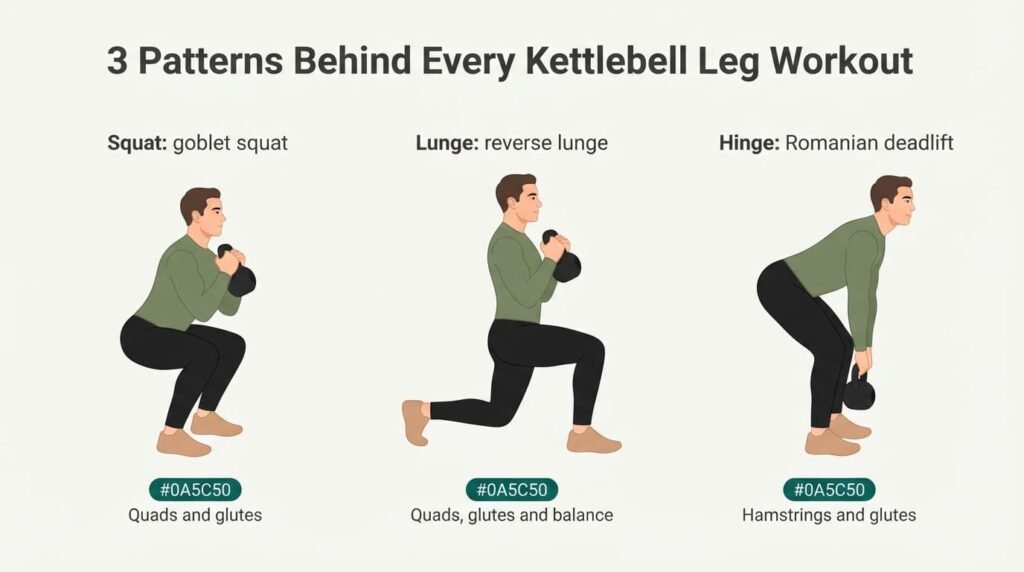
If you only remember one thing, make it this: own the goblet squat and the kettlebell deadlift before anything else. Those two lifts teach the squat and the hinge, the two patterns behind nearly every lower body movement you do in daily life, from sitting down to picking a bag off the floor. Everything else in this guide builds on them.
Frequently asked questions
What are the best kettlebell leg exercises for beginners?
The goblet squat, kettlebell deadlift and reverse lunge are the best starting points. They teach the squat, hinge and lunge patterns that every other lower body kettlebell exercise builds on.
Can you build leg muscle with kettlebells?
Yes, especially as a beginner. Kettlebell leg exercises build strength and muscle in the quads, glutes and hamstrings. As you get stronger, you will need heavier bells or harder single-leg variations to keep progressing.
What weight kettlebell should I use for legs?
Most beginners start with 8 to 12 kg for squats and lunges and 12 to 16 kg for deadlifts. People with lifting experience often need 16 to 24 kg.
What are the best kettlebell glute exercises?
Kettlebell swings, hip thrusts, Romanian deadlifts and single-leg Romanian deadlifts are the best kettlebell glute exercises. Sumo squats and reverse lunges also work the glutes well.
Are kettlebell swings a leg exercise?
Yes. Swings mainly train the glutes and hamstrings, along with the back and core. In one study, swing training improved squat strength and jump height in just 6 weeks.
How often should I do kettlebell leg workouts?
Two or three times a week, with at least one rest day between sessions, works well for most beginners.
What are good kettlebell hamstring exercises?
The kettlebell Romanian deadlift, single-leg Romanian deadlift and swing are the most effective. Keep a soft bend in the knees and push your hips back to feel the stretch in your hamstrings.
Are kettlebell squats bad for your knees?
For most people, no. Controlled squats help strengthen the muscles that support the knees. Keep your knees in line with your toes, start with a comfortable depth, and stop if you feel sharp pain.
Can I do a full leg workout with one kettlebell?
Yes. One kettlebell is enough for goblet squats, lunges, deadlifts, swings, hip thrusts and step-ups. Use pauses, slower lowering and single-leg versions to make a light bell more challenging.
Should I do kettlebell leg exercises before or after cardio?
If strength is your main goal, do your kettlebell leg workout first, while your legs are fresh. Walking or easy cycling afterwards is fine. Avoid heavy leg work the day before a long run or a hard cardio session.
Are kettlebell leg exercises good for weight loss?
They help by building muscle and burning calories, especially circuits that include swings. Weight loss still depends mainly on your overall calorie balance, so pair your workouts with sensible eating and daily movement.
How long should a kettlebell leg workout take?
Most beginner kettlebell leg workouts take 15 to 25 minutes, plus a 5-minute warm-up. Short, focused sessions two or three times a week work better than one long, exhausting one.
Can I do kettlebell leg exercises with bad knees?
Often yes, with adjustments. Box squats to a chair, reverse lunges, low step-ups and hinges such as Romanian deadlifts are usually knee-friendly. Avoid deep or painful ranges, and get persistent knee pain checked by a professional.
What’s next?
Reading is the easy part. Pick one of these and do it today.