

Jogging vs Running: The Real Difference (Pace, Effort, Benefits and Which Is Better)
Jogging vs running is one of those questions that sounds simple until you try to answer it. Is jogging just slow running? Is there a speed where a jog becomes a run? And does it actually matter which one you do?
The short answer: jogging is running at a slow, relaxed pace, an effort where you could still hold a conversation. Running usually means a faster, harder effort. There is no official line between the two, and the difference between jogging and running depends far more on your effort than on a fixed number on a watch. A comfortable jog for a seasoned runner might be a hard run for a beginner.
This guide explains the real difference, the paces and heart rate zones that usually separate them, how jogging form compares with running form, what the research says about health and longevity, and how to decide which one suits your goals. I am writing it as someone who started as a slow beginner, so I will keep it practical.
At a glance
- Jogging is slow, relaxed running at a conversational pace
- Running is faster and harder, usually at a pace where talking is difficult
- There is no official speed limit, but many people consider anything slower than about 6 mph (around 10 minutes per mile) a jog
- Effort matters more than pace, and the talk test is the easiest guide
- Both use the same basic movement, but running has a longer stride and more knee drive
- Research suggests light to moderate jogging, a few times a week, is linked with long-term health benefits
- Most beginners should start with jogging, and most runners still jog for most of their training
What is the difference between jogging and running?
Jogging and running are the same movement: a gait where both feet leave the ground for a moment between steps. What separates them is speed and effort.
| Feature | Jogging | Running |
|---|---|---|
| Pace | Slow, relaxed | Moderate to fast |
| Effort | Easy to moderate | Moderate to hard |
| Talk test | Can speak in full sentences | Short phrases or no talking |
| Typical heart rate | About 60 to 75 percent of maximum | About 75 to 90 percent or more |
| Stride | Shorter, lower | Longer, more knee drive and push off |
| Main goal | Health, endurance, enjoyment | Speed, performance, fitness gains |
| Recovery needed | Low | Moderate to high |
So in the jogging vs running debate, the difference is really a sliding scale. At one end is a gentle shuffle that is barely faster than walking. At the other end is an all-out sprint. Somewhere in between, a jog turns into a run.
Is there a speed where a jog becomes a run?
There is no official definition, but a common rule of thumb is that anything slower than about 6 miles per hour, or about 10 minutes per mile (just over 6 minutes per kilometre), is a jog. Anything faster is a run.
Our treadmill pace chart converts any treadmill speed into pace per mile and per kilometre.
| Pace per mile | Pace per kilometre | Speed | Common label |
|---|---|---|---|
| 13 minutes or slower | 8 minutes or slower | About 4.6 mph or less | Very easy jog |
| 11 to 13 minutes | About 7 to 8 minutes | About 4.6 to 5.5 mph | Jog |
| 9 to 11 minutes | About 5.5 to 7 minutes | About 5.5 to 6.7 mph | Jog or easy run |
| 7 to 9 minutes | About 4.5 to 5.5 minutes | About 6.7 to 8.6 mph | Run |
| Under 7 minutes | Under 4.5 minutes | Over 8.6 mph | Fast run |
But this rule has a big problem. A fit, experienced runner might jog at 9 minutes per mile and find it completely easy. A beginner at 12 minutes per mile might be working hard. That is why effort is a better guide than pace. If you want to check your numbers, our pace calculator converts between pace and speed.
The talk test: the easiest way to tell
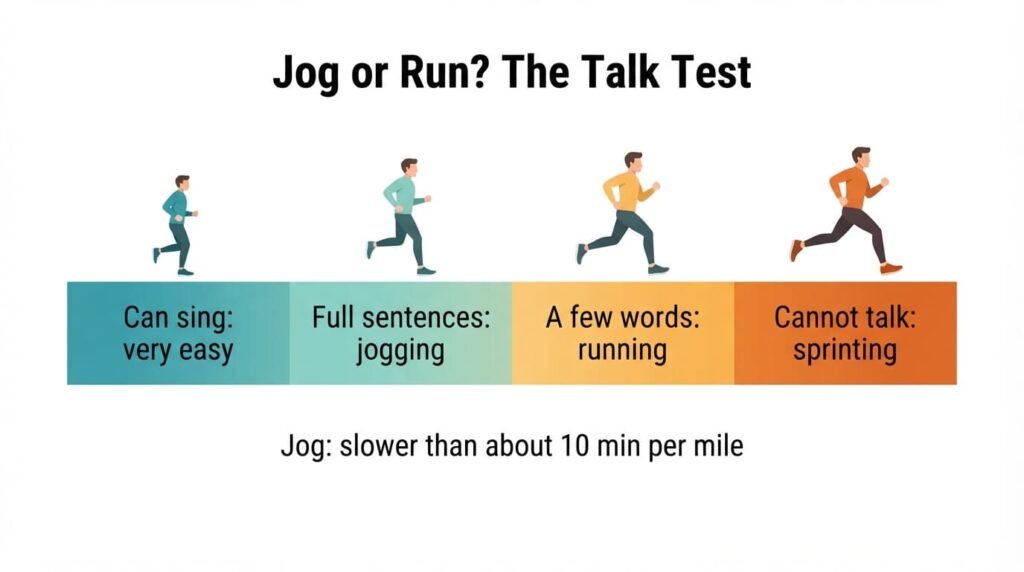
The talk test is the simplest way to settle jog vs run for yourself, whatever your fitness:
| How talking feels | Effort | What you are doing |
|---|---|---|
| You could sing | Very easy | Brisk walk or very slow jog |
| You can talk in full sentences | Easy | Jogging |
| You can say a few words at a time | Moderate to hard | Running |
| You cannot talk | Very hard | Fast running or sprinting |
If you use a heart rate monitor, jogging usually sits around 60 to 75 percent of your maximum heart rate, which many people call zone 2. Running at a harder pace moves into the higher zones. Our target heart rate calculator can estimate your zones, and our guide to steady state cardio explains why easy efforts matter so much.
Jogging form vs running form
The basic movement is the same, but there are small differences.
| Form feature | Jogging form | Running form |
|---|---|---|
| Stride length | Shorter | Longer |
| Knee lift | Low | Higher |
| Arm swing | Relaxed, small | Stronger, more drive |
| Foot strike | Usually under the body, gentle | Under the body, with more push off |
| Body lean | Upright, very slight lean | Slight forward lean from the ankles |
| Cadence | Often a little lower | Often a little higher |
Good jogging form in 6 steps
- Stand tall, with your head up and your eyes looking ahead
- Relax your shoulders and keep your hands loose
- Bend your elbows to about 90 degrees and swing your arms forward and back, not across your body
- Take short, light steps and land with your foot roughly under your body
- Let your heel, midfoot or forefoot touch down, whichever feels natural, as long as you are not reaching far ahead with your foot
- Breathe steadily and stay at a pace where you could chat
Good jogging form is mostly about staying relaxed. Many beginners run too fast, tense up and overstride. Slowing down usually fixes all three. Our detailed guide to running form covers this further, and our guide on how to breathe while running helps if you get out of breath quickly.
Benefits of jogging vs running compared
| Benefit | Jogging | Running |
|---|---|---|
| Heart and lung fitness | Good | Very good |
| Calories per minute | Moderate | Higher |
| Calories per mile | Similar | Similar |
| Impact on joints | Lower | Higher |
| Injury risk | Lower | Higher, especially if you increase too fast |
| Easy to sustain for longer | Yes | Harder |
| Mental benefits | Yes | Yes |
| Builds speed | A little | Yes |
Here is a point about jogging vs running that surprises many people: the number of calories you burn per mile is fairly similar whether you jog or run. Running burns more per minute, so you burn more in the same time. But if you cover the same distance, the difference is smaller than most people think. If your goal is calorie burn, the total time and distance matter more than the exact pace.
What the research says about jogging and longevity
A Danish study followed 1,098 healthy joggers and 413 healthy non-joggers for 12 years. Light jogging, defined as jogging for 1 to 2.4 hours per week, no more than about 3 times a week, at a slow or average pace, was associated with the lowest risk of death. Light joggers had a much lower risk than sedentary non-joggers, and moderate joggers also did better. The small group of strenuous joggers did not have a statistically clear advantage over sedentary people, but that group was small and the result was uncertain.
A much larger US study of 55,137 adults found that runners, including those who ran only 5 to 10 minutes a day at slow speeds of under 6 miles per hour, had a lower risk of death from all causes and from heart disease than non-runners over about 15 years.
And a systematic review and meta-analysis of 14 studies, with more than 230,000 participants, found that any amount of running was associated with a lower risk of death from all causes, heart disease and cancer, compared with no running. Higher amounts did not seem to bring clearly greater benefits.
These are observational studies, so they show links rather than proof. But together they give a reassuring message for beginners: you do not need to run fast or far. Easy jogging, a few times a week, is associated with big health benefits.
Jogging vs running: which should you choose for your goal?
| Your goal | Better choice | Why |
|---|---|---|
| Getting started with exercise | Jogging | Easier to sustain, lower injury risk |
| General health and longevity | Jogging, with some running if you like | Light to moderate jogging is linked with the best outcomes |
| Weight loss | Either | Total time and consistency matter most |
| Running a race faster | Both | Mostly easy jogging, plus some faster runs |
| Improving endurance | Mostly jogging | Easy miles build your aerobic base |
| Joint pain or carrying extra weight | Jogging, or a run walk method | Less impact |
| Stress relief | Whichever you enjoy | Enjoyment keeps you consistent |
For most people, the honest answer is jogging most of the time and running some of the time. Even competitive runners do much of their weekly training at an easy, conversational pace, often described as the 80/20 approach, with around 80 percent easy and 20 percent harder work.
How to start jogging as a beginner
If you are new, start with a mix of walking and jogging. Our run walk method guide explains this step by step, and our running for beginners guide has a full plan.
| Week | Workout (3 times a week) | Total time |
|---|---|---|
| 1 | 1 minute jog, 2 minutes walk, repeat 6 times | 18 minutes |
| 2 | 2 minutes jog, 2 minutes walk, repeat 5 times | 20 minutes |
| 3 | 3 minutes jog, 1 minute walk, repeat 5 times | 20 minutes |
| 4 | 5 minutes jog, 1 minute walk, repeat 4 times | 24 minutes |
| 5 | 8 minutes jog, 1 minute walk, repeat 3 times | 27 minutes |
| 6 | Jog continuously for 20 to 25 minutes | 20 to 25 minutes |
If a week feels too hard, repeat it. Always start with a few minutes of brisk walking. Our guide to the warm-up before running has a simple routine.
When and how to go from jogging to running
Once you can jog comfortably for 20 to 30 minutes, you can start adding some faster running. Keep it simple:
- Strides: at the end of an easy jog, run 4 to 6 times for 15 to 20 seconds at a faster but relaxed pace, walking back to recover
- Tempo segments: once a week, include 5 to 10 minutes at a comfortably hard pace in the middle of a jog
- Intervals: run 1 minute at a hard pace, then jog or walk for 2 minutes, repeated 4 to 6 times
Add only one harder session a week at first, and keep the rest of your weekly time easy. If you want to go further for longer, our guide on how to increase running endurance has more ideas.
Jogging vs running: injury risk and how to reduce it
Faster running places more force on your muscles, tendons and joints with each step, so it generally carries a higher injury risk than easy jogging. The biggest risk for both, though, is doing too much too soon.
- Increase your weekly time or distance gradually
- Keep most of your sessions easy
- Wear comfortable, supportive running shoes
- Mix in strength work for your legs, hips and core
- Rest when something hurts, and see a professional if pain does not settle
Our shin splints stretches and calf stretches guides are useful additions for anyone starting to jog.
This article is general information, not medical advice. Check with your doctor before starting a new exercise programme if you have a heart condition, high blood pressure, joint problems or any other health concerns. See our medical disclaimer.
Is jogging a full-body workout?
Jogging works your legs and hips most, but your core, back and arms help keep you upright and balanced. It is a great cardio workout, but it does not build much upper body strength. Our article on whether running is a full-body workout explains what jogging does and does not train.
Jogging vs running: 5 common myths
| Myth | The reality |
|---|---|
| Jogging does not count as real exercise | Easy jogging is associated with big health benefits in long-term research |
| You have to run fast to lose weight | Total time and consistency matter more than pace |
| Joggers are not real runners | If both feet leave the ground, you are running. Pace does not decide who counts |
| Running is bad for your knees | For most healthy people, gradual running does not appear to harm the knees, and it strengthens the muscles around them |
| You should feel exhausted after every run | Most training should feel easy. Exhaustion every time leads to injury and burnout |
Many of these myths stop beginners from starting at all. If you remember one thing from this jogging vs running guide, let it be this: slow is not wrong.
Jog vs run for weight loss
When people compare jog vs run for weight loss, they often assume faster is always better. Running does burn more per minute, but jogging lets you go for longer, recover faster and train more often. Over a month, a person who jogs 4 times a week for 30 minutes will usually burn more in total than someone who runs hard once a week and then needs days to recover. Our guide to whether cardio helps you lose weight explains how exercise and eating fit together.
Jogging vs running on a treadmill
On a treadmill, the jog vs run question is easier to answer because the speed is on the screen. A common starting point is 4 to 5.5 mph (about 6.5 to 9 km/h) for jogging, and above 6 mph (about 9.7 km/h) for running. Set a 1 percent incline to make the effort feel more like running outdoors. As always, use the talk test rather than a fixed number: if you cannot speak in full sentences, you are running, whatever the screen says.
Jogging vs running as you get older
As we get older, recovery tends to take a little longer, and tendons can become less forgiving of sudden jumps in training. That does not mean you have to stop running. Many people simply shift the balance: more easy jogging, fewer hard runs, and more strength training. If you are over 50 and new to exercise, a run walk approach and plenty of easy jogging is a sensible way to start, with a check-up from your doctor if you have any heart or joint concerns.
A simple weekly mix of jogging and running
Once you are past the beginner stage, a balanced week might look like this: 2 easy jogs of 25 to 35 minutes, 1 session with strides or short intervals, and 1 longer, slow jog at the weekend. Add 2 short strength sessions and at least 1 full rest day. This blend gives you the health benefits of easy jogging and the fitness boost of faster running, without piling on too much stress at once.
Let your body decide on the day
Some days a run feels effortless, and other days even an easy jog feels heavy. Poor sleep, stress, heat and a busy week all change how hard the same pace feels. That is one more reason to choose your effort by feel rather than by the numbers on your watch. On a tired day, jog gently or walk. On a good day, add a few strides. Over months, listening to your body like this keeps you consistent and far less likely to get injured.
The bottom line
The real difference between jogging and running is effort and pace. Jogging is relaxed, conversational running. Running is faster and harder. There is no official cut-off, but anything slower than about 10 minutes per mile is commonly called a jog, and the talk test is the easiest guide.
In jogging vs running, for most beginners and for general health, jogging is the better place to start and to spend most of your time. Research links light to moderate jogging a few times a week with a lower risk of early death. Once you can jog comfortably for 20 to 30 minutes, adding a little faster running will build speed and fitness. Whichever you choose, the version you enjoy and keep doing is the one that will do you the most good.
Frequently asked questions
What is the difference between jogging and running?
Jogging is slow, relaxed running at a pace where you can still talk in full sentences. Running is faster and harder. They use the same movement, and there is no official speed that separates them.
How fast is jogging compared to running?
A common rule of thumb is that anything slower than about 6 mph, or 10 minutes per mile, is jogging, and anything faster is running. Effort is a better guide than pace, because it depends on your fitness.
Jogging vs running: which is better?
It depends on your goal. For beginners and general health, jogging is easier to sustain and carries a lower injury risk. For speed and race performance, you will need some faster running too.
Does jogging burn as many calories as running?
Per minute, running burns more. Per mile, the difference is fairly small. So if you jog for longer, you can burn a similar number of calories.
Is jogging good for weight loss?
Yes, alongside healthy eating. Jogging is easier to keep up for longer and more often, which helps with total calorie burn and consistency, the two things that matter most.
How long should I jog each day?
Research links as little as 5 to 10 minutes of running a day with health benefits. A good beginner target is 20 to 30 minutes of easy jogging, 3 times a week.
What is good jogging form?
Stand tall, relax your shoulders, swing your arms forward and back, take short light steps landing roughly under your body, and keep a pace where you can still talk.
Is it okay to jog every day?
Some people do, but most beginners do better with 3 or 4 sessions a week and rest days in between. Your muscles, tendons and bones need time to adapt.
Is slow jogging still good exercise?
Yes. Research suggests that slow or average pace jogging a few times a week is associated with excellent long-term health outcomes. You do not need to run fast to benefit.
What’s next?
Reading is the easy part. Pick one of these and do it today.