Boxing Jump Rope: Why Boxers Skip, Footwork Drills and 3-Minute Round Workouts
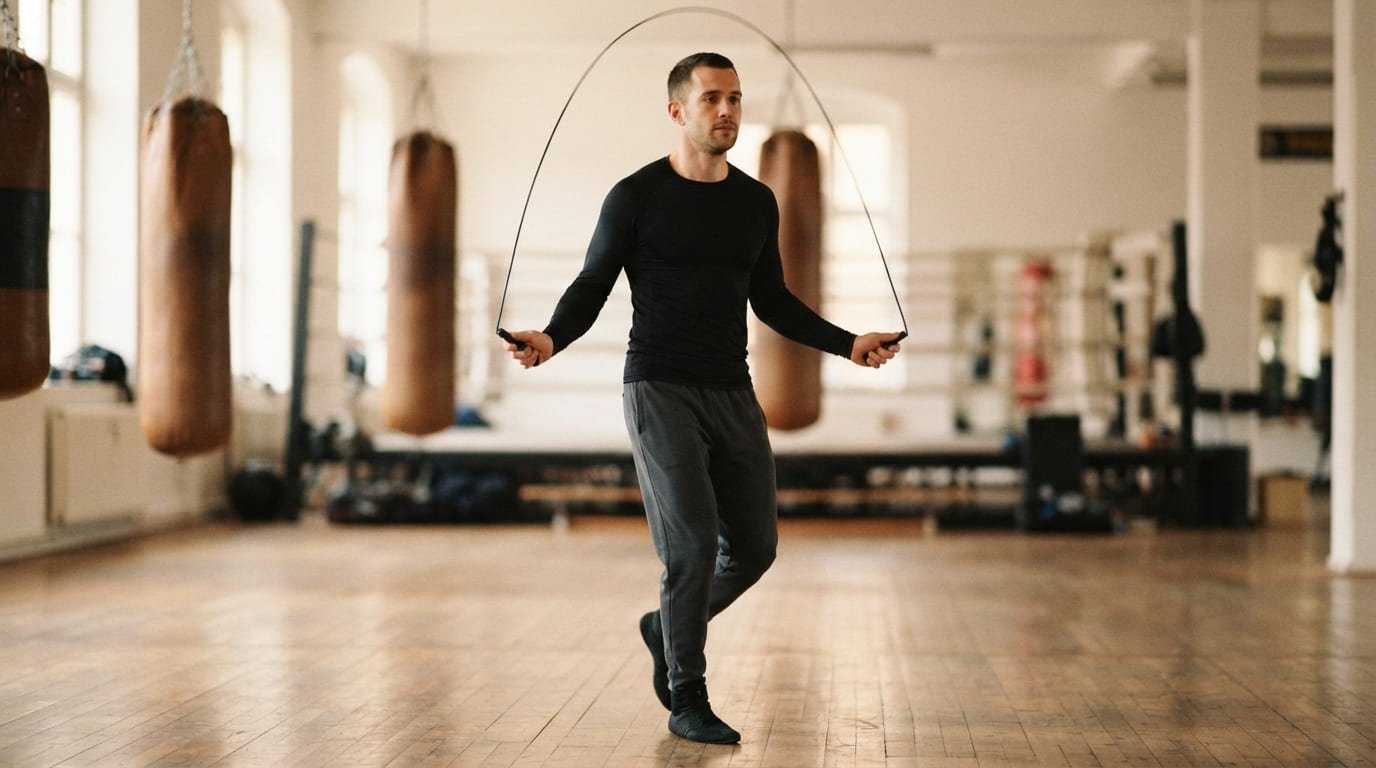
The boxing jump rope is one of the most recognisable sights in any boxing gym. Walk into a gym at the start of a session and you will hear the steady tick of ropes on the floor, with fighters bouncing lightly from foot to foot as if they barely touch the ground.
That image makes skipping look effortless. It is not. But it is learnable, even if you have never set foot in a boxing gym, and you do not need to box to benefit. A boxing jump rope routine is a great way to build rhythm, foot speed and fitness at home with a piece of kit that costs very little.
This guide explains why boxers jump rope, what the research shows, how to learn the famous boxer step, 6 footwork drills and three workouts built around 3-minute rounds. There is also a 6-week plan, whether you are training for a bout or simply want to move like a boxer.
At a glance
- Boxers use the rope to build footwork, rhythm, calf endurance and cardio fitness
- In one study, 8 weeks of jump rope training improved punch reaction time and jab speed in young amateur boxers, about as much as plyometric training
- The boxer step shifts your weight from foot to foot, so it lets you skip for longer
- A short, light rope suits footwork. Use your wrists and stay low
- Boxers often skip in 3-minute rounds with 1 minute of rest to match the rhythm of a fight
- Start with 30-second sets if you are new. Full rounds come later
- You do not need to be a boxer to use these workouts
Why do boxers jump rope?
Ask why do boxers jump rope and most coaches will give you several answers. It is cheap, it is portable, and it trains exactly the qualities that boxing demands.
| What it builds | Why a boxer needs it |
|---|---|
| Light, quick feet | Moving in and out of range, and staying balanced |
| Rhythm and timing | Boxing has a rhythm, and footwork needs to stay relaxed |
| Calf and foot endurance | Boxers stay on the balls of their feet for many rounds |
| Cardio fitness | Keeping going through round after round |
| Hand and foot coordination | Your hands and feet must work together |
| Shoulder endurance | Hands stay up for a long time in a fight |
| Mental focus | A long skipping session rewards patience and concentration |
| Warming up | Raises body temperature and gets the feet moving |
It also has a practical benefit for anyone learning the sport that gets less attention. Skipping is an easy way to warm up and it is a good break from hitting things, so hands and knuckles get a rest.
What the research says about boxing and jump rope
There is a small but useful study on boxing and jump rope. Twenty-four high school amateur boxers, aged 12 to 18, with 3 to 5 years of boxing experience, were split into two groups. One did plyometric training, and the other did jump rope training, for 30 minutes, 3 days a week, for 8 weeks.
Both groups improved their lower body power, the reaction time of their punches and the speed of their jab. There was no difference between the groups, so jump rope training was about as useful as plyometrics in this study.
It is worth noting the limits. The study was small, it involved young experienced boxers and there was no group that did neither type of training. Still, it does support what coaches have long believed.
Wider research points the same way. A review of 21 jump rope studies found small to moderate gains in cardiorespiratory endurance, jumping and sprinting, though most of the participants were young.
Choosing a jump rope for boxing
Boxers usually choose a fairly light rope that turns quickly.
| Rope | Pros | Cons |
|---|---|---|
| Thin speed cable | Fast, ideal for footwork | Harder to learn with, and stings |
| PVC rope | Cheap and quick | Can kink |
| Beaded rope | Easy to feel and hear | Slower and noisier |
| Leather rope | Traditional boxing feel, turns well | Wears out on rough floors |
| Weighted rope | Good for shoulder endurance | Too slow for fast footwork |
If you are new to skipping, a beaded jump rope or a light PVC rope is the easiest way to begin. Move on to a faster rope when your timing is reliable. Some boxers also use a weighted jump rope for shoulder endurance, but keep it as an extra rather than your main rope.
Length is important too, and it affects how quick your feet feel. Many boxers use a slightly shorter rope, because it turns faster and keeps the feet quick. Beginners should start longer, reaching around the armpits. Our guide to how long a jump rope should be shows you how to set it.
Boxing jump rope form
- Stand tall with your chin level, shoulders relaxed and chest up
- Keep your elbows close to your ribs and hands near your hips
- Turn the rope with your wrists rather than your arms
- Stay on the balls of your feet, with your heels just off the floor
- Keep your knees soft and absorb each landing
- Jump just high enough to clear the rope, about 2 to 3 cm
- Keep your eyes forward as if you were looking at an opponent
- Breathe steadily, and relax your jaw and hands
If you have never skipped before, spend your first few sessions on the basic bounce. Our jump rope workout guide takes you through the basics step by step.
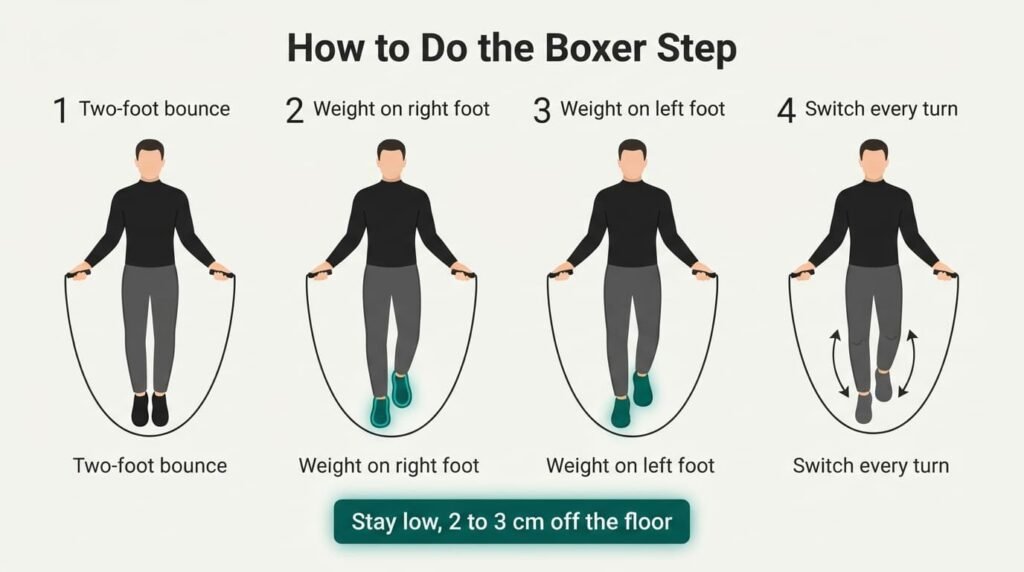
How to do the boxer step
The boxer step, also called the boxer skip, is the signature move of boxing skipping. Instead of landing on both feet together, you shift your weight from one foot to the other. Only one foot carries most of the load at any moment, so your calves get brief rests and you can last much longer.
- Start with the basic two-foot bounce for 10 seconds
- Shift your weight on to your right foot, and let your left toes touch the floor lightly
- On the next turn, shift your weight on to your left foot, and let your right toes touch lightly
- Keep going in a rhythm: right, right, left, left. Each foot takes two turns
- Once that feels natural, change feet on every turn: right, left, right, left
It can feel awkward for a few sessions. Stay relaxed, and go back to the two-foot bounce whenever you lose the rhythm.
One thing to be aware of. A small study of 16 teenage boys found that an alternating step produced higher impact forces than a two-foot bounce, with more knee movement inward. So build up gradually, and do not jump straight into long rounds of the boxer step.
6 boxing jump rope footwork drills
Add these one at a time. Spend 20 to 30 seconds on each at first.
1. Side-to-side shuffle
Jump a few centimetres left, then a few centimetres right, keeping your feet together. This builds the lateral movement you use to step out of range.
2. Forward and back
Jump slightly forward, then slightly back. It trains the in-and-out movement that is the basis of boxing footwork.
3. Stance switch
Land with your left foot in front, then switch to your right foot in front on the next turn, like a small scissor. This mimics your boxing stance and trains quick changes.
4. High knees
Lift your knees higher on each turn for 10 to 20 seconds. It raises your heart rate quickly. Our high knees exercise guide covers the form.
5. Speed bursts
Skip at an easy pace for 20 seconds, then as fast as you can with good form for 10 seconds. This mimics the bursts of effort in a round. It trains the same quick feet as our speed and agility exercises.
6. Crossovers
Cross your arms in front of you as the rope comes down, jump through the loop, then uncross them. It is an advanced coordination drill, so wait until your basic skipping is solid. A slightly longer rope helps.
3 jump rope for boxing workouts
Workout 1: beginner rounds (about 15 minutes)
If you are new, you are unlikely to manage a full 3-minute round yet, so start with shorter skipping bursts inside each round.
| Round | Work | Rest |
|---|---|---|
| Rounds 1 to 4 | 3 minutes: 30 seconds skipping, 30 seconds of shadow boxing, repeated | 1 minute |
Shadow boxing here just means throwing light punches in the air while moving your feet. Our boxing bag workout teaches the basic punches and stance.
Workout 2: classic 3-minute rounds (about 24 minutes)
| Round | What to do | Rest |
|---|---|---|
| 1 | Easy basic bounce | 1 minute |
| 2 | Boxer step | 1 minute |
| 3 | Boxer step with side-to-side shuffle | 1 minute |
| 4 | Forward and back, stance switch | 1 minute |
| 5 | Boxer step with 10-second speed bursts every 30 seconds | 1 minute |
| 6 | Easy boxer step to finish | 1 minute |
If 6 rounds is too many, start with 3 and add one every week.
Workout 3: rope and bag (about 30 minutes)
| Part | What to do | Time |
|---|---|---|
| Warm-up | Easy skipping | 3 minutes |
| Round 1 | Bag work, simple combinations | 3 minutes, then 1 minute of rest |
| Round 2 | Rope, speed bursts | 3 minutes, then 1 minute of rest |
| Round 3 | Bag work, combinations | 3 minutes, then 1 minute of rest |
| Round 4 | Rope, boxer step | 3 minutes, then 1 minute of rest |
| Round 5 | Bag work, all-out final minute | 3 minutes, then 1 minute of rest |
| Cool down | Easy walking and stretching | 3 minutes |
No bag? Replace bag work with shadow boxing. If you do hit a bag, read our guide to boxing gloves for beginners first, and always wrap your hands.
A 6-week boxing jump rope plan
Do this 3 times a week. Keep at least one rest day between hard sessions.
| Week | What to do | Goal |
|---|---|---|
| 1 | 5 rounds of 1 minute: 20 seconds skipping, 40 seconds rest | Learn the basic bounce |
| 2 | 5 rounds of 2 minutes: 30 seconds on, 30 seconds off | Add time on the rope |
| 3 | 4 rounds of 2 minutes, mostly skipping, trying the boxer step | Start the boxer step |
| 4 | 4 rounds of 3 minutes: 1 minute on, 30 seconds off, repeated | Reach full-length rounds |
| 5 | 3 rounds of 3 minutes continuous, 1 minute of rest | First continuous rounds |
| 6 | 4 rounds of 3 minutes with drills and speed bursts | Move like a boxer |
It is normal to repeat a week if your legs feel heavy. Most beginners need longer than they expect for their calves to adapt. Our guide to conditioning workouts for beginners offers other ways to build fitness at the same time.
Boxing jump rope training if you do not box
You do not need gloves, a gym or any plan to fight. A boxing jump rope session is just a more interesting way to do cardio. Here is why I think it suits ordinary beginners:
- Rounds keep it interesting. Three minutes on and one minute off feels much less boring than a long, steady session
- The clock sets the pace. You always know how long is left, which makes it easier to stick with
- It teaches rhythm. Footwork drills give your brain something to focus on, and the time passes faster
- It fits small spaces. A boxing jump rope routine needs only a clear area and a rope
- It is cheap. A simple rope and a round timer app are all you need
If you do fancy trying the sport later, you will walk into your first class with better footwork and fitness than most beginners. If you never do, you will still have a quick, effective way to get your heart rate up in about 20 minutes.
Use a round timer
A free boxing round timer app on your phone makes these workouts far easier to follow. Set it to 3-minute rounds with 1 minute of rest, or to shorter rounds if you are new. Many have a warning sound 10 seconds before the end of the round, which is a good cue for a speed burst.
Skip to music
Rhythm is a big part of the appeal of boxing and jump rope training. Many people find that music at around 110 to 130 beats a minute matches a comfortable skipping pace. Choose something you enjoy, and let your feet find the beat. It sounds like a small detail, but it can make a boxing jump rope session feel more like play than exercise.
Pairing a boxing jump rope routine with strength work
Skipping builds rhythm and fitness, but it will not build much strength by itself. A simple week might include two boxing jump rope sessions and two short strength sessions, with walking on the days between. Good additions include push-ups for punching muscles, rows for balance across the shoulders and core work for turning your body. Our full body workout for beginners fits well alongside the rope.
When boxers skip in a session
| Timing | Purpose | How long |
|---|---|---|
| Start of a session | Warm up and get the feet moving | 3 to 10 minutes |
| Between bag rounds | Keep the heart rate up, and give the hands a rest | 1 to 3 minutes |
| End of a session | Build endurance and practise footwork when tired | 5 to 15 minutes |
| Rest days | Light footwork practice | Up to 10 minutes, if your calves feel good |
Beginners should start with the warm-up only. It is much easier to skip fresh, and it keeps your total weekly impact under control.
Common mistakes
| Mistake | What happens | Fix |
|---|---|---|
| Turning from the shoulders | Arms tire fast | Keep elbows close and use your wrists |
| Jumping too high | Slow feet and more impact | Stay low, 2 to 3 cm |
| Landing flat-footed | Heavy, noisy steps | Land softly on the balls of your feet |
| Looking down | Poor posture and timing | Eyes forward |
| Trying full rounds in week one | Sore calves and shins | Build up with short sets |
| Holding your breath | You tire quickly | Breathe steadily and relax your jaw |
| Rushing the boxer step | Tripping and frustration | Master the two-foot bounce first |
Looking after your calves and shins
Boxers skip a lot because they have built up to it over months or years. Your legs need time too. Rest if you feel pain along the shin or in the Achilles tendon. Stretch your calves after sessions, and use a forgiving surface such as a rubber mat or a wooden floor rather than bare concrete. Our guides to calf stretches, shin splints stretches and tibialis anterior exercises help to keep your lower legs in good shape.
Check with a doctor or physiotherapist before you start if you have a heart condition, joint problems or a recent injury. If you are training children, ask a qualified coach to supervise, because their joints are still developing.
This article is general information, not medical advice. See our medical disclaimer.
The bottom line
Why do boxers jump rope? Because a simple, cheap rope builds the light feet, rhythm, calf endurance and cardio fitness that boxing demands. A small study of young amateur boxers found jump rope training improved punch reaction time and jab speed about as much as plyometric training.
You do not have to be a boxer to benefit. Start with short sets of the basic bounce, learn the boxer step, then add footwork drills and build towards 3-minute rounds. Keep your elbows in, stay low and give your calves time to adapt. Six weeks is enough to feel a real change in how light you are on your feet.
Frequently asked questions
Why do boxers jump rope so much?
Because it builds footwork, rhythm, calf endurance, coordination and cardio fitness in one simple exercise. It also warms up the body and gives the hands a rest from punching. A small study also found it improved punch reaction time and jab speed in young boxers.
How long should a boxer jump rope?
Many boxers skip for anywhere from 10 to 30 minutes per session, often in 3-minute rounds with 1 minute of rest. Beginners should start with a few minutes in short intervals and build up over several weeks.
What is the boxer step in jump rope?
It is a skipping style where you shift your weight from one foot to the other instead of landing on both together. Each foot takes turns carrying the load, which lets you skip longer and builds rhythm.
What is the best jump rope for boxing?
Boxers usually like a light, fast rope such as a thin speed cable, a PVC rope or a leather rope. Beginners may find a beaded rope easier to learn with, and they can move on to a faster rope later.
Does jump rope improve punching power?
It may help indirectly. In one study of young amateur boxers, jump rope training improved lower body power, punch reaction time and jab speed. It did not specifically prove more knockout power, and strength training also plays a part.
Is jump rope for boxing good for beginners?
Yes, even if you never plan to box. Start with the basic two-foot bounce in short intervals, then add the boxer step and footwork drills. Many beginners enjoy working in rounds.
Can I do boxing jump rope workouts at home?
Yes. You need a rope, a little ceiling height and a mat or forgiving floor. Replace bag work with shadow boxing if you do not have a bag.
How many times a week should I do a boxing jump rope workout?
Three sessions a week is a good target, with a rest day between hard sessions. Experienced boxers skip more often, but only after building up to it over a long time.
Should I jump rope before or after boxing training?
Both are common. Use a few minutes before a session as a warm-up, and add longer rounds at the end if you still have energy. Beginners should skip first, while their legs are fresh.
What’s next?
Reading is the easy part. Pick one of these and do it today.