Weighted Jump Rope: Real Benefits, What Weight to Choose and a 6-Week Plan
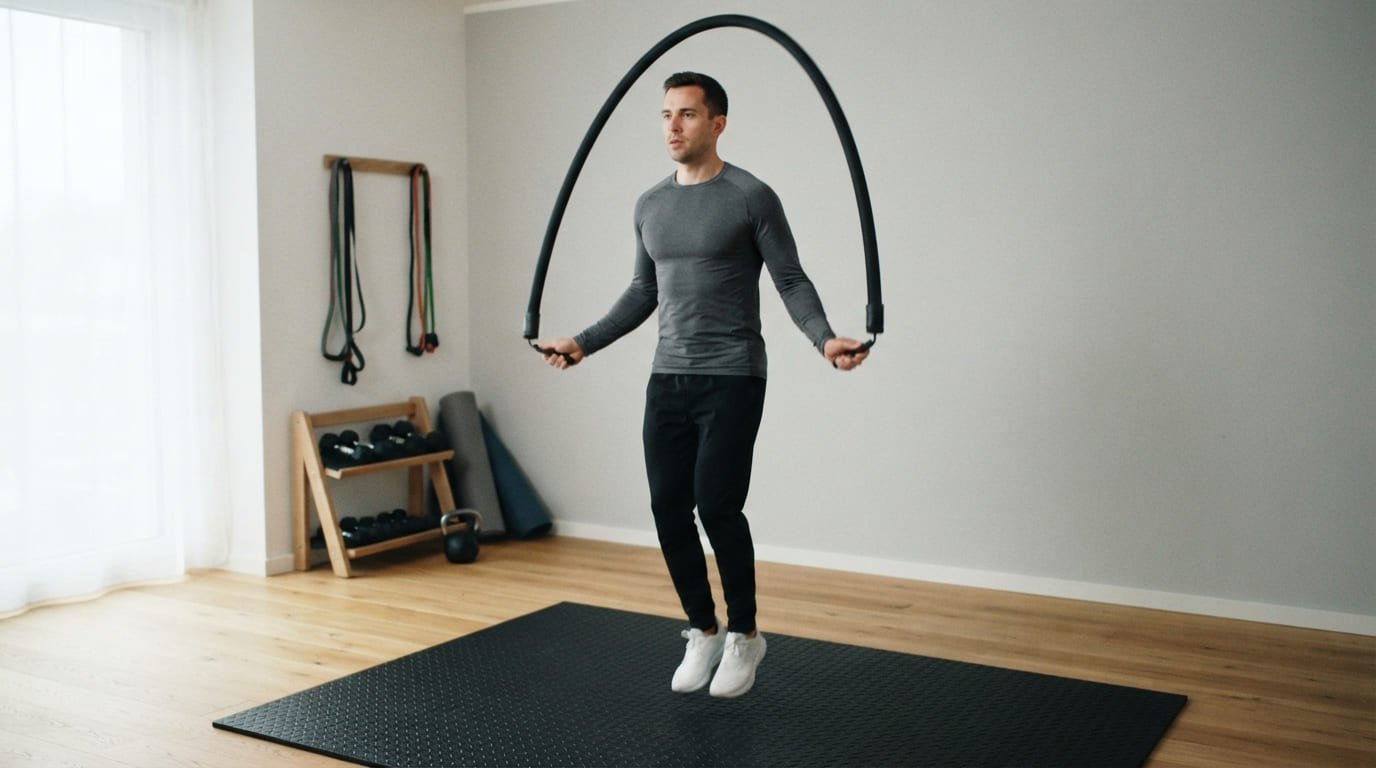
A weighted jump rope looks like a simple upgrade. Same rope, more weight, more results. The adverts promise bigger shoulders, faster fat loss and a full-body workout in half the time.
I wanted to know how much of that holds up, because a heavier rope costs more and asks more of your shoulders, wrists and calves. The honest answer is mixed. A weighted jump rope is a genuinely useful tool, especially if a light rope whips around too fast for you to time your jumps. But the research on weighted skipping is thin, and some of the bigger claims have little behind them.
This guide covers what a weighted jump rope actually does, the real benefits, what the studies show, how to choose your weight, and four beginner workouts with a 6-week plan. It also explains who should wait before buying one.
At a glance
- A weighted jump rope has a heavier cord, heavier handles or both, usually about 0.5 to 2.5 kg in total
- A heavy cord is easier to feel and time, which helps many beginners stop tripping
- It adds more work for your forearms and shoulders, but it will not replace strength training
- Research on regular jump rope training is good. Research on weighted ropes specifically is very limited
- One small 6-week study of weighted skipping found no change in shoulder rotation strength
- Start light, about 0.5 kg in the rope, and use short intervals
- Build up on a regular rope first if you have sore shins, calves, wrists or shoulders
What is a weighted jump rope?
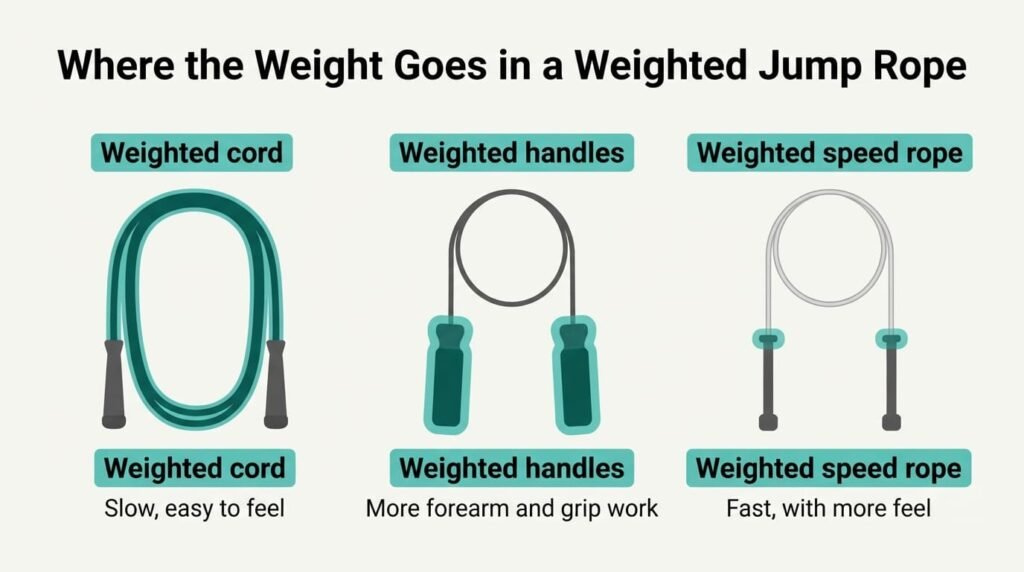
A weighted jump rope is any skipping rope that weighs noticeably more than a standard one. A basic speed rope weighs very little, often under 150 g. A weighted rope might weigh anywhere from about 500 g to 2.5 kg. Where that extra weight sits changes how the rope feels.
| Type | Where the weight is | How it feels | Best for |
|---|---|---|---|
| Weighted cord | In the rope itself | Slow, smooth and easy to feel | Beginners learning timing, shoulder work |
| Weighted handles | In the handles | Rope spins normally, hands feel heavier | Forearm and grip work |
| Weighted cord and handles | Both | The hardest option | Experienced skippers |
| Weighted speed rope | A light extra load in a thin cable | Fast, with a little more feedback | People who already skip well |
| Removable weights | Small weights slide into the handles | Adjustable | Anyone unsure which load suits them |
This distinction matters more than most people realise. Weight in the cord changes the way the rope moves, so your arms and shoulders have to work to turn it. Weight in the handles mostly works your grip and forearms, and the rope behaves much as normal.
The real benefits of weighted jump rope training
Here are the benefits of weighted jump rope training that I think are reasonable to expect, and the ones I would treat with caution.
To see how a weighted rope shifts the load compared with normal skipping, our guide to jump rope muscles worked compares each style.
| Claim | My honest verdict | Why |
|---|---|---|
| Easier to time your jumps | Likely true | A heavy cord turns more slowly and you can feel where it is |
| More forearm and shoulder work | Likely true | Your upper body has to move a heavier load for every turn |
| Better grip endurance | Likely true | You hold on to more weight for longer |
| Harder workout in less time | Plausible | It feels harder, but measured calorie differences are not well studied |
| Builds big shoulders | Unlikely | The load is small compared with presses and raises |
| Burns far more fat | Unproven | Fat loss depends mostly on your overall diet and activity |
The most useful benefit, in my view, is the first one. Many beginners give up on skipping because a light rope flies around faster than they can feel it. A rope with some weight in the cord slows everything down and gives you feedback on every turn, and that can make learning much less frustrating.
What the research says about weighted skipping
Regular jump rope training has reasonable evidence behind it. A review of 21 studies with over 1,000 mostly young participants found small to moderate improvements in resting heart rate, body fat, cardiorespiratory endurance, strength, jumping and sprinting. It did not find significant changes in lean mass, so skipping was not a muscle builder on its own.
Weighted ropes are a different story. When I searched the research, I found very little that tested them directly. One small exploratory study had CrossFit athletes add weighted skipping three times a week for 6 weeks. It measured shoulder rotation strength and found no significant change. The study had no control group, so it does not prove much either way, but it certainly does not support the claim that a weighted rope quickly builds stronger shoulders.
That is why I treat many of the marketing claims with care. A weighted rope may well feel harder and may suit you better. We just do not have strong evidence that it delivers more results than a regular rope used consistently.
Who should use a weighted jump rope?
| You are | Should you try one? | What to choose |
|---|---|---|
| A beginner who keeps tripping | Yes, a light one can help | About 0.5 kg weighted cord |
| Already skipping 10 minutes comfortably | Yes, for variety | 0.5 to 1 kg cord |
| Wanting more upper body work | Worth trying, alongside strength training | 1 to 1.5 kg cord |
| Practising fast footwork or double unders | Not really | A speed rope or weighted speed rope |
| Getting over sore shins or calves | Wait until the pain has settled | A regular rope, then build up |
| Dealing with shoulder, elbow or wrist pain | Get it checked first | Possibly a regular rope only |
If you are new to skipping altogether, our guide to the jump rope workout teaches the basics, and that is the best place to begin.
What weight should you choose?
Beginners often assume heavier means better. In my view it usually means sore shoulders and very short sets. Start lighter than you think you need.
| Total rope weight | Who it suits | What it feels like |
|---|---|---|
| About 0.25 to 0.5 kg | Beginners, and anyone wanting a little extra feedback | Noticeably easier to time than a thin rope |
| About 0.5 to 1 kg | Most people after a few weeks | Clear shoulder and forearm work, 20 to 30 second sets |
| About 1 to 1.5 kg | Experienced skippers | Hard work. Short sets of 15 to 30 seconds |
| About 2 kg and above | Well-trained users only | More of a shoulder conditioning tool than a skipping rope |
Sizing still matters with a heavier rope. Our guide on how long a jump rope should be explains how to set the length for your height.
How to use a weighted jump rope
The technique is close to normal skipping, with a few changes because of the heavier load.
- Stand tall with your elbows close to your sides and your hands just in front of your hips
- Swing the rope from your shoulders and forearms at first, because a heavy cord needs a bigger, slower start
- Once the rope is moving, keep the turn smooth and steady rather than forcing it
- Jump just high enough to clear the rope, about 2 to 3 cm off the floor
- Land softly on the balls of your feet with slightly bent knees
- Stop the set when your form slips, rather than chasing a time
Expect a slower rhythm than with a light rope. Around 80 to 110 turns a minute is common at first, and that is fine.
Where to skip
The surface matters even more with a heavier rope, partly because you may jump for longer as the timing gets easier. Use wooden flooring, a gym floor or a jump rope mat on hard floors, and avoid carpet that grabs the rope and concrete without any cushioning. Wear supportive trainers. A heavy cord can also leave a mark on delicate floors and hurts more if it catches your shin, so give yourself plenty of room.
4 weighted jump rope workouts for beginners
Warm up first with 3 minutes of marching, arm circles and ankle circles. Our guide to warming up before a workout has a full routine.
Workout 1: first week intervals (10 minutes)
| Work | Rest | Rounds |
|---|---|---|
| 20 seconds of basic bounce | 40 seconds | 10 |
Stop at 10 rounds even if you feel fine. Calves and shoulders usually feel it the next day.
Workout 2: the pyramid (12 minutes)
| Work | Rest |
|---|---|
| 15 seconds | 45 seconds |
| 20 seconds | 40 seconds |
| 30 seconds | 60 seconds |
| 40 seconds | 60 seconds |
| 30 seconds | 60 seconds |
| 20 seconds | 40 seconds |
| 15 seconds | 45 seconds |
Repeat once if you still feel good.
Workout 3: rope and strength circuit (15 minutes)
Do each move for 30 seconds, rest for 30 seconds, and complete 3 rounds.
- Weighted skipping, basic bounce
- Bodyweight squats
- Weighted skipping, alternate foot step
- Incline push-ups
- Plank
Workout 4: rope swap (15 minutes)
If you own a regular rope too, try this. Alternate 30 seconds of weighted skipping with 30 seconds of faster skipping on a light rope, then rest for 60 seconds. Repeat 8 times. Going from heavy to light makes the regular rope feel very fast, which many people enjoy.
A 6-week weighted jump rope plan
Do this 2 or 3 times a week on non-consecutive days, and keep walking or doing other low-impact exercise on the days between.
| Week | Session | Total skipping time |
|---|---|---|
| 1 | Workout 1, twice | About 7 minutes a week |
| 2 | Workout 1 with 25 second sets, twice | About 8 minutes a week |
| 3 | Workout 2, twice | About 10 minutes a week |
| 4 | Workout 2 and Workout 3 | About 12 minutes a week |
| 5 | Workout 3, three times | About 15 minutes a week |
| 6 | Workout 3 twice and Workout 4 once | About 18 minutes a week |
Build total jumps slowly. Weekly impact adds up faster than most people expect, and calves and shins need time to adapt. Our guide to how often a beginner should work out explains how to balance hard days and rest days.
Weighted jump rope vs regular rope
| Point | Weighted jump rope | Regular or speed rope |
|---|---|---|
| Learning to time jumps | Often easier | Harder at first |
| Top speed | Slower | Faster |
| Upper body effort | Higher | Lower |
| Tricks and double unders | Harder | Much easier |
| Cost | Usually higher | Usually lower |
| Space needed | Similar, but a stray rope stings more | Similar |
So which is better? For fast footwork and double unders, a light rope wins. For a slower, more controlled session with more upper body effort, a weighted rope is great. Many people happily own one of each.
Weighted jump rope vs strength training
A weighted rope adds some upper body work, but it does not replace strength training. The review above found no significant change in lean mass with jump rope training, and the small load in a rope cannot match presses, rows and raises. If you want stronger shoulders and arms, keep exercises like those in our shoulder workout with dumbbells in your week, and use the rope for cardio and conditioning.
If grip is your limiting factor, our guide to hand grip exercises and the forearm workout at home will help more than a heavier rope alone.
Is a weighted jump rope good for weight loss?
This is one of the most common reasons people buy one, so it deserves a straight answer. Any jump rope can help you burn calories, because skipping is vigorous exercise. A weighted rope may burn somewhat more per minute because it feels harder, but I could not find good measurements of how much more.
Our guide on how many calories jumping rope burns explains how the numbers are worked out.
There is also a catch. A heavier rope can shorten your sets, so you might do less total work than you would with a light rope. And in the 8-week rope skipping trial I describe in our beaded jump rope guide, fitness improved while body composition did not change, even though the participants skipped regularly. Skipping alone does not guarantee fat loss.
So buy a weighted rope if you enjoy it, not because it promises faster weight loss. What you eat, how much you move across the whole week and whether you keep going for months will matter far more than the weight of the cord. You can estimate your calories with our calories burned calculator.
What to look for when buying
- Adjustable length. A rope you can shorten yourself is much easier to fit
- Smooth bearings. The rope should turn freely without twisting
- Comfortable handles. Grippy, and not too thick for your hands
- A sensible starting weight. Around 0.5 kg in the cord suits most beginners
- Removable weights if you are unsure. They let you change the load without buying another rope
- A durable cord. PVC-coated or thick rubber cords last longer on hard floors
A note on these points: there are no affiliate links on this page and I do not earn anything if you buy a rope. I also have not tested individual brands, so this is general buying advice rather than a product review.
Common mistakes
| Mistake | What happens | Fix |
|---|---|---|
| Starting too heavy | Sore shoulders and very short sets | Start at about 0.5 kg in the rope |
| Doing the same volume as a light rope | Calves and shins get overloaded | Use short sets and build slowly |
| Swinging with the whole arm throughout | Shoulders tire quickly | Start the turn with the shoulders, then keep it smooth |
| Jumping too high | More impact on the joints | Stay low, 2 to 3 cm off the floor |
| Skipping on bare concrete | Harder on the shins and feet | Use a mat or a sprung floor |
| Using it for tricks too early | Tripping and sore shins | Learn tricks on a light rope first |
Safety and when to back off
Weighted skipping is high impact and loads your shoulders, so build up gradually. Back off and rest if you notice:
- Pain along the shin bone, which our guide to shin splints stretches covers
- Tight, sore calves that do not ease within a couple of days. See our calf stretches
- Pain at the front or top of the shoulder
- Wrist or elbow pain while turning the rope
If you have had a recent injury, have joint problems or have been told to avoid high-impact exercise, check with a doctor or physiotherapist first. If you are carrying extra weight, it is sensible to build up with low-impact cardio before adding jumping.
This article is general information, not medical advice. See a doctor or physiotherapist if pain is sharp, does not settle or keeps returning. See our medical disclaimer.
The bottom line
A weighted jump rope is a useful tool, not a shortcut. The biggest practical benefit is that a heavier cord is easier to feel and time, and it adds some extra work for your forearms and shoulders. Regular jump rope training has reasonable evidence behind it, but research on weighted skipping is very limited, so be sceptical of big promises about muscle and fat loss.
Start with about 0.5 kg, keep your sets short, and build up over six weeks. Keep your strength training going, and consider a light rope too if you want speed or tricks. Used that way, a weighted rope can make skipping more enjoyable, and that is often what keeps you doing it.
Frequently asked questions
What are the benefits of weighted jump rope training?
The most likely benefits are easier timing, because you can feel a heavier cord, plus more forearm, shoulder and grip work. Regular skipping also improves cardio fitness. Claims about big muscle gains or much faster fat loss are not well supported.
Is a weighted jump rope better than a regular one?
Neither is better overall. A weighted rope is slower, easier to time and harder on the upper body. A light rope is better for speed, footwork and double unders. Many people use both.
What weight jump rope should a beginner use?
Start with about 0.25 to 0.5 kg in the cord. It gives you more feedback without overloading your shoulders. Move up only when you can skip comfortably for 30 to 40 seconds at a time.
Will a weighted jump rope build muscle?
It adds some work for your forearms and shoulders, but it is unlikely to build much muscle on its own. A review of jump rope training found no significant change in lean mass. Combine it with strength training if muscle is your goal.
Does weighted skipping burn more calories?
It feels harder and probably burns somewhat more per minute, but this has not been well measured. You may also skip for shorter sets. How long and how often you train matters more than the rope weight.
What is a weighted speed rope?
It is a thin, fast rope with a little extra weight in the cable or handles. It keeps much of a speed rope’s quickness while giving you more feel for where the rope is. It suits people who can already skip well.
How long should I use a weighted jump rope for?
Beginners do well with 20-second sets and a total of 3 to 4 minutes of skipping per session. Build up gradually to 10 to 15 minutes across a session over six weeks or more.
Is a weighted jump rope bad for your shoulders?
Not usually, if you start light and build slowly. Too much weight too soon can irritate the shoulders. Keep your elbows close to your sides, and stop and get advice if you feel pain at the front or top of the shoulder.
Can I use a weighted jump rope every day?
It is better not to at first. Two or three sessions a week gives your calves, shins and shoulders time to adapt. Walk or do other low-impact exercise on the days between.
Can I learn to jump rope with a weighted rope?
Yes, and many beginners find it easier. A light weighted cord turns more slowly and is easier to feel. Use a low weight, short sets and a rope sized correctly for your height.
What’s next?
Reading is the easy part. Pick one of these and do it today.